





The Canadian federal government’s response to repeated demands for bail reform has been ignored, resulting in offenders being able to reoffend within days, weeks or even minutes.
And the Government’s handling of a gun ban programme has been ineffective and expensive.
“Why don’t the Liberals want Canadians to be safe?” Sheldon Yakiwchuk asks.
Let’s not lose touch…Your Government and Big Tech are actively trying to censor the information reported by The Exposé to serve their own needs. Subscribe to our emails now to make sure you receive the latest uncensored news in your inbox…
Catch. And. Release.
Cassie Kelloway wasn’t shocked. Her home had been broken into and the man responsible had been caught. A judge in Newfoundland had granted him what he himself called a “last chance.” He had a father and a sister willing to vouch for him. He had conditions, a curfew and an address to go home to.
Two weeks later, Justin King was back in handcuffs. New charges – another break-and-enter, plus extortion, forcible confinement and possessing a break-in instrument. Four separate breaches of his bail conditions – all of it inside of fourteen days.
Cassie Kelloway told reporters she wasn’t shocked. She said the residents had predicted this before he was even released.
That sentence is the whole story. Not the charges. Not the bail conditions. Not the judge’s speech. The fact that the people closest to the situation – the people whose homes were being broken into – called it before it happened, and nobody with the authority to prevent it listened to them.
Now, let’s talk about the judge.
Judge Andrew Wadden, when granting Justin King his “last bail chance,” took a moment to scold what he called “inflammatory rhetoric” surrounding the bail reform debate in this country. He said phrases like “jail, not bail” and “catch and release” were divisive and unhelpful. He said the percentage of Canadians in pre-trial detention was actually going up – so why were people still demanding reform?
I want to sit with that argument for a moment.
Because it’s a genuinely interesting one to make from the bench of a courtroom where you have just released a man with 21 charges related to five separate break-and-enters to a community whose residents are openly predicting he will reoffend, while simultaneously calling the people demanding change “inflammatory.”
Justin King was back in custody fourteen days later.
I’ll leave the “inflammatory rhetoric” question right there.
Here’s what makes this story particularly rich. This isn’t new.
On 13 January 2023, every single Canadian premier signed a letter to the federal government demanding urgent bail reform.
The letter specifically asked Ottawa to create a reverse onus on bail for people charged with possessing loaded prohibited and restricted firearms – meaning the accused would have to justify their release, not the Crown justify their detention.
The federal government’s response was Bill C-48, passed in 2023, which introduced modest reverse-onus provisions. And … three years later, Justin King gets his “last chance” and uses it inside of two weeks.
Now, four premiers – Danielle Smith, Scott Moe, Doug Ford and François Legault – have just signed another letter. This time to Mark Carney. This time, demanding something different, not just bail reform.
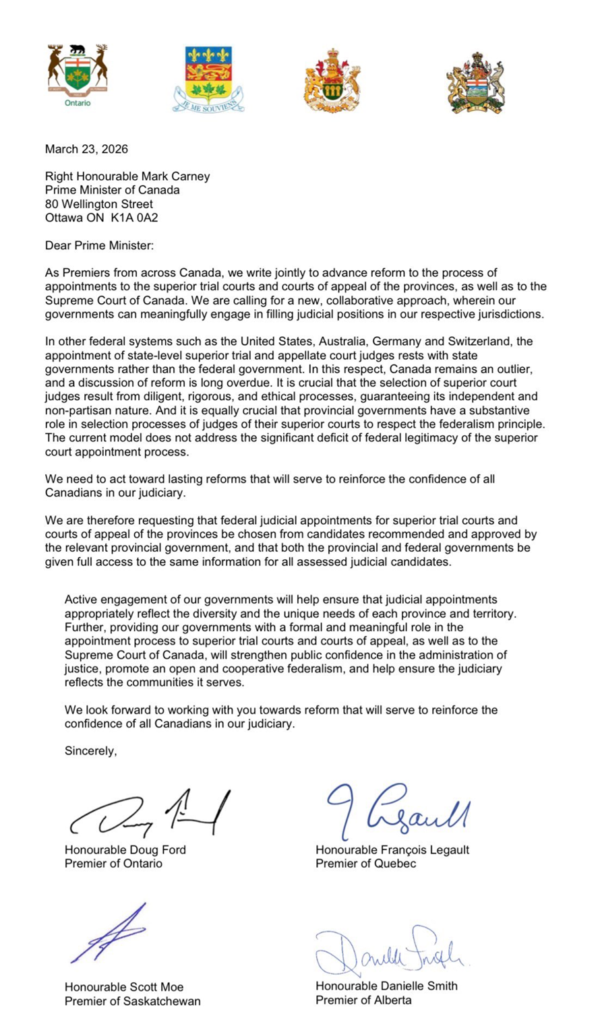
They want a meaningful role in how judges are appointed to the superior trial courts, the courts of appeal and the Supreme Court of Canada in their respective provinces.
When the people running four of Canada’s most populous provinces are writing letters about how judges are being selected, the problem has moved upstream from individual decisions to the bench itself.
And here is the part that made my jaw drop.
Less than twenty-four hours before that letter arrived on Mark Carney’s desk, his government went to the Supreme Court of Canada and asked the justices to restrict how provinces can use Section 33 of the Charter – the notwithstanding clause.
Carney wants the Supreme Court to limit it. This case involves Quebec’s Bill 21, but the implications run far wider than Quebec. If the Court agrees, every province loses a significant piece of its ability to govern its own people according to its own democratic mandate.
So, four premiers write to the Prime Minister asking for more say in who sits on the courts that govern their provinces – and the Prime Minister, the day before, had already asked those same courts to take away the provinces’ ability to override them.
These are not unrelated events.
We’ve also just finished looking at what Canada’s immigration system has produced after a decade of the same government’s management – ghost schools, untracked student permits, 17,000 criminals waved through, somewhere between 20,000 and half a million undocumented people the government cannot locate and an Auditor General’s report confirming all of it as a pattern of known concerns that were simply left in place. If you missed that one, you can find it here: ‘You Would Have Been Called a Racist: The Auditor General just confirmed everything’.
The picture being assembled here is of a federal government that has consistently made choices that weaken the state’s ability to protect its own citizens and equally consistent choices that protect and expand the state’s power over the provinces that are trying to fill the gap. And nowhere is that picture clearer than in the gun file.
In May of 2020, the Trudeau government used an Order-in-Council – bypassing Parliament entirely – to immediately prohibit over 1,500 makes and models of firearms. The announced justification was public safety following the Nova Scotia mass shooting that killed 22 people.
The programme has since been the most expensive and least effective policy initiative in recent Canadian memory, and that is not a partisan opinion.
The original government estimate for the compensation costs alone was roughly $200 million, but Public Safety Minister Bill Blair revised that to $300 million to $400 million.
The Parliamentary Budget Officer produced an estimate range of $47 million to $756 million – a spread so wide it is essentially an admission that nobody actually knows.
Meanwhile, the Fraser Institute put the total cost, including administration, logistics and destruction, at between $2.6 billion and $6.7 billion.
By 2024, the programme had spent $67.2 million in administration before collecting a single firearm from an individual.
The pilot programme ran in Cape Breton, Nova Scotia. The government expected to collect roughly 200 firearms; they collected 25 from 16 people, and they called this a success.
As of late February 2026, approximately 44,000 firearms have been declared under the programme – note that declared does not mean surrendered, it’s just a fraction of the hundreds of thousands of affected guns believed to be in private hands.
At current rates, the cost-per-firearm collected runs into the tens of thousands of dollars per gun when you factor in what’s been spent.
More than half of Canada’s provinces refused to participate.
Alberta prohibited local law enforcement from touching the programme.
Saskatchewan passed legislation requiring fair market compensation to any gun owner whose firearm is seized.
Manitoba, Ontario and Newfoundland also refused a role.
Of 138 municipal police forces in Canada, only two agreed to help.
The Ontario Provincial Police refused.
The Ontario Association of Chiefs of Police recommended against participation.
The National Police Federation – representing RCMP members – said the programme “diverts extremely important personnel, resources and funding away from addressing the more immediate and growing threat of criminal use of illegal firearms.”
The Toronto Police Association said the programme would have “essentially zero impact on crime in Toronto.”
And then in September of 2025, audio of Public Safety Minister Gary Anandasangaree was leaked. In it, he expressed serious doubt about whether the programme could ever be enforced, admitted police didn’t have the resources to do it and suggested the Prime Minister was keeping it alive to appease Quebec voters.
His most quoted line from the recording was this: “Don’t ask me to explain the logic to you on this.” He later issued a statement saying his comments were “misguided.” The logic, as the minister himself acknowledged, cannot be explained, because the logic was never about stopping crime. Every police organisation in Canada said so.
The criminals in this country are better armed today than the day this ban was announced and the licensed gun owners who complied with the law are out of their property and, in many cases, thousands of dollars.
So, let’s ask it plainly. Why don’t the Liberals want Canadians to be safe? Why does a repeat offender with 21 charges get a “last chance” that a victim’s community predicted would fail, and then it fails in two weeks and the judge’s contribution to that outcome is a lecture about “inflammatory rhetoric”? Why do the premiers of every province have to write letters – in 2023 and again in 2026 – begging a federal government to take bail reform seriously, while that same government is simultaneously asking courts to limit the provinces’ ability to govern themselves?
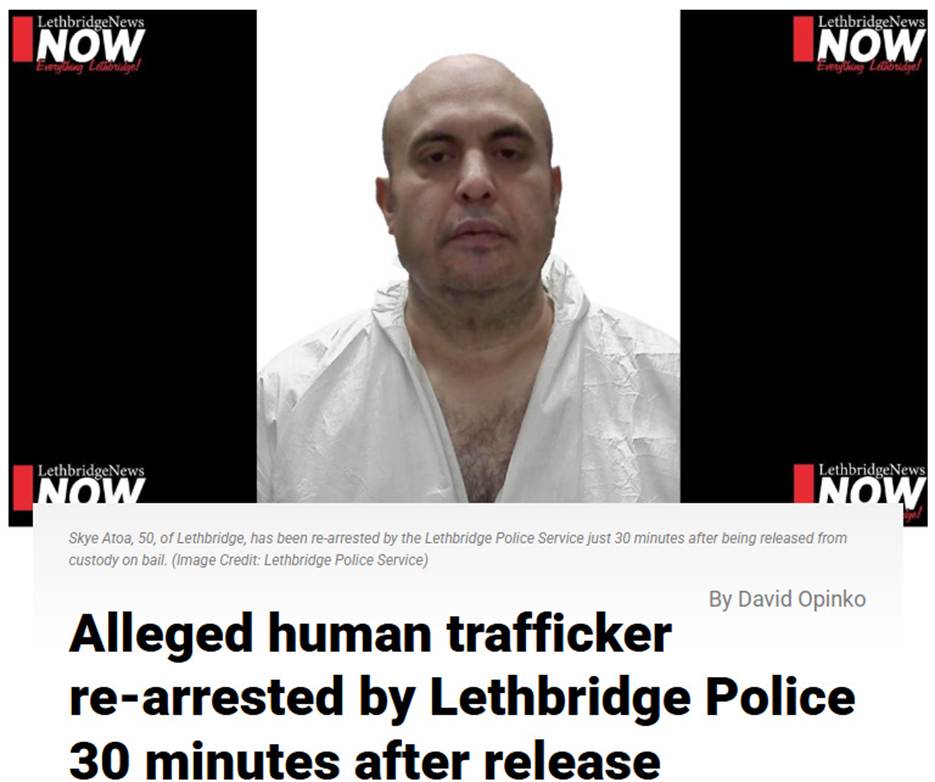
Why does a gun ban with no impact on criminal gun violence, opposed by 136 of 138 police forces, rejected by more than half of Canadian provinces and described by the government’s own minister as impossible to explain continue to consume billions of dollars that stands absolutely no chance at actually reducing crime, while those committing these crimes, still have a revolving door – seeing them back on the streets to reoffend – within days/weeks, sometimes within even minutes?
Why don’t the Liberals want Canadians to be safe? What’s the endgame here, anyway?
Featured image: The Supreme Court of Canada, Ottawa, Ontario, Canada. Source Getty Images
The Expose Urgently Needs Your Help…
Can you please help to keep the lights on with The Expose’s honest, reliable, powerful and truthful journalism?
Your Government & Big Tech organisations
try to silence & shut down The Expose.
So we need your help to ensure
we can continue to bring you the
facts the mainstream refuses to.
The government does not fund us
to publish lies and propaganda on their
behalf like the Mainstream Media.
Instead, we rely solely on your support. So
please support us in our efforts to bring
you honest, reliable, investigative journalism
today. It’s secure, quick and easy.
Please choose your preferred method below to show your support.

Categories: Breaking News, World News