





Palantir chief executive Alex Karp has argued that the workers most likely to remain valuable in the age of AI are not only those with practical trade skills, but also the neurodivergent. Speaking at Palantir’s AIPCon conference, Karp said there were “basically two ways to know you have a future”: vocational training or being neurodivergent. The first part of that argument is already well established in the wider debate over automation. The second is more unusual, and more revealing, because it challenges the assumption that the safest workers will be those who followed the most conventional educational and professional path.
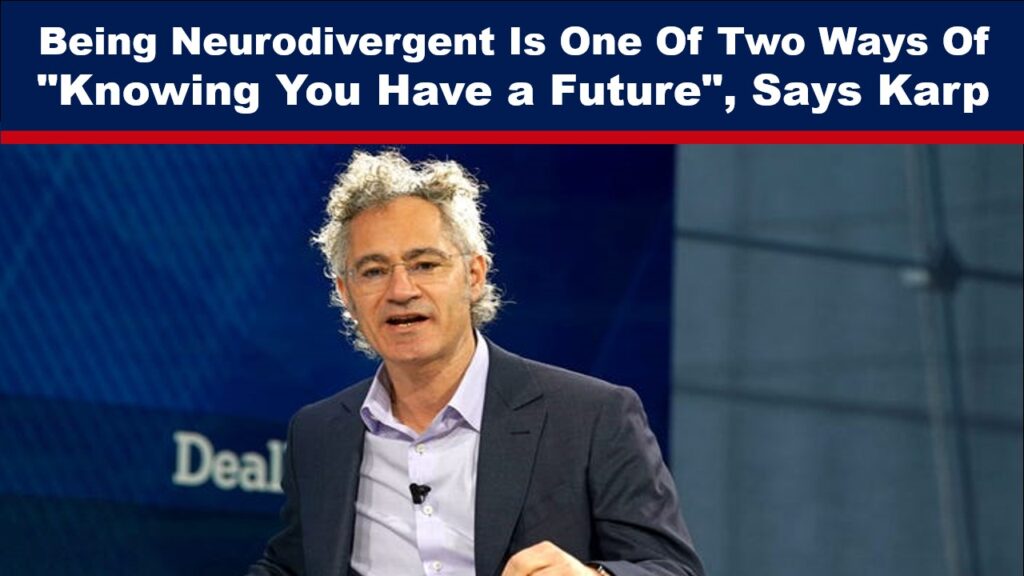
Karp’s broader point is that artificial intelligence is likely to erode the value of routine white-collar work more quickly than many people expect. In recent coverage of the remarks, he was described as referring to “neurodivergent” in a broad sense, including conditions such as dyslexia, autism and ADHD. Karp, who recently credited the success of Palantir to his “lifelong struggle with” dyslexia, appears to see atypical ways of thinking as a potential strength in a labour market where standardised cognitive tasks are increasingly vulnerable to software.
That argument is not emerging in isolation. The World Economic Forum’s Future of Jobs Report 2025 says employers expect 170 million jobs to be created and 92 million displaced globally by 2030, with AI and information-processing technologies among the most important drivers of change. The report says 86% of businesses expect these technologies to transform their operations. This does not point to a labour market in which credentials alone guarantee security, but rather points to one in which adaptability, distinctiveness and non-routine skill may become more valuable than polished conformity.
Karp’s remarks also fit with a growing body of reporting suggesting that manual and site-based work remains less exposed than many office roles. A recent AI job-risk index highlighted in U.S. coverage found some of the least exposed occupations included roofers, mechanics and other skilled trades, while many highly educated desk jobs ranked as more vulnerable. The reason is straightforward. Large language models perform best where work can be reduced to text, pattern recognition and repeatable instructions. They are less effective in environments that are physically variable, unpredictable or dependent on practical judgment.
The more controversial part of Karp’s argument concerns the kind of thinking that AI may struggle to replicate. Neurodivergence is a broad and often loosely used term, and there is no serious basis for claiming that every neurodivergent person will be protected from labour-market disruption. But Karp’s suggestion appears to be that people who think in less conventional ways may be less exposed to replacement where originality, obsession, unusual pattern recognition or non-standard problem solving still matter. Palantir itself has made a point of backing that view in practice through a Neurodivergent Fellowship programme and public statements about neurodivergent talent as an asset rather than a liability.
There is also a wider cultural challenge embedded in what he said. For years, the prestige model in Western labour markets placed its confidence in university credentials, managerial polish and fluency in the language of institutions. Artificial intelligence is beginning to unsettle that hierarchy. If software can perform more of the structured, document-heavy, rules-based work that once sustained large parts of the professional class, then the relative value of practical trades and unconventional cognitive strengths may rise. That does not mean the future belongs only to welders and people with ADHD. It does suggest that the old assumption, that the most secure career is the most conventional one, is becoming harder to defend.
Karp’s wording was deliberately provocative, and it should be read with some caution. Still, the underlying question he raises is serious. If AI becomes increasingly capable of reproducing average white-collar performance, then the workers who remain in demand may be those whose value does not depend on being average at all. That includes people who can operate in the messy physical world, and perhaps also those whose minds do not fit neatly into the patterns institutions have historically preferred.
The Expose Urgently Needs Your Help…
Can you please help to keep the lights on with The Expose’s honest, reliable, powerful and truthful journalism?
Your Government & Big Tech organisations
try to silence & shut down The Expose.
So we need your help to ensure
we can continue to bring you the
facts the mainstream refuses to.
The government does not fund us
to publish lies and propaganda on their
behalf like the Mainstream Media.
Instead, we rely solely on your support. So
please support us in our efforts to bring
you honest, reliable, investigative journalism
today. It’s secure, quick and easy.
Please choose your preferred method below to show your support.

Categories: Did You Know?