





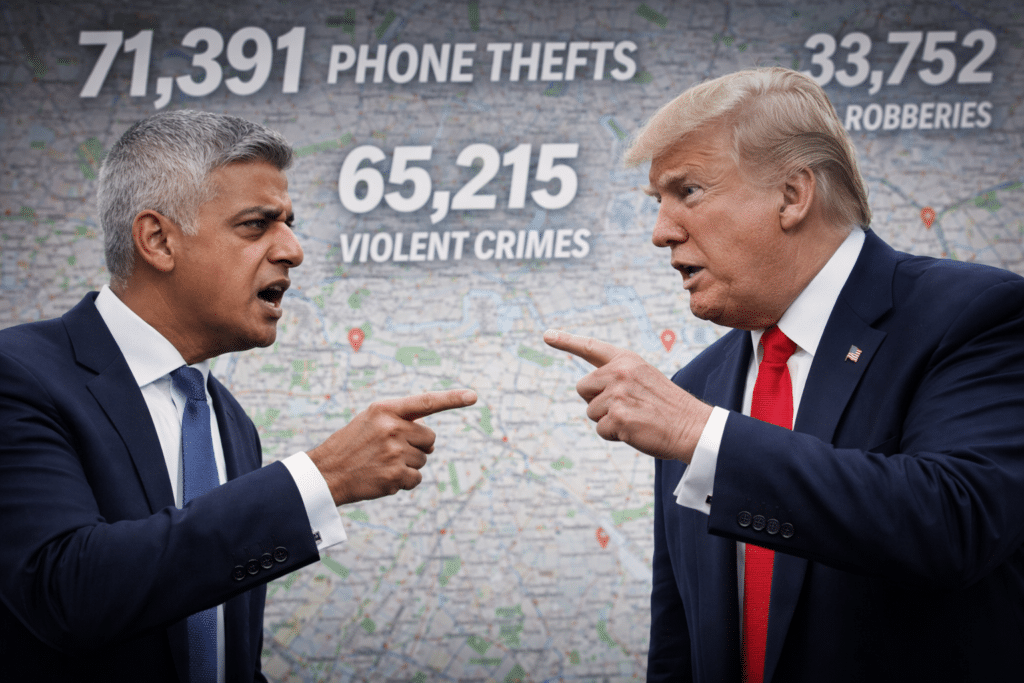
Sadiq Khan says Donald Trump is spreading “lies” and “propaganda” about London. Trump says he is drawing attention to the effects of “left-wing governance” in Western cities. Khan’s rebuttal leans heavily on a small set of recent crime figures, especially London’s lower homicide rate and a fall in phone theft last year. Those numbers are real, but they’re also very carefully chosen. Once the timeline is widened, and we focus on the absolute totals, the picture looks far less flattering for the mayor. London may not be the apocalyptic nightmare as painted by Trump’s allies, but the numbers don’t support Khan’s attempts to dismiss the criticism either. So, what do the numbers really reveal about the state of the capital?
Trump vs Khan: Who Said What?
Trump has repeatedly described London as crime-ridden and has combined that criticism with older rhetoric about the city being culturally transformed beyond recognition. Khan responded this week by urging diplomats to push back against “disinformation and lies,” warning that anti-London narratives could damage investment, tourism and education.
“A lot of this misinformation, disinformation and lies comes from the United States of America,” Khan said. “It’s really important to counter the propaganda coming from President Trump.”
A White House spokesperson, responding to Khan’s remarks, said, “Left-wing policies … have made once-great cities like London unrecognisable.”
The spokesperson said Trump was “rightfully warning European leaders that Western civilisation will continue to erode if they don’t quickly reverse course”.
Trump’s wider argument is not just that London has a crime problem – which is undoubtedly has, regardless of Khan’s cherry-picked statistics – but rather that the city represents a broader Western pattern: weaker enforcement, more visible disorder, and a political class that responds to criticism with selective numbers and reputation management instead of addressing the real cause. Khan’s response largely avoids the broader charge, and instead, he points to a narrow set of favourable metrics from the latest year.
Khan’s Numbers May Be True, But They’re Selective
Sadiq Khan’s strongest counter is the decline in homicides. The Metropolitan Police said London recorded 97 homicides in 2025, down from 109 in 2024 and 153 in 2019, producing the city’s lowest murder rate per capita since records began. Teenage homicides also fell to eight, which is their joint lowest level in almost three decades. They are serious declines, and it’s important to acknowledge them.
He also points to phone theft. City Hall said this year that mobile phone theft fell 12.3% in 2025, from 81,365 cases in 2024 to about 71,391. Personal robbery, the Mayor’s office said, was down 15%, equivalent to 4,309 fewer offences, and knife crime was down 14.5%, or 2,420 fewer offences, in the 12 months to November 2025.
Those figures help Khan politically because they are recent, favourable, and easy to repeat. However, they do not settle the argument. A fall in stolen phone figures still leaves a city where tens of thousands of people are robbed every year, while a drop in burglary and street crime does not clear London of its critical safety issues. The city’s knife-crime burden remains large enough for the Met and City Hall to continue treating it as a standing emergency, for example.
What Happens If You Look Beyond Khan’s Chosen Statistics?
The longer trend is much messier than Khan’s rebuttal suggests. The Evening Standard reported that London’s recorded crime rate was 89 offences per 1,000 people in 2016/2017, which is the first Khan first became mayor. By 2019/2020, that had risen to 104 per 1,000. The same report says crime overall is down 2.4% over the last 12 months, suggesting some recent easing, but crucially means that crime numbers are higher now than before Khan took office.
This is an important distinction because Khan’s argument relies heavily on short-term improvement while avoiding the broader record of his time in office. A city can improve from a poor recent year and still be in a worse position than before current leadership took charge. Presenting only the latest fall without the wider comparison may be politically useful, but it’s not an honest way to review the city’s condition.
The same issue appears in the knife-crime debate. In 2024, the Office for National Statistics (ONS) formally reviewed one of the Mayor’s claims that “knife and gun crime, homicides and burglary have all fallen since 2016”. The ONS found that the knife-crime part of the claim was incorrect. It determined that the statement was only true for knife crime with injury for those under 25 years, and that “total knife crime has increased significantly since 2016”. That is the national statistics authority – not a political opponent – independently finding that his claims were simply false.
London is in Critical Condition: The Absolute Numbers are Damning
Even with the recent improvements Khan highlights, London’s total figures remain high enough to justify the criticism. Key figures for the year ending March 2025 included 101 homicides, 65,215 violence-with-injury offences, 27,344 sexual offences, 33,752 robberies, 465,085 thefts, 33,491 burglaries, and 96,227 shoplifting reports. Some may have been down year-on-year, others were up, but all of them describe a city in a public-order crisis.
The Metropolitan Police’s own knife-crime bulletin says almost 60% of knife-enabled offences in 2025 were robberies, and around 103 knife-enabled incidents resulted in severe or fatal injury requiring hospital treatment every month. About half of knife-crime victims were under the age of 25. These numbers may not categorise London as uniquely lawless by worldwide standards, but they do support the view that the city continues to face a large and presistent burden of predatory street crime and violence.
So, is Trump Lying about London?
Trump’s larger point is that London exemplifies a Western metropolitan model in which disorder is often minimised and official claims are heavily curated, while residents are asked to accept levels of theft and street predation that would once have been seen as politically intolerable. On that point, the numbers do not rescue Khan as neatly as he suggests.
Meanwhile, Khan can fairly say that homicide is down and that some recent categories have improved. However, he cannot fairly imply that this resolves the case. The longer trend under his leadership is clearly mixed. The ONS has already rebuked his misleading knife-crime claims in the past, and the city’s absolute crime totals remain high enough that public concern is plainly rooted in more than “propaganda”.
Final Thought
Khan’s defence of London rests on cherry-picked numbers and convenient timelines. Trump’s critique is exaggerated, but not unfounded. London can post a low homicide rate and still leave residents confronting tens of thousands of phone thefts, tens of thousands of robberies, and a knife-crime problem the national statistics watchdog has already forced City Hall to correct.
The issue here is not that Trump is overstating the problem, but rather that Khan appears to be understating it.
The Expose Urgently Needs Your Help…
Can you please help to keep the lights on with The Expose’s honest, reliable, powerful and truthful journalism?
Your Government & Big Tech organisations
try to silence & shut down The Expose.
So we need your help to ensure
we can continue to bring you the
facts the mainstream refuses to.
The government does not fund us
to publish lies and propaganda on their
behalf like the Mainstream Media.
Instead, we rely solely on your support. So
please support us in our efforts to bring
you honest, reliable, investigative journalism
today. It’s secure, quick and easy.
Please choose your preferred method below to show your support.

Categories: UK News
Khan, like stamer have been placed in there positions deliberately to destroy the UK. It’s all by design! It is linked to communism….The whole labour party needs to be replaced very soon!
It is linked to communism because the Rothschilds were behind both. The original communists in the USSR (Bolsheviks) were funded by the jewish banking families named Rothschild, Schiff & Warburg.
More like the German government who wanted to destabilize the Russian empire for various reasons. $20m came from Jacobb schiff and other wall street big wigs to over throw the tzar. Once Lenin and trotshky took over they oppossed the bolshiviks. Communism wasn’t the initial goal. Bolshiviks also committed countless crimes to gain financing and stole land and goods and robbed banks. It wouldn’t make sense for the elite to support communism which was on direct opposition to an upper class. But, hey, you know, anything to talk crud about jews… Never mind all the other groups involved.
Basically there was a lot of oil in Russia that wall street wanted access to. It’s not some grand Jewish conspiracy. It’s pretty much like how wall street and London have screwed up the middle east…. Again oil.
If you are looking for a conspiracy then look at oil.
Karl Marx was a rabid capitalist as he and engles invested a lot on the London stock exchange and made a lot of money that financed his stupid ideas. That’s not some Jewish conspiracy.
Man, you people read any old conspiracy book and think that’s the holy word of truth.
Don’t worry, the green party will gain seats and then the destruction ramps up big time.
I’ve been to London. Good luck finding white English people.
I was in Berkshire & Middlesex the other day. Same Story. The area I grew up in is unrecognisable. I cant describe my disgust.