





According to data up to and including 2023 released by Health New Zealand, incidences of cancer spiked in 2023 among the 45-64 age group.
The data does not show sufficient information to determine whether covid vaccination was a factor, as suggested by studies in other countries, but the increase in cancer in New Zealand is a red flag that needs immediate investigation, Dr. Guy Hatchard writes.
“Cancer is our number two killer in New Zealand. The investigation of its causes demands up-to-date and comprehensive information,” he said.
Let’s not lose touch…Your Government and Big Tech are actively trying to censor the information reported by The Exposé to serve their own needs. Subscribe to our emails now to make sure you receive the latest uncensored news in your inbox…
Red Flag: 2023 New Zealand Cancer Data Released by Health NZ – A Record
Health New Zealand has released the data for new cancer registrations during 2023.
Data by age, sex, cancer type and ethnicity from 2001 to 2023 is now available and can be downloaded using the Cancer Web Tool. Please note these figures are already two years behind; we don’t yet know what has happened in 2024 and 2025. 2024 figures are not expected from Health New Zealand until the end of 2026. There are many types of cancer associated with multiple risk factors and causes. Care should always be taken when interpreting any data.
In 2023, there were an all-time record 29,719 new cancer registrations. This was a rate of 5.69 cancers per 1,000 population compared to an average rate during 2015 to 2019 of 5.27. That is a 7.9% increased rate of cancer occurrence. There were 4,500 more cancers in 2023 than the average for 2015-2019.
Effect of an Ageing Population
There is, however, another factor other than total population size that needs to be taken into account when interpreting cancer data. New Zealand has an ageing population. Around 60% of all cancers occur among people who are 65+ in age. Because susceptibility to cancer increases with age, there is an expectation that overall cancer rates will increase as the percentage of older people in the whole population increases over time. Between 2015 and 2019, the average percentage of the New Zealand population aged 65+ was 15%; in 2023, the equivalent figure was 16.5%.
The conventional wisdom is that increases in rates of cancer incidence are primarily due to the effect of an ageing population, along with any modifications due to changes in risk factors. For example, any significant increase in smoking rates is known to increase cancer incidence over the longer term. So, the question is: Was the 2023 increase in cancer due solely to the effect of a rising and ageing population? Have there been any increases in cancer risk factors modifying the data? In order to investigate this question and adjust for the effect of age, the Hatchard Report conducted an analysis of cancer registrations by age bracket.
Overview of Cancer Incidence by Age
We looked separately at age ranges 0-4, 5-24, 25-44, 45-64 and 65+.
Cancer rates among the 65+ population remained more or less stable at 21 new cases per 1,000 population in 2023, a rate that has been maintained over the last ten years.
Cancer rates among 45-64 year olds rose by 8% in 2023 compared to the 2015-2019 average.
Cancer rates among 25-44 year olds rose by 2%.
Cancer rates among 5-24 year olds rose by 17% and by 11% for 0-4 year olds, but the numbers of cases in these two age brackets are small (around 60-70 cases per year for 0-4 and 250-300 for 5-25 year olds), ensuring these rises do not reach statistical significance.
The most notable finding is among mature working-age people aged 45-64. There were 1,215 additional new cancers registered in this age group above the 2015-2019 average and 817 above 2020 (the last year without significant covid-19 infections or covid-19 vaccines). The rate of cancers (7.45 cancers per 1,000 population) was a historical high. The rate of cancers in this age group had been relatively stable in the ten years before 2018, when there was a sudden spike in cancer registrations.
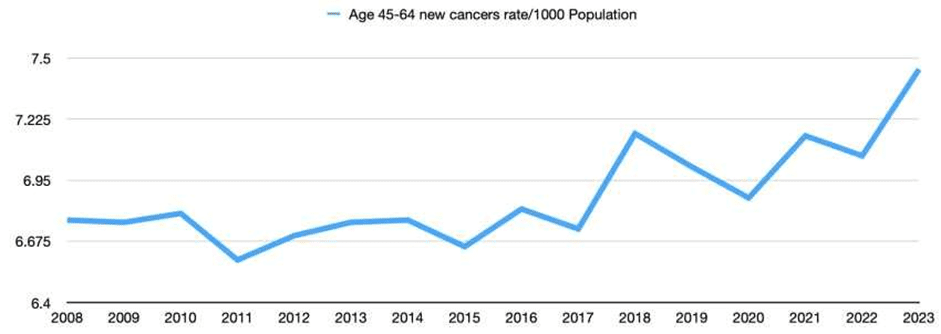
2018 Cancer Registrations Rose Due to a Cancer Screening Drive
Prostate cancer is the most common cancer in men, and breast cancer in women. From 2015 to 2018, Health New Zealand instituted the New Zealand Cancer Plan, which aimed to systematically increase cancer awareness and the availability of cancer screening programmes especially in regional centres which had been under serviced. One result of this intensive initiative was a dramatic rise in the number of early prostate diagnoses among mature men and a more modest spike in breast diagnoses, which particularly generated a spike in cancer registrations in 2018 in the 45-64 age range. There were no similar new screening initiatives in 2023 for common cancers likely to significantly affect the registration totals. Therefore, the 2018 spike in cancer registrations should be regarded as an outlier or anomaly, which makes the peak in 2023 cancer registrations all the more significant.
What Types of Cancer Increased?
In 2023, the largest increases among the whole population were in the incidence of breast, melanoma and prostate cancers. The incidence of lung cancer decreased. The 2023 New Zealand figures do not distinguish which types of cancer particularly affected which age groups. The number of cancer deaths for 2023 is not yet published. Nor are any figures available for recurrence of cancers or speed of progression of cancers, which overseas reports suggest have been significantly affected during the last four years (2022-2025).
Were Either Covid-19 Infection or Covid-19 Vaccination Risk Factors for Cancer?
We have previously reported on large population studies from Korea, Japan and Italy which found relatively higher cancer rates among the covid vaccinated compared to the unvaccinated. It is a matter of regret that Health New Zealand have so far made no visible effort to find out if covid vaccination has been a risk factor for cancer development here in New Zealand. This is a serious issue affecting the well-being of the whole of society, especially as Health New Zealand is still recommending that many categories of people receive covid booster injections.
There are many factors which influence the incidence of cancer. The 2023 New Zealand data which has been released is insufficient on its own to lead to any definitive conclusions. Moreover, it is two years out of date. Cancers take time to develop. If there are new risk factors particularly affecting mature working-age people, it is not yet clear what these factors are.
2023 New Zealand Cancer Data is a Red Flag Which Needs Immediate Investigation
The increase in cancer incidence in 2023 to record high rates for mature working-age people is a red flag that requires more detailed investigation and more rapid compilation of data for 2024 and 2025.
Anecdotal reports we have received indicate that waiting lists to see an oncologist in New Zealand are becoming longer, which makes it likely that the 2023 increases are continuing into 2024 and 2025. It is vital to find out as soon as possible if this is the case. Cancer is our number two killer in New Zealand. The investigation of its causes demands up-to-date and comprehensive information. This investigation should include a comparison of cancer outcomes of vaccinated and unvaccinated populations. This should be an urgent public health imperative.
About the Author
Guy Hatchard, PhD, is a New Zealander who was formerly a senior manager at Genetic ID, a global food testing and safety company (now known as FoodChain ID).
You can subscribe to Dr. Hatchard’s websites, HatchardReport.com and GLOBE.GLOBAL, for regular updates by email. GLOBE.GLOBAL is a website dedicated to providing information about the dangers of biotechnology. You can also follow Dr. Hatchard on Twitter HERE, Facebook HERE and Substack HERE.
The Expose Urgently Needs Your Help…
Can you please help to keep the lights on with The Expose’s honest, reliable, powerful and truthful journalism?
Your Government & Big Tech organisations
try to silence & shut down The Expose.
So we need your help to ensure
we can continue to bring you the
facts the mainstream refuses to.
The government does not fund us
to publish lies and propaganda on their
behalf like the Mainstream Media.
Instead, we rely solely on your support. So
please support us in our efforts to bring
you honest, reliable, investigative journalism
today. It’s secure, quick and easy.
Please choose your preferred method below to show your support.

Categories: Breaking News, World News
https://covidcollateral.com/
Hi Rhoda,
Another interesting article.
There has never been any such disease as Covid.
Just like the Spanish Flu fluid, the C19 fluid caused a lot of deaths and cancer.
The same Gates family was involved in both productions of the fluid.
Because I had read about the Spanish flu, I realised C19 was a re-run.
I had also read that the Egyptian’s pushed rods up unruly prisoners noses to puncture the brain, so no PCR tests for me.
Why do you think Big Pharma insisted BEFORE they would even release their Wonder Vaccine they were given lifetime immunity from prosecution for any deaths or injuries caused including biomedical injuries ie: cancers.
They knew that intentionally interfering with the genome natural inherited immunity system would have consequences and too make matters worse, they could not tell who could be most at risk- perfectly healthy one day, dead the next, chronically ill one day, chronically ill the next- they knew that it would be random but the Big Profit potential with the added bonus of a lifetime income stream of pharmaceutical interventions to help those who survived but were injured these were just TOO GOOD to miss out on.
There was no pandemic, it was a bio weapon where flu had been given a boost and allowed to escape, the World went mad because China in order to cover up the release and wishing to divert attention implemented a series of staged events which the WHO were in full agreement with, and we all know what then happened………..madness and opportunity.
Safe and effective