





Reports that a technology company in Russia is implanting neural chips into pigeons’ brains to turn them into remote-controlled “bio-drones” have ignited a mix of curiosity, concern, and scepticism around the world. What sounds like something out of science fiction is now being tested in Moscow and beyond, with potentially serious implications for surveillance, warfare, and technology ethics.
The story highlights how innovation can outpace regulation and public debate. With early flight trials already underway, experts and observers are debating whether these pigeon drones represent harmless ingenuity or something more troubling. Even as the developers tout civilian applications, the possible military uses and ethical ramifications are hard to ignore.
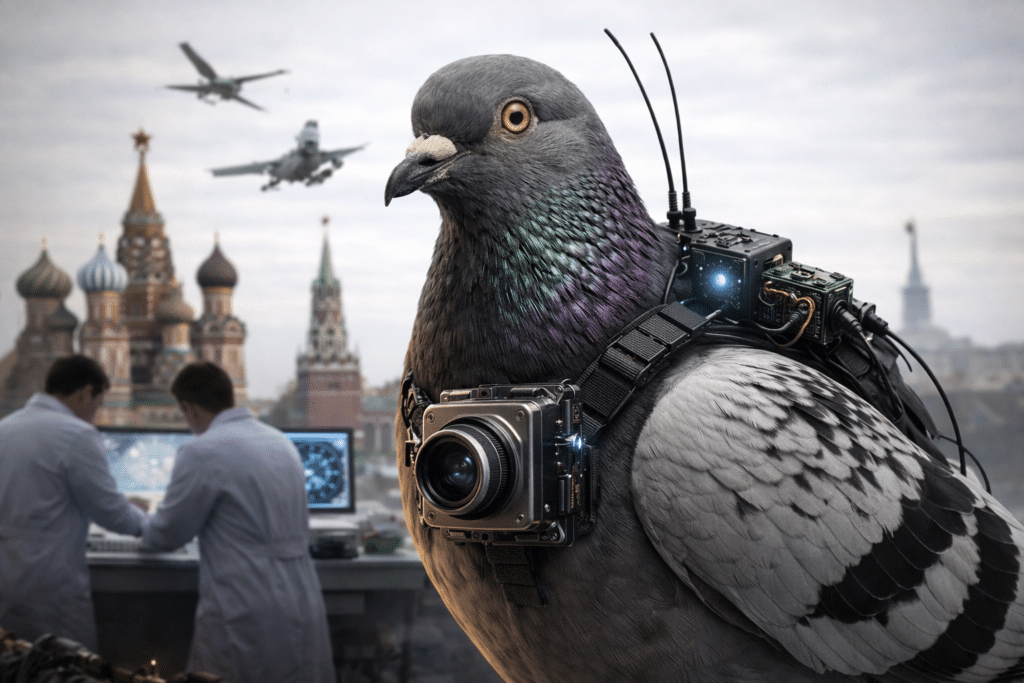
How It Works
According to multiple reports, Russian start-up Neiry Group has developed miniature neural interfaces that can be implanted into the brains of pigeons. These implants, paired with a small controller and electronics strapped to the bird’s back, allow an operator to influence the direction of flight by stimulating certain brain regions. Cameras attached to the birds’ chests transmit video back to controllers, and solar panels help power the system.
Neiry claims the system can guide the birds along preset routes of up to 400 kilometres, and that biological carriers like pigeons have advantages over mechanical drones, such as endurance and the ability to navigate tight or restricted spaces.
The company is reportedly funded in part by Russia’s National Technology Initiative, which aims to advance national leadership in cutting-edge technologies. Investigations suggest Neiry received hundreds of millions of rubles from this programme and collaborates with Moscow State University’s AI institute, which has connections to influential figures — including, according to some reports, President Vladimir Putin’s daughter.
Russia Says Its for Civilian and Security Purposes
Neiry executives describe a range of potential civilian uses. They say the technology could be used for inspecting infrastructure, monitoring environmental conditions, aiding search-and-rescue operations, and performing logistics tasks in locations where traditional drones struggle to operate.
This emphasis on peaceful applications is central to the company’s outreach. Leaders insist that their bio-drones are intended for beneficial purposes, and they downplay immediate military use. In interviews, they have said they are focusing first on pigeons but envision adapting the system for larger birds — such as ravens, seagulls, and even albatrosses — depending on the mission requirements.
Experts are Concerned
Despite these assurances, sceptics and experts have raised serious concerns about the Russian project. Many point out that technology capable of controlling the flight of animals could easily be repurposed for surveillance or military objectives. In some reporting, scientists and defence analysts note that any system designed to remote-control biological organisms carries inherent risks if misused.
For instance, James Giordano, a scientific adviser with ties to the US Department of Defense, has warned that such bio-drones could, in theory, be used as carriers for biological agents or to spread disease behind enemy lines — a possibility that some see as far-fetched but others view as a legitimate concern in modern warfare planning.
Bioethicists have also weighed in on the moral dimensions. Professor Nita Farahany of Duke University has described efforts to use neural implants for remote control of living creatures as “icky,” arguing that animals should not be treated merely as programmable tools, especially when ethical guidelines and oversight are unclear.
Echoes of Historical Projects
This is not the first time that the idea of animals in espionage or military work has captured the public imagination. Declassified historical records show past attempts by intelligence agencies to harness animals like pigeons and even cats as surveillance tools. These earlier programmes were often fraught with technical challenges and ethical controversy.
What makes the current effort in Russia unusual is the combination of modern neuroscience, compact electronics, and real-world flight testing. If the technology works as described, it would represent a new class of “bio-drone” that blends biological and mechanical elements in ways previously seen only in speculative fiction.
In Germany, researchers have previously experimented with cyborg cockroaches, using implanted electronics to influence movement for navigation and sensing tasks. That project was framed as research into search-and-rescue, environmental monitoring, and robotics development, rather than active surveillance or military deployment.
While the technologies differ in scale and ambition, these cases point to a growing international interest in blending biological organisms with machine control. As covered previously in How Germany is Preparing Cockroaches for Warfare, the emergence of such projects suggests that the line between experimental research and potential security applications is becoming increasingly blurred.
Geopolitical and Ethical Implications
Critics also argue that the lack of independent verification of Neiry’s claims is problematic. So far, much of the public information about the project comes from company statements and media reports, with no peer-reviewed research or third-party demonstrations confirming operational capability.
The development of remote-controlled pigeons comes at a time of heightened geopolitical tension — particularly around the war in Ukraine and strained relations between Russia and the West. The possibility that such technology could be adapted for military use has only amplified scrutiny from foreign analysts and defence communities.
More broadly, this episode raises questions about the ethical boundaries of neuroscience, robotics, and animal welfare. As neural interface technology advances, society will need clearer frameworks to govern its use — especially when that use involves altering the behaviour of living creatures for human objectives.
Final Thought
Whether Neiry’s pigeon bio-drones ultimately prove practical or remain an experimental curiosity, the story underscores a key tension of our era: technology is evolving at a pace that challenges existing ethical norms and regulatory regimes. From surveillance to warfare to animal rights, the debate over cyborg creatures reveals how innovation can blur the line between promise and peril.
As governments and citizens grapple with the implications, one question looms large: how will humanity balance the benefits of cutting-edge science with the moral responsibilities that come with it? The answer may shape the future of both technology and society.
The Expose Urgently Needs Your Help…
Can you please help to keep the lights on with The Expose’s honest, reliable, powerful and truthful journalism?
Your Government & Big Tech organisations
try to silence & shut down The Expose.
So we need your help to ensure
we can continue to bring you the
facts the mainstream refuses to.
The government does not fund us
to publish lies and propaganda on their
behalf like the Mainstream Media.
Instead, we rely solely on your support. So
please support us in our efforts to bring
you honest, reliable, investigative journalism
today. It’s secure, quick and easy.
Please choose your preferred method below to show your support.

Categories: Did You Know?, World News
Western’s suspiciousness to Russians technology should be viewed with a turn to Russian’s fear for Western’s lust to AI warfare. The proxy war in the Ukraine is used by western intelligence to explore the capacity of IT devices and A.I. Current Ukraine defence minister is an IT expert and most of his advisors are IT institutions. They are already using robot soldiers. Recently Russian soldiers had to surrender themselves to these robots, yet do robots response with mercy?
Yes….and Putin himself is implanting the neurochips 🤣
Our defensive line of bird killing wind turbines will take car of any incursions by Soviet Cyber Pigeons….
During WW2 Russians strapped explosives to dogs’ backs and trained them to run underneath enemy tanks and blow up. Now they can just program the dogs to find tanks and blow them up. No extensive training required.
I can see some real uses for this technology.