





A recent meningitis outbreak in the UK prompted a surge of panicked headlines – followed by acknowledgement, and relief, that cases may already have peaked. What should we all know about this disease?
“Outbreaks are alarming, and fear is exacerbated by media reporting. But although meningitis spreads via close, prolonged contact … it is not highly contagious,” World Council for Health writes.
Let’s not lose touch…Your Government and Big Tech are actively trying to censor the information reported by The Exposé to serve their own needs. Subscribe to our emails now to make sure you receive the latest uncensored news in your inbox…
Meningitis: the Facts Behind the Headlines
By World Council for Health, 26 March 2026
This month, a meningitis outbreak among students in Kent, England – linked to a nightclub in Canterbury – was the subject of serious concern. It tragically claimed the lives of two young people: a teenager and a 21-year-old.
The media coverage was alarming: for example, “The deadly delays in tackling meningitis outbreak,” The Telegraph said. And “experts warn of explosive outbreak … one of the fastest-growing outbreaks of the disease they have seen in the UK,” The Guardian reported.
Yet a few days later, the tone and content were calmer. The BBC announced, “Meningitis outbreak passes peak, says health agency.” Similarly, The Guardian went with, “Kent meningitis outbreak may have peaked as UKHSA reports slowdown in cases.”And the Daily Mail confirmed that “Meningitis cases fall as health officials reveal some people were wrongly told they had the disease.”
So, what are the facts about meningitis, and what do the statistics actually show us? (N.B. Information presented here is up-to-date at the time of writing.)
Meningitis: Key Facts
• Meningitis is not a single disease. It’s an umbrella term which covers inflammation of the brain/spinal cord (the meninges).
• Most cases are not the dangerous kind. Viral meningitis is far more common and usually self-limiting. Bacterial meningitis is rarer but more serious.
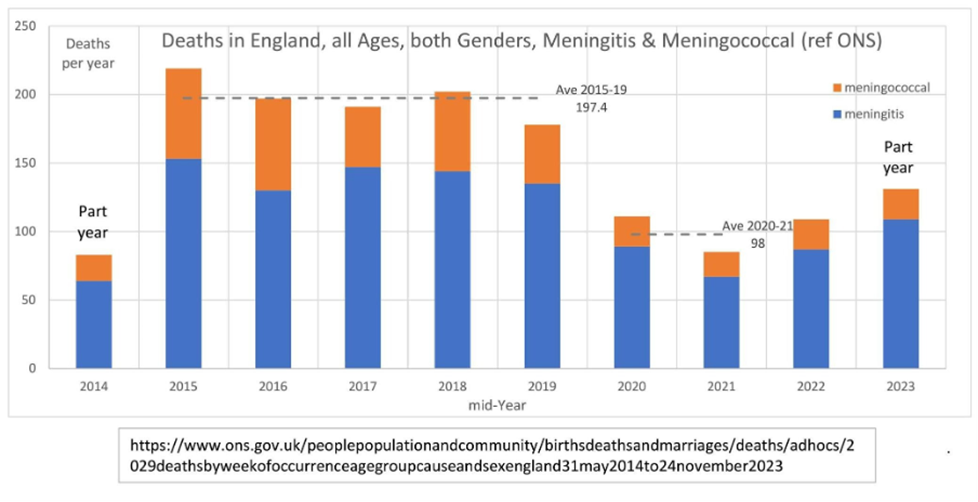
• Overall risk is to the public is low. Total meningitis deaths (from all causes combined) are typically in the low hundreds per year. The meningococcal form – which is most associated with outbreaks among young people – accounts for only a small fraction of these. In England in 2023-4, there were 8 recorded deaths from meningococcal disease, compared with around 30 deaths in adjacent years. The case fatality rate may appear to fluctuate a lot, but that is a normal statistical volatility owing to the small numbers overall.
• Many people carry the bacteria harmlessly. Around 1 in 10 people may carry meningococcal bacteria without symptoms.
• Early symptoms are non-specific. These include common symptoms such as headache, fever and nausea. But severe cases can deteriorate very quickly.
What Happened in the Kent Outbreak?
In a 23 March post on the Where are the Numbers Substack, statistician Martin Neil uses AI number-crunching to explain the striking drop in cases.
Read more: Is the UK meningitis ‘outbreak’ diagnosing hangovers? Where are the Numbers, 23 March 2026
Early “case numbers” can expand rapidly. This is becausethe testing process is not only capturing reality, but also uncertainty. The key takeaway from Neil’s analysis is that early “suspected” cases were frequently misclassified – and only after further testing were they downgraded. Here’s a summary of his main points:
• The broad range of non-specific symptoms overlaps with other, more benign conditions (such as a general malaise, fever – or even the common hangover).
Initial screening often uses single-target rapid PCR, which is prone to yielding false positives.
• A test might detect harmless “carriage” of the bacteria, rather than actual invasive disease. As mentioned earlier, around 10% of the population are carriers: according to Neil, this makes carriage “100,000× more common than invasive disease.”
• Neil applies Bayes’ Theorem to demonstrate that “Only ~0.5% of positive PCRs represent true invasive meningococcal disease.”So, while an increase in relativerisk might look dramatic, absolute risk remains very low.
The downgrading of cases has also been noted by Tom Jefferson (clinical epidemiologist) and Carl Heneghan (Professor of Evidence-based Medicine), in their Trust the Evidence Substack. They even show “confirmed” cases as being quietly downgraded!
“Something odd happened on the 21st (March) as the number of confirmed cases dropped from 23 to 20 […] All very odd. So, can a confirmed case be unconfirmed?”—Tom Jefferson and Carl Heneghan
They consider the UKHSA’s text explaining the reasons behind such reclassification as being “disturbingly vague.”
The Medical Conundrum – Erring On The Side Of Caution
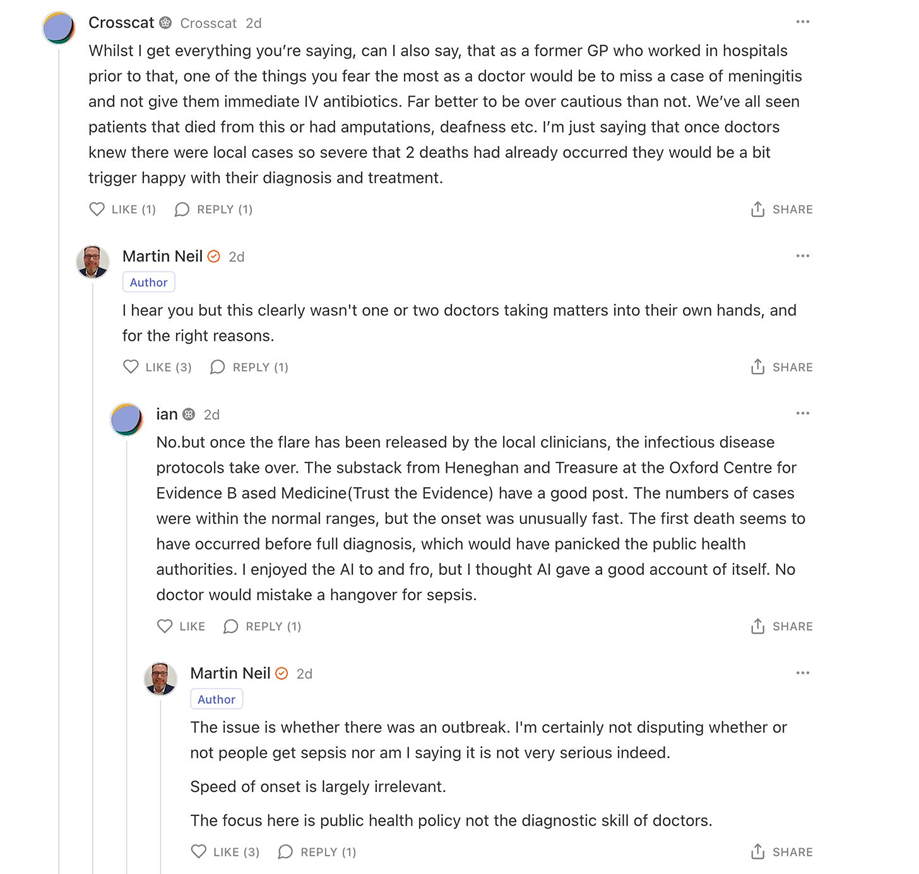
There is, of course, a dilemma for doctors and medical authorities in knowing when and how to take appropriate measures without overreacting. This was well summarised in one of the Comment threads below Martin Neil’s post.
So, When Is There Cause For Concern?
The website ‘Meningitis Research Foundation’ gives clear advice about the set of symptoms which indicate possible meningitis. In these circumstances, seek medical help immediately:
- Confusion and disorientation
- Seizures
- Rash that doesn’t fade when pressed with a glass
- Severe neck stiffness
- Fever
- Severe headache
- Sensitivity to light
- Vomiting
- Unusual drowsiness and being hard to wake
Meningitis Research Foundation also refers to limb pain and cold hands and feet as symptoms of sepsis, which is caused by the same bacteria as meningitis.
Conclusion: Maintaining A Perspective
Outbreaks are alarming, and fear is exacerbated by media reporting. But although meningitis spreads via close, prolonged contact (which is why, when cases occur, they tend to cluster around young people living and socialising together), it is nothighly contagious. It can be summarised as “common carriage: rare disease,” and year-on-year fatality numbers do remain low.
It is, of course, important to know which symptoms are not just a “mere headache” and require urgent medical attention. But it’s also important not to panic, to look beyond the headlines and to always be aware of the statistical and classificatory confusion that can lead to a “case-demic.”
Disclaimer
This article is not intended to be used in place of individual medical advice. It cannot be used to diagnose illness or access treatment. People may use the materials provided by the World Council for Health to complement the care provided by their qualified, trusted health professionals. All information provided by World Council for Health or in connection with its website is offered to promote consideration by people and their trained healthcare providers of various evidence-based prevention and treatment options. The information on this website is for general informational purposes and is not a substitute for medical advice. Errors and omissions may occur.
References
- BBC News. (2026). Meningitis outbreak passes peak, says health agency.
- Bratcher, H. B., Rodrigues, C. M. C., Finn, A., Wootton, M., Cameron, J. C., Smith, A., Heath, P. T., Ladhani, S., Snape, M. D., Pollard, A. J., Cunningham, R., Borrow, R., Trotter, C., Gray, S. J., Maiden, M. C. J., & MacLennan, J. M. (2019). UKMenCar4: A cross-sectional survey of asymptomatic meningococcal carriage amongst UK adolescents at a period of low invasive meningococcal disease incidence (Version 2). Wellcome Open Research, 4, 118. https://doi.org/10.12688/wellcomeopenres.15362.2
- Daily Mail. (2026, March 22). Meningitis cases fall as health officials reveal people were wrongly told they had the disease.
- Guardian. (2026, March 18). What is behind the UK’s meningitis outbreak and how serious is it?
- Guardian. (2026, March 20). Kent meningitis outbreak may have peaked as UKHSA reports slowdown in cases.
- Heneghan, C., & Jefferson, T. (2026, March 25). Canterbury tales revisited. Trust the Evidence.
- Meningitis Research Foundation. (n.d.). Meningitis and sepsis symptoms.
- Meningitis Research Foundation. (n.d.). What’s the difference between bacterial and viral meningitis?
- National Health Service / ONS dataset. (2023). Deaths by week of occurrence, age group, cause and sex, England (31 May 2014 to 24 November 2023).
- Neil, M. (2026, March 23).Is the UK meningitis “outbreak” diagnosing hangovers? Using AI to calculate relative & absolute risk of meningitis given symptoms and test. Where Are the Numbers?
- Nomis. (2023). Deaths dataset (linked ONS data).
- Reuters. (2026, March 18). UK races to contain meningitis outbreak in Kent after two deaths.
- Telegraph Media Group. (2026, March 18). The deadly delays in tackling meningitis outbreak.
- UK Health Security Agency. (2024). Invasive meningococcal disease in England: Annual laboratory-confirmed reports for epidemiological year 2023 to 2024.
- UK Health Security Agency. (2025). Invasive meningococcal disease in England: Annual laboratory-confirmed reports for epidemiological year 2024 to 2025.
- UK Health Security Agency. (2026, March 16). Cases of invasive meningococcal disease notified in Kent. Updated March 25, 2026.
About the Author
The World Council for Health (“WCH”) is a non-profit initiative for the people, that is informed and funded by the people. Its global coalition of health-focused initiatives and civil society groups seeks to broaden public health knowledge and sense-making through science and shared wisdom. They are dedicated to safeguarding human rights and free will while empowering people to take control of their health and wellbeing.
Featured image: Thousands of students rushed to get vaccinated after the UK meningitis “breakout.” Source: Metro
The Expose Urgently Needs Your Help…
Can you please help to keep the lights on with The Expose’s honest, reliable, powerful and truthful journalism?
Your Government & Big Tech organisations
try to silence & shut down The Expose.
So we need your help to ensure
we can continue to bring you the
facts the mainstream refuses to.
The government does not fund us
to publish lies and propaganda on their
behalf like the Mainstream Media.
Instead, we rely solely on your support. So
please support us in our efforts to bring
you honest, reliable, investigative journalism
today. It’s secure, quick and easy.
Please choose your preferred method below to show your support.

Categories: Breaking News, UK News