





Methane on Titan, the largest of Saturn’s moons, is of non-biological origin and replenished by geological processes. Also, scientific exploration of the Lost City Hydrothermal Field and experiments provide proof that oil and methane are abiotic. Additionally, the concept of “fossil fuel” is fundamentally at odds with the Second Law of Thermodynamics.
The idea that hydrocarbon fuels are formed from the remains of living organisms (i.e. “fossil fuels”) is likely to become increasingly discredited. Future generations will view the term “fossil fuels” as ridiculous and outdated, as the science of abiotic oil continues to gain acceptance and recognition.
Let’s not lose touch…Your Government and Big Tech are actively trying to censor the information reported by The Exposé to serve their own needs. Subscribe to our emails now to make sure you receive the latest uncensored news in your inbox…
The Great Oil Conspiracy: How the US Government Hid the Nazi Discovery of Abiotic Oil from the American People by Jerome R. Corsi, 2014 edition
Please note: The following has been summarised by an AI programme. AI programmes are prone to inaccuracies and “hallucinations.” We advise readers to refer to the original book to check the accuracy of information. A copy of the book can be downloaded HERE and you can listen to the audiobook HERE.
Chapter 2: The suppressed Science of Abiotic Oil
Table of Contents
- The Debate Over the Origin of Oil
- Kerogen Formation and the Fossil Fuel Process
- Experimental Evidence for Abiotic Methane Production
- Implications of Abiotic Methane for Earth's Hydrocarbon Reserves
- Historical and Theoretical Foundations of Abiotic Oil Theory
- Thomas Gold's Contributions and the Deep Biosphere Hypothesis
- Evidence from Titan and the Abiotic Origin of Methane
- The Lost City Hydrothermal Field and Abiotic Hydrocarbon Production
- Advancements in Understanding Abiotic Hydrocarbon Stability
- Resistance to Scientific Paradigm Shifts and the Future of Fossil Fuel Theory
The Debate Over the Origin of Oil
The abiotic theory of the origin of oil, which suggests that oil is not derived from organic material, is still widely ridiculed in the United States as a “conspiracy theory” by the scientific community, despite most geo-scientists acknowledging that the idea of oil being produced by buried dinosaurs and ancient forests is no longer tenable.
The prevailing view among US geo-scientists is that oil is derived from ancient biological debris, such as plankton and algae, and is therefore considered a “fossil fuel”, even though the term “fossil” refers to the structure of an animal or plant filled with minerals, rather than the actual animal or plant itself.
Richard Heinberg, a senior fellow-in-residence at the Post Carbon Institute, argues that the assertion that all oil is abiotic requires extraordinary evidence to overcome the abundant evidence that ties specific oil accumulations to specific biological origins through a chain of well-understood processes.
Seppo Korpela, a professor at the Ohio State University Department of Mechanical Engineering, explains that fossil fuels form when organic matter in sedimentary layers is deprived of oxygen, allowing anaerobic bacteria to turn the organic material into kerogen, a substance that can be thought of as “immature oil”.
Kerogen Formation and the Fossil Fuel Process
Kerogen is a loose, geological term that refers to the naturally occurring, solid, insoluble organic material that occurs in source rocks and can yield oil upon heating, and is not a term typically found in chemistry textbooks or used by professional chemists.
The process by which kerogen is supposed to transform into “fossil fuel” involves the accumulation of dead organic material on the bottom of oceans, riverbeds, or swamps, mixing with mud and sand, and then being subjected to heat and pressure to produce oil, with the “oil window” being the zone at depths of between 6,000 and 13,000 feet where the temperature and pressure are suitable for this process to occur.
The process of transforming organic layers into kerogen, a dark and waxy substance, occurs over time as more sediment piles on top, resulting in heat and pressure that transforms the organic layer, and this process is described in the Schlumberger Oilfield Glossary.
The kerogen molecules eventually crack into shorter and lighter molecules composed almost solely of carbon and hydrogen atoms, which can turn into either petroleum or natural gas, depending on how liquid or gaseous the mixture is, as explained by the concept of kinetic cracking of kerogen into petroleum.
Chemical textbooks typically do not provide chemical formulae for kerogen, and the transformation from kerogen to fossil fuels appears to be more a matter of faith than an observed process that can be described in a precise chemical formula and replicated in a laboratory, according to M. Vandenbroucke of the French Institute of Petroleum.
Experimental Evidence for Abiotic Methane Production
In 2004, a research team led by Henry Scott of Indiana University, including Dudley Herschbach, a Harvard University research professor and Nobel Prize winner, successfully synthesized methane in a laboratory without using organic materials by squeezing together iron oxide, calcium carbonate, and water at high temperatures and pressures, testing a fundamental principle of the Fischer-Tropsch equations.
The experiment, which involved temperatures as hot as 500 degrees Celsius and pressures as high as 11 gigapascals, demonstrated the possibility of producing methane through abiotic means, which challenges the conventional understanding of the origin of oil and gas, and has implications for the concept of kerogen and the transformation of rock into hydrocarbon fuel.
The scientists conducted an experiment using a “diamond anvil cell” mechanism, which consisted of two diamonds, each about three millimeters high, to compress a small metal plate holding a sample of iron oxide, calcite, and water, in order to simulate the conditions deep within the earth.
The diamonds were chosen for the experiment because they are one of the hardest substances on earth, can withstand tremendous force, and are transparent, allowing scientists to use beams of light and X-rays to identify the contents of the cell without disrupting it, as explained by researchers including Henry P. Scott, Russell J. Hemley, Ho-kwang Mao, Dudley R. Herschbach, Laurence E. Fried, W. Michael Howard, and Sorin Bastea.
The goal of the experiment was to prove that a hydrocarbon of the petroleum family could be produced via simple inorganic reactions involving no biological agents, and remarkably, the experiment was successful in producing methane, the principal component of natural gas, at temperatures around 500 degrees Celsius and pressures of seven gigapascals or greater.
Implications of Abiotic Methane for Earth’s Hydrocarbon Reserves
The scientists found that inorganic chemicals, such as iron oxide, calcium carbonate, and water, could be combined to produce the “organic” chemical, methane, which suggests that there may be untapped methane reserves well below the earth’s surface, as summarized by Laurence Fried of Livermore Laboratory’s Chemistry and Minerals Science Directorate.
The experiment’s findings have broad implications for the hydrocarbon reserves of the planet and could indicate that methane is more prevalent in the mantle than previously thought, with Dr. Fried noting that methane in the interior of the earth might exist at depths between 100 and 200 kilometers, and that at temperatures above 2,200 degrees Fahrenheit, the carbon in calcite formed carbon dioxide rather than methane.
The research suggests that hydrocarbon reserves in the Earth’s mantle could be much larger than those found in the Earth’s crust, and that methane is thermodynamically stable under conditions typical in the mantle, indicating that such reserves could potentially exist for millions of years.
Scientists have concluded that the potential may exist for the high-pressure formation of heavier hydrocarbons by using mantle-generated methane as a precursor, and that if methane can be generated synthetically in a lab, it could be a precursor to forming heavier hydrocarbons, possibly even petroleum, from abiotic processes in the Earth’s mantle.
Historical and Theoretical Foundations of Abiotic Oil Theory
The experiment that generated synthetic methane was inspired by the work of Dmitri Mendeleev, who argued in 1877 that petroleum is “born within the depths of the Earth, and it is only there that we must seek its origin”, and Thomas Gold, who introduced the idea of abiotic oil to a United States audience.
Thomas Gold, an Austrian-born Cornell University astrophysicist, published a controversial book in 1998 entitled “The Deep Hot Biosphere: The Myth of Fossil Fuels”, which suggested that the Russian-Ukranian deep, abiotic theory on the origin of oil was correct, despite being ignored by Western scientists and geologists.
Gold’s work was influenced by his background in astronomy and his experience in developing radar for the British Admiralty, and he eventually became a professor at Cornell University, where he chaired the astronomy department and directed the Center for Radiophysics and Space Research.
Thomas Gold’s Contributions and the Deep Biosphere Hypothesis
The scientists involved in the experiment, including Herschbach, believe that their results encourage the idea that more complex hydrocarbon structures could also be created in an abiotic manner, which could have significant implications for our understanding of the origin of oil and other hydrocarbon fuels.
As an astronomer, Thomas Gold was aware that hydrocarbons are abundant in the solar system, with carbon being the fourth most abundant element in the universe, and hydrocarbons being found in various forms, including gaseous, liquid, and solid states, on planetary bodies.
The abundance of abiotic hydrocarbons in the universe, known to astronomers, has not been widely accepted by geologists in the United States, who commonly assume that hydrocarbons are formed through organic processes on Earth.
Gold agreed with Russian and Ukrainian scientists that petroleum is abiogenic and ubiquitous deep in the Earth, meaning that it can be found everywhere in the Earth’s mantle, and that oil pools in sedimentary rock because it is porous and has fissures that allow oil to seep up from the mantle.
According to Gold, the presence of oil in sedimentary rock is not due to the rock being the “source rock” for organic matter, but rather because the rock provides a porous environment for the oil to accumulate, and that hydrocarbons can seep from deep-water vents, providing nutrients for microbes to live without the need for light or photosynthesis.
Gold also proposed that life is not limited to the surface of the planet, but rather the Earth itself is a biosphere, teeming with organisms that can live deep below the surface, and that the presence of macrobiotic and bacterial life in petroleum reserves could have been picked up from the layers of rock through which the oil passed on its way to the surface.
Thomas Gold criticized scientists who insist that oil has a biological origin, pointing out that nobody has been able to synthesize crude oil or coal in a laboratory from organic matter, and his theory of abiotic oil was later supported by the discovery of methane on Titan, one of Saturn’s moons, which was found to be of non-biological origin and replenished by geological processes.
Evidence from Titan and the Abiotic Origin of Methane
The discovery of methane on Titan was made by NASA scientists using the Cassini-Huygens probe, which landed on Titan in 2005, and the analysis of the methane’s composition revealed that it was composed of Carbon-13, an isotope associated with abiotic origins, rather than Carbon-12, which is preferred by living organisms.
The findings on Titan provide evidence for Gold’s theory of abiotic oil, suggesting that hydrocarbons can be formed and replenished through geological processes, rather than solely through biological processes, and have significant implications for our understanding of the origin and distribution of oil on Earth and elsewhere in the solar system.
The Carbon-13 atom has an extra neutron in its nucleus, making it slightly heavier than the Carbon-12 atom, and NASA scientists have found that the methane on Titan does not show the expected Carbon-12 enrichment, suggesting that it may not result from organic processes.
Titan has been found to have hundreds of times more liquid hydrocarbons than all the known oil and natural gas reserves on Earth, with scientists from Johns Hopkins reporting that several hundred lakes or seas on Titan contain more hydrocarbon liquid than the entire known oil and gas reserves on Earth.
The Cassini-Huygens probe has collected data that shows dark dunes running along the equator of Titan, covering twenty percent of its surface, and containing a volume of hydrocarbon material several hundred times larger than Earth’s coal reserves, as reported by lead scientist Ralph Lorenz in the Geophysical Research Letters.
The Lost City Hydrothermal Field and Abiotic Hydrocarbon Production
The Lost City Hydrothermal Field, discovered by the deep-sea-diving submarine Alvin in 2000, is a remarkable submarine ecosystem that lives off deep-earth hydrocarbon venting out of calcium carbonate chimneys, confirming Thomas Gold’s hypothesis that sea-bottom life derives nourishment from abiotic hydrocarbons.
The scientific exploration of the Lost City has also backed up the theory that deep-earth, deep-water hydrocarbons are abiotic in nature, formed according to the laws established in the Fischer-Tropsch equations, as reported by Giora Proskurowski in the February 1, 2008, issue of Science Magazine.
Proskurowski’s research, led by the University of Washington and the Woods Hole Oceanographic Institute, found that the hydrogen-rich fluids venting from the Lost City’s chimneys were produced by abiotic processes, providing further evidence for the theory of abiotic oil production.
The article “Abiogenic Hydrocarbon Production at Lost City Hydrothermal Field” by Kelley, published in Science Magazine on February 1, 2008, discusses the synthesis of hydrocarbons caused by the interaction of seawater with rocks underneath the hydrothermal vent field, which is attributed to abiogenic production by Fischer-Tropsch type reactions.
According to Proskurowski and his team, radiocarbon evidence suggests that an inorganic carbon source derived from the earth’s mantle is leached from the host rocks, and their findings illustrate that abiotic synthesis of hydrocarbons may occur in the presence of ultramafic rocks, water, and moderate amounts of heat.
The process of serpentinization, which involves the formation of serpentinite from olivine, creates a reducing chemical environment characterized by high hydrogen concentrations suited to abiotic hydrocarbon productions, and Proskurowski’s paper specifically cited the FIT equations in describing this process.
A breakthrough in the FTT equations involved the realization that FTT reactions can occur in deep underwater hydrothermal conditions, where dissolved carbon dioxide is the carbon source used to combine with the hydrogen produced by serpentinization to form simple C1-C4 hydrocarbon chains.
Advancements in Understanding Abiotic Hydrocarbon Stability
A seminal paper authored by scientists from the University of California at Davis, the Lawrence Livermore National Laboratory, and Shell Products & Technology, entitled “Stability of hydrocarbons at deep Earth pressures and temperatures,” was accepted for publication in the Proceedings of the National Academy of Sciences on March 18, 2011, and it revealed how hydrocarbons may be formed from methane deep within the earth at extreme pressures and temperatures.
The paper by Leonardo Spanu, Davide Donadio, Detlef Hohl, Eric Schwegler, and Giulia Galli, provides important insights into the stability of hydrocarbons at deep Earth pressures and temperatures, and its findings have significant implications for our understanding of the formation of hydrocarbons in the Earth’s crust.
The scientific community is beginning to recognize that higher-chain hydrocarbons can be formed deep within the earth through abiotic processes, as evidenced by a simulation study conducted by UC Davis chemistry and physics professor Giulia Galli and her team, which showed that methane molecules can fuse to form larger hydrocarbon molecules under high temperatures and pressures.
Despite this discovery, a press release issued jointly by UC Davis and the Lawrence Livermore National Laboratory downplayed the significance of abiotic oil by stating that nearly all commercially produced crude oil and natural gas are formed by the decomposition of living organisms, in an effort to maintain the traditional biological origin theory.
Resistance to Scientific Paradigm Shifts and the Future of Fossil Fuel Theory
According to physicist Thomas Kuhn’s 1962 book, The Structure of Scientific Revolutions, scientific progress is often hindered by the reluctance to abandon established theories, and new ideas are often met with resistance, as they are seen as “heresies” or “conspiracy theories” that challenge the prevailing paradigm.
The concept of “fossil fuel” is fundamentally at odds with the Second Law of Thermodynamics, which states that energy dissipates, and organic material disintegrates into constituent chemicals upon death, rather than transforming into oil, as the traditional theory suggests.
The idea that hydrocarbon fuels are formed from the remains of living organisms is likely to become increasingly discredited, much like the outdated theory that the sun and planets revolve around the earth, and it is predicted that future generations will view the term “fossil fuels” as ridiculous and outdated, as the science of abiotic oil continues to gain acceptance and recognition.
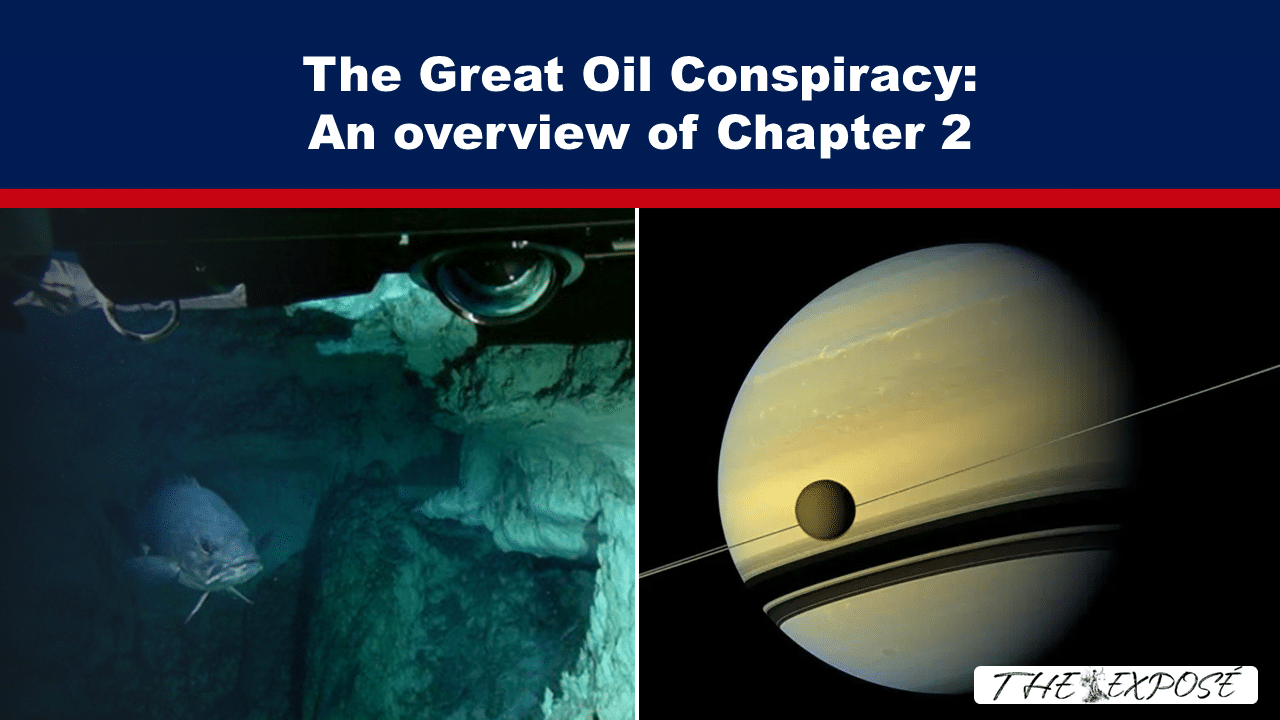
Featured image: The Lost City Hydrothermal Field (left) Source: Lost City Research. Moon Titan appears in front of Saturn in an image captured by NASA’s Cassini spacecraft (right). Source: BBC Sky at Night Magazine
The Expose Urgently Needs Your Help…
Can you please help to keep the lights on with The Expose’s honest, reliable, powerful and truthful journalism?
Your Government & Big Tech organisations
try to silence & shut down The Expose.
So we need your help to ensure
we can continue to bring you the
facts the mainstream refuses to.
The government does not fund us
to publish lies and propaganda on their
behalf like the Mainstream Media.
Instead, we rely solely on your support. So
please support us in our efforts to bring
you honest, reliable, investigative journalism
today. It’s secure, quick and easy.
Please choose your preferred method below to show your support.

Categories: Breaking News, World News
Fossil fuels exist. These are coal and lignite.
Methane can form abiotically also in a reaction between Aluminium Carbide and water. First aluminium and carbon form carbide in high temperature underground and the carbide is then exposed to water resulting in the following fully abiotic reaction. Al4C3 + H2O = CH4 + Al2O3
The balanced chemical equation Al4C3 + 6H2O → 3CH4 + 2Al2O3
Science. Once again science is not “settled”. It’s too bad it is politicized.
Politicized STILL half wrong because politicians are DUMB & easily turn corrupt using monetary & wealth lifestyle. The hidden hands behind the scene is the true origins of whose who’s in power in our world.
Science just a REBRAND name taken from our super-intelligent ancestors. NASA still using SAROS CYCLE calculation taken from Mesopotamia’s era to calculate 100% accuracy of Sun’s eclipses.
This is just one of the OLD world ‘real-science’ rebrand by modern science to fool the masses.
Pyramids around the world, India’s old temples, man-made structures under the ocean, Maccu Piccu, Borobudor & many more of old world’s super intelligent & advanced in technology far beyond our current era.
Please DO NOT FEED me with NASA bullshits..!!
Space does not exist. Planets & heliocentric model ARE still a THEORY until today. Theory 100% NOT FACT…!!! Get some dose of reality, please..!!
Oil still debated until today & the origins of oil still considered “THEORY” because SHEEPLES still consider EARTH is a ball planet…!!
Modern Science showing us “THEORY” of BALL EARTH crust, mantle & core are ridiculous because NEVER in history human could dig the earth deep enough to know the earth’s core or mantle.
If human NEVER dig deep enough to see the real earth’s core, it’s a science fiction & a dumb lie.