





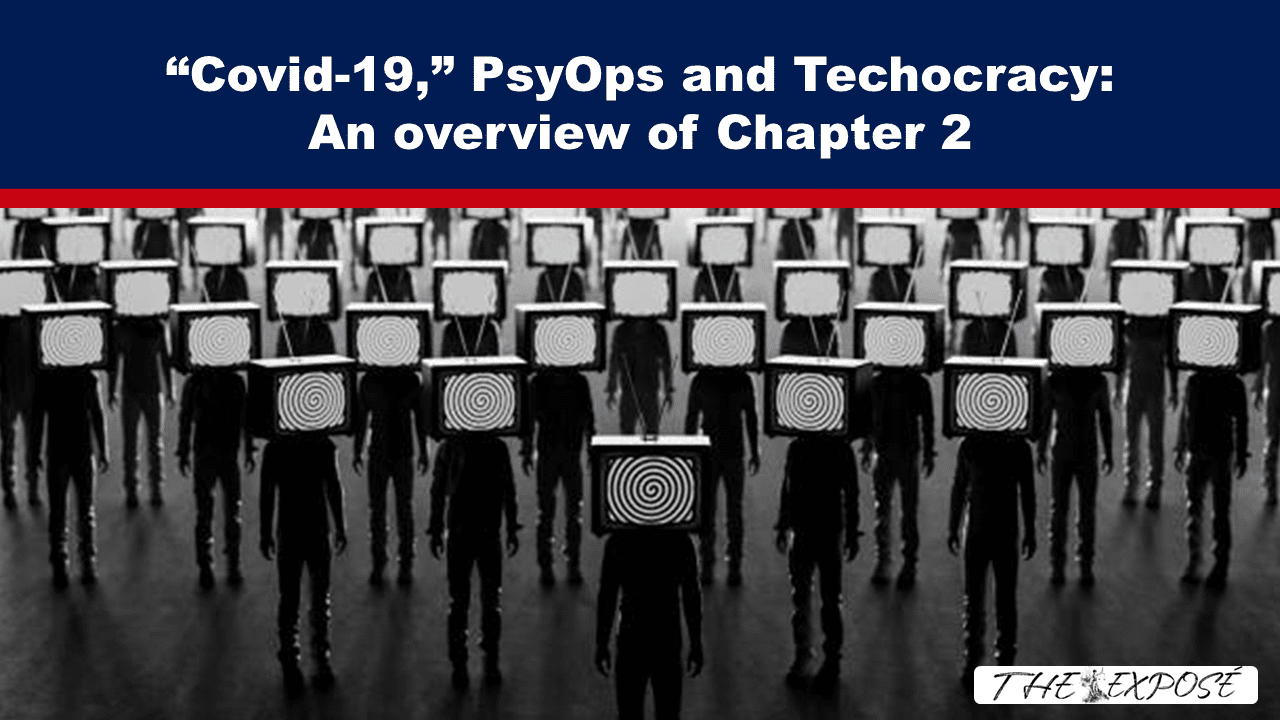
In this chapter, David A. Hughes discusses the origins and history of exploiting shock and stress for social control purposes, beginning during World War I with the Tavistock Institute.
He then discusses programmes such as CIA’s MKULTRA, which used mind control, psychotropic drugs and psychological manipulation to control and neutralise resistance, and other mind control initiatives which used techniques to reprogramme behaviour, often using traumatic experiences to induce a state of shock and paralysis.
All these trauma-based mind control techniques fed into the psychological operations deployed during the covid era to shock and terrorise populations into submission.
Let’s not lose touch…Your Government and Big Tech are actively trying to censor the information reported by The Exposé to serve their own needs. Subscribe to our emails now to make sure you receive the latest uncensored news in your inbox…
David A. Hughes is a Senior Lecturer in International Relations at the School of Social and Political Sciences, University of Lincoln, UK. In 2024, he published a book about the covid-era psychological warfare that worked to turn people against one another and to prevent them from uniting against their oppressors. As a result, at the time the book was published, society was deeply divided between those who could see through psychological operations and those who could not.
The book was published under a Creative Commons Attribution 4.0 International License. You can read the book online HERE, download a copy HERE or search online for a suitable seller to purchase a copy. Hughes provides a list of sources at the end of each chapter.
The following is an AI-generated summary of a chapter from the book. AI programmes are prone to inaccuracies and what’s known in the industry as “hallucinations.” We advise readers to refer to the original book to check the accuracy of information.
“Covid-19,” Psychological Operations, and the War for Technocracy by David A. Hughes, 2024
Chapter 2: Shock and Stress
Table of Contents
- Origins of Shock and Stress as Tools of Social Control
- Tavistock's Network and Institutional Influence
- Pharmacological Social Control
- Counterinsurgency Tactics in Malaya, Kenya and Vietnam
- Domestic Suppression and Psychological Warfare in the US
- Drugs and the 1960s Counterculture as Tools of Control
- Mass Psychological Manipulation and Social Engineering
- Theoretical Foundations of Social Turbulence and Crisis
- Future Shock and Managed Psychosis in Society
- The 1970s Transition to Post-Industrial Society
- Terrorism and the Strategy of Tension
- Shock as a Tool of Political and Economic Suppression
- The Shock Doctrine's Historical and Institutional Roots
- Covid-19 Lockdowns as a Shock and Awe Operation
- Lockdowns, the Erosion of Scientific Consensus and the Transnational Deep State
- Isolation as a Mechanism of Control and its Psychological impact
- Defamiliarization and the Creation of a New Normal
- Language as a Tool of Propaganda and Control
Origins of Shock and Stress as Tools of Social Control
The concept of exploiting shock and stress for social control purposes originated from the observation of World War I victims of shell shock, who displayed increased psychological malleability, and has since been developed by social engineers, including those at the Tavistock Institute, which has been instrumental in weaponizing psychiatry.
The Tavistock Institute, founded by Hugh Crichton-Miller in 1920, has been involved in various experiments, including those using electro-convulsive shock, barbiturates, and hypnosis, to induce neurotic behavior and control individual behavior, with key figures such as John Rawlings Rees playing a significant role in these efforts.
Researchers like Ivan Pavlov and Eric Trist have also made significant contributions to the understanding of how stress and shock can be used to break down an individual’s psychological endurance, making them more suggestible and susceptible to reprogramming, with Pavlov’s work showing that 30 days of modern warfare can push most men beyond their psychological limits.
The principle of “depatterning” the mind, or breaking down old patterns to build new ones, has been established as a key component of psychological warfare research, with techniques such as Pavlovian conditioning and Chinese “thought reform” being used to achieve this goal, and the COVID-19 lockdowns in 2020 being cited as an example of a shock and awe operation that utilized these techniques.
The work of authors like George Orwell, who wrote about the power of tearing human minds apart and reassembling them in new shapes, and researchers like Joost Meerloo, who discussed the importance of breaking down old patterns to build new conditioned reflexes, has also been influential in the development of these concepts, with the ultimate goal of achieving social control through the manipulation of human psychology.
The involvement of prominent figures, such as CIA Director Allen Dulles, in experiments to achieve similar results, including the use of “brain washing” and “brain changing” techniques, highlights the extent to which these concepts have been explored and developed by various organizations and individuals, with the aim of exploiting shock and stress for social control purposes.
The Tavistock Institute, led by figures such as Ewen Cameron, who was the president of the American Psychiatric Association, the Canadian Psychiatric Association, and the World Psychiatric Association, was involved in mind control experiments for the CIA in the 1950s, using techniques like electroshock and drugs to “depattern” victims and put them into a state of shock.
These experiments, known as “psychic driving,” aimed to break down prisoners and make them susceptible to interrogation, with the goal of extracting information from them, and were described by Klein as “attacking the brain with everything known to interfere with its normal functioning—all at once.”
The CIA’s MKULTRA and other mind control programs yielded the KUBARK Manual in 1963, which provided a guide to “interrogation” techniques, including the use of psychological shock or paralysis to break down a prisoner, and was intended to be used as a tool for social control.
Tavistock’s Network and Institutional Influence
The Tavistock Institute’s approach to psychiatry was centered around the idea of using it as a means of social control, with the goal of guiding the population into accepting the policies of a small Anglo-American international financial establishment, and was described by Minnicino as “the means of class war” and by Marcus as “a weapon of the ruling class.”
The institute’s methods, as proposed by Rees, included the use of “shock troops” or mobile teams of psychiatrists who would be loyal to the network and would provide treatment or experimentation to people without their consent, targeting “constitutionally inferior groups” and “social problem groups” along eugenics lines.
The Tavistock Institute of Human Relations was formed in 1947, with the support of the Rockefeller family, and was led by Rees, who was rewarded with a new appointment in 1948 for offering up his network to the Rockefeller family, and the institute’s work was influenced by the ideas of Machiavelli and the concept of “psychic driving” developed by Cameron.
The President of the UN World Federation of Mental Health, who stepped down from the Tavistock Institute, was able to plant his protégés in key positions and grow a transnational network of influential practitioners and research labs, thereby dominating the postwar mental health profession.
Pharmacological Social Control
The founding connection between the World Health Organization and the Rockefeller-Rees axis was confirmed when Brock Chisholm, an ally of Rees, was appointed as the first Director-General of the World Health Organization in 1948.
Rees’ influence expanded into the National Institute of Health and the National Institute of Mental Health in the United States, complementing Rockefeller control over the American Medical Association and American Psychiatric Association, which raises serious questions about the mental health profession and its potential use as a means of social control.
The routine prescription of antidepressants may be intended to facilitate social control via biochemical means, rather than solely to treat depression, and it has been suggested that psychiatry could be used to “neutralise” dissidents by mentally murdering them, which is a form of murder that can be perpetrated if the Rockefeller forces control the majority of the psychiatric profession.
Counterinsurgency Tactics in Malaya, Kenya and Vietnam
The Tavistock Institute’s methods of counterinsurgency, as described by Winston Churchill’s claim that “the empires of the future are the empires of the mind”, involve shifting the battlefield from control of territory to control of minds, and using primary weapons such as food control, resettlement, and counter-gangs to make people more susceptible to behaviour modification and infiltrate and subvert resistance movements.
The use of these methods can be seen in the example of Malaya, where British intelligence infiltrated the communist armed guerrillas, destroyed the rice crop, and punctured food cans, sending the population into near starvation, and then blamed the guerrillas for the false flag operation, leading the population to resettle to “New Villages” set up by the government, which allowed for further control and manipulation.
The British used psychological operations and counterinsurgency tactics in Malaya and Kenya, including forced resettlement and food control, to suppress national liberation movements and gain control over the population, with the goal of selecting out future leaders and passing political control to Western intelligence.
The CIA adopted similar tactics, bringing in Sir Robert Thompson, who had served in the Malayan operation, to help with the Vietnam War, and implementing the Taylor-Staley strategic hamlet programme, which resulted in the forced relocation of 13 million farmers and workers to fortified villages.
Domestic Suppression and Psychological Warfare in the US
The use of counterinsurgency methods was later deployed domestically in the West, particularly in the United States, where they were used to suppress the African-American population and other social movements, with the FBI using tactics such as infiltration, frame-ups, and covert operations to eliminate political opponents.
The concept of “counter-gangs,” developed by Brigadier Frank Kitson, was used to infiltrate and subvert foreign resistance movements, and was later applied domestically, with mind-controlled operatives being used to infiltrate and provoke violence in radical groups, allowing for prosecution and further suppression.
Notable examples of the use of these tactics include the assassination of Martin Luther King Jr. and the murder of Fred Hampton and Mark Clark, as well as the use of FBI infiltration and covert operations to provoke violence and suppress radical groups, with the corporate media often covering up these actions.
The use of psychological operations and counterinsurgency tactics has been recommended by think tanks such as the American Institute of Research, and has been used to maintain control over populations and suppress dissent, both domestically and internationally, with the goal of selecting out and eliminating potential leaders and troublemakers.
Drugs and the 1960s Counterculture as Tools of Control
The Tavistock Institute played a significant role in the drugs counter-culture of the late 1960s, which was aimed at reducing youth resistance, and this effort was an extension of the work of Tavistock’s Ewen Cameron and William Sargant in MKULTRA experiments involving psychotropic drugs and mind control.
According to the KUBARK Manual, the function of drugs is to cause capitulation and aid in the shift from resistance to cooperation, and authors like Aldous Huxley promoted the use of certain drugs, such as mescaline and LSD-25, in his writings, including “Brave New World” and “Doors of Perception”.
The use of drugs as a means of control led to the creation of a generation of “doped-up zombies, ‘change agents,’ and shock-troops for Tavistock’s Brave New World” among US college students in the 1960s, and the CIA’s history of bringing narcotics into the United States, particularly in black communities, is also linked to this concept of “medication into submission”.
Mass Psychological Manipulation and Social Engineering
The Tavistock Institute’s ultimate goal was to apply mind control techniques to societies at large, using shock and stress as key factors, and to this end, they sent “flying squads” to war-torn areas and disaster zones to study the potential for manipulating shocked and stressed populations.
Researchers like Kurt Lewin and William Sargant worked on developing methods for inducing controlled, irrational behavior by groups of people, and their work was supported by funding from charitable trusts and wealthy families, such as the Rockefellers, the Mellons, and the Morgans, highlighting the Establishment’s investment in psychological means of social control.
The concept of “massive over-prescription” of medications since the early 1960s has also contributed to the creation of a docile and comfortably numb population, which has been silenced, sedated, and marginalized over decades, raising critical questions about the escalating use of prescription medications and its impact on society.
Theoretical Foundations of Social Turbulence and Crisis
The manipulation of fear, anger, and excitement can be used to impair judgement and increase suggestibility, allowing for the implementation of various beliefs in a large number of people, as noted by Sargant in 1997, and this principle has been operative in various periods of common danger, including wartime, epidemics, and other crises.
The concept of “permanent social turbulence” was introduced by Tavistock’s Fred Emery and Eric Trist in 1963, which involves a series of sharp and universal shocks that destabilize a targeted population, plunging society into a form of managed psychosis, and causing people to adopt more infantile forms of reasoning and accept what was once considered abnormal.
The Tavistock Institute, along with other organizations and individuals, such as the Stanford Research Institute and Zbigniew Brzezinski, have been involved in promoting the idea of social turbulence and the need for a transition to a “post-industrial” model, which would prevent non-Western societies from catching up with their Western counterparts.
Future Shock and Managed Psychosis in Society
The use of successive social, economic, political, and cultural shocks can lead to maladaptive responses and neurotic behaviors on a grand scale, allowing populations to be manipulated into accepting significant changes, such as the transition to a “super-industrial” society, as described by Alvin Toffler in his book “Future Shock”.
The concept of “future shock” refers to the shattering stress and disorientation caused by subjecting individuals to too much change in too short a time, and this can be induced by various means, including energy shortages, economic and financial crises, and terrorist attacks, which can drive society into a state of mass psychosis.
The idea of a “turbulent environment” has been discussed by Emery and Emery, who suggest that a series of shocks delivered with increasing intensity can have a profound impact on society, and this concept has been referenced by other authors, such as Digital Citizen, who notes that society can be shocked by various means, leading to a state of mass psychosis.
The HUGHES concept creates a “dissociative mode within individuals and societies,” leading to unpredictable and undesirable social interactions, and ultimately resulting in an atomized society where people are conditioned to maladapt to stress through television, as discussed by Emery and Emery in 1976.
The 1970s Transition to Post-Industrial Society
The 1970s saw a significant transition to a “post-industrial” society, triggered by events such as energy shortages, economic and financial instability, and terrorist attacks, which were used to shock Western societies into accepting this transition, with the decoupling of the US dollar from gold in 1971 being a key factor in ushering in a new era of instability in the global economy.
The 1973 oil price shock, which saw the price of oil quadruple in a matter of days, had a major impact on industrial activity worldwide, leading to a significant drop in industrial production, steep increases in bankruptcies and unemployment, and consolidating the power of Wall Street, the City of London, and the Seven Sisters, as noted by authors such as Strange and Engdahl.
According to Engdahl, the 1973 oil price shock was not an exogenous event, but rather a planned outcome of the May 1973 Bilderberg meeting, which aimed to manage the flood of oil dollars arising from the petrodollar arrangements, and was secretly orchestrated by Washington and London, with the purpose of undermining industrial growth in the “Third World” and tilting the balance of power back to Anglo-American financial interests.
The oil price shocks and consequent oil shortages were artificially created, as argued by Marcus, who believed that the Rockefeller family played a key role in rigging the October Arab-Israeli war, and that the purpose of these events was to undermine industrial growth in the “Third World” and to consolidate the power of Anglo-American financial interests, using tactics such as the “grossly impudent lie,” as described by Hitler.
Terrorism also contributed to the social turbulence of the time, with the emergence of militant organizations such as the Provisional IRA, the Weather Underground, and the Red Brigades, which were often infiltrated by operatives and psychologically manipulated victims, and were used to syphon off vulnerable workers into violent and self-destructive forms of radicalism, as noted by authors such as Kitson, Minnicino, and Wolfe.
Terrorism and the Strategy of Tension
The “Strategy of Tension” was a tactic used by clandestine NATO networks, such as Operation Gladio, to create social turbulence by attacking innocent civilians, including women and children, in order to make the public willing to trade part of their freedom for greater security.
This strategy, which was later globalized through the “War on Terror”, involved deceptively blaming terrorist attacks on “far left” groups to undermine the class struggle and create a sense of insecurity among the public.
The concept of “social turbulence” is often camouflaged by researchers such as Emery and Trist, who suggest that it arises from unpredictable changes in the environment, rather than from artificially induced actions by powerful entities.
However, according to Naomi Klein’s “Shock Doctrine”, social turbulence is actually designed to create bewilderment and anxiety, allowing for the implementation of radical pro-corporate measures, often referred to as “shock therapy”, in the wake of collective shocks such as wars, coups, terrorist attacks, market crashes, or natural disasters.
Klein argues that neoliberalism and “disaster capitalism” rely on disasters to progress, with social engineers taking advantage of the public’s disorientation to remake the world in their image, often using tactics such as terror to achieve their goals, as seen in examples such as the Pinochet dictatorship in Chile and Operation Condor in Argentina.
The use of shock tactics to manipulate the public has been employed in various forms, including the forced disappearance of left activists, and has been facilitated by the work of economists such as Milton Friedman, who has promoted the idea of using disasters as opportunities to implement free market capitalism.
Shock as a Tool of Political and Economic Suppression
The Tiananmen Square massacre in 1989 and the subsequent arrest of tens of thousands of activists enabled the Chinese Communist Party to establish a vast export zone with workers who were too terrified to demand their rights, illustrating the first category of shock, which involves the use of force to suppress opposition and implement economic policies.
The second category of shock involves war, as seen in the Falklands War, which allowed Margaret Thatcher to crush the UK miners’ strike and launch the first privatisation frenzy in a Western democracy, and the Kosovo War of 1999, which created conditions for rapid privatisation in the former Yugoslavia.
The third category of shock is financial, as exemplified by the Latin American and African debt crises and hyperinflation in the 1980s, which were leveraged to force privatisation, and the Asian financial crisis of 1997-8, which forced open the markets of the “Asian Tigers”.
The Shock Doctrine’s Historical and Institutional Roots
According to Naomi Klein, the shock doctrine, which involves exploiting moments of shock to implement radical economic policies, has its origins in CIA torture experiments in the 1950s and later the CIA coup in Chile, and was later used by neoconservatives to call for a shock therapy-style economic revolution in the US in the mid-1990s.
Klein notes that the 9/11 attacks provided an opportunity for the Bush administration, which was packed with followers of Milton Friedman, to wage privatised wars abroad and build a corporate security complex at home, but she avoids suggesting that 9/11 was deliberately orchestrated by deep state actors, instead portraying it as a traumatic event that was exploited by the administration.
The shock doctrine has a Nazi heritage, requiring a major collective trauma to suspend democratic practices and allow for iron-fisted leadership, and Klein’s work highlights the Schmittian overtones of a state of exception, but she stops short of suggesting that such traumatic events have been artificially manufactured to bypass democracy.
Klein’s book highlights the role of key figures, including Donald Rumsfeld, who was a close friend of Milton Friedman, and veterans of earlier disaster capitalism experiments in Latin America and Eastern Europe, in exploiting the shock of 9/11 to implement their economic agenda, but she titles a section of her book “No Conspiracies Required”, underscoring her reluctance to suggest that 9/11 was a deliberate act of manipulation.
Covid-19 Lockdowns as a Shock and Awe Operation
The concept of the “shock doctrine” is highlighted by Klein, who notes that in a state of shock, societies often become vulnerable to authority figures telling them to fear one another and relinquish their rights for the greater good, as seen in the context of the “Covid-19” operation.
The idea of “shock and awe” is discussed by Ullman et al., who describe it as actions that create fears, dangers, and destruction that are incomprehensible to the people at large, with the objective of controlling the adversary’s will, perceptions, and understanding.
The use of “shock and awe” tactics can be seen in the “Covid-19 lockdowns”, which were a deployment by governments against their own citizens, aimed at crippling public resistance to the transition to technocracy, and were successful in the short term due to the high level of obedience and conformity exhibited by the public.
Joseph Cyrulik of the Centre for Strategic and International Studies, a CIA partner think tank, is mentioned as having contemplated the possibility of a decisive attack against the political will of an entire populace, which would involve killing and wounding people, damaging and destroying their homes and communities, and undermining their confidence and sense of security.
The methods described by Cyrulik are consistent with the attempted transnational regime change from liberal democracy to technocracy, and the “Covid-19 lockdowns” can be seen as a fitting description of such an attack, which was aimed at destroying the people’s faith in their government, military, and themselves.
The “Covid-19 lockdowns” were a result of governments being controlled by a transnational capitalist oligarchy, which used the lockdowns as a means to transition to technocracy, and the social response to the countermeasures was marked by an astonishing level of obedience and conformity.
The Covid-19 pandemic led to a significant shift in people’s behavior, with many individuals accepting the new “lockdown” arrangement and sacrificing their life conditions, social relationships, work, friendships, and even their religious and political convictions, as observed by Agamben in 2021.
This phenomenon is reminiscent of the millions of people in Nazi Germany who were eager to surrender their freedom, as noted by Fromm in 1960, and is also consistent with the idea of a “great rupture” proposed by Klein in 2007, where social engineers can remake the world while the population is “psychologically unmoored”.
The World Economic Forum’s “Great Reset” agenda is aligned with this concept, and authors like Schwab and Malleret have advised decision-makers to take advantage of the shock inflicted by the pandemic to implement radical, long-lasting, systemic change, as stated in their 2020 publication.
The Covid-19 operation employed various psychological warfare techniques, including disruption of behavioral patterns, isolation, defamiliarization, and implantation of triggers, which were deployed in the early stages of the pandemic to achieve the desired objectives, as highlighted by Hughes in 2022.
The disruption of behavioral patterns was a key aspect of the operation, with the global “lockdowns” of March 2020 being a prime example, where healthy people were quarantined en masse without any recognized scientific reason, as noted by the World Health Organization in 2019.
The use of shock and stress was a deliberate tactic, as evident in the CIA’s advice to exploit the moment of shock to achieve objectives, and the rapid passage of legislation such as the UK Coronavirus Act, which was rushed through a disoriented legislature before it could be properly read or debated.
The scale, intensity, and coordination of the Covid-19 operation suggest the involvement of a transnational deep state, and the operation’s use of psychological warfare techniques is consistent with the “shock doctrine” concept, which involves using the shock of a crisis to implement radical changes.
Lockdowns, the Erosion of Scientific Consensus and the Transnational Deep State
The Chief Scientific Adviser, Patrick Vallance, stated on March 13, 2020, that the aim was to build up herd immunity to reduce transmission and protect vulnerable individuals, without advocating for full lockdown measures.
Neil Ferguson’s “Report 9” of March 16, 2020, also did not recommend full lockdown measures, including the closing of businesses, despite using fear-mongering statistics.
The Prime Minister’s father, Stanley Johnson, publicly called for pubs to carry on business as usual on March 17, 2020, further highlighting the lack of consensus on lockdown measures.
The Scientific Advisory Group for Emergencies (SAGE) was effectively “closed” from March 19-22, and when it reconvened on March 23, there was no record of a decision to implement a full lockdown in the SAGE minutes.
The sudden implementation of lockdown measures in the United Kingdom on March 23, 2020, without a clear reason or recommendation from scientific advisers, raises questions about who made the decision and on what basis.
This event is seen as an example of the transnational deep state exercising veto power over democratic processes, with the decision to lockdown being taken at a higher level than national governments, which challenges the principles of liberal democracy and national sovereignty.
The use of lockdown measures and the generation of uncertainty and fear among the population can be compared to techniques used in psychological warfare and torture manuals, such as disrupting routines and temporal rhythms to cause disorientation and feelings of fear and helplessness.
The book by Schwab and Malleret, published in 2020, appears to provide a blueprint for using a pandemic for psychological warfare purposes, with passages that seem to be familiar with the principles of psychological manipulation and control.
Isolation as a Mechanism of Control and its Psychological impact
The CIA has documented techniques, including disrupting sleep and mealtimes, blocking out natural light, and isolating prisoners, to reduce their capacity for resistance, as noted in their 1983 manual, sections K-2, E-3, and H-6.
Similarly, authors Klaus Schwab and Thierry Malleret, in their 2020 work, describe the Covid-19 lockdowns as altering people’s sense of time, making it “amorphous and undifferentiated,” although they present no evidence to support this claim, which seems to resemble a planned outcome.
The World Economic Forum agenda contributor, Ruth Ogden, agrees that there was a widespread distortion of time during lockdown, which can be linked to the concept of isolation and its effects on human psychology.
Isolation is a key component in Pavlovian conditioning, as it allows for the taming of wild animals, and similarly, totalitarians use isolation to condition their political victims, as noted by Joost Meerloo in 1956.
The concept of isolation is also discussed by Hannah Arendt, who writes that the loyalty required from totalitarian subjects can only come from completely isolated individuals who derive their sense of belonging from their membership in a movement or party.
Research by the CIA, as well as scientists such as Donald O. Hebb and Lawrence Hinkle, has shown that isolation increases a person’s susceptibility to propaganda, breaks down their brain function, and makes them more malleable.
The Human Resource Exploitation Training Manual, adapted from the KUBARK Manual, recommends maintaining isolation, both physical and psychological, from the moment of apprehension, as it deprives the prisoner of their usual support structures and social support.
Isolation is also the first step on Albert Biderman’s 1957 “Chart of Coercion,” which includes variants such as complete solitary confinement, complete isolation, semi-isolation, and group isolation, all aimed at depriving the victim of their ability to resist.
According to Philip Zimbardo, being part of a social support network is the most effective way to prevent mental and physical illnesses, highlighting the importance of social connections in maintaining individual resilience.
The “Covid-19” operation utilized isolation as a key feature to exert control over individuals, including stay-at-home orders, enforced working from home, “self-isolation,” and mandatory isolation in hotels for some travelers, which is a tactic often used by abusers to control their victims, as noted by Anthony and Cullen in 2021.
The prolonged isolation and chronic social deprivation imposed by the “lockdowns” exacerbated the desire for social connection and group belonging, making people more susceptible to group-based psychology and tribal identification, as well as propaganda vulnerabilities, according to Kyrie and Broudy in 2022.
The British Prime Minister emphasized the importance of minimizing social contacts to stay safe, which led to ordinary people having their usual support mechanisms stripped back, resulting in loneliness and despair affecting large numbers of people, with Bill Gates acknowledging in December 2021 that stress and isolation had triggered far-reaching impacts on mental health.
The isolation caused by the “lockdowns” was psychologically harmful, depriving people of necessary social interaction for mental wellbeing, as noted by Meerloo in 1956, and led to a sharp decrease in social interaction, with predictable effects on the public’s mental health, including a rise in suicide calls, overdoses, and suicide rates among young people in the United States.
The UK Government was aware of the adverse impact of social restrictions on people’s wellbeing and mental health, with nearly half of adults reporting boredom, loneliness, anxiety, or stress, yet maintained the third national “lockdown” until July 19, 2021, despite this knowledge.
Isolation can lead to introspection, which can result in delusion, as noted by the CIA in 1983, and Biderman’s “Chart of Coercion” recommends methods that foster introspection, while Meerloo warns that a person closed off from the outside world may find repressed memories and anxieties coming to the surface and assuming “gigantic proportions” due to the inability to evaluate or check fantasies against everyday events.
Defamiliarization and the Creation of a New Normal
The Covid-19 pandemic was utilized as a means to implement psychological operations, including defamiliarization, which involves creating a sense of radical disconnection from the familiar and reassuring, in order to produce dissociation and psychosis in individuals and entire societies.
According to the KUBARK Manual, defamiliarization is a deliberate tactic used to enhance feelings of being cut off from the known and plunged into the strange, and this principle is based on tactics deployed in communist and Nazi regimes, as well as Chinese brainwashing techniques.
The concept of defamiliarization is also reflected in the idea of “resettlement” in Tavistock counterinsurgency operations, which serves to uproot individuals from their social milieu and familiar environments, and this tactic was applied to entire societies during the Covid-19 pandemic.
The pandemic was used to create a moment of rupture, where “everything changes,” and all old rules can be done away with, allowing for the introduction of a new regime of control, as described by authors such as Schwab and Malleret, who stated that “the world as we knew it in the early months of 2020 is no more, dissolved in the context of the pandemic.”
The shock of the lockdowns in March 2020 was a success in creating disorientation and loss of cognitive function, as people’s everyday habits of life were replaced with something new and unfamiliar, and the idea of the “new normal” was introduced, which relies on the same principles and outcomes as defamiliarization to induce disorientation and loss of cognitive function.
The “new normal” reflects an alien, dehumanized biodigital surveillance state, where people are required to physically distance from others, wear masks, and constantly monitor the virus, creating a profoundly unfamiliar and disturbing social environment, similar to some of the early MKULTRA experiments, as described by authors such as McCoy.
The use of mask mandates, in particular, turned the social environment into something unfamiliar and disturbing, with some accounts comparing it to an LSD trip, highlighting the extreme nature of the psychological operations implemented during the Covid-19 pandemic, as described by authors such as Ellul, Meerloo, and van der Pijl.
The experiences of individuals who have taken LSD, such as Alfred Hoffmann, Mal Evans, and others, often involve hallucinations of people’s faces appearing as grotesque, colored masks, which bears a striking resemblance to the masked world of “Covid-19” as depicted in a photograph by Jose Carlos Fajardo.
Language as a Tool of Propaganda and Control
The concept of Pavlovian conditioning, as used in the USSR, demonstrates how language can be degraded and used as a tool for control, where words become behavioral triggers that evoke fear and terror, rather than conveying meaningful information.
In a totalitarian system, language is weaponized to control the population, with propaganda terms repeated to trigger fear-based behavior, train obedience, and suppress independent thinking, as described by authors such as Meerloo.
The Human Resource Exploitation Training Manual, published by the CIA, explains how an individual’s suggestibility is heightened during a moment of psychological shock, making them more receptive to suggestion and implantation of trigger words, sounds, and images.
Trigger words, such as “9/11”, “terrorism”, and “Covid-19”, are designed to reactivate trauma and associate with the original event, and are often implanted in people’s minds through the media, as seen in the aftermath of the 9/11 attacks and the Covid-19 pandemic.
The use of trigger words and phrases, such as “lockdowns”, “self-isolation”, “social distancing”, and “new normal”, during the Covid-19 pandemic, has created a new lexicon of terms that are subliminally associated with the original trauma, and are used to control and influence people’s behavior.
Authors such as Klein and Lacter have written about the effects of trauma and trigger words on individuals and society, with Klein quoting Mao to describe how a person’s mind can be turned into a “blank slate” during a moment of shock, allowing for the implantation of new ideas and trigger words.
The concept of MKULTRA-style programming, which involves the use of psychological manipulation and control, has been applied to entire populations through the media, as seen in the coverage of the 9/11 attacks and the Covid-19 pandemic, with the goal of shaping public opinion and behavior.
The repetition of certain words and images by mainstream journalists, politicians, and talking heads during the Covid-19 pandemic was a deliberate attempt to etch trigger words into public consciousness, allowing for trauma-based mind control to be exercised, similar to the tactics used after 9/11.
The Expose Urgently Needs Your Help…
Can you please help to keep the lights on with The Expose’s honest, reliable, powerful and truthful journalism?
Your Government & Big Tech organisations
try to silence & shut down The Expose.
So we need your help to ensure
we can continue to bring you the
facts the mainstream refuses to.
The government does not fund us
to publish lies and propaganda on their
behalf like the Mainstream Media.
Instead, we rely solely on your support. So
please support us in our efforts to bring
you honest, reliable, investigative journalism
today. It’s secure, quick and easy.
Please choose your preferred method below to show your support.

Categories: Breaking News, World News
Many of us knew convid was a hoax right from the start. Lies fall apart. Stupid screens, bogus tests, daft one way systems in shops..big businesses open, small ones shut, the other way around makes more sense. Masks next week…not tomorrow…money making bs…never wore one…politicians having parties..BLM rallies OK…anti lock down…super spreaders..I and my friends were on a war footing straight away…violence was on the table…we moved freely around town like resistance fighters…I had zero tolerance for mask holes and covidiots…the new normal was not going to stay. End of story. The elites are terrified. The public are turning against them and they will soon be rounded up.
Yes, but many of us saw through this during the “Covid” era, mainly due to the internet posting of “Truth” from well educated, renownned experts who we immediately knew were telling us the facts. They exposed the fake news of the day. No wonder they now see widespread censorship as essential to prevent this in the future. Good luck with that one. I don’t think they will ever succeed.
This is exactly what I want to hear… Thank you!