





The UK is facing an energy crisis that is going to require radical solutions to solve. Many countries are ramping up coal-fired electricity generation in response. Is it time for the UK to do the same – to go for “Coal not Cold”?
David Turver explains why we will need new coal-fired electricity generation capacity to keep the lights on.
Let’s not lose touch…Your Government and Big Tech are actively trying to censor the information reported by The Exposé to serve their own needs. Subscribe to our emails now to make sure you receive the latest uncensored news in your inbox…
Coal Not Cold
By David Turver, 5 April 2026
This article is adapted from a section of a new paper by the new think tank, the Great British Business Council. I am a co-author of the paper, although it should be noted that Catherine McBride did most of the work. The new paper shows how Net Zero has resulted in Premeditated Industrial Destruction and what to do about it. The paper is recommended Easter reading and can be found on THIS link.
Introduction
The UK closed its last coal-fired power station at Radcliffe-on-Soar in 2024. This closure marked the end of a series of closures marked by politicians blowing up other coal-fired power stations to celebrate, publicly, their compliance with the Net Zero agenda.
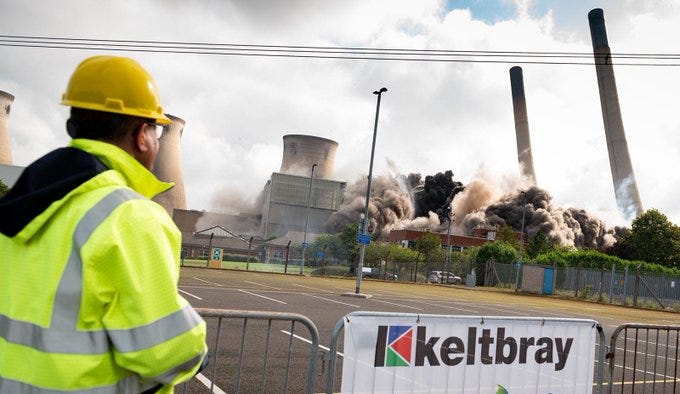
Now Germany is considering reopening some of its coal-fired power stations in response to the energy crisis caused by the war with Iran. Many other countries, such as India, South Korea, Japan, Indonesia, Thailand, the Philippines, Vietnam and Bangladesh, are stepping up the generation of coal-fired power to offset gas shortages created by the conflict.
Emissions of sulphur oxides (SOx), nitrogen oxides (NOx) and particulates have always been more powerful arguments for reducing coal use than carbon dioxide emissions, but new super-critical power plants scrub their emissions very effectively. Time to explore whether the UK should be reopening coal mines and rebuilding coal-fired power stations to keep the lights on. Should we focus on “Coal Not Cold”?
Coal Reserves
The UK has a lot of coal. The data on coal reserves and resources is quite old, but the coal has not gone anywhere. Euracoal estimated in 2015 that the UK was sitting on 3,560 million tonnes of hard coal resources and a further 1,000Mt (metric tonnes) of lignite. They also estimated that the UK had 277Mt of economically recoverable hard coal reserves.
We only have one remaining large-scale coal mine, Aberpergwm in South Wales, not far from Port Talbot. Coal prices have risen from around $42/t in 2016 to over $144/t at the time of writing, so it may be economically feasible to restart old mines and extract more domestic coal.
What are the benefits of restarting coal mining and coal-fired electricity generation?
Fuel Diversification
First is the diversification of fuel supplies. The war with Iran and the consequent restrictions on the flow of oil and gas through the Strait of Hormuz has highlighted the fragility of global supply chains. Before the war, about one-fifth of global liquefied natural gas (“LNG”) flowed through that critical global chokepoint. Constraints on supply have pushed up gas prices. The blowing up of the Nordstream pipeline and the war in Ukraine have also constrained the flow of pipeline gas to Europe from Russia. Diversification of fuel supplies is becoming of critical importance, which is why we are seeing many countries increase their coal consumption.
Having a fleet of coal power stations alongside gas-fired generation would encourage price arbitrage to keep electricity prices low and reduce reliance on gas with a reliable energy source.
Coal can also be used to produce liquid fuels. For example, China uses about 400Mt of coal annually in the Fischer-Tropsch process to produce petrochemicals and liquid fuels such as petrol and diesel. This diversifies China’s fuel supplies and reduces its reliance on oil imports, particularly important at a time of constrained oil supplies. With a change of regulatory regime, the UK’s vast coal resources could potentially be used to offset oil and refined product imports.
Energy Security
Diversification of fuel supplies also leads to stronger energy security. One of the problems of intermittent renewables is that sometimes they produce more electricity than demand, and at other times they produce almost nothing. This problem can be partially solved by adding battery storage. However, such storage is extremely expensive and is useless in the face of extended calm periods.
The UK has comparatively little gas storage capacity, about 3.2 billion cubic metres (about 35TWh), representing just over a week’s worth during winter. Extra short-term storage can be made available by line-packing – increasing pipeline pressure – but increasing long-term storage is expensive and time-consuming. By contrast, coal can be stored in stockpiles near the power plant very cheaply and does not need to rely on long and fragile global supply chains – homegrown, secure energy.
Keeping the Lights On
The case for reopening coal mines and restarting or rebuilding UK coal-fired generation capacity is made stronger when the state of our electricity generation system is considered. Our gas fleet is ageing and, of course, the last coal power plant was turned off in 2024. The typical operational life for a gas plant is 25–30 years. With careful maintenance, lives could possibly be extended up to 40 years. However, intermittent operation can reduce component life again. Using plant data from the Digest of UK Energy Statistics (“DUKES”) and assuming a 35-year life for our gas fleet, we can see in Figure 2 that firm power capacity starts to fall rapidly in 2028 and by 2035 is down to just 25.5GW (or 28.8GW if Hinkley Point C is online by then).
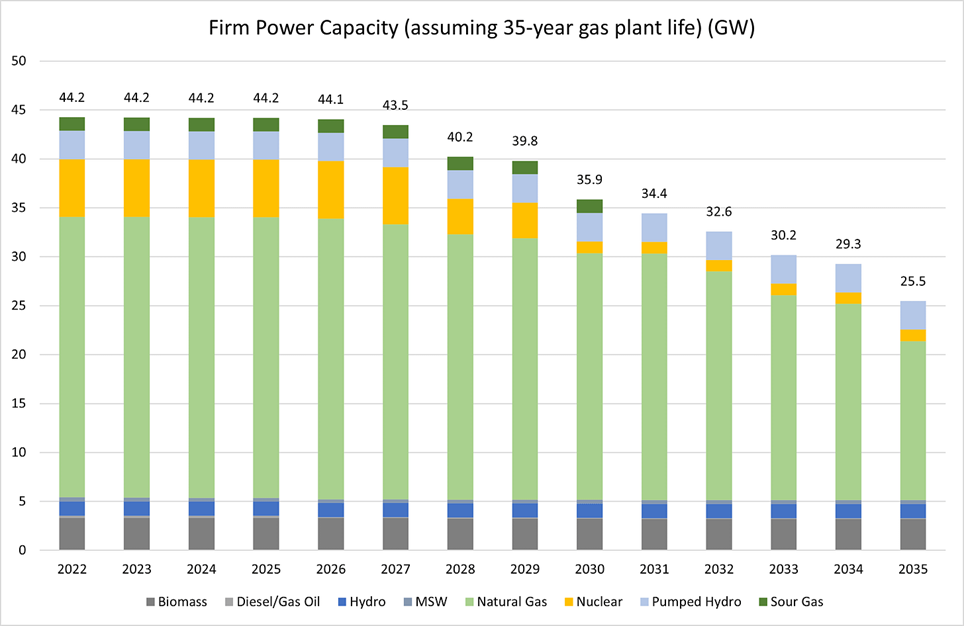
The National Energy System Operator (“NESO”) expects both total electricity demand and peak demand to rise over the period to 2030 and beyond. We will become increasingly reliant on intermittent renewables and on dark, cold and calm winter evenings the output from wind and solar can fall to almost zero. This means we will need firm power capacity available to meet the shortfall.
As Figure 2 shows, will become increasingly short of firm power capacity and it is therefore critical that new firm capacity is built quickly. One answer might be to build new gas-fired generators. However, there is an eight-year lead time on new gas-fired power plants, meaning that if we started building today, we would not get new capacity online until 2034. This leaves coal as a viable alternative because it should be possible to build quicker, with construction times in China as low as 20 months. It is becoming inevitable that we will need new coal-fired electricity generation capacity to keep the lights on.
Cheap and Reliable Power
The UK has the most expensive industrial electricity prices in the developed world. One of the reasons is that we have spent hundreds of billions of pounds on intermittent and unreliable wind and solar power. It is of critical importance that we bring down electricity prices. One of the reasons why China is so competitive is that coal is the backbone of its electricity generation. Coal-fired generation is cheap – cheaper than gas and intermittent renewables – if carbon costs through the Emissions Trading Scheme and Carbon Price Support mechanism are removed.
Coal-fired generation is also reliable and flexible. Coal-fired power plants are not subject to the vagaries of the weather, which is why most coal is generally used as constant baseload power. However, newer plants can operate at lower minimum loads and can flex up and down in response to changes in demand and changes in the output of intermittent renewables.
Overcoming Objections
The main objections to new coal power plants relate to emissions. If carbon dioxide (CO2) emissions are discounted due to the US removal of the greenhouse gas endangerment finding, that leaves real pollutants such as particulates, SOx and NOx to deal with. Fortunately, modern super-critical (“SC”) and ultra-super-critical (“USC”) plants in China have proven highly effective at removing these pollutants.
First SC and USC plants operate at higher thermal efficiency levels than conventional plants, thus reducing coal use and raw pollutant generation per MWh of electricity produced. Studies have shown that modern Ultra Low Emissions plants in China remove over 99.9% of all particulate matter and over 99.8% of PM2.5 particulates. Other studies show sulphur dioxide removal rates of 97.8-99.7% in high-efficiency, low-emissions power plants in China. NOx removal efficiencies of 90% can also be achieved.
If the problems of particulate, SOx and NOx emissions can be overcome, then there is no real objection remaining to using coal-fired power.
Conclusion
Recent geopolitical events in Ukraine and the Middle East demonstrate the fragility of global supply chains and the paramount importance of energy security. Successive governments have phased out coal-fired generation and closed coal mines in pursuit of Net Zero. The benefits of coal-fired power plants are obvious, and the downsides of coal have been largely eliminated through technological enhancements. The case for coal is becoming increasingly hard to ignore and many people would surely prefer we use coal rather than be left cold and shivering in their homes. Coal not Cold.
About the Author
David Turver is a British retired consultant, chief information officer and project management professional. He publishes articles on a Substack page titled ‘Eigen Values’ where he writes about contentious issues such as climate, energy and net zero. You can subscribe to and follow his Substack page, ‘Eigen Values’, HERE.
Featured image: Ratcliffe-on-Soar coal power station before it was closed. It is set to be demolished to clear the way for a zero-carbon manufacturing and technology site by 2030. Source: Energy Live News
The Expose Urgently Needs Your Help…
Can you please help to keep the lights on with The Expose’s honest, reliable, powerful and truthful journalism?
Your Government & Big Tech organisations
try to silence & shut down The Expose.
So we need your help to ensure
we can continue to bring you the
facts the mainstream refuses to.
The government does not fund us
to publish lies and propaganda on their
behalf like the Mainstream Media.
Instead, we rely solely on your support. So
please support us in our efforts to bring
you honest, reliable, investigative journalism
today. It’s secure, quick and easy.
Please choose your preferred method below to show your support.

Categories: Breaking News, UK News
I don’t think we need any more studies, consultants, public enquiries or whatever – reinstating coal fired power stations is a no-brainer. It will give us breathing space (pun intended) to build the nuclear plants we should have been developing all along.
If we don’t do this, a lot of people are going to perish not from CO2 ‘pollution’ or ‘boiling planet syndrome’ but from energy poverty. No one wants this but many seem to be wilfully blind to it.
We can only hope that reality bites before it’s too late and that reason and pragmatism step in to save the day.
While the re-opening of UK coal mines is welcome and much supported, especially by the coal miners and their families that suffered from Margaret Thatchers destruction of theirs and other industries. However, there are more fundamental questions that the general public should be asking. Why are the UK’s oil and gas fields being sold on the open market? when both are a natural resource belonging to the population whose use would make the UK energy independant and solve, at a stroke, the power poverty that we all live with.
Crude oil never runs out as it is Abiotic. Created in the bowels of the Earth and is not a fossil fuel as is taught. It never runs out. Scarecity is a blatant lie to fool people into believing it is a limited resource. That is how the giant oil conglomerates keep prices high. A prime example of cost manipulation and profiteering is the difference in the price of diesel compared to petrol. Diesel is far less expensive to produce than petrol yet is considerably more expensive. Ask your self why is that? Start asking questions and demand government immediately begins using our own oil and gas reserves that would instantly mean significantly lower energy prices for the UK consumer.
If govt paid any attention to our demands, we wouldn’t have millions of foreign invaders destroying our civilization from within.
Only the young people ask questions anymore. The older ones have asked and asked and only been ignored, fired from their jobs, jailed, or in especially vocal cases, assassinated. They’ve largely given up.
Speaking of wasted energy resources and environmental pollution:
“An underground coal fire in Centralia, Pennsylvania, has been burning since 1962, ignited by a trash fire that spread to abandoned mine tunnels. The fire, spanning 300 feet deep and six square miles, [is causing] severe toxic gas emissions and sinkholes, forcing most residents to relocate and leaving the town largely abandoned… The fire is estimated to have enough fuel to burn for another 250 years.” Google AI
It’s obvious how much our government really cares about about us or the planet when they have let this fire go on for 64 years so far, with another 200 years to go. It could have been extinguished by filling the coal seams with mud or eliminating the oxygen down there with liquid nitrogen.
The govt says it cost them $42 million (always question govt numbers) to remove the people. Would that have been enough to put the fire out if they’d tried to when it started?
Maybe China is even worse about allowing air pollution, but at least they are burning coal for fuel and using the heat and energy they get from it to keep their country running.
It was probably ignited deliberately in order to disperse some part of the population.
Nuclear? No thanks. Nuclear waste storage costs are never counted because the time period for safekeeping waste means it is just too expensive and cannot be calculated within a sensible costing method. Coal and gas and oil from within our territory should be used to raise living standards of UK citizens with no long-distance transport costs that are payable on imports from overseas sources.The political will is missing to put British citizens’ interests before those of big business.
What a good idea especially if greenhouses could be built along side or near to so that they could then use the heat from the hot water returning from the generators instead of just cooling it and also utilise the CO2 to assist in plant growth and use less water and fertilisers and off peak electricity could lengthen the day and everyone is a winner