





The UK’s oil refining industry is vital to national energy security and supplies petrochemical products, but since 2019, two of the UK’s six refineries have closed.
The oil industry’s decline is driven by overcapacity, falling domestic demand and increasing environmental regulations. The closure of refineries, such as Grangemouth and Lindsey, has significant impacts on employment.
The UK’s chemical industry is struggling due to the government’s pursuit of Net Zero, with 25 sites closing over the past 5 years and a 40% reduction in UK chemical production.
The UK’s high energy costs are harming its industries, including the plastics and chemicals sectors, which are significant contributors to the economy. INEOS, the owner of Britain’s largest chemical plant, are struggling with high energy costs and are warning of job losses and facility closures if protective measures are not taken.
The UK plastics industry, a global leader, has an annual turnover of over £32.8 billion and employs approximately 160,000 people directly, but it is at risk due to high energy costs and competition from cheaper Chinese imports.
Let’s not lose touch…Your Government and Big Tech are actively trying to censor the information reported by The Exposé to serve their own needs. Subscribe to our emails now to make sure you receive the latest uncensored news in your inbox…
On 1 April, the Great British Business Council (“GBBC”), a newly formed think tank, published a paper titled ‘Premeditated Industrial Destruction: How the UK Destroyed Its Industry and A Plan To Reverse This’.
The paper is authored by economist Catherine McBride, retired engineer and consultant David Turver and public relations consultant Brian Monteith. It demonstrates how the Government’s Net Zero policies are destroying the foundations of the UK economy and provides recommendations on how Net Zero could be reversed.
Because this paper is important in revealing some home truths, we are reproducing it in a series of articles, more manageable chunks if you will, so that, hopefully, more will read it, or at least read part of it. We have made some minor edits for readability purposes. For those who choose to read the paper in one sitting, you can do so HERE.
Chapter 3: Oil refining and petrochemicals
By Great British Business Council, 1 April 2026
Table of Contents
Introduction
Refining is a high-volume, low-margin industry that is vital to national energy security and to supplying petrochemical feedstocks to the chemical, pharmaceutical, and plastics industries.
In 2019, the oil refining industry contributed £3.7 billion in direct Gross Value Added to the UK economy, according to the UK Petroleum Industry Association (now the Fuel Industry UK), and up to £8.6 billion when supply chain, logistics, engineering and distribution are included. The industry is highly productive, with only 12,000 direct employees at the time, but it supported over 100,000 jobs, including supply-chain and related employment, and generates £5-£7 billion annually in corporate, business and income tax revenues. Unfortunately, since 2019, two of the UK’s six refineries have closed, with the loss of 820 direct jobs. But neither the government nor Fuel Industry UK has recalculated the GVA of the remaining industry.
Trade
The Standard International Trade Classification’s ‘SITC 5 Chemicals’are the UK’s second-largest goods export after machinery and transport equipment. Since 2019, using Office for National Statistics (“ONS”) Chained Volume Measures (“CVM”) to account for inflation, chemical exports have fallen by 15%. In 2014, the UK had a small trade surplus in SITC Chemicals; in 2025, it has now flipped into a £4.8 billion trade deficit.
The importance of Brent Crude for the refining industry
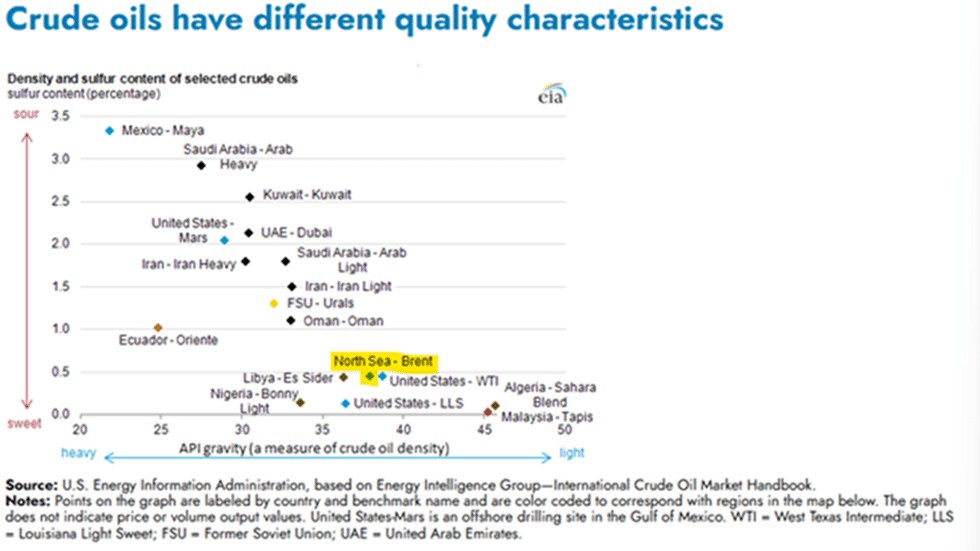
The refining industry in the UK mostly uses light sweet crudes, such as North Sea Brent Crude (sulphur content 0.37% and API gravity of 38.3), which is cheaper to refine, as it requires less desulphurisation and has a higher yield of premium products such as petrol, diesel, jet fuel and naphtha. Light sweet crudes sell at a premium to “bottom of the (distillation) barrel” heavy sour fuel oils.
In addition to petrol, diesel, jet fuel, shipping fuel, heating oil and kerosene, oil refineries produce the building blocks of industry and metropolitan life: asphalt, plastics, sulphur, ammonia used in fertilisers, rubber, chemicals, pharmaceuticals, bleaching agents and explosives. However, as UK crude oil production falls, oil refineries and related industries, such as petrochemicals, plastics and fertiliser production, are also closing.

The UK’s four remaining refineries have a combined capacity of approximately 1 million barrels per day, representing about two-thirds of the UK’s 2010 refining capacity. The UK’s average consumption of refined oil in 2024 was around 1.4 million barrels per day, so domestic production accounted for only 70% of that consumption.
Declining demand for products
At the industry’s peak, the UK had 18 refineries, but the recent closures of Grangemouth and the Lindsey refinery in 2025 leave just four. This is primarily due to overcapacity in Europe, falling domestic demand for refined oil and derived products and increasing environmental regulations and taxes. The drop in demand for oil-derived products is driven by a decline in UK manufacturing. For example, rubber is a derivative of oil refining and is used for hoses, seals, conveyor belts, vibration dampers, tyres, gaskets, washers, electrical insulation for wires, waterproofing membranes, insulation, flooring, medical tubing and gloves, and textiles. Many of these items are used in the production of machinery, appliances, and clothing, which have generally shifted to Asia. For example, the production of household appliances such as washing machines requires hoses, washers and door seals, but as appliance production has moved to Asia, UK demand for the rubber components has also diminished.
Closed Oil Refineries
The Grangemouth Refinery ceased crude processing in April 2025 and the Lindsey Oil Refinery in Lincolnshire is being sold to Phillips 66 Limited by its administrators, but it will not remain a stand-alone refinery. Together, they refined 260,000 barrels of crude per day, equal to about 22% of the UK’s total refining capacity of 1.2 million barrels. UK Consumption is approximately 1.35 million barrels per day; therefore, imports will need to increase by 260,000 barrels per day to offset the shortfall.
The impact of all this on employment is enormous. Closure of the Lindsey Refinery’s integration into the Humber refinery’s operation will result in 1,000 job losses, including employees, contractors and suppliers. Utilising data provided by Petroineos, PwC estimates that the Grangemouth Refinery employed 518 people (on a Full-Time Equivalent, or FTE, basis) in 2023. Whilst this represents only a small portion (0.5%) of the working-age population in the Falkirk council area (102,021 according to ONS), it comprises a set of relatively well-paid, skilled technical jobs. Refinery workers at Grangemouth earn £53,000 per year on average, significantly above the Scottish average of £35,000 for a full-time worker. Accounting for its supply chain and the spending of its employees in the wider economy, the Grangemouth Refinery supports 2,808 FTE jobs. PwC estimates that, in 2023, the Grangemouth Refinery provided £404 million in total GVA, of which £179 million is direct, £180 million is indirect and £44 million is induced. Of the refinery’s UK supply chain spend, 85% (i.e., £290 million) was in Scotland.
The Grangemouth refinery was established in 1924 and was among the UK’s first. In April 2025, it closed despite being Scotland’s only remaining oil refinery. The decision was apparently accelerated by the 2035 ban on the sale of petrol and diesel cars, even though oil has many other uses beyond vehicle fuels. Grangemouth was the only refinery connected to North Sea oil production via the Forties Pipeline System.
Although the Grangemouth refinery accounted for about 80% of Scotland’s fuel production and 65% of Scotland’s total oil products, it employed only 400 to 500 on-site workers, making the Grangemouth refinery one of the UK’s most efficient companies. Its closure will lower Scottish productivity.
An executive at Valero Energy Corporation, commenting on the recent closures of two UK refineries, remarked at an energy conference that once refineries have closed, restarting them would be very expensive: a new refinery would cost around $1 billion to build. Valero’s Pembroke refinery makes its own energy but still has to purchase emissions allowances, which are twice its labour costs. The company bought the Welsh refinery because of its access to plentiful supplies of Crude via the deep-water port at Milford Haven, which accommodates super tankers.
Crude oil is the largest input cost for refineries, and they cannot operate efficiently without a consistent, reliable supply. This is also the case for downstream products: ExxonMobil most likely decided to close its Ethylene plant at Mossmorran due to the planned closure of the Petroineos oil refinery at Grangemouth, which supplied Mossmorran’s feedstock.
Petrochemicals
Chemicals are the UK’s second most valuable goods export, after machinery and transport equipment. It is also the UK’s second-largest industry, comprising over 4,000 companies, employing 137,000 direct employees in 2023, generating £62 billion in turnover, £9.8 billion in research and development, and £7.2 billion in capital spending. The industry added over £30 billion to the UK’s GVA in 2023.
The chemicals employees earn, on average, 27% more than the UK average. It is difficult to imagine why any government would be trying to close this industry. We can only assume that the successive UK governments are doing this by accident rather than by design. Energy costs have not only increased the cost of industrial production in the UK but also the cost of domestic energy, thereby reducing consumers’ discretionary spending.
Brent Crude is a light, sweet oil with low sulphur content of only 0.37%, making it ideal for use in the petrochemical industry. Sulphur makes refining more expensive as it is considered a contaminant that must be removed before processing. High-sulphur oils burn less efficiently and produce more pollution. The New York Mercantile Exchange (“NYMEX”) classifies sweet crude as that with less than 0.5% sulphur. Most oil contains between 1% and 5% sulphur.
The key to lower costs in the petrochemical industry is determined by the cost of its feedstock, energy and the scale of production. The US shale boom has created the world’s cheapest ethane, up to 70% cheaper than European ethane, as well as ample supplies of natural gas. Trinidad and the Middle East also have large amounts of natural gas, often priced below EU and US market prices. While China uses very cheap syngas made from coal. The UK’s last remaining ethane cracker at Grangemouth predominantly uses imported US ethane rather than North Sea ethane or European naphtha. The Ethane is liquefied to -89 °C and transported to the UK on purpose-built very large ethane carriers (“VLECs”) designed specifically for INEOS. Despite this, it remains dramatically cheaper than European naphtha. INEOS Grangemouth also supplies raw materials to INEOS’ Olefins and Polymers Europe, a petrochemical and plastics plant, whose products range from construction materials to clothing.
The chemical operations at Grangemouth, Britain’s largest chemical plant, were also at serious risk of closure along with the refinery. Its owner, INEOS, has warned that high energy costs and carbon taxes have rendered the site uncompetitive relative to its US operations. In December 2025, the Government announced a £120 million support package to keep the facility in operation. Had the INEOS Grangemouth chemical operations closed, it would have resulted in an additional 900 direct job losses, with thousands more jobs lost indirectly. The 1,700-acre refinery, petrochemical and plastics site, Scotland’s largest industrial complex, directly employs 2,000 people plus up to 5,000 contractors across INEOS’ refinery and other businesses. The oil refinery has closed, but the petrochemical and plastics complex at Grangemouth remains operational thanks to the government support to secure the Grangemouth ethylene cracker. But a better solution may have been to review the Government’s decision to prevent any new gas permits in the North Sea and the requirement for the plant to invest in converting North Sea gas into hydrogen
According to a report by the Chemical Industries Association (“CIA”), 25 sites have closed over the past 5 years, resulting in a 40% reduction in UK chemical production. The CIA survey showed that in the last quarter of 2025, 38% of companies reported a decrease in employee numbers, 37% reported a decrease in sales and 87% expected weak business in 2026. The Chief Executive of the Association, Steve Elliott, stated that this is a consequence of the UK’s pursuit of Net Zero on a timeline out of step with industry’s international competitors.
Ethylene Production
Ethylene is the largest‑volume petrochemical globally, with over 200 million tonnes produced each year. Ethylene is essentially the “building block” of modern materials. It is the foundation material for plastics, chemicals and everyday products. Major uses include: polyethene plastics (bags, films, bottles, pipes); vinyl chloride used to produce PVC; ethylene oxide used to produce detergents, antifreeze and solvents; polyester precursors used to produce textiles and fibres; medical supplies and packaging; and, Industrial chemicals used across manufacturing.
In November 2025, ExxonMobil announced it would close its ethylene plant at Mossmorran in Fife, Scotland, in February 2026. A total of 179 directly employed jobs will be at risk, along with 250 contractor positions and up to 50 employees will be transferred to the Fawley Petrochemical Complex in Hampshire, approximately 500 miles away. Most people may have shrugged at this news, not knowing what ethylene is or why it matters to their lives.
In the UK, ethylene has been traditionally produced by steam cracking naphtha. Naphtha is extracted during crude oil distillation to produce petrol, diesel and kerosene. Naphtha boils between 30°C and 180°C and is one of the first major fractions removed in crude oil refining. Production is generally continuous to supply inputs to downstream petrochemical plants.
It is cheaper to produce ethylene from steam cracking ethane, a by-product of US shale gas production. The plentiful supply of cheaper ethane from fracking has shifted US ethylene feedstocks from 40% Naphtha and 28% ethane in 2005, to 7% naphtha and 61% ethane in 2015. However, among crude oils, Brent Crude is well-suited to naphtha production because of its low sulphur content and because light crudes produce more naphtha than heavy crudes.
Ethylene supply and use in the UK
The UK had three primary ethylene production centres, but now it has only one: the INEOS Grangemouth Ethylene Plant, which was due to close in February 2026 but received a last-minute support package – £120 million from the government and £30 million from the site’s owner, INEOS, on 17 December 2025. It is now the only ethylene producer left in the UK. The Fife Ethylene Plant at Mossmorran closed in February 2026. While the Wilton plant has been offline since 2020 and its owners, SABIC UK Petrochemicals, announced in June 2025 that it will remain closed.
Ethylene feedstock is used by factories that produce: polyethene plastics used to make containers, packaging films, bottles and plastic pipes for construction; Ethylene oxide and ethylene glycol used in antifreeze, PET bottles and Polyester fibres; vinylchloride monomer and PVC which is used in pipes, cable insulation and window frames; ethylbenzene and styrene used in polystyrene for packaging and ABS plastics; and, synthetic ethanol used in solvents and chemical intermediates.
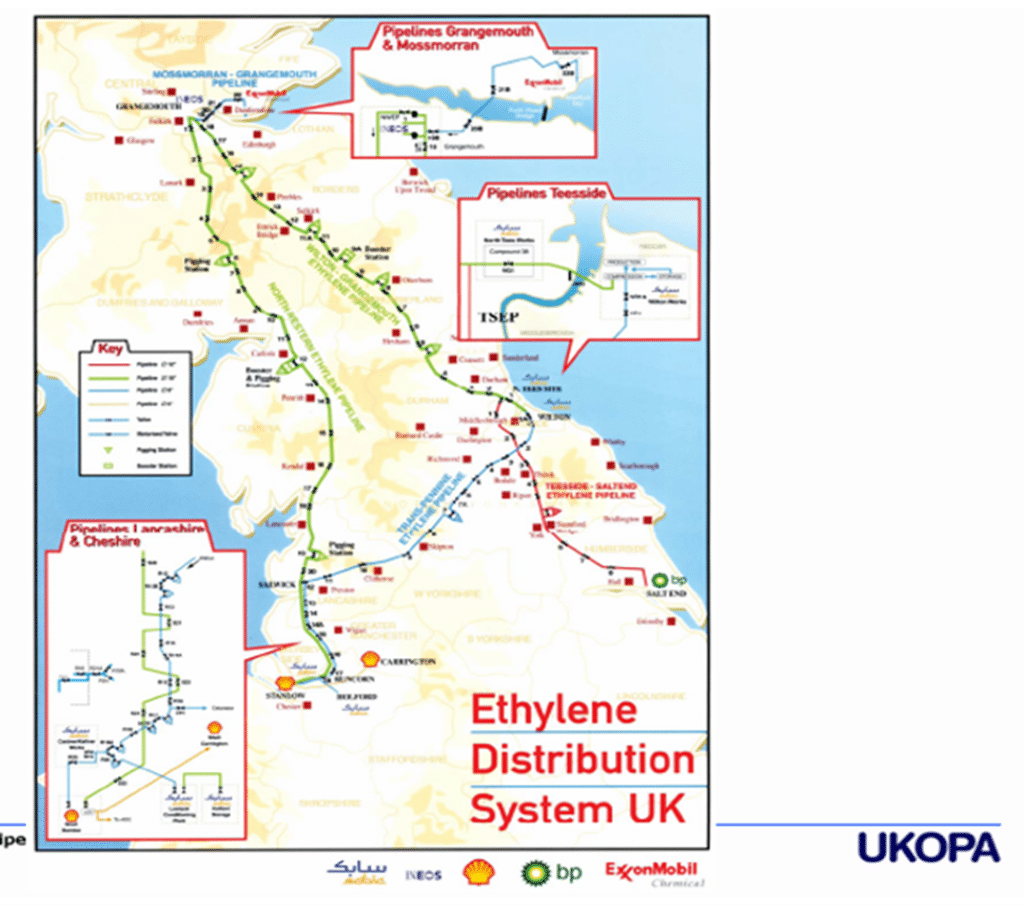
The UK has an ethylene pipeline network, shown in Figure 17 below, which was specifically built to connect ethylene production centres with UK manufacturers that convert ethylene into plastics and other chemicals. The UK’s ethylene pipeline distributes ethylene to manufacturers at Grangemouth, Wilton, Stanlow, Runcorn, Carrington, Saltend and Hull, and to bulk storage sites at Wilton and Holford. The pipeline is the most effective means of transporting ethylene across the country. It avoids the additional energy required to liquefy it (-103°C), the hazards of road or sea transport, and the hazards of loading and offloading. It was originally constructed by ICI (Imperial Chemical Industries) in 1966/7 and was later extended and upgraded.
Ethylene glycol and polymers
The UK still makes a small amount of ethylene glycol. Producing 660,000 kg in 2023, which is expected to increase to 760,000 kg by 2028. Ethylene glycol is made from ethylene oxide, which in turn comes from ethylene. It is used to make polyester (PET), hydraulic fluids, antifreeze and coolants. The UK still makes some polymers, but it imports most of the monomers needed to make polymers.
The UK’s chemical graveyard
Why can’t the UK compete in chemical production? Primarily, UK Crackers are smaller and older than those in the US, and there is no financial incentive for UK chemical companies to invest in new facilities. The unavoidable fact is that the UK government is doing everything in its power to shut down oil and gas production, thereby making oil and gas derivatives more expensive and globally uncompetitive: it has put a moratorium on fracking in the UK, prevented new North Sea gas fields from going into production, imposed 78% direct taxes on oil and gas company profits, made it difficult to obtain permission for new gas fields, introduced CPS on the use of natural gas, ETS allowances and environmental permitting, and has not created a surplus of Natural Gas Liquids (“NGLs”) including ethane, propane, butane, isobutane and pentane.
International competition undermines UK pigment production
Venator Materials UK, a chemical manufacturer operating from Greatham, Wynyard and Birtley, entered administration in September 2025. A Chinese company, LB Group Co., Ltd., signed an Asset Purchase Agreement with Venator Materials UK Ltd on 16 October 2025 to acquire the Greatham Titanium Dioxide (TiO₂) manufacturing site and associated pigment assets. Completion of the sale still requires regulatory approvals, which are standard for cross‑border industrial asset sales.
Venator’s UK operations at Wynyard and Greatham employed about 800 people. Venator was one of the world’s major producers of TiO2 used in paints, plastics, coatings and cosmetics. The Greatham site was one of the largest TiO2 plants in Europe, and Venator was one of Teesside’s largest private-sector employers, having acquired ICI’s pigments business from Huntsman Corporation in 2017 through debt issuance. More than 270 workers at Greatham were made redundant as the plant was mothballed before a sale bid, with 232 workers retained to assist with the administration process.
The UK’s high natural gas and energy costs, and carbon-emission allowances, have made UK TiO2 plants uncompetitive relative to those in the US and Asia. The Greatham plant still uses the Sulphate process to produce TiO2, which is more polluting and energy-intensive than the alternative Chloride process. However, it can use low-grade ilmenite as a feedstock, unlike the Chloride process, which requires more expensive high-grade rutile.
The Sulphate process is energy-intensive, requiring temperatures above 1000 °C in large rotary kilns for calcination and waste treatment. The Greatham plant has to purchase UK carbon allowances (ETS) for its hydrocarbon combustion, process emissions and waste-acid treatment. As an Energy-Intensive Industry (“EII”), it received free allowances for some of these emissions but the remainder had to be purchased at market rates. As an EII, Greatham also received a 90% discount on the Climate Change Levy (“CCL”) and was compensated for carbon costs in its electricity costs, but these discounts accounted for only a small share of its total energy costs. The Sulphate process produces about 6 tonnes of CO2 per tonne of TiO2, from fuel, electricity, process emissions and waste treatment. This is roughly double the chloride process.
The Graham plant also incurred significant compliance costs of £10 to £20 million per year to obtain water discharge permits; the UK requires continuous emissions monitoring (“CEMS”) and mandatory reporting. The sulphate process produces sulphate-rich wastewater that must be neutralised with iron sulphate crystallisation before discharge into local waterways. Water treatment costs £100 to £300 per tonne of TiO2. The company had to comply with the UK’s hazardous waste regulations to dispose of its iron sulphate heptahydrate and acidic sludge. The site was required to comply with the UK’s Control of Major Accident Hazards Regulations because it handled concentrated sulfuric acid. In addition, the plant had to comply with the EU Industrial Emissions Directive (“IED”), which sets strict limits on emissions to air, water and land, as well as on other waste.
Chinese TiO2 producers operate under much weaker carbon-pricing and environmental compliance pressures than UK or EU plants. China’s carbon taxes do not apply to industrial process emissions, and its electricity producers pay less than £10 per tonne of CO2. This has allowed them to undercut European plants, such as Greatham. Chinese TiO2 capacity and production have expanded substantially in recent years, with domestic output accounting for nearly 70% of the global total by 2024, leading to multiple anti-dumping investigations by the EU, Brazil and India.
It is unsurprising that the LB Group UK Ltd, based in Jiaozuo, China, has signed a purchase agreement for the Greatham plant. LB Group is the world’s largest producer of TiO2 pigment with a 1.5 Mtpy capacity – accounting for 15% of global output. Its market dominance is a result of China’s low energy costs and lax environmental regulations.
The Venator story is illustrative of how Britain’s self-harming high energy cost can not only close businesses and put British industrial capacity at risk but also lead to the loss of vital British intellectual property.
Plastics
The UK plastics industry is a global leader operating at the cutting edge of technology and constitutes an important UK economic strength. It has an annual turnover of over £32.8 billion and employs approximately 160,000 directly, and a further 400,000 through indirect jobs. There are 5,700 companies in the UK plastics industry. Plastics are one of the UK’s largest exports. In 2025, the UK exported plastics in primary forms worth £3 billion and plastics in non-primary forms with £3.3 billion.
The industry is a dominant player worldwide across the three core sectors of the plastics industry: material and additive manufacturers, material processors and machinery manufacturers/suppliers. The industry processes 3.5 tonnes of material to produce 1.8 million tonnes of plastic materials.
Hydrocarbon feed stocks, ethane, propane, naphtha and gas oil are heated to 750 to 900ºC in a steam cracker fuelled by natural gas to produce ethylene, propylene, butadiene and benzene. These products are then chemically linked to form polymers such as polyethene, polypropylene, PVC, PET, PS, ABS, SAN and polyurethane.
Clothing textiles account for 35% to 40% of total global plastic production. Polyester (PET) alone is 59% of all fibres and is used in fleece, for linings and fast fashion. Elastane (Spandex and Lycra) is used to make sportswear, leggings and tights. While Polyurethane (“PU”) is used to make shoe soles and synthetic leather, EVA is used to make running shoe midsoles and flip-flops, rubber is used to make outsoles, and PVC is used for waterproof footwear. The UK no longer produces textiles for the mass clothing market, but it does produce nylon fibres used in aerospace composites, defence textiles and industrial fabrics.
INEOS Acetyls, Hull
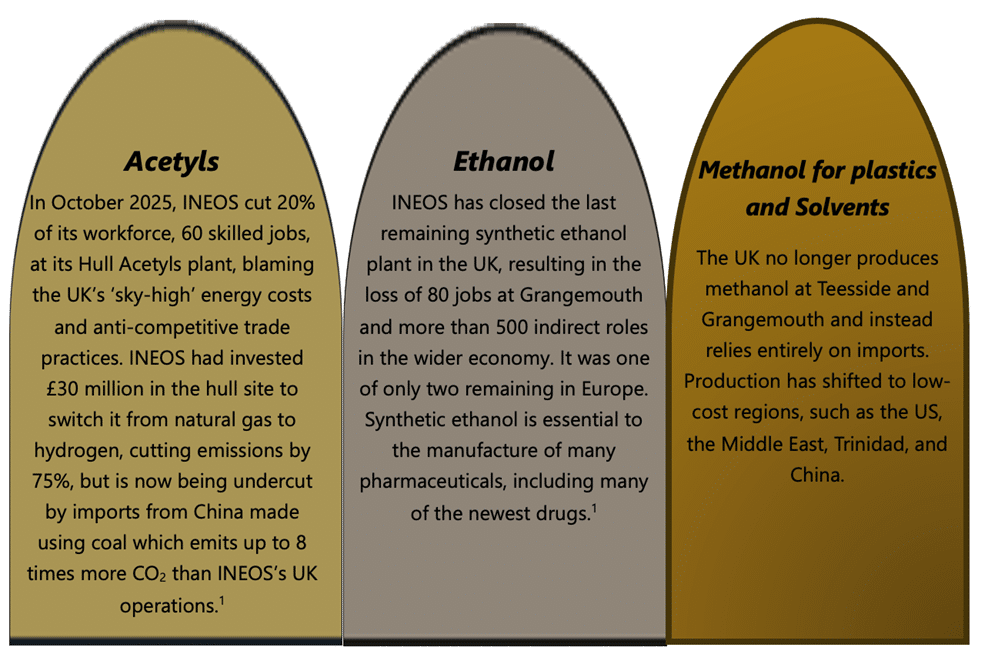
In October 2025, INEOS announced it was cutting 20% of the workforce – 60 skilled jobs – at its Acetyls plant in Hull. The reason cited was “soaring energy costs and anti-competitive trade practices, as importers ‘dump’ product into the UK and European markets.”
INEOS has invested £30 million at the Hull site to switch from natural gas to hydrogen, cutting emissions by 75%, equivalent to taking 160,000 cars off the road. Despite this investment, INEOS now warns that without tariffs to protect sites like Hull, such progress will come at the cost of British jobs.
INEOS is the largest producer of acetic acid, acetic anhydride and ethyl acetate in the UK and Europe. These chemicals are essential for everything from food preservation and pharmaceuticals, including aspirin and paracetamol, to diagnostic tests, adhesives and industrial coatings. Without them, modern life doesn’t function.
INEOS blamed “dirt-cheap carbon-heavy imports from China, produced using coal and emitting up to eight times more CO₂ than INEOS’s UK operations.” It has warned that, unless such action is taken, more production facilities will close and thousands more jobs will be lost in Hull and across the UK chemical industry.
Pharmaceutical and healthcare petrochemicals
Petrochemicals are used in the production of many common pharmaceuticals, such as antibiotics and aspirin, as well as in their coatings, capsules, stabilisers and packaging. The UK still produces some of the key petrochemicals used in pharmaceutical production, including ethylene, propylene, aromatics and other petrochemical intermediates derived from crude oil or natural gas via refineries and crackers. Pharmaceutical plants are heavy users of process heat, steam and electricity, much of which comes from oil and gas. But the UK imports many other feedstocks, such as methanol and ethylene glycol, as well as importing 50% of its gas and 34% of its oil.
Petrochemicals are also used in the production of healthcare equipment, including protective clothing and gloves, syringes, IV bags, tubing, packaging, surgical instruments, sterilisation wraps, blister packs for pills, glues, adhesive tapes and sutures.
The pharmaceutical and life sciences industry is a massive business for the UK. Adding £17.6 billion in GVA in 2021, according to the Association of the British Pharmaceutical Industry. In 2023/24, there were 6,170 businesses, employing 359,600 people and generating a turnover of £146.9 billion. Biopharmaceuticals account for 40% of companies, 45% of employment and 67% of turnover.
Although the UK pharmaceutical industry is structurally dependent on oil- and gas-derived feedstocks and energy, it is only marginally reliant on domestic refining capacity. Further closure of UK refineries would increase import dependence but not necessarily halt pharmaceutical production. However, the combination of reduced feedstock supplies, high industrial energy costs and high UK wages and taxation may be enough to drive the industry out of the UK.
Petrol and Diesel
Finally, petrol and diesel: 45% to 55% of all refined oil in the UK is turned into road fuels. According to Fuels Industry UK, UK refineries produce more petrol than the UK consumes, but less diesel than the UK requires, so the UK exports petrol and imports Diesel. While only 40% of UK cars run on diesel, 95% of vans and buses, and 99% of Trucks and machinery do. Despite the subsidies and mandates, at the end of Dec 2024, of the 41.7 million licensed vehicles in the UK, less than 1.4 million were zero-emission vehicles (“ZEV”), of which 1.3 million were ZEV cars.
North Sea crudes tend to be light sweet crudes that are more suited to petrol, diesel, jet fuel and naphtha production. UK refineries were mainly built between 1950 and 1970 when most vehicles in the UK ran on petrol. Now, diesel demand is higher as car owners were encouraged to switch to diesel in the early 2000s to lower CO2 emissions, and larger trucks, machinery and farm equipment all run on diesel. But UK refineries are geared towards producing petrol and jet fuel, while those on the continent produce more diesel, as demand for it is greater there. There is also less demand for naphtha as it is being replaced by cheaper ethane, a byproduct of US shale gas.
Refineries purchase different grades of oil based on price, availability, transport costs, product demand and their refinery configuration. But that doesn’t mean that once the crude oil reaches a Dutch, German or Scandinavian refinery, the UK market will never see it again. The UK remains a major customer for European refined oil products, especially diesel. Two of Europe’s largest refineries are in Rotterdam: one is owned by Shell and the other by BP. Neither company has a refinery in the UK. This explains why UK trade with the Netherlands appears disproportionately high given their population sizes: we export crude oil to them and then import refined products, such as diesel, back.
About The Great British Business Council
The Great British Business Council (“GBBC”) was established to enhance public and political understanding of the advantages a thriving business community provides to local security, standard of living and wellbeing. It aims to support British firms and small businesses by promoting well-crafted, practical, evidence-based policy reforms that foster enterprise and innovation. It is independent of any political party, as it hopes that all parties will consider adopting the straightforward, practical policy suggestions it proposes.
The GBBC is funded by private donations from concerned citizens who want the UK to thrive economically as it once did. If you would like to join us or donate to their cause, please contact in**@**BC.UK or follow them on LinkedIn, X (Twitter), Facebook, YouTube, TikTok and Bluesky.
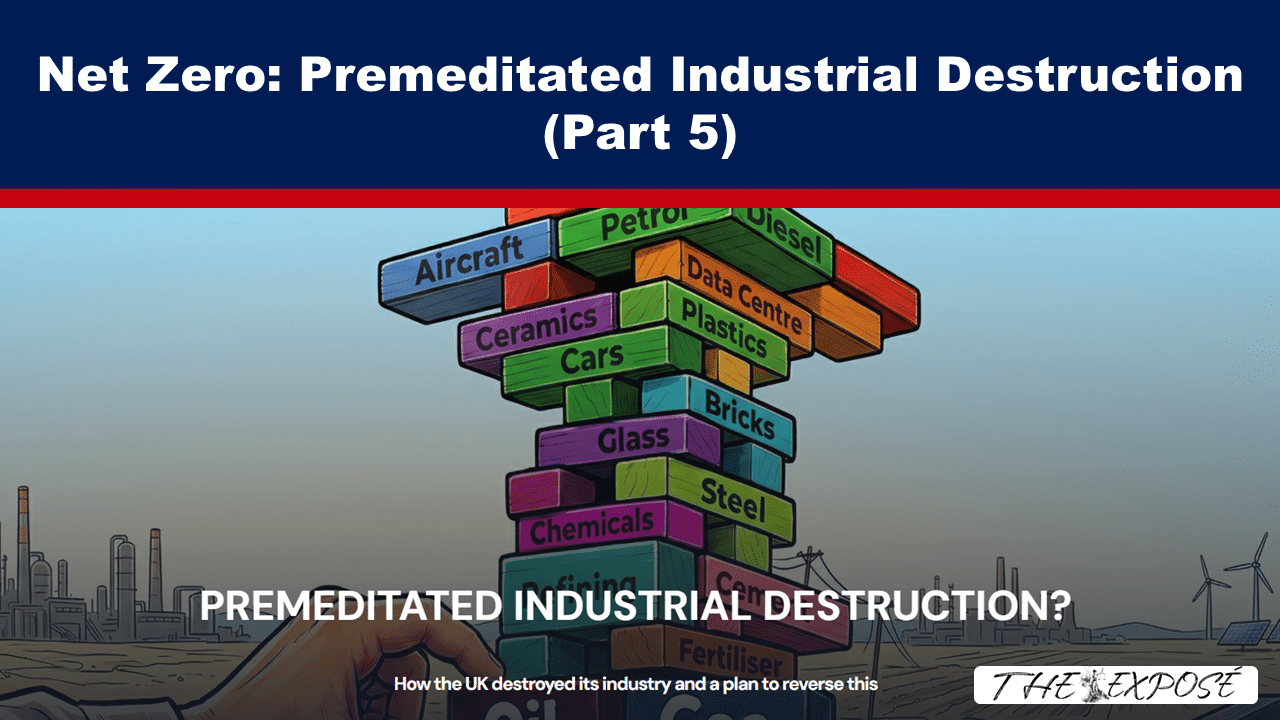
Featured image: Cover of the GBBC paper, ‘Premeditated Industrial Destruction: How the UK Destroyed Its Industry and A Plan To Reverse This’
The Expose Urgently Needs Your Help…
Can you please help to keep the lights on with The Expose’s honest, reliable, powerful and truthful journalism?
Your Government & Big Tech organisations
try to silence & shut down The Expose.
So we need your help to ensure
we can continue to bring you the
facts the mainstream refuses to.
The government does not fund us
to publish lies and propaganda on their
behalf like the Mainstream Media.
Instead, we rely solely on your support. So
please support us in our efforts to bring
you honest, reliable, investigative journalism
today. It’s secure, quick and easy.
Please choose your preferred method below to show your support.

Categories: Breaking News, UK News