





The UK government is mandating the fortification of non-wholemeal wheat flour with folic acid.
The legislation was passed in 2024. Since then, the UK flour milling sector has been working to implement it. The deadline for millers to comply is 13 December 2026. It applies to millers who produce more than 500 tonnes of flour per year.
They claim the policy is safe. However, analysis of studies on cancer incidents following folic acid intake shows that there is an 18-23% increase in cancer at the folic acid dose that would result from the fortification of flour as stipulated by the Government.
Prostate cancer is of particular concern, Dr. Clare Craig warns.
Let’s not lose touch…Your Government and Big Tech are actively trying to censor the information reported by The Exposé to serve their own needs. Subscribe to our emails now to make sure you receive the latest uncensored news in your inbox…
Folic Acid and Cancer: The Safety Studies Do Not Show What Is Claimed
By Dr. Clare Craig, as published by Health ethics Advocacy and Research Team (“HART”) 19 July 2026
Why Cancer Is The Question
Folic acid forms the building blocks of DNA and drives cell division. Early embryos have cells dividing at enormous speed and they need a ready supply. Anything that helps cell division presents a hypothetical risk for people with cancer and also for the initiation of cancer in healthy people. Consequently, studies have been carried out to try and measure where that hypothetical concern is present in reality.
Measuring the Harm
The strongest test for harm is a randomised controlled trial, in which people are assigned by the toss of a coin to receive either the treatment or a placebo and are then followed up to see what happens. In 2013, researchers pooled every large folic acid trial, involving around fifty thousand people, into one analysis in The Lancet. They reported no significant effect on cancer. That result became the basis of the official safety verdict.
A year earlier, a separate, more careful review split the same trials by dose given. It found an increase in cancer in the trials using lower doses, close to the amount fortification delivers, but none in the trials using much higher doses.
That headline, a six per cent increase reported as no significant effect, is an average across every dose the trials used. Split the trials into three dose groups, on both the published figures and the patient-level data behind the 2013 analysis, and the average comes apart.
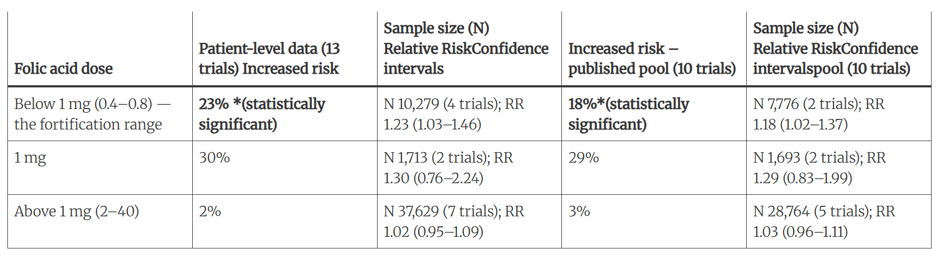
The increase is seen at the exact range that fortifying flour will deliver. That is the reverse of how a drug normally behaves, since a larger dose would usually carry more risk, not less. The result below 1 milligram is the same even if the single polyp-prevention trial that critics single out is excluded and it is seen in ordinary adults rather than just in high-risk groups.
Prostate cancer in particular is a concern. In one trial, men given 1 milligram of folic acid a day were diagnosed with prostate cancer at 2.6 times the rate of those on a placebo, a ten-year risk of 9.7 per cent against 3.3 per cent. The trial had been designed to study bowel polyps rather than the prostate. Sixteen years later, there have still been no further trials to measure this properly. Instead, researchers re-examined the data from the other folic acid trials already run. Pooled together, six trials covering around 25,000 men showed a 24 per cent increase in prostate cancer among the men given folic acid (relative risk 1.24, 95 per cent confidence interval 1.03 to 1.49). A reanalysis at a case level claimed there was no signal but they specifically excluded dosages within the fortification range. Folate obtained from food carried no such risk, which points to the synthetic form rather than the vitamin as it occurs in the diet.
What Fortification Delivers
Under the new UK regulations, flour must carry 250 microgrammes of folic acid per 100 grammes. This works out at about 188 microgrammes once processing losses are allowed for. Government modelling puts the extra intake for an average woman of childbearing age at roughly 90 microgrammes a day, which on its own looks modest. The implication would be that a woman’s wheat intake each day would not exceed either two thin slices of bread or a quarter of a pizza. However, this is clearly diet-dependent. It is easy for a carbohydrate-heavy diet to quickly breach safe levels, as shown in the table.
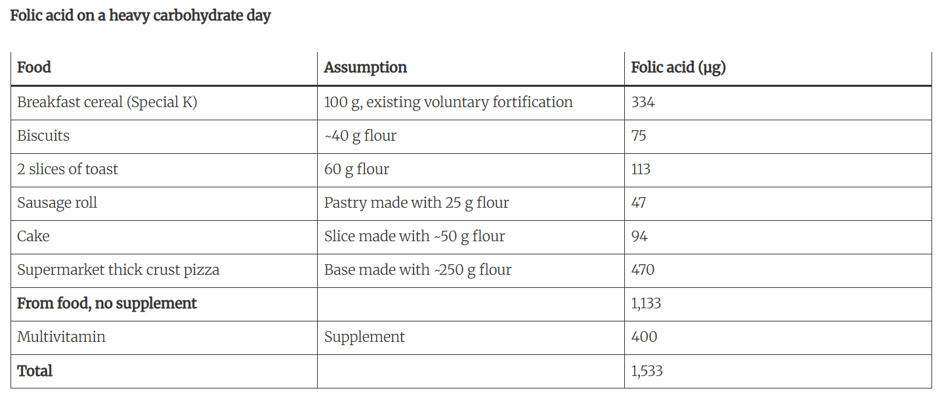
Women planning a pregnancy are still advised to take a 400 microgramme supplement; many breakfast cereals are already fortified and heavy wheat eaters will take in more than the average. The government estimates that between 225,000 and 400,000 people will, once their annual intake is considered, have on average exceeded the upper limit every day. Many more will have exceeded it on some days. The government also admits that even before fortification, 72,000 primary school children already exceed the limit on folic acid intake largely from breakfast cereals. They did not estimate what proportion of children would breach the upper limit after fortification, and there are no studies to say whether the “upper limit” is safe anyway in children. It is just a guess.
Why The Signal Is More Likely Understated
Every feature of the cancer trials limited the detection of any potential safety signal.
| Feature of the trials | What it does to the result |
| Most ran only about 5 years | Misses cancers that take longer to appear; the 2013 authors said their work could not address later cancers or later effects in younger people. |
| Two Norwegian trials, followed for cancer for about six and a half years, well after treatment ended. | Found significantly more cancer and more deaths, including deaths from cancer, in a country that does not fortify its flour. (The study was in heart patients). |
| Many run in the US and Canada where background fortification dampens any signal | Where the placebo group ate folic acid too the trial was comparing folic acid with slightly more folic acid, which blurs any difference |
| Conducted in patients who were already ill | Heart, kidney and bowel-growth patients, not the healthy adults, children and non-pregnant people that fortification will reach |
Given the inadequacy of the current evidence, perhaps the government should run one before spending money on an intervention that would make safety studies hard to carry out and expose the whole population to any potential risk.
What It Means
The claim that the existing studies show the policy to be safe is false. They do not. Once the dosage is considered, there is a detectable increase in cancer at the exact dose that would result from fortification. This pattern was found independently by two teams, even in trials too short to capture a delayed effect. At fortification doses the harm is clearly seen with longer follow-up.
The burden of proof is the point. Fortification is not a pill that a person chooses to take. It is added to a staple food and eaten, unavoidably and for a lifetime, by a whole population, most of whom gain nothing from it. For an exposure that broad and that involuntary, the standard should be a positive demonstration of benefit for all as well as safety. The safety studies have been inadequate but even they, at the dose fortification will use, point towards harm.
Don’t forget the government petition HERE, which is halfway to getting a parliamentary debate.
See also previous HART articles on folic acid here:
- Six Saved Babies. What About the Seventy Who Died?
- What you need to know about Folic Acid Part One: The Deficiency That Wasn’t
- What you need to know about Folic Acid Part Two: How 100 microgram Became 400
- What you need to know about Folic Acid Part Three: Folic Acid Is Not Folate
- Support debate on folic acid in flour
- Some people should avoid folic acid but how?
- Why can’t Public Health U-turn?
- The NHS’s folic acid rewrite – What an FOI revealed
- Reality behind the claim folic acid could “save 200 babies”
- Australia added folic acid to flour in 2009 then went silent about the results
About the Author
Dr. Clare Craig is a British Diagnostic Pathologist and medical researcher who worked in the NHS for 15 years before becoming a Consultant Pathologist in 2009. She is best known for her covid-19 research. She has worked pro bono since May 2020 to analyse covid pandemic data and distil evidence for lay audiences.
She is the author of two books: ‘Expired: Covid the untold story’ (2023) and ‘Spiked: A shot in the dark’ (2025).
Since January 2021, she has co-chaired the Health ethics Advisory and Research Team (“HART”) with Dr. Jonathan Engler, providing independent expert information on covid issues. She contributes to HART in a personal capacity.
The Expose Urgently Needs Your Help…
Can you please help to keep the lights on with The Expose’s honest, reliable, powerful and truthful journalism?
Your Government & Big Tech organisations
try to silence & shut down The Expose.
So we need your help to ensure
we can continue to bring you the
facts the mainstream refuses to.
The government does not fund us
to publish lies and propaganda on their
behalf like the Mainstream Media.
Instead, we rely solely on your support. So
please support us in our efforts to bring
you honest, reliable, investigative journalism
today. It’s secure, quick and easy.
Please choose your preferred method below to show your support.

Categories: Breaking News, Latest News, UK News
Pregnant women are told to take folic acid when the correct advice should be to make sure they have enough folate in the diet.
I agree they should not add folic acid to bread and baked goods. I live on bread because I have went off my food. I tried to take a folic acid supplement and felt very ill with it. I had no idea they were adding it to bakery as well.
Hi rachel469, they are adding folic acid to white flour. All products that use white flour as an ingredient will therefore have this additive, even home baked food (if the flour you purchase comes from one of the large millers).
As I understand it, it is the SYNTHETIC folic acid that is causing the problems, not the natural ‘folic acid’ which is known as natural folate.
Don’t put folic acid in flour. The brain blood barrier will block it, and naturally derived folic acid too, which the brain needs.