





Jessica Rose fact checks The New York Times’ recent article claiming that covid vaccines do not cause miscarriages when given during pregnancy.
“It is an entirely uninformed piece of writing, and it is misleading,” she writes.
Let’s not lose touch…Your Government and Big Tech are actively trying to censor the information reported by The Exposé to serve their own needs. Subscribe to our emails now to make sure you receive the latest uncensored news in your inbox…
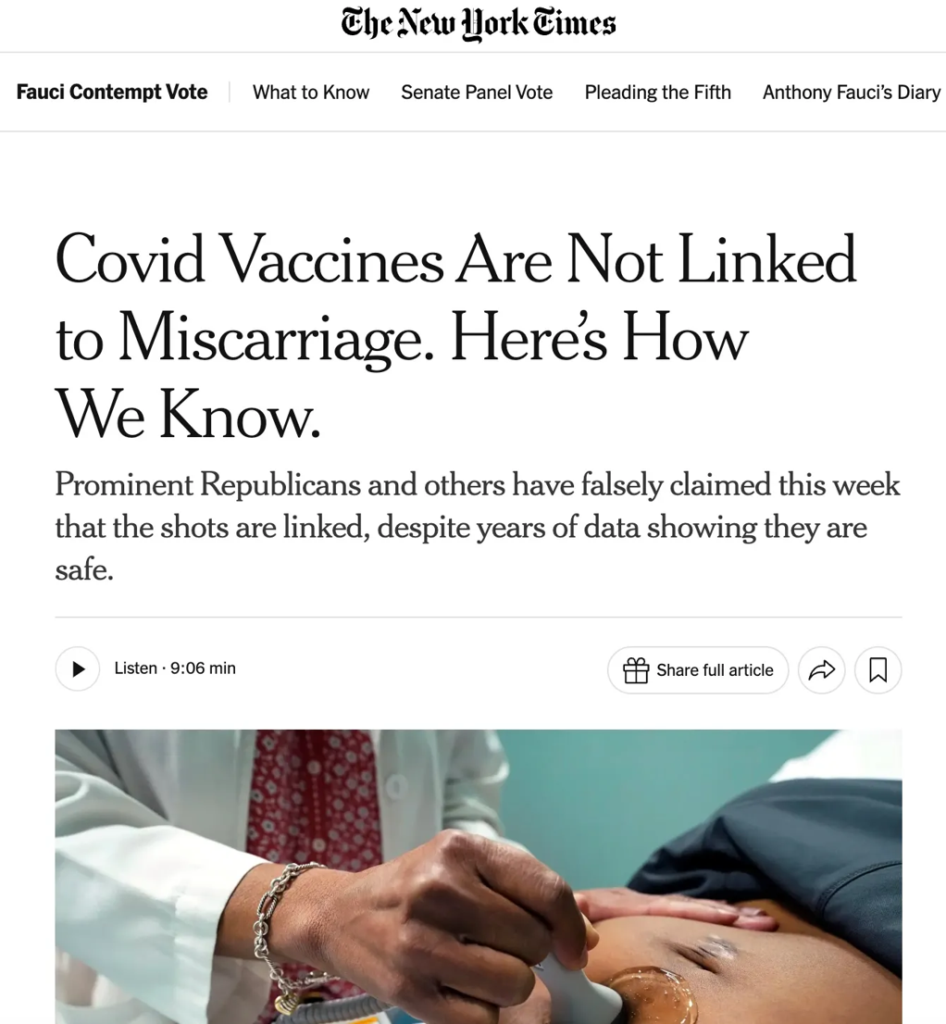
Misleading article by the New York Times: ‘Covid Vaccines Are Not Linked to Miscarriage. Here’s How We Know’
By Jessica Rose, 14 August 2021
A new York Times (“NYT”) article entitled ‘Covid Vaccines Are Not Linked to Miscarriage. Here’s How We Know’, by Maggie Astor and Roni Caryn Rabin, published on 13 August 2026 is misleading in its framing, selective in what it emphasises and incomplete on the biology and the actual content of the Fauci texts.
Here is a point-by-point breakdown of the problems with this article, grounded in the Fauci texts, the PubMed/PMC review cited HERE, and the article’s own wording.
1. The headline and lead frame legitimate discussion of the texts as “false claims”
The article opens: “Prominent Republicans and others have falsely claimed this week that the shots are linked, despite years of data showing they are safe.” It says officials “falsely suggested” a link by “seizing misleadingly on old text messages.”
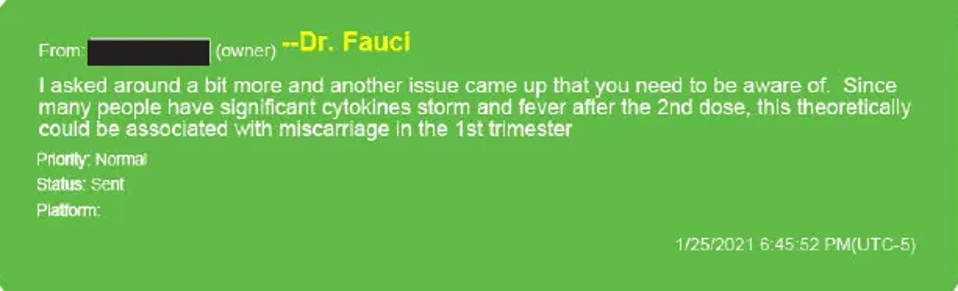
Reality check: The released texts show Fauci himself writing (25 January 2021) that because many people experience “significant cytokines storm and fever after the 2nd dose, this theoretically could be associated with miscarriage in the 1st trimester.” Walensky called it “Definitely a good point, esp. after dose two.” Murthy agreed it was “a really good point.” That is not a Republican invention; it is Fauci’s own language. Calling attention to a private theoretical warning that was not highlighted publicly is not inherently “false.” The article’s language collapses any discussion of those texts into “false claims that the shots are linked,” which is a straw man when the texts themselves raise the theoretical association via cytokine response.
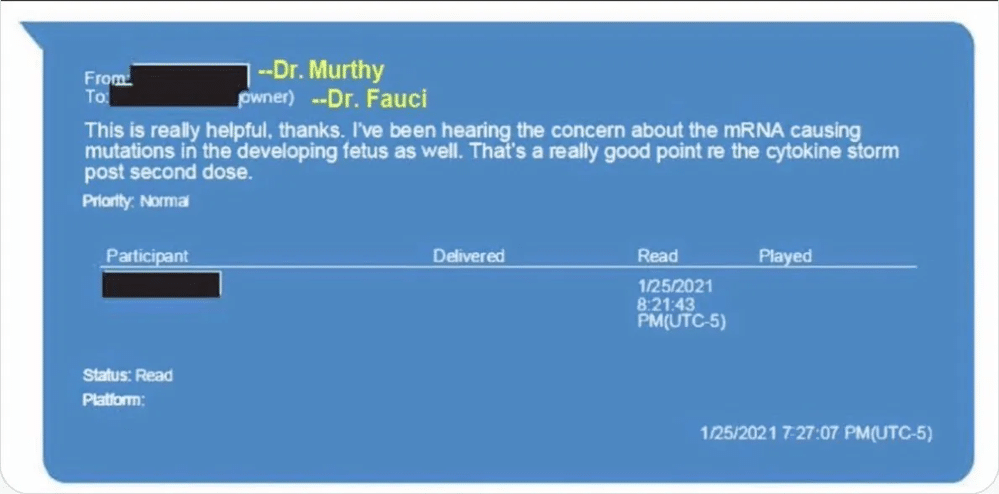
2. The article soft-pedals the content and context of the texts
It describes the January 2021 discussion as covering “the limitations of the data then available … as well as the theoretical risks for pregnant women based on information available at the time.”
This is incomplete.
Fauci first said there was “no data or theoretical reason” to prefer early vs. later vaccination, then followed up after “ask[ing] around a bit more” with the specific cytokine-storm/fever → first-trimester miscarriage concern. The NYT article never quotes or engages that precise language. It also notes that the conversations “were not public” while claiming officials “did not hide the uncertainty.”
Public messaging around the same period emphasised “no red flags” among the early vaccinated pregnant women and moved toward stronger recommendations.
Read more:
- 31% of women who were exposed to COVID-19 products prior to pregnancy experienced a miscarriage according to VAERS domestic data, Jessica Rose, 12 November 2023
- Another inexplicable FOIA request response, Jessica Rose, 18 March 2022
A private flag of a mechanistic concern based on known reactogenicity is newsworthy precisely because it was not the public emphasis. Omitting the specific wording makes the texts sound more anodyne than they were.
3. It ignores the established reproductive immunology that makes the theoretical concern non-frivolous
My X thread and the linked review (‘The Update Immune-Regulatory Role of Pro- and Anti-Inflammatory Cytokines in Recurrent Pregnancy Losses’, published in the International Journal of Molecular Sciences in 2022), document that an adverse (excessively pro-inflammatory) cytokine milieu at the maternal-foetal interface can assault immunological tolerance and lead to foetal rejection or miscarriage. This is a well-studied and published phenomenon. Mechanisms include disruption of the required Th2/Treg-favouring balance, effects on trophoblast/placenta, impaired blood supply and related pathways.
Prolonged or overexposure to pro-inflammatory cytokines is described as potentially harmful to pregnancy.
An exhaustive list of studies exists that consistently support that a shift toward pro-inflammatory cytokines disrupts the Th2/Treg-dominant tolerance needed for pregnancy maintenance.1,2,3,4,5,6,7,8,9,10
The NYT piece never engages this biology. It treats the “theoretical risks” as something that was later simply disproven by epidemiology, without acknowledging that cytokine storms or fever are not biologically inert in early pregnancy.
Large observational studies can constrain average risk without rendering the known mechanism of cytokine imbalance in recurrent pregnancy loss irrelevant for individual susceptibility or for why a senior official would flag dose-2 reactogenicity. Presenting the science as a pure “no link/question answered” binary is incomplete.
4. Overstatement of what the observational data prove
The article cites British meta-analyses (2022 ~118k, 2023 ~150k), a Vaccine Safety Datalink study (~113k), a Scottish study and a CDC pregnancy registry analysis, stating they show vaccination “is not linked to an increased risk of miscarriage, stillbirth or preterm birth.” It quotes “experts” that the question “has been answered many times over” and calls this “one of the most studied interventions.”
The NYT piece correctly notes the studies are mostly observational (not randomised assignment during pregnancy) and therefore “can’t prove cause and effect,” yet it still presents the volume and consistency as decisive.
Problems with relying on observational data: Early 2021 data were sparse precisely because pregnant women were excluded from initial trials – for a good reason.
Read more: ‘Exposure’ during pregnancy…, Jessica Rose, 13 December 2022
Later studies have limitations common to observational work (confounding by indication, healthy-vaccinee effects, incomplete ascertainment of early losses, timing of vaccination relative to gestational age, etc.).
“No signal detected in these datasets” is not identical to “zero biological possibility in any individual via the cytokine pathway Fauci and the reproductive-immunology literature both reference.”
The article leans hard on the former while treating any residual concern as falsehood.
5. Incorrect debunking of the 82% figure is used to dismiss broader points
The authors claim that the 82% figure is a distorted reading of the early NEJM/V-safe analysis that restricted the denominator to the small number of already-completed early pregnancies while most women vaccinated in the first/second trimester were still pregnant.
The NEJM was forced to publicly correct their mistake based on the use of an inappropriate denominator that changed the reporting frequency of miscarriages from 12.6% to 83% when this correction was made.
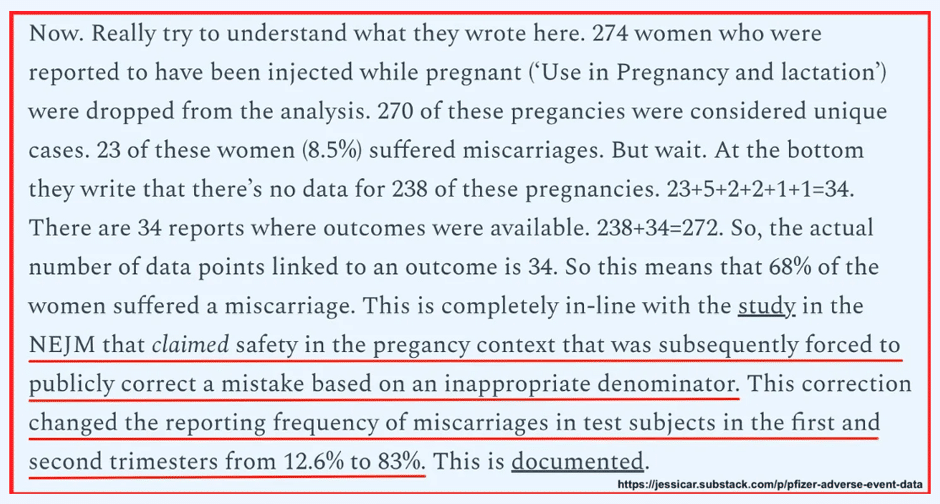
Nonetheless, the focus of the NYT article should have been on the known cytokine mechanism and the private warning, not on defending the 16.2% calculation. The NYT piece uses the debunking of that specific bad statistic as part of a broader dismissal of “false claims” tied to the texts. This is a classic motte-and-bailey fallacy: defend the easy target (82%) while the harder target (private theoretical concern grounded in known biology and public reassurance) receives less scrutiny.
6. Asymmetry in risk discussion
The article details the risks of covid-19 infection in pregnancy (higher hospitalisation, ICU, death, perinatal mortality) and the physiological reasons pregnant women are vulnerable. Those risks were real. However, it does not apply equivalent scrutiny to the fact that a strong systemic inflammatory response (the very thing Fauci flagged) – induced by the covid-19 injectable products – is itself a recognised potential threat to early pregnancy.
7. VAERS data
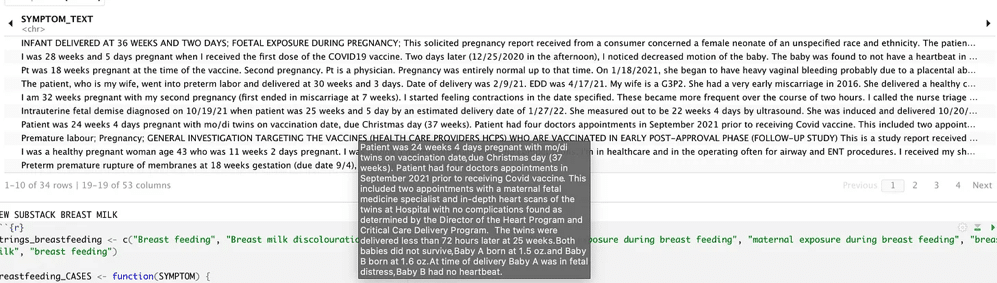
My December 2022 analysis of VAERS (9 December 2022) extracted reports containing “exposure” MedDRA terms.
Read more: ‘Exposure’ during pregnancy…, Jessica Rose, 13 December 2022
After removing SARS-CoV-2 exposure and nondescript accidental-exposure entries, 1,981 reports remained that involved exposure in the context of pregnancy (maternal exposure during and before pregnancy, etc.). Of those 1,981 women, 49.7% reported a miscarriage. Among the small subset (4%) who reported having delivered, 42.5% reported premature deliveries. Individual symptom texts included multiple tragic cases of premature delivery followed by loss.
I also published data provided by an obstetrician and gynecologist tracking new patients and miscarriages in their practice for 2020 (baseline), 2021 and 2022.
Read more: Real time obstetrician/gynecologist’s data on new patients and miscarriages for 2021 and 2022 (and now 2020 for baseline), Jessica Rose, 18 November 2022
It revealed that new-patient numbers in 2021 and 2022 fell below the 2020 monthly average (roughly 32–40). It also revealed absolute miscarriage counts were higher in most months of 2022 versus 2021. Miscarriage rates (miscarriages relative to new patients) were approximately twice as high on average in 2022 as in 2021. Cumulative plots of losses versus cumulative new patients further illustrated the divergence.
The NYT piece frames the policy evolution as pure progress from uncertainty to settled safety, without focusing on whether the private mechanistic concern warranted more transparent public discussion in real time for informed consent.
It is an entirely uninformed piece of writing, and it is misleading.
References
- 1 Yang X, Tian Y, Zheng L, Luu T, Kwak-Kim J. The Update Immune-Regulatory Role of Pro- and Anti-Inflammatory Cytokines in Recurrent Pregnancy Losses. Int J Mol Sci. 2022 Dec 21;24(1):132. doi: 10.3390/ijms24010132. PMID: 36613575; PMCID: PMC9820098
- 2 Bagkou Dimakou D, et al. Peripheral cytokines as candidate biomarkers for recurrent pregnancy loss. Reprod Fertil. 2026. doi:10.1530/RAF-25-0152
- 3 Makhseed M, Raghupathy R, Azizieh F, et al. Th1 and Th2 cytokine profiles in recurrent aborters with successful pregnancy and with subsequent abortions. Hum Reprod. 2001;16(10):2219-2226. doi:10.1093/humrep/16.10.2219
- 4 Ng SC, Gilman-Sachs A, Thaker P, et al. Expression of intracellular Th1 and Th2 cytokines in women with recurrent spontaneous abortion, implantation failures after IVF/ET or normal pregnancy. Am J Reprod Immunol. 2002;48(2):77-86. doi:10.1034/j.1600-0897.2002.01105.x
- 5 Raghupathy R. Cytokines and pregnancy complications: modulation for prevention and treatment. Explor Immunol. 2022;2:59. doi:10.37349/ei.2022.00059
- 6 Piccinni MP, Beloni L, Livi C, et al. Defective production of both leukemia inhibitory factor and type 2 T-helper cytokines by decidual T cells in unexplained recurrent abortions. Nat Med. 1998;4(9):1020-1024. doi:10.1038/nm0998-1020
- 7 Hill JA, Polgar K, Anderson DJ. T-helper 1-type immunity to trophoblast in women with recurrent spontaneous abortion. JAMA. 1995;273(24):1933-1936. doi:10.1001/jama.1995.03520480039038
- 8 Calleja-Agius J, et al. Investigation of systemic inflammatory response in first trimester pregnancy failure. Hum Reprod. 2012;27(2):349-357
- 9 Bates MD, Quenby S, Takakuwa K, Johnson PM, Vince GS. Aberrant cytokine production by peripheral blood mononuclear cells in recurrent pregnancy loss? Hum Reprod. 2002;17(9):2439-2444. doi:10.1093/humrep/17.9.2439
- 10 Kuroda K, et al. Increasing number of implantation failures and pregnancy losses associated with elevated Th1/Th2 cell ratio. Am J Reprod Immunol. 2021;86(5):e13429. doi:10.1111/aji.13429
About the Author
Dr. Jessica Rose is a Canadian researcher with a Post Doctorate in both Biochemistry and Molecular Biology, a PhD in Computational Biology and a Master’s in Immunology, as well as a Bachelor’s Degree in Applied Mathematics. She publishes articles on a Substack page titled ‘Unacceptable Jessica’ which you can subscribe to and follow HERE. You can also follow her on Twitter (now X) HERE.
The Expose Urgently Needs Your Help…
Can you please help to keep the lights on with The Expose’s honest, reliable, powerful and truthful journalism?
Your Government & Big Tech organisations
try to silence & shut down The Expose.
So we need your help to ensure
we can continue to bring you the
facts the mainstream refuses to.
The government does not fund us
to publish lies and propaganda on their
behalf like the Mainstream Media.
Instead, we rely solely on your support. So
please support us in our efforts to bring
you honest, reliable, investigative journalism
today. It’s secure, quick and easy.
Please choose your preferred method below to show your support.

Categories: Breaking News, Latest News, US News