





Prime Minister Andy Burnham is boasting about a £10 billion allocation to build 70,000 new homes across England, marking the first wave of his pledged “biggest council housebuilding programme since the postwar period.”
The initial funding from the £39 billion Social and Affordable Homes Programme targets 60% for social rent and 40% for other subsidised types like shared ownership and sheltered housing.
However, expanding social housing is an unsustainable policy that creates welfare dependency, distorts the private market and imposes long-term financial liabilities on the public.
Additionally, evidence from the United States suggests that publicly subsidised housing projects suffer from high construction costs, lack of financial transparency and inefficiencies driven by regulatory requirements and above-market wage mandates.
Let’s not lose touch…Your Government and Big Tech are actively trying to censor the information reported by The Exposé to serve their own needs. Subscribe to our emails now to make sure you receive the latest uncensored news in your inbox…
The following are two related articles, combined into one and re-published by UK Reloaded. The first is about why social housing should not be the UK government’s priority and the second is about what the UK can learn from America’s mistakes.
Table of Contents
The Last Thing the UK Needs Is More Social Housing
By Pete North
Today [24 August] Reform UK formally released their housing policy. The party has pledged to prioritise British-born young workers for social housing and to build 50,000 new affordable homes per year.
I’m not minded to delve too deeply into their 10-page PDF because they’ve already told me what I need to know. Reform is doing what all parties do – pledging to build more homes to an arbitrary target. Pure populism. Left-wing populism as it happens.
Social housing is the very last thing we should be building. The long-term objective of housing policy should be to restore a functioning housing market in which the great majority of households can meet their needs through private provision. In such a market, large-scale social housing would become largely unnecessary. The current model, which treats social housing as a major part of the housing system rather than a limited safety net, creates more problems than it solves.
Social housing necessarily involves rationing. When homes are offered at rents significantly below market levels, demand will always exceed supply. There is no truly fair or objective way to allocate subsidised housing. Means-testing, points systems and priority banding all involve subjective judgements about who is most deserving. These systems are open to manipulation, inconsistency and accusations of unfairness. They also create strong incentives for people to present themselves in ways that maximise their chances of receiving a subsidised home, rather than focusing on improving their own circumstances.
This rationing system tends to produce a race to the bottom. Because access to social housing is determined by assessed need rather than ability to pay, it rewards dependency and penalises self-reliance. Households that work hard, save and avoid falling into difficulty often find themselves at the back of the queue, while those who remain in the system for longer periods can secure better properties. Over time, this dynamic concentrates people with multiple disadvantages in the same areas, creating clusters of welfare dependency that are difficult to escape.
These problems are not new. The large social housing estates built in the post-war period were designed for a very different economy. Entire districts were built around major employers such as mines, shipyards, steelworks and large manufacturing plants. These industries provided stable, well-paid employment across generations, often within walking distance of the homes. When those industries declined or disappeared, the economic foundation of these estates collapsed. What remained were concentrations of unemployment, low skills and welfare dependency, with few local opportunities for work. The physical legacy of that era continues to shape housing policy today, even though the economic model that justified it no longer exists.
Modern attempts to expand social housing repeat many of the same mistakes on a smaller scale. Building more homes at heavily subsidised rents adds permanent liabilities to the public finances. These properties typically require ongoing subsidy for maintenance and management, and the capital invested in their construction is never recovered through rental income. Each new social rent home adds to the stock of assets that lose money every year. This approach treats housing as a form of permanent welfare rather than as infrastructure that should, over time, pay for itself.
The existence of a large social housing sector also distorts the wider market. By removing a significant number of homes from the market and offering them at below-cost rents, it reduces the incentive for private developers to build homes at the lower end of the market. It also creates political pressure to maintain high levels of housing benefit to support those in the private rented sector, which in turn pushes up rents for everyone else. The result is a system that protects existing social tenants while making it harder for younger households and new entrants to the market to find affordable accommodation.
A better approach is to focus on increasing the overall supply of housing across all tenures. When the market is allowed to function properly, through planning reform, faster decision-making and the release of suitable land, more homes are built at a wider range of price points. This reduces pressure on both the private rented sector and the social sector. As overall supply increases and prices moderate, the need for large-scale subsidised housing diminishes. The role of social housing can then be limited to providing temporary or targeted support for those who genuinely cannot access the market, rather than acting as a parallel housing system.
This does not mean abolishing social housing entirely. There will always be a small number of people who, due to age, disability or severe disadvantage, require long-term supported accommodation. However, this should be a residual function, not the default response to housing need. For most working-age households, the goal should be to help them move into the mainstream market rather than locking them into subsidised tenancies for decades. Lifetime social tenancies at heavily discounted rents create strong disincentives to work and save, and they prevent the turnover of stock that would allow new households to be housed.
Reforming social housing also requires confronting uncomfortable realities about its current performance. Many social housing estates suffer from poor management, high levels of anti-social behaviour and weak communities. These problems are not primarily caused by the physical quality of the homes, but by the concentration of households with complex needs and limited economic prospects. Simply building more of the same model will not solve these issues. A smaller, better-managed social housing sector, focused on those with the greatest need and combined with stronger expectations around behaviour and contribution, would deliver better outcomes at lower cost.
The current trajectory, which treats the expansion of social housing as a central part of the response to the housing crisis, is unsustainable. It adds to the fiscal burden without addressing the underlying shortage of homes. It creates unfair rationing systems and long-term welfare traps. And it preserves a model of housing provision that was designed for an economy that no longer exists. A serious housing policy must instead prioritise the measures that increase total supply across the market, reduce long-term dependency, and allow social housing to return to its proper role as a limited and targeted form of support.
This article (‘The last thing we need is more social housing’) was created and published by Pete North and is republished here under “Fair Use”
Lessons From America: The Trap of Hiding the Costs of Low-Income Housing; The Road to (Debt) Hell is Paved With Good Intentions
By Peter Halligan
The UK is facing a housing crisis – the council waiting list has 1.3 million on it – various political parties have announced plans to build between 50,000 and 300,000 (affordable) new homes every year for 5-10 years.
The lunatic Marxist UK government has a lot in common with the lunatic “liberals” of California and Oregon.
Oregon is currently run by Democrats. The state has a Democratic trifecta, meaning the party controls the governorship and both chambers of the state legislature
California is currently run by the Democratic Party, which holds a Democratic trifecta and triplex, controlling the governorship, both chambers of the state legislature, and all other statewide constitutional offices.
Here is a salutary lesson from the similarly lunatic and incompetent Oregon State legislatures:
Oregon’s spending on low-income housing has exploded in the past five years. The state has given developers an unprecedented $1.4 billion, and the cost of developing each apartment has nearly doubled, to $540,000. Dozens of projects are lined up for an additional $850 million in future state funding. Federal tax credits, which the state oversees, will bring even more money to bear.
Yet one thing has remained constant: The public isn’t allowed to see the details of how all these dollars are being spent.
Oregon is one of the only states in the country with a carve-out in its public records law that prevents disclosing the financial details of subsidized housing projects, thwarting researchers and journalists who have tried to examine their costs.
The issue is especially pressing in the Pacific Northwest, where leaders have tied the lack of affordable housing to the region’s dire homelessness crisis. Understanding and controlling the cost of construction could make it possible, with the same amount of money, to either build more rent-restricted apartments or to discount rents more steeply.
A “study published last year and co-authored by Jason Ward, an economist who directs the nonpartisan Rand Corp.’s Housing Centre, compared the costs of constructing subsidised housing among California, Texas and Colorado, finding that California’s highest-in-the-nation prices were driven by requirements to pay “substantially above-market wages and unusually large architectural and engineering fees.”
If California had Colorado’s production costs, the study found, it could have built four times as many rent-subsidised apartments.
Those types of analyses are impossible to perform in Oregon.
Oregon’s Secret Spending on Low-Income Housing, Real Clear Investigations, 21 August 2026
An extract from the report:
Key Takeaways
- California is the most expensive state for multifamily housing production in every cost category the authors considered.
- Longer production timelines are strongly associated with higher costs. The time to bring a project to completion in California is more than 22 months longer than the average time required in Texas.
- Municipal impact and development fees vary substantially across states; they are $1,000 per unit on average in Texas, $12,000 per unit in Colorado, and $29,000 per unit in California.
- Key drivers of the remarkably high cost of publicly subsidised affordable housing production in California include requirements for affordable housing developers to pay substantially above-market wages and unusually large architectural and engineering fees, likely related to highly prescriptive design requirements.
- Within California, production costs vary substantially across metropolitan regions – the average cost per square foot in San Francisco is roughly 1.5 times the average cost in San Diego.
- Halving the difference in market-rate production costs between California and Texas could reduce rental prices for new apartments in California by roughly 15 per cent.
- If California had Colorado’s production costs for publicly subsidised affordable apartments, the roughly $1.25 billion in recent spending by the state’s four largest funding programs would have produced more than four times as many units.
Political leaders of each of the UK’s major parties should read these reports and articles carefully and avoid the waste of public money they reveal.
The UK will not be immune from the waste and pitfalls they reveal.
This article (‘Lessons from America – the trap of hiding the costs of low income housing’) was created and published by Peter Halligan and is republished here under “Fair Use”
Please take a (paid or unpaid) subscription to Peter Halligan’s Substack. You can also donate to Peter Halligan via Ko-fi; any amount from three dollars upwards. Ko-fi donations here: https://ko-fi.com/peterhalligan
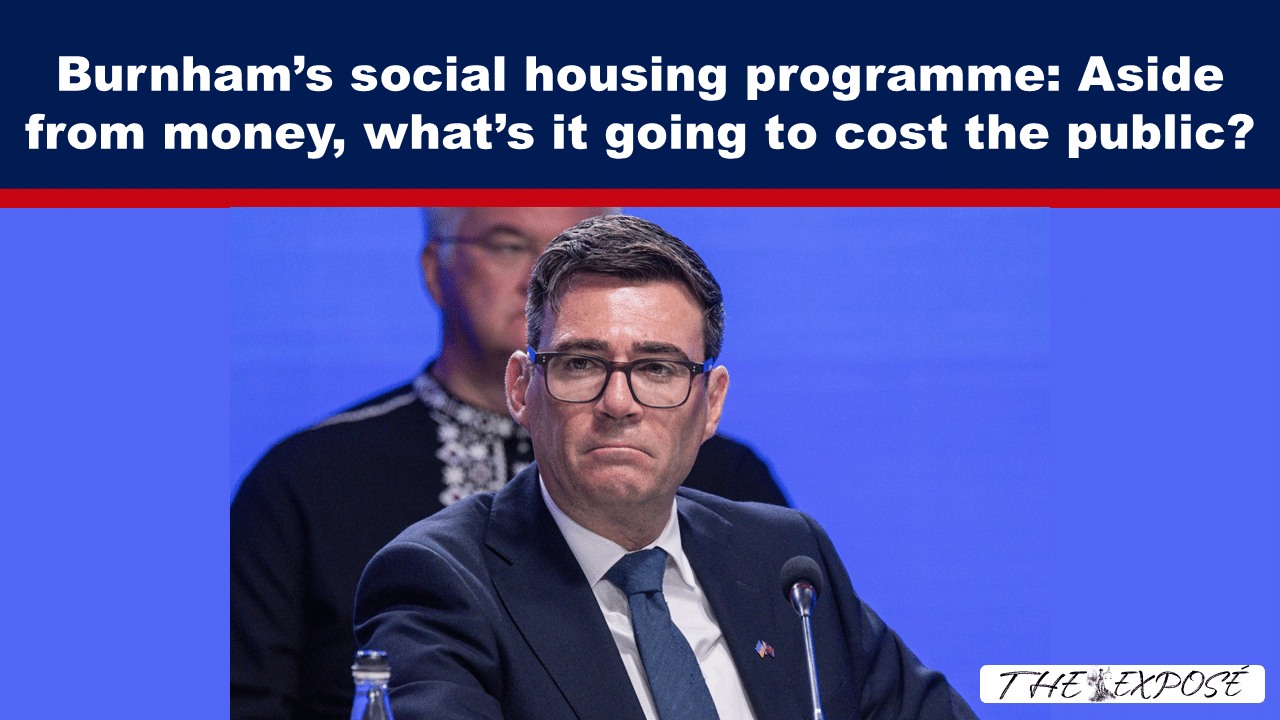
Featured image: Andy Burnham has handed an embattled housebuilder £350m to boost his council housebuilding blitz. 33 groups – councils, housing associations and developers – will receive funding under Burnham’s scheme. However, only three councils are among the 33 groups receiving guaranteed funding, with most of the money going to housing associations. Several of the housing providers have faced criticism from the Housing Ombudsman over their treatment of tenants. Source: The Telegraph
The Expose Urgently Needs Your Help…
Can you please help to keep the lights on with The Expose’s honest, reliable, powerful and truthful journalism?
Your Government & Big Tech organisations
try to silence & shut down The Expose.
So we need your help to ensure
we can continue to bring you the
facts the mainstream refuses to.
The government does not fund us
to publish lies and propaganda on their
behalf like the Mainstream Media.
Instead, we rely solely on your support. So
please support us in our efforts to bring
you honest, reliable, investigative journalism
today. It’s secure, quick and easy.
Please choose your preferred method below to show your support.

Categories: Breaking News, Latest News, UK News