





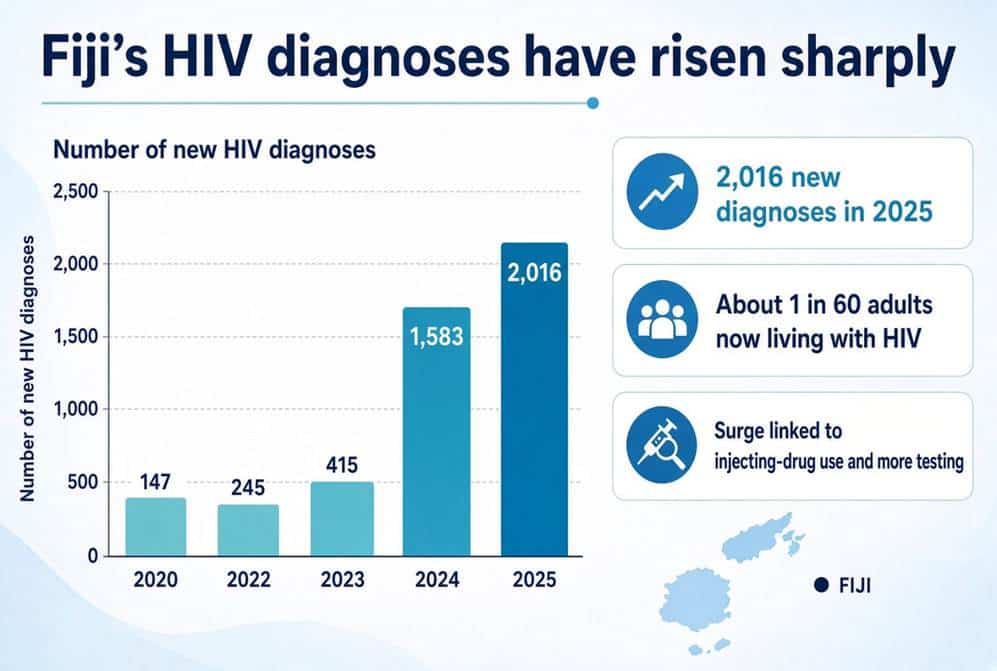
After years of relatively low numbers, Fiji recorded 2,016 new HIV diagnoses in 2025. Officials point to methamphetamine injection, needle-sharing and a huge testing drive as an explanation.
Not everyone is convinced by the official narrative. Some researchers are asking questions, based on the evidence.
In the following, Dr. Philip McMillan explains why 8 months ago he could reliably predict that we are likely to see a huge surge in AIDS/HIV in populations with high rates of covid vaccine uptake.
If Dr. McMillan is right, “Fiji’s emergency is an early chapter, not a local curiosity,” he says.
Let’s not lose touch…Your Government and Big Tech are actively trying to censor the information reported by The Exposé to serve their own needs. Subscribe to our emails now to make sure you receive the latest uncensored news in your inbox…
Fiji’s HIV Emergency Was Predictable If You Followed the Spike Protein Data
By Dr. Philip McMillan, 25 September 2026
I Was Not Being Psychic
About eight months ago I said we were likely to see a surge in HIV, especially in highly vaccinated regions. It sounded like speculation. It was not. I do not have a gift for prophecy. I look for relevant science and ask what must follow if that science is even partly correct.
In January 2026, an Italian group published work on the potential impact of SARS-CoV-2 spike protein on the HIV reservoir in people already living with HIV. The experimental numbers were small. The direction was consistent. Vaccine mRNA and SARS-CoV-2 spike appeared able to reactivate latent HIV. I recorded a 46-minute presentation on that paper in February [16 minutes is free to watch; the full presentation is behind a paywall]. I will not repeat the slides here. I want to explain why Fiji now matters.
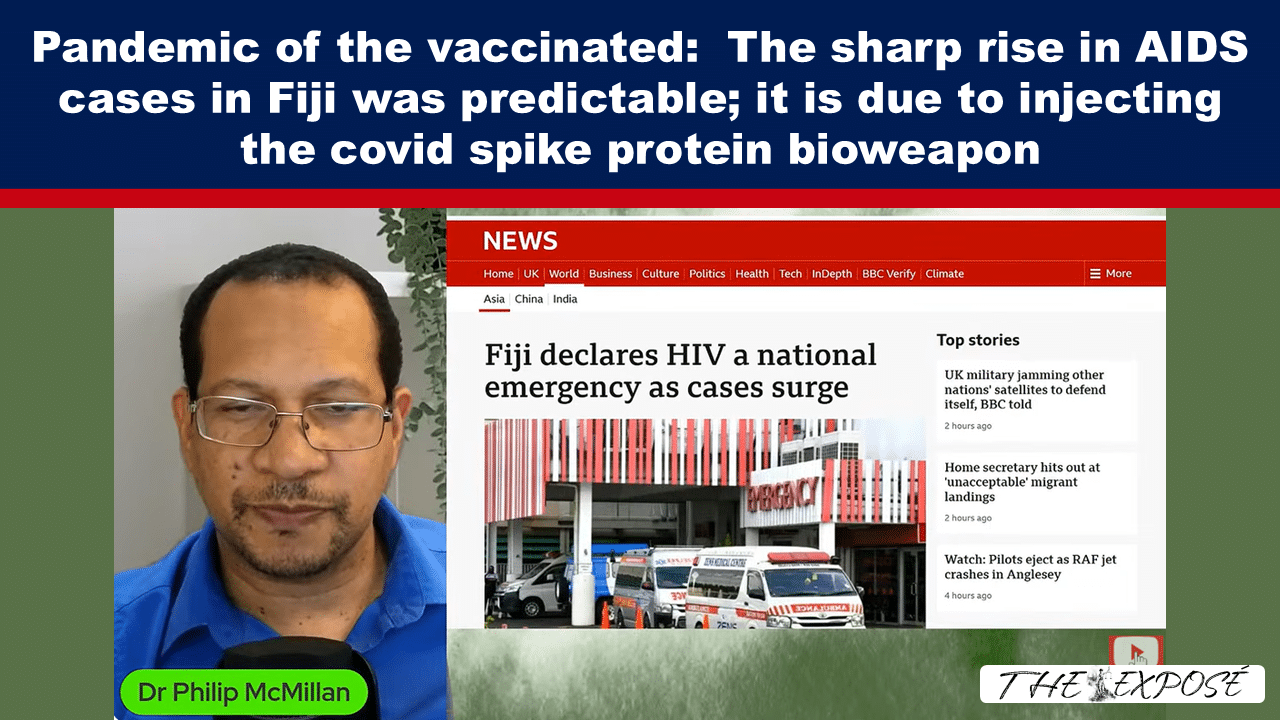
Seven days ago, the BBC reported that Fiji had declared HIV a national emergency: 2,016 new diagnoses in 2025 alone. An outbreak-level response was no longer enough. Most people will read that as a remote Pacific story about drugs. I read it as a test of a mechanism I have already described.
What the Numbers Actually Show
New HIV diagnoses in Fiji did not drift upward. They bent.
There were 147 new diagnoses in 2020, 245 in 2022, 415 in 2023, 1,583 in 2024 and 2,016 in 2025. That is not a surveillance artefact. That is a change in slope.
Fiji also has a documented injecting-drug problem. People share needles. Some share blood after a hit, a practice called “bluetoothing.” I have no doubt this contributes. I am saying it is unlikely to be the whole story. If this were only intravenous drug use in a small island nation, controlling the sharing should eventually flatten new cases. If I am right about circulating spike and latent virus, controlling the drug problem will not be enough. The curve will keep trying to rise.
Fiji is also highly vaccinated. Adult coverage ran into the mid-nineties, AstraZeneca first, then Pfizer. I am not reducing this to “the vaccine did it.” I am describing a combination of infection, vaccination and immune priming. That distinction matters.
Latent Does Not Mean Gone
HIV is a serious virus. It carries envelope proteins on its surface and enzymes inside, including reverse transcriptase and protease. Once inside a cell, it converts its RNA to DNA and integrates that DNA into the host genome. From then on, you do not clear it. You can silence it. You cannot evict it.
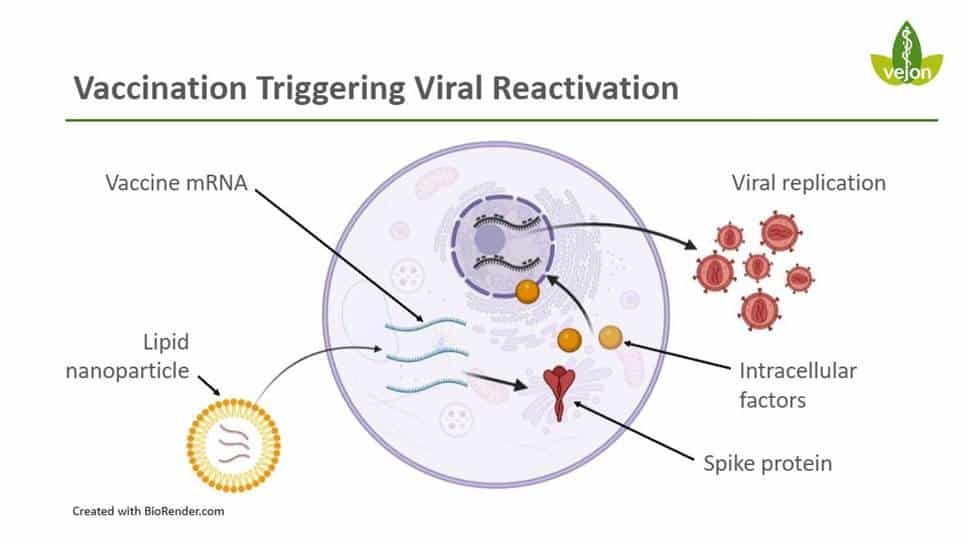
Latent infection means the virus is embedded and quiet. It is not actively copying, and the person may not be infectious in the way an untreated, replicating infection is. The Italian work, and the logic of spike in the systemic circulation, point to the same conclusion: exposure to spike can restart that copying.
Think of a cell in two parts: cytoplasm and nucleus. HIV enters, its genetic material is written into the nucleus and the virus then either sleeps or starts manufacturing new particles. Spike can push nearby infected cells out of the sleeping state, whether it comes from an infection that has breached the airway lining or from intracellular production after a lipid nanoparticle delivers mRNA. The paper described soluble factors released from a transfected or infected cell acting on neighbouring cells that already carry HIV. Those neighbours then start producing virus.
That is the step people skip. A latent carrier is less infectious. A reactivated carrier has virus in the blood again. Place that person in a needle-sharing network, and you have added infectious blood to a practice that already transmits HIV with brutal efficiency. Not every new diagnosis needs to be a first-time infection from a stranger. You only need more virus circulating among people who share equipment and partners.
[In his article, Dr. McMillan has embedded a video that is only available on Substack and so cannot be embedded here. You can watch the video on Substack HERE.]
Why Highly Vaccinated Regions Matter in This Framing
I have said for a long time that mucosal immunity in the upper airway is not the same as systemic immunity. When the lining of the nose and throat responds with sneezing, running and local containment, that is often the better sign. What worries me is infection that provokes little upper-airway response yet still reaches the bloodstream. Once spike and inflammatory signalling become systemic, T cells, B cells and natural killer cells can be depleted. That is a poorer environment for keeping latent viruses asleep.
HIV is not the only virus that behaves this way. Varicella zoster can produce shingles after an immune insult. Epstein-Barr is discussed in long covid. Herpes simplex can recrudesce. The principle is the same: a sleeping DNA virus meets a systemic inflammatory or transcriptional push and starts replicating.
Fiji gives us a population with high vaccine coverage, subsequent covid circulation, a sudden expansion of injecting and a 15-fold rise in recorded diagnoses from 2020 to 2025. Officials will emphasise expanded testing, and they should. More tests find more cases. But that does not explain why so many people are positive when you look.
How This Claim Can Be Wrong – And How It Can Be Right
I do not mind being wrong; however, I mind missing a mitigation window.
If this is only drugs and better case-finding, needle programmes, treatment and contact tracing should bring new diagnoses down once they are fully in place. If circulating spike is reactivating latent HIV and increasing infectiousness within those same networks, Fiji’s emergency is an early chapter, not a local curiosity. You would expect similar bends in other highly vaccinated settings where covid still reaches the blood-side immune system and where sharing or unprotected sex can finish the job.
The Italian paper was in vitro. It was not a trial in Fijian villages. The authors themselves concluded that urgent further investigation was needed. That is exactly the standard I am applying: extrapolate the mechanism, watch the pattern and demand the measurements that would kill the idea. That means viral loads in previously diagnosed patients after covid waves, and phylogenetic trees showing whether new clusters grow out of old reservoirs or only out of new infections among young injectors.
The paper was published in January 2026, and I spoke about it in February 2026. The emergency declaration is now. I can only share what I know – and the more I see, the more concerned I am that these predictions were not dramatic enough.
About the Author
Philip McMillan is a British medical doctor and consultant physician who is focused on covid-19, long covid and chronic health conditions such as dementia and arthritis. He is the co-founder and executive director of McMillan Research and CEO of Vejon Health. He publishes articles on a Substack page titled ‘Vejon COVID-19 Review’. As well as on his Substack page, he uploads videos to his Rumble channel HERE and YouTube channel HERE.
The Expose Urgently Needs Your Help…
Can you please help to keep the lights on with The Expose’s honest, reliable, powerful and truthful journalism?
Your Government & Big Tech organisations
try to silence & shut down The Expose.
So we need your help to ensure
we can continue to bring you the
facts the mainstream refuses to.
The government does not fund us
to publish lies and propaganda on their
behalf like the Mainstream Media.
Instead, we rely solely on your support. So
please support us in our efforts to bring
you honest, reliable, investigative journalism
today. It’s secure, quick and easy.
Please choose your preferred method below to show your support.

Categories: Breaking News, Latest News, World News