





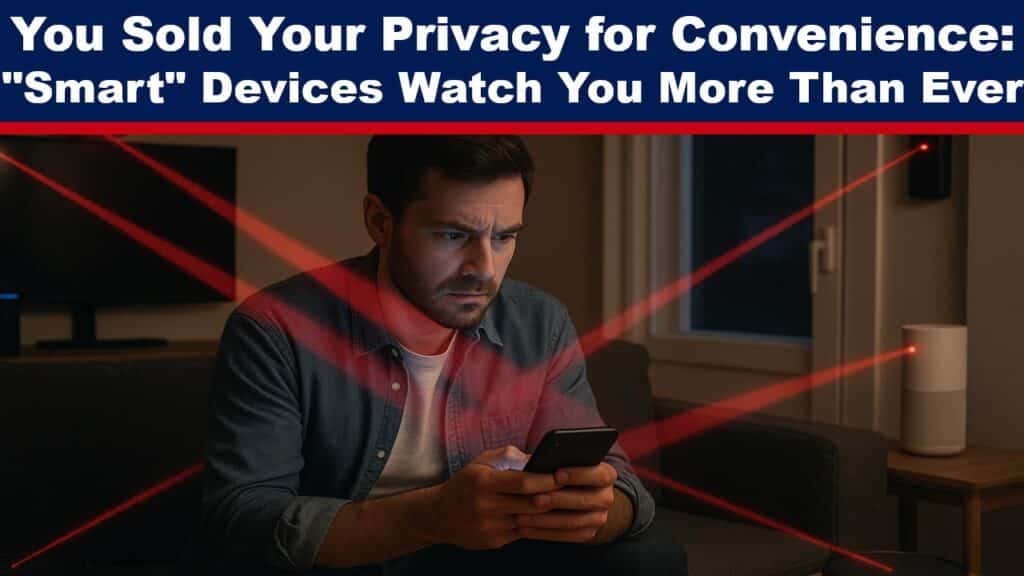
The problem is not just that we’re being tracked more than ever; it’s that everyone is actively paying for the surveillance. Video doorbell ownership in the US rose from 4% to over a 35% between 2017 and 2024. Smart TVs – which track and sell your viewing analytics – are now in 86% of homes, up from 47% a couple of years ago. 75% of cars shipped in 2024 were embedded with cellular modems, permanently streaming live data about drivers and passengers. The average online household in the US has a staggering 17 connected devices. And the data-broker market – the industry buying and selling your personal information – will soon reach $500 billion annually.
We have more eyes on us than at any point in history, more people analysing our every move, and a lot of questionable legality about it all. Here’s how your connected devices are creating a whole new industry worth hundreds of billions of dollars.
Phones: The Master Sensors
It’s no secret that phones are the masters of personal surveillance. Your phone tracks your precise location, frequent destinations, pairs with Bluetooth beacons and wi-fi networks, and tracks every tap and swipe. It feels every movement you make in your waking life, and even tracks your sleeping habits. The market for all this information is enormous, but not always legal.
The Federal Trade Commission sued data broker Kochava for selling location trails tied to visits to clinics and places of worship, with information farmed from “hundreds of millions of mobile devices”. In 2022 and 2023, Google was ordered to pay a record-breaking multi-state settlement of almost $500 million for misleading location controls affecting up to 250 million users.
Your TV is Now Watching YOU
Most smart TVs have built-in capabilities to automatically recognise the content you watch on streaming platforms, and even on HDMI inputs. The FTC found Vizio guilty of tracking 11 million TVs without informed consent from viewers, selling the data for ad targeting – and paid a fine of $2.2 million.
Remember this is separate to the surveillance performed by streaming platforms, boxes, and applications themselves, which each collect billions of viewing hours’ worth of data too. This is your TV recognising and recording what’s projected on its screen, even if it comes from an external input like a HDMI cable.
Doorbells & Home Cameras: The Eyes on Your Street
The presence of video doorbells has increased more than ten-fold in the US in the past few years. They record faces, licence plates and all daily comings-and-goings on your property, often with audio and precise timestamps stored in the cloud. That stream can be accessed by providers, outside reviewers for “quality control”, and law enforcement if requested. Essentially, your entire family’s daily, weekly and monthly routines can be mapped by one single doorstep camera. Surveillance cameras don’t need to be installed by governments – most people are installing them voluntarily.
In 2023, the FTC charged Ring – the leading video doorbell provider – with letting employees and contractors view private videos and failing to stop hackers from taking over cameras. The settlement forced $5.6 million in refunds, data deletion, and security fixes. If you have one of these installed then two-factor authentication, short data retention settings, limited sharing, and any possible encryption should all be very high priorities.
Smart Speakers & Voice Assistants Are Listening
Speakers transcribe commands and can capture “false-wake” snippets, with transcripts and audio recordings retained for “quality control” and training purposes. Depending on how much someone uses these services, entire calendars, personal relationships, messages and private communications could all be recorded – even when it “accidentally” started listening without an active prompt. The dangers of audio surveillance should not be underestimated.
In 2023, Amazon agreed to pay $25 million after the FTC and DOJ found that its voice assistant “Alexa” not only stored children’s voice recordings and geolocation information, but also undermined and avoided deletion requests.
Robot Vacuums & Edge Gadgets Are At It Too
Automated vacuums build precise floor plans, and camera models in your home capture photos that can be stolen. Between the photos and home layouts, valuables and daily patterns can be identified by hackers or shared by internal employees. If you think this is approaching sci-fi paranoia, you should know that it’s already happening.
In 2022, Roomba units captured in-home photos and video clips which were sent to a third-party data-labelling contractor to help train its AI. Some of those contractors leaked the images to close social groups, which then spread online. Footage included sensitive moments inside private homes – such as someone sitting on a toilet – and the leak exposed a weak point in the chain. When imagery from your home enters a third-party workflow, you’re suddenly relying on multiple organisations’ security and ethics.
Eufy – a home camera provider – experienced a server update error that briefly allowed users to see other customers’ surveillance camera feeds. They were also found guilty of uploading images and thumbnails to the cloud and public URLs even when users selected local-only storage options. Streams and images could be fetched via unprotected URLs, raising concerns about access without proper authorisation.
Cars Record Much More Than You Think
Three quarters of all cars sold in 2024 were capable of collecting and sharing enormous amounts of data about its drivers and passengers. Logging routes, speed and braking, paired-phone data, and even cabin imagery, they are able to share everything they track to data brokers and insurance providers. Many owners don’t expect a car to perform such expansive surveillance on them, but they monitor more than you think.
Recently, Texas sued GM for selling driving data to insurers without consent, Tesla employees were found to privately share sensitive customer camera footage, and the FTC later barred GM from selling driver geolocation data for five years.
We recently covered a deeper dive into the information cars store on drivers, which you can read here: Your Car Tracks a LOT More Than You Think – The Exposé
So, Why Do People Keep Saying Yes to Surveillance?
Most of this monitoring comes paired with features people do actually want. They buy smart doorbells for delivery alerts, accept TV recommendations and use streaming services for their favourite shows, use voice commands to stay organised, and connect to their cars for live traffic updates and remote start capabilities.
These are each small conveniences that are traded for a high premium: their privacy. The result is a persistent, ever-growing trail of where you live, when you leave, where you go, what you watch, who is at your door or in your car, and how you make decisions. That trail generates billions of dollars for data brokers, ad networks, and pricing engines – and most people don’t even know it’s happening.
How to Reduce Your Trail
- Phone: limit location access in device settings
- TV: turn off ACR or viewing data, check again after updates
- Cameras: use two-factor authentication, enable short retention, limit shared users
- Speakers: opt out of human review and delete voice history
- Car: reduce analytics, restrict trip history, delete the companion app, and factory-reset before servicing or selling
If you want to know what information you’ve given out, you have legal rights in the UK, EU and several US states. You’re able to request access or deletion of stored information from any vendor or service, although it’s not made quick or easy to get it. Ask providers or sellers directly about what data is ingested by the car or device. Remove any unnecessary tracking settings, which are often turned on by default, and revoke background permissions from all applications.
Final Thought
In a world where many protest against surveillance and censoring, a shocking majority is voluntarily opting in for it. For minor convenience boosts, people are increasingly buying devices that invade not just their own privacy, but anyone else in their home or car too. Make sure to familiarise yourself with what data you are sacrificing, and consider whether the benefits are worth the privacy sacrifice.
Join the Conversation
Have you ever checked your devices for privacy settings? What surprised you the most? Much of the population never bother to look, and by the time they check, they’ve surrendered years of private, intimate behavioural data that’s worth billions to vendors. Add your thoughts below.
The Expose Urgently Needs Your Help…
Can you please help to keep the lights on with The Expose’s honest, reliable, powerful and truthful journalism?
Your Government & Big Tech organisations
try to silence & shut down The Expose.
So we need your help to ensure
we can continue to bring you the
facts the mainstream refuses to.
The government does not fund us
to publish lies and propaganda on their
behalf like the Mainstream Media.
Instead, we rely solely on your support. So
please support us in our efforts to bring
you honest, reliable, investigative journalism
today. It’s secure, quick and easy.
Please choose your preferred method below to show your support.

Categories: Did You Know?
How long before I get automatically banned from driving for doing 90 mph sometime?
That’s coming-don’t worry about that!
And as you’re 78, you’ll also be considered too old to drive…
I don’t carry a phone when I’m out. I don’t have a TV. I have no smart speakers. My laptop is in a different room and is only used for accounts and DVDs…I don’t have a smart watch…I wear a 1953 ex military Bulova…I wear a peaked hat…I know how to disable cameras just enough….I don’t shop online…I use cash if I can…I told the tax office I would not do on line returns..and I don’t. I have no doctor…this is how I enjoy my life. Unjabbed untested…separate from as much society as possible. Try it.
Same here…I aviod the electronic tech and smart devices as much as I can. I was given a smart watch for Christmas and I just gave it away
Do you have a Digital ID yet?
The World Bank wants an Online Avatar of every person apparently, based on your Digital ID.
https://www.youtube.com/watch?v=FUQT9E_e8Ic
I rarely watch videos, but thanks for putting this up.
very informative info above
I love your behavior!!! High-5 to ya!!! #OffTheGrid
Here in the USA we have flock cramra’s on a lot of telephone poles to record our lisence plate on our cars.
The measures I take:
Don’t connect using bluetooth
Disconnect from wifi if home, I have window bars and a non-wifi cam system that detects motion and records to card.
Was thinking about encrypting ring but they make it so all advantages disappear.
My clips are always interfered with, with dodgy criminal activity clips missing. I have so many cams, they’d have to employ a small army to watch it all.
Taped over all mobile phone cameras, front and back.
Only watch dvds
Oh and boring lengthy series, that they can look at lol.
I have a vpn but even that is open to onlookers.
Clips have vanished from 3 different cam systems. I would say the nature of what vanishes belongs to law rather than regular hackers because those that vanish may upset the community cohesion agenda. The lights come on so the offending crims think they’re being filmed but when I look at the history, there is nothing there, but it’s on another system altogether elsewhere.
They’re up to all sorts and are in everything.
Also there are companies that hire ex military to gather Kompromat for a price and to bring about control of an individual by spreading their information to others that are not entitled to it.
I am 76 YOF and the dystopia explained in this article is so upsetting that I had to stop reading three times to let off steam, I got my dishes washed, some pictures hung on the wall, and started preparing lunch but still upset.
Did you manage to sort out your viewing/reading issues?
It’s sad how people are easy manipulated into investing this stuff?? I mean you have NO CONTROL when it comes to cars & cellphones, but everything else it’s crazy. I like the statement about govt. doesn’t have to use surveillance cameras, people are investing into these devices. One of my sibling has his whole house controlled by Alexa, it’s pretty sad! He doesn’t know better, lol…. The book 1984 told it all…