





5 important stories from this week that might have been overlooked.
The EU’s plans to give the US access to national biometric databases; the launch of the UK’s mass internet message surveillance programme; an EU-funded organisation has determined the use of certain terms, such as “lady,” “masterpiece” and “maiden name,” should be abolished; German lawmakers are forcing car manufacturers to remotely disable car preheaters on internal combustion engine vehicles only; and, the Polish President has vetoed a law implementing the EU Digital Services Act.
Let’s not lose touch…Your Government and Big Tech are actively trying to censor the information reported by The Exposé to serve their own needs. Subscribe to our emails now to make sure you receive the latest uncensored news in your inbox…
News Round-Up: EU To Share Biometrics with the US, Banning ‘Mother Tongue’, and Germany Remotely Disabling Car Preheating
By Epp Tuul, as published by Freedom Research on 18 January 2026
Over the past week, the following topics attracted our attention:
- EU to Hand the US Access to Europeans’ Biometrics
- UK Launches Mass Internet Message Surveillance
- EU’s “Work of Genius”: “Maiden Name,” “Chairman,” and “Mother Tongue” Deemed Offensive and Non-Inclusive
- Climate Transition: Germany Forced Lexus to Remotely Disable Car Preheaters
- Polish President: EU’s DSA Creates ‘Ministry of Truth’
EU to Hand the US Access to Europeans’ Biometrics
EU countries are preparing to allow the United States access to national biometric databases holding sensitive personal data, such as fingerprints and facial scans. This is in exchange for letting EU citizens keep their visa-free travel to the US, according to Euractiv.
Washington first demanded access back in 2022. At that time, it was assumed that citizens of EU countries, except Romania, Bulgaria and Cyprus, would be able to travel to the US without a visa.
The US calls the plan “Enhanced Border Security Partnerships” (“EBSP”), and the European Commission is set to lead the negotiations for a framework agreement with the US this year. The planned agreement specifies the types of databases and categories of data to which the US would eventually have access. According to the Commission’s document, the agreement may cover a citizen’s origin, political views, religious or philosophical beliefs and genetic or biometric information. The document also states that such data should only be transferred in “strictly necessary and proportionate cases” in order to prevent crime or terrorism. Appropriate safeguards must be applied, in particular restrictions on the length of time for which the data can be stored.
Once the framework agreement has been concluded, EU countries will enter into direct negotiations with the Trump administration. Each country will conclude its own agreement with Washington, in line with the EU agreement, specifying the exact databases and data to be shared with the US authorities. There are only a few exceptions among EU countries that are not covered by the general agreement: Denmark and Ireland, the former having an exemption from EU directives and the latter not belonging to Schengen.
Although relations between the EU and the US have been tense for some time due to a number of trade and rule-of-law issues, US access to the data of millions of Europeans does not seem to be controversial among EU governments – EU countries gave the European Commission the mandate to negotiate on their behalf in December last year. Only one country, Germany, appears to be drawing a “red line.” European Data Protection Supervisor Wojciech Wiewiórowski also noted that the agreement sets a precedent as the first EU agreement to transfer vast amounts of personal data to another country’s border control agency. Overall, however, Wiewiórowski supports the EU-US border control framework agreement, which he believes could provide better protection of fundamental rights, but states that the data shared must be clearly defined and limited to individuals who are actually travelling to the US.
UK Launches Mass Internet Message Surveillance
On January 8, the Online Safety Act 2023 (Priority Offences) Amendment came into force in the UK, requiring digital platforms to scan, detect, and block user-generated content before it reaches its recipient or becomes publicly visible. The UK also plans to give law enforcement access to encrypted messages, writes Reclaim The Net.
The law now defines cyberflashing, including threats to do so, and incitement or assistance to serious self-harm as priority offences. If content is defined as a priority offence, platforms must implement the most stringent measures, which are more severe than those applied to so-called ordinary illegal content. One of these stricter measures is the obligation to prevent users from encountering content classified as a “priority violation” in the first place. To do this, technology companies must make extensive use of automated scanning systems, content detection algorithms, and artificial intelligence trained to assess the legality of the text, images, and videos, all in real time. Digital services where users can communicate with each other, including messaging, social media, forums, and even search engines, must now monitor people’s communications. In other words, they must perform message surveillance.
The UK Department for Science, Innovation and Technology (“DSIT”) introduced the changes in a promotional video in which a smartphone scanned photos and warned the user that an “unwanted nude photo” had been detected. The visual presentation clearly illustrates the basic requirement of the law: platforms must monitor every message and post in the background to identify and block prohibited content. Critics say the system turns private communication spaces into effective surveillance environments.
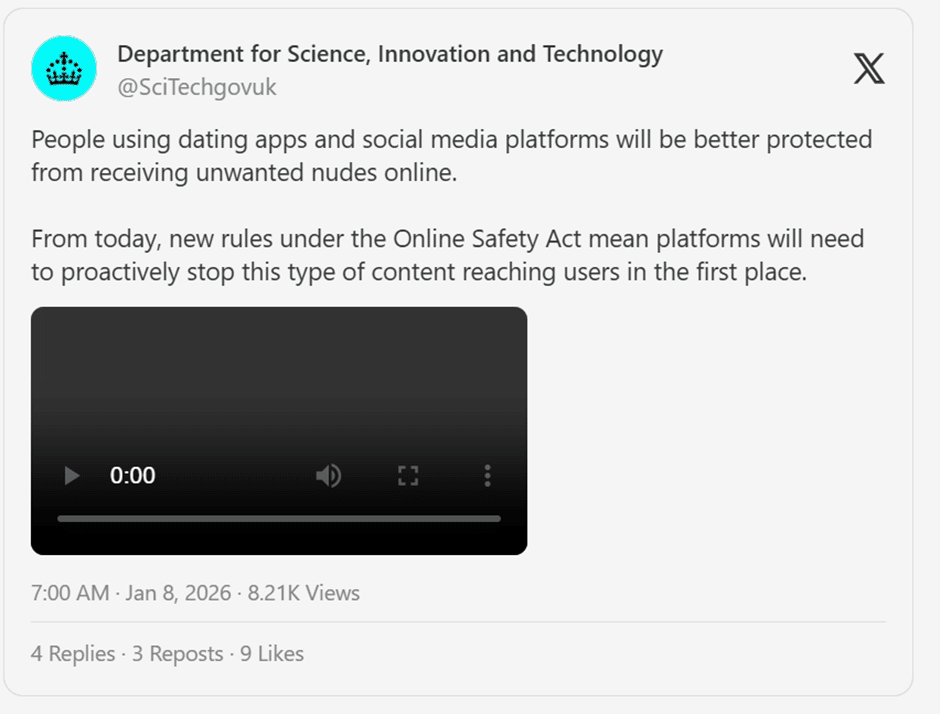
A press release from the Ministry of Technology states that digital platforms must now “take proactive steps to prevent this vile content before users see it.” According to the press release, this is part of the government’s strategy to reduce violence against women and girls by half over the next ten years. Technology Minister Liz Kendall said in a press release: “We’ve cracked down on perpetrators of this vile crime – now we’re turning up the heat on tech firms. Platforms are now required by law to detect and prevent this material. The internet must be a space where women and girls feel safe, respected, and able to thrive.”
If a platform fails to meet the requirements, it will face a significant penalty: fines of up to 10% of the company’s global turnover or £18 million (approximately €20.8 million), whichever is greater. Other possible measures include blocking access to the service in the UK. Just a week ago, the UK threatened to block Elon Musk’s social media platform X, having launched an official investigation into it for uncensored images created using artificial intelligence.
However, critics argue that these requirements represent a major structural change: constant monitoring of user-generated content. To comply, platforms must continuously monitor all messages, images and uploaded files across the internet – including in applications previously considered private. Critics warn that this could lead to the monitoring of legitimate communication and a restriction of lawful expression, since automated systems often misjudge content and context. Overall, the UK is implementing a model of preemptive censorship of online communication, placing a large part of internet activity under constant surveillance while treating users’ privacy as secondary.
The UK’s next target is encrypted messages. The government has confirmed plans to empower Ofcomto require access to private communications, including encrypted ones, to detect “harmful” content – ostensibly for user safety. This “upload prevention” approach would force messaging services (e.g. Facebook Messenger, Signal, iMessage) to deploy technology for scanning devices for terrorist and child abuse material before encryption and transmission. This client-side scanning would render end-to-end encryption largely meaningless by monitoring messages on the user’s device. Officials state that Ofcom’s already wide-ranging powers (see also HERE, HERE and HERE) will be applied once a related report – due in April 2026 – is completed.
Critics warn that once the client-side scanning technology is installed on a device – no matter how vile the content that it checks to discover – it will remain there forever and can be repurposed to search for any other type of content as well. It will begin with a check for child abuse material (the targeting of which all would support), then expand to terrorist content, “hate speech,” “misinformation” and maybe even political satire. Ultimately, there is a serious risk that virtually every message will be scanned and potentially logged in a database, since no system can reliably detect the illegal content alone without examining the rest of the text.
EU’s “Work of Genius”: “Maiden Name,” “Chairman,” and “Mother Tongue” Deemed Offensive and Non-Inclusive
An organisation funded by the European Union has banned common terms such as “lady,” “masterpiece,” “policeman” and “maiden name.” The association recommends not using such biased terms and has offered more “inclusive, preferred” alternatives for each, writes Express. Words containing “man”, “woman,” “master,” “mother” or “father” seem to have fallen particularly under the scrutiny.
The organisation targeted the words as part of a diversity campaign aimed at promoting gender neutrality in language use. Potentially “unequal, discriminatory or demeaning” words are listed in a 38-page report titled ‘Gender Mainstreaming Guidance: Guidelines for the Use of Language as a Driver of Equality and Inclusivity’. The document was funded by the European Union and compiled by UN Women.
The document argues that the language highlighted in it contributes to the perpetuation of casual sexism and affects women both at work and in their private lives. “Using gender-fair and inclusive language helps reduce gender stereotyping, promotes social change and contributes to achieving gender equality,” the document states.
The report offers more appropriate and inclusive words to replace each of the words it condemns. For example, “lady” should be replaced with “woman”; “lady-like” with “courteous, cultured”; “maiden name” with “birth name”; and “ladies and gentlemen” with “Colleagues, Friends, Participants.” “Frenchmen” should be referred to as “the French, or French people,” “mother tongue” should be “native tongue,” and “fatherland” as “native land.” The document calls for ending the use of “motherly” and using “loving, nurturing” instead. According to the document, “masterpiece,” “mastermind” and “masterplan” are also non-inclusive, offering “work of genius”, “genius, creator, instigator” and “comprehensive plan, vision” as more inclusive alternatives, respectively.
The report warns that “the internet has provided a new dimension for the expression and transmission of sexism” and recommends avoiding the terms “female” and “male” so as not to reduce people to their biological characteristics. Instead, “woman” and “man” are more appropriate. At the same time, the report recommends replacing all job titles with gender-neutral ones. For example, “policeman” should be replaced with “police officer” and “chairman” should henceforth be referred to as “chair, chairperson, head.” “Businessman” would be “business person/executive; plural: business people” and “ombudsman” would be replaced with the strange “Ombud, ombudsperson.” Therefore, a correct example of how language is used could soon be this: “Business people met with head to discuss comprehensive plan and determine the human induced work of geniuses’ goals.” Understandable?
However, some expressions in the document were classified as directly discriminatory, sexist or gender stereotypical, directing men and women into traditional and limited roles. Such expressions exist in many languages, for example, “this is a man’s work,” “she runs/fights like a girl,” “thank you to the ladies for making the room more beautiful,” “men just don’t understand.” Such expressions should be completely eliminated from language use and replaced with more neutral ones.
The document also covers written, audio and visual materials, including voice-overs. In these cases, the voices of women and men should be combined, regardless of the topic. The guidelines acknowledge that it is not possible to achieve absolute equality in the number of women and men shown in every photo, illustration or video, but it is still important that the participation of women does not appear to be exceptional or accidental. This applies to work, physical labour, the office, home, school, politics, public life, etc.

Climate Transition: Germany Forced Lexus to Remotely Disable Car Preheaters
German lawmakers forced Lexus and Toyota to remotely disable car preheaters. Lexus preheaters were taken out of service with a nationwide software update. Toyota, however, deactivated its internal combustion engine preheaters allegedly to protect vehicle owners from fines, according to Gadget Review.
Toyota spokesperson Ralph Müller confirmed that the preheater function, previously available free of charge through the MyToyota or Lexus Link Plus apps, has now been deactivated on all internal combustion engine vehicles throughout Germany. It turns out that German lawmakers consider remote engine preheating to be an unnecessary feature that produces avoidable emissions. Some critics, though, view the German authorities ‘ approach to preheating as environmental terrorism.
Toyota used remote access to disable the preheating function to ensure compliance with requirements and, allegedly, to protect owners from possible penalties and fines. In Germany, the function can now only be used by “pure” electric cars and plug-in hybrids, where the cabin heating works without having to start the internal combustion engine.
So far, Germany is the only EU country to have introduced this rule, justifying interference with vehicle software with the country’s regulations. However, this is part of Germany’s broader campaign against fossil fuels. For example, the country demands that 65% of all new heating systems would use only renewable energy from 2024 onwards, with the broader goal of completely eliminating gas and oil heating by 2045. It is noteworthy, however, that gas heating is currently still used in about 56% of German apartments.
The government has now announced its intention to amend the controversial “Heating Act” this year and allow for greater flexibility and technological options. But car owners have already fallen victim to the climate revolution, starting with the requirement to favour electric vehicles and now also with forced decommissioning.
Polish President: EU’s DSA Creates ‘Ministry of Truth’
Karol Nawrocki, who was elected President of Poland last year, vetoed the law implementing the EU Digital Services Act last week, even though parliament had passed the law at the end of last year. In the President’s opinion, the implementation law gave government officials too much power to decide what content is allowed on the internet. According to the president, the state should not decide what citizens can say or think, nor determine who is allowed to think or say anything at all, writes Euractiv.
“The most effective way to take away freedom is not to ban freedom of speech, but to impose a single, official version,” said Nawrocki in a video address explaining his decision. The president explained that “a situation where a government official decides what is allowed on the internet is reminiscent of the structure of the Ministry of Truth in Orwell’s book ‘1984’. The author wrote about a mechanism of power that first takes control of language, information and ultimately the minds of citizens.” According to the president, the world created by Orwell and its Ministry of Truth are cautionary symbols, where power decides what is “truth” and “disinformation” and who can speak and who cannot. In this case, according to Nawrocki, freedom gets more and more lost at every step, under the guise of seemingly noble slogans such as “security,” “common good” and “protection of the weakest.”
The implementing law for the EU Digital Services Act (“DSA”) had aimed to amend Poland’s Electronic Services Act in order to align the local law with EU requirements. Those required online platforms to remove so-called illegal content and ensure user safety. The draft would have also established a Polish national digital services coordinator for enforcing the EU rules and reporting to the European Commission.
In May last year, the European Commission launched infringement proceedings against Poland at the Court of Justice of the European Union for failing to appoint the required national coordinator. EU officials plan to pursue the case until Poland implements the DSA. Following the veto, a Commission spokesperson stated: “We urge Poland to align its national legislation with the DSA and to appoint and empower a competent authority.”
Polish Prime Minister Donald Tusk criticised the veto, calling it incomprehensible that the president blocked the DSA implementing act, whose purpose was to combat online abuse and Russian propaganda. Minister for Digital Affairs Krzysztof Gawkowski was more blunt, stating that the veto put internet security and Polish children at risk from online criminals:

Under the Polish constitution, parliament can override the President’s veto with a three-fifths majority in the Sejm [the lower house of the Polish parliament], but there is currently no such majority. The government must therefore either obtain the support of the opposition, pass an amended bill or wait for a new President.

The Expose Urgently Needs Your Help…
Can you please help to keep the lights on with The Expose’s honest, reliable, powerful and truthful journalism?
Your Government & Big Tech organisations
try to silence & shut down The Expose.
So we need your help to ensure
we can continue to bring you the
facts the mainstream refuses to.
The government does not fund us
to publish lies and propaganda on their
behalf like the Mainstream Media.
Instead, we rely solely on your support. So
please support us in our efforts to bring
you honest, reliable, investigative journalism
today. It’s secure, quick and easy.
Please choose your preferred method below to show your support.

Categories: Breaking News, World News
These 5 articles really bring home the danger we are in. Kudos to Poland – the only country with a decent independant leader!
UK online law is supposed to keep females safe online. Why so much preference for this over keeping them safe in real life?
specially since you are soon no longer allowed to use the word Females.
Europe has gone crazy. When are people going to revolt against this?
That’s exactly what I was to comment…👍🏻👍🏻👎
The last thumb was meant to be up!
.Women don’t need to be chaperoned online, neither do adults. This Law exceeds govt. interference in private maters.
Elected have become immensely ticklish to critics and mockery, haven’t they?
For now, the whole world is watching…
Join AntiCom
It’s the equivalent of Antifa but targeting Commies instead. It would appear that these people are insane and need to be removed from office. Maybe a side effect of the convid poison jab.
I cannot believe it, how could the examples of the new way to illustrate “2024 UN <censored> Kosovo” – with someone wearing a dress or a skirt, and even have long hair? – isn’t that seen as sexist? Or, if you are going to have a “birthing person” – with a skirt, then, why not in all fairness also have a “birthing contributor” wearing a skirt, and have nice long hair?