





During a visit to Rome’s Sapienza University last week, Pope Leo XIV issued a stark warning against artificial intelligence. He linked Europe’s accelerating military build-up, the spread of AI-directed warfare, and the hollowing out of diplomacy in a damning moral indictment. European military spending rose 14% in 2025 to $864 billion, according to the Stockholm International Peace Research Institute, and Leo told students not to call that “defence” when it drains money from education and healthcare, increases insecurity, and enriches elites who “care nothing for the common good”. He also said that the use of AI and high-tech weaponry in conflicts from Ukraine to Gaza, Lebanon and Iran is driving an “inhuman evolution” of war in a “spiral of annihilation”.
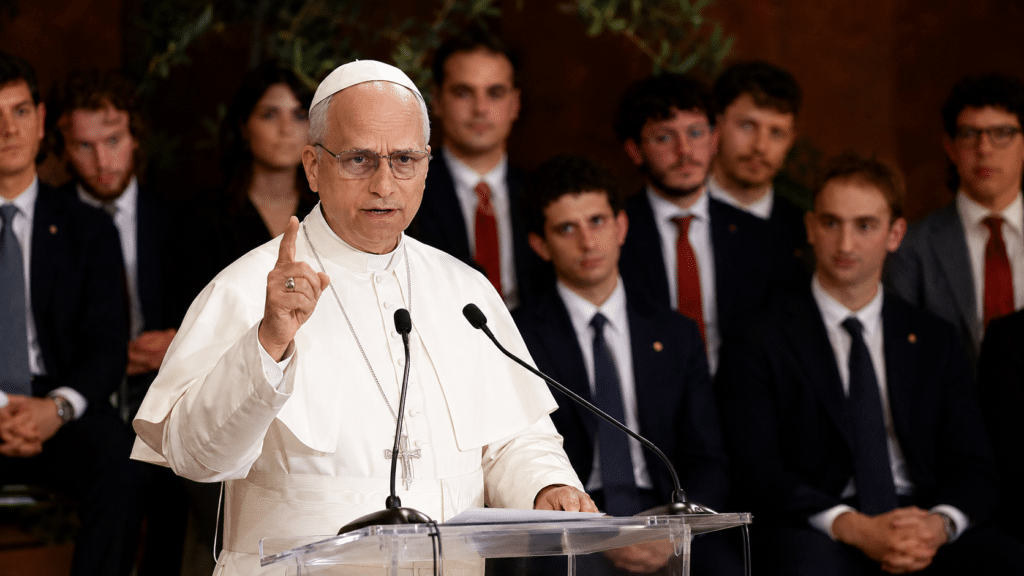
Europe Increases Military Spending, Pope Rejects the Narrative
Pope Leo’s intervention was aimed directly at the political vocabulary now used to justify Europe’s military turn. In Reuters’ account, he said Europeans should not call rearmament “defence spending” when it increases tensions, weakens trust in diplomacy, and shifts resources away from social needs. These comments go to the centre of a debate running across the continent, where governments increasingly present higher military budgets as unavoidable realism rather than as a political choice with social costs.
European military spending just climbed by the largest amount since the end of the Cold War, following pressure from the war in Ukraine and US President Donald Trump’s demands that NATO allies contribute more. Leo said that this is not a simple budgetary adjustment to address new threats, but a reordering of priorities that is being sold to the public as prudence, despite redirecting money and political resources away from civilian life and towards permanent preparation for conflict.
AI Leads to Inhuman Evolution & Spiral of Annihilation, Pope Claims
During the university visit on May 14, the Pope called for tighter monitoring of how AI is developed and used in both military and civilian settings:
“What is happening in Ukraine, in Gaza and the Palestinian territories, in Lebanon and in Iran describes the inhuman evolution of the relationship between war and new technologies,” the pope said during a visit to the Sapienza University of Rome on May 14, urging vigilance over AI systems “so that they do not remove responsibility from human choices and do not worsen the tragic nature of conflicts.”
“Study, research and investments should go in the opposite direction,” he said. “They should be a radical ‘yes’ to life, yes to innocent life, yes to young life, yes to the life of peoples who cry out for peace and justice.”
This approach cuts into the standard defence-industry argument that AI is merely making war more precise, efficient, and deterrence-focused. According to Pope Leo, AI does not simply sit inside existing military structures as a neutral tool, but changes the very character of war itself by speeding up decisions, making conflicts more abstract, and allowing states to claim technological necessity where moral judgement should still apply. The problem, he says, is not just autonomous weapons themselves, but the whole direction of travel in which human responsibility is displaced by systems, optimisation, and distance.
Vatican Prepares Broader Intervention on AI
What the Pope said last week was not an isolated outburst. According to reports, Leo is expected to issue his first encyclical later this month with a likely title “Magnifica Humanitas” (magnificent humanity), placing artificial intelligence at the centre of a new moral and labour question for the Church. The document is expected to argue that technology must remain subordinate to the human person, not the other way around, and to frame AI as the defining social challenge of a new industrial revolution.
The Vatican, therefore, is not treating AI as a niche technical problem or a matter left to engineers, regulators, or corporate ethics boards. Instead, it’s moving to place human dignity, labour rights, and moral agency at the centre of the conversation. Axios says that the Holy See has already implemented internal AI guidelines and monitoring structures, while the late Pope Francis repeatedly warned that AI could deepen inequality, surveillance, and autonomous warfare. It seems that Leo is ready to take Francis’ arguments a step further, and make the defence against AI a central theme of his papacy.
Is AI Military Spending Essential for National Security, or Is It Just Enriching the Elites?
Those opposing the increased spending and the AI boom say the rising military expenditure only enriches elites and betrays diplomacy by diverting funds from education and healthcare during a time when social needs are critical. AI in warfare absolves humans of moral responsibility for their choices and accelerates conflicts, requiring strict monitoring to prevent technology from overtaking human dignity and judgment. It’s also argued that humanitarian corridors and educational opportunities should be prioritised in the meantime to assist people suffering from war, displacement and lack of medical care for conditions like cancer.
But people looking ahead at national security concerns argue that defence must be prioritised. Increased defence spending is seen as essential security investment responding to real threats like the Russia-Ukraine war and meeting NATO commitments urged by allied leadership. Advanced military technology including AI represents necessary modernisation for national defence capabilities and maintaining strategic advantages in an evolving security environment. And specifically regarding Gaza, it’s said that security concerns and political considerations must guide responses to the ongoing situation, balancing humanitarian gestures with broader regional stability and alliance commitments.
Final Thought
Europe is not simply spending more on arms. With the recent sharp increase in commitments, it looks more like the start of an entirely new political and technological order in which war is easier to fund, justify, and automate. Pope Leo’s warning can be taken as moral rhetoric detached from the real security issues being faced worldwide, or it can be inferred as a necessary stance against an almost inevitable AI-led, conflict-dominated future. Can civilisation really continue down this path while still pretending it’s acting in the service of peace?
The Expose Urgently Needs Your Help…
Can you please help to keep the lights on with The Expose’s honest, reliable, powerful and truthful journalism?
Your Government & Big Tech organisations
try to silence & shut down The Expose.
So we need your help to ensure
we can continue to bring you the
facts the mainstream refuses to.
The government does not fund us
to publish lies and propaganda on their
behalf like the Mainstream Media.
Instead, we rely solely on your support. So
please support us in our efforts to bring
you honest, reliable, investigative journalism
today. It’s secure, quick and easy.
Please choose your preferred method below to show your support.

Categories: World News
I am sure majority are taken in by the slick Ai revolution. What interests me is the limited profile of Ai and whether regular folks will follow or discern the bullshit that is preprogrammed for them …
Interesting times – the previous pope was promoting the “globalist agenda”, big pharma, one world religion or so it seems.
What this Pope is saying about AI is most relevant. The Western “governments” should implement the same intervention and do away with the “division of labour”. If only the voters could have a vote on all this.
NATO, aka America, deliberately manoeuvred Russia into crossing the border into East Ukraine. It, using puppet Boris Johnson, then stamped upon the peace conference in Turkey. America wanted to demonise Russia, yet again, to enrich the arms industry, the banks, and push forward genocidal policies.