





A proposed constitutional amendment by Hungary’s governing Tisza Party triggered backlash after initially seeking to remove references to protecting the country’s ‘Christian culture’ from the Basic Law.
The government later revised the proposal, insisting the changes were aimed only at abolishing the Sovereignty Protection Office, amid criticism that the original amendment could weaken Hungary’s migration policy and constitutional identity.
Let’s not lose touch…Your Government and Big Tech are actively trying to censor the information reported by The Exposé to serve their own needs. Subscribe to our emails now to make sure you receive the latest uncensored news in your inbox…
Confusion over Tisza’s Constitutional Amendment on Christianity and Migration
By Lili Zemplényi, as published by the Hungarian Conservative on 27 May 2026
Last week, Hungarian Prime Minister Péter Magyar’s brother-in-law and Tisza MP Márton Melléthei-Barna submitted an amendment to the Basic Law that the prime minister himself proposed modifying just days later.
Initially, Melléthei-Barna suggested removing the following two sentences from Hungary’s Basic Law: “The protection of the constitutional identity and Christian culture of Hungary shall be an obligation of every organ of the State. In order to protect constitutional identity, an independent organ established by a cardinal Act shall operate.”
Prime Minister Magyar now proposes deleting only the second sentence, while retaining the first. Tisza appears to have backtracked after criticism that the original proposal would have undermined Hungary’s migration policy and the constitutional protection of Christianity.
Scrapping the Sovereignty Protection Office
Péter Magyar insisted that the amendment was intended solely to abolish the Sovereignty Protection Office, not to remove the constitutional obligation to protect the “Christian culture of Hungary.” According to the government, deleting only the second sentence of Article R(4) would provide sufficient legal basis to eliminate the Office, whose abolition Tisza had pledged during the election campaign.
The previous government established the Sovereignty Protection Office to investigate and report on foreign influence operations deemed harmful to Hungary’s sovereignty. Because the Office focused heavily on non-governmental organisations (“NGOs”) and other civil actors receiving foreign funding, the then opposition frequently described it as a “thought police.”
Removing the Requirement to Protect Christian Culture
(Besides the National Avowal) Hungary’s Basic Law contains two further references to Christianity. First, Article R(4), cited above, states the country’s obligation to protect the “Christian culture of Hungary.” Later, the constitution declares that “… Hungary shall protect the right of children to a self-identity corresponding to their sex at birth, and shall ensure an upbringing for them that is in accordance with the values based on the constitutional identity and Christian culture of our country.”
Tisza’s proposal to remove one of these references to Christianity and the protection of Hungary’s “Christian culture” quickly triggered a backlash. The Christian Democratic People’s Party – formerly Fidesz’s coalition partner – launched a petition against the amendment. Within two and a half days, 40 thousand signatures were collected opposing the government’s proposal.
In its criticism, the Christian Democratic People’s Party noted that Tisza had provided no explanation in the amendment’s reasoning as to why the clause concerning Christianity should be removed. Following Tisza’s partial withdrawal of the proposal, the Christian Democrats praised the coordinated efforts of the petition’s signatories.
Implications on Migration Policy
The removal of the entire paragraph from the Basic Law could have had serious implications for Hungary’s migration policy. Hungary’s duty to protect its “constitutional identity and Christian culture” was the constitutional basis to reject the EU’s Migration and Asylum Pact as well as of the strict migration policies that characterised the previous government’s 16-years.
Once MP Márton Melléthei-Barna proposed the changes, Fidesz sharply criticised the move, arguing that strong anti-migration measures are supported by the majority of Hungarians and that their constitutional basis should therefore not be removed from the Basic Law. After Tisza partially withdrew its proposal, MP Gergely Gulyás described the reversal as a Fidesz victory in defending the country’s migration policy.
“Strong anti-migration measures are supported by the majority of Hungarians”
In 2018, the proclamation on Hungary’s “constitutional identity” was introduced to the Basic Law as a reaction to and against the EU pushing for compulsory migration relocation quotas. The EU’s Migration and Asylum Pact, which enters into force on 11 June 2026, introduces three types of measures on how EU Member States that are not under migratory pressure must aid countries that are experiencing difficulties handling migration.
One of these measures is to accept 21,000 migrants from the Member States that are under migratory pressure. Instead of this migrant relocation scheme within the European Union, the previous Hungarian government insisted on the need to protect the EU’s external borders and stop illegal arrivals. In 2018, Article R (4) was introduced to the constitution to reinforce this policy as well as Hungary’s legal grounds to resist illegal migration while also serving as a ground to oppose the EU’s migrant relocation plans.
Albeit this Article from the Basic Law was not directly referenced in the European Court of Justice’s (“ECJ”) migration-related judgements (see C-808/18 and C-123/22), Hungary is fined 1 million EUR a day for its Orbán-era migration policies. Since June 2024, Hungary has been ordered to pay a daily fine of 1 million EUR on top of a lump sum amount of 200 million EUR for non-complying with the ECJ’s 2020 judgement that ruled that Hungary has failed to fulfil its obligations when handling asylum applications.
Despite the fines, the previous Hungarian government was unwilling to amend its migration laws and, rather than complying with the rulings, Budapest began preparing a lawsuit against the European Court of Justice. Péter Magyar, who seeks to reset Hungary’s relations with the EU, is likely to pursue a different approach to handling the penalties. The details of the current government’s solution, however, have yet to be clarified.
Related articles from the Hungarian Conservative:
- Hungary’s New Government Accused of ‘Betrayal’ over Migration Policy Shift
- Hungary’s Magyar Seeks Political Deal with Brussels on EU Funds by Late May
About the Author
Lili Zemplényi is a graduate of University College London (UCL). Currently, she is completing her MA at the Higher School of Economics. Previously, she worked as an intern at the Hungarian Academy of Sciences, Institute for Political Science.
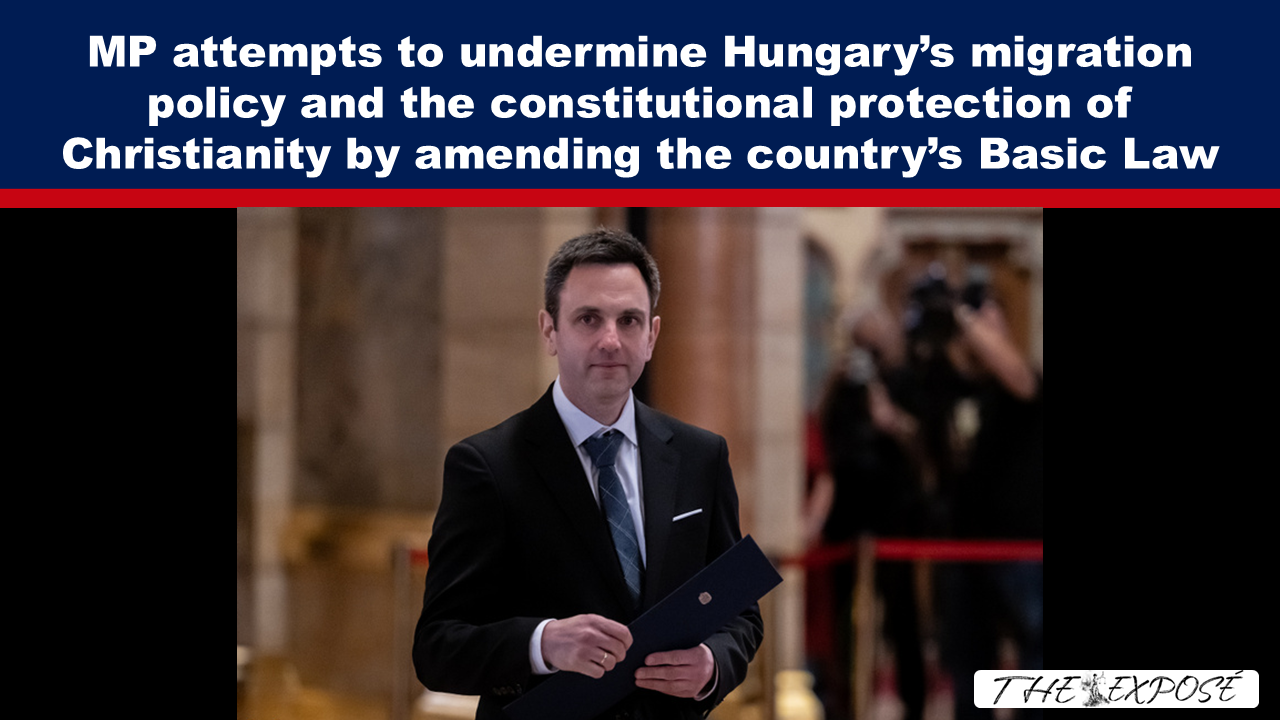
Featured image: Márton Melléthei-Barna, 4 May 2026. Source: Index

Categories: Breaking News, World News
https://expose-news.com/2026/05/27/mp-attempts-to-undermine-hungary/
Sooo, the new party who said they would not bow to the EU lies and threats are already trying to sell out Hungary by changing bits of legislation behind the backs of the people who supported Orban (for 14 years of not succumbing to the tyranny of the totalitarian mob at the EU) how gullible can some people be!
It’s so disappointing; I can’t believe the Hungarian people voted for this person. Were the elections fudged?
Let’s hope the Hungarian people, despite failing to vote Orban back in, will stand up to this attempt to force them to join the no-borders no-native culture/religion wackos. They used to be a shining example of standing up to the awful globalists who are trying to reduce us all to the level of the third world.
So Soros finally got his useful idiots in office?
When Tisza MP Márton Melléthei-Barna and the Prime Minister allow this to become law then Hungary is done, Islam will move in and the people will be in bondage, what do you think made Hungary what it is today ??? surely not Islam or secularism or evolution, God fearing people made Hungary what it is today, and now Ignorant unwise people want to change it.
Nothing is won until that MP is out of office immediately.