





China has become the first country to approve a commercial implantable brain-computer interface. The device, known as NEO, is designed to help people with paralysis regain hand function by translating brain signals into commands for a robotic glove. But this isn’t just a medical breakthrough; it’s also a vital geopolitical marker, and a warning against the potential misuse of intimate tech. In the race to connect human brains directly to machines, Beijing has reached the market before Elon Musk managed to deliver his “Neuralink” project. And experts are already sounding the alarm.
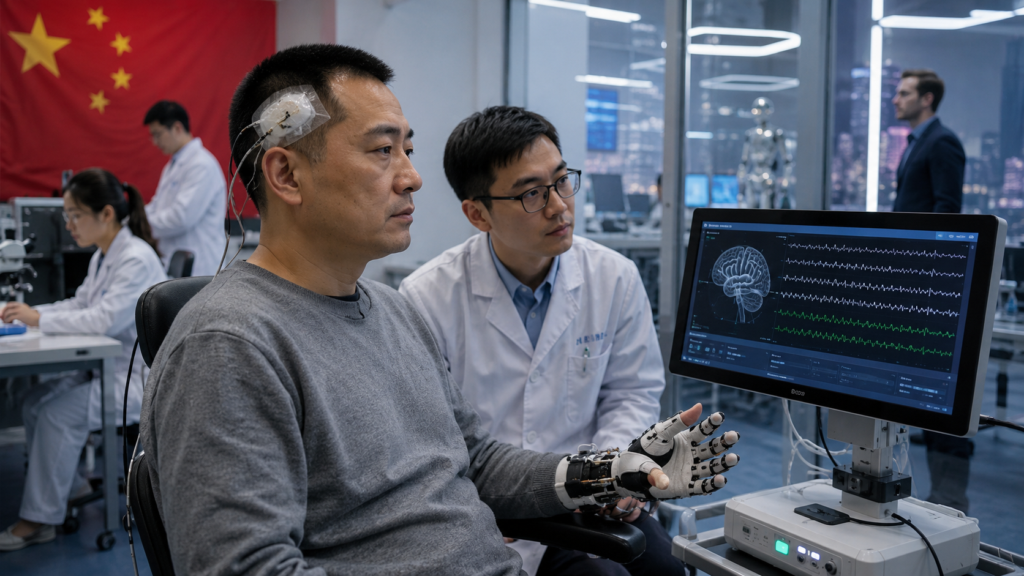
The device was developed with Neuracle Medical Technology in Shanghai, with research links to leading Chinese institutions including Tsinghua University. China’s National Medical Products Administration approved the system in March, making it the world’s first invasive brain-computer interface medical device to receive market approval. For now, the product is intended for people with spinal cord injuries who retain some upper arm function, but have lost the ability to grasp with their hands.
The chip bypasses part of the broken communication pathway between the brain and the body, in patients living with paralysis. When the user thinks about moving their hand, the implant detects signals from the brain’s motor area, sends those signals to an external computer, and the chip translates them into movement via a robotic glove.
Significantly, China has managed to beat Musk to market. Neuralink was founded in 2016, and built around a surgically implanted device called the N1 and a robot designed to place tiny electrode threads into the brain. Its first human clinical trial was approved by the FDA in 2023, and Neuralink said it implanted its first human participant in January 2024, with the early goal of allowing people with severe paralysis to control computers and digital devices through neural signals. Both Musk and China’s NEO were pursuing broadly the same ambition, using brain activity to control external technology, but by reaching commercial approval first, Beijing has gained a symbolic and regulatory advantage that could shape medicine, military research and human-machine control.
A key difference between the two projects is in the way the implant is inserted. Neuralink, led by Musk, uses very thin electrode threads implanted into the brain tissue itself, and done by a surgical robot. NEO is a coin-sized wireless sensor that sits on or near the surface of the brain’s protective membrane rather than penetrating deep into the cortex, making it significantly less invasive but also potentially less precise than systems recording from inside the brain tissue.
For China, this represents part of a wider push to compete in strategic technologies worldwide from electric vehicles and batteries to artificial intelligence, robotics, quantum computing, and advanced biotechnology. The country has set out a plan to build a globally competitive brain-computer interface (BCI) industry within five years, covering both implantable and non-invasive devices.
Brain-computer interfaces could transform life for people with amputations, stroke damage, ALS, and spinal cord injuries around the globe. Helping a person to move, speak, or use a computer grants independence in a way the world has never seen before.
But these are not ordinary consumer gadgets. Success at the forefront of the emerging BCI industry represents a huge step forward in medicine, surveillance, disability support, military interest, and human enhancement. The same technology that helps a paralysed person grasp a cup may also be misused for psychological manipulation, hacking, coercion, and state access to the most intimate signals a person produces.
The history of modern technology is filled with examples of tools introduced for convenience, safety, or medical benefit that later became systems for surveillance, data extraction, or behavioural control. Smartphones, for instance, were communication devices long before they became tracking infrastructure. Social media looked like a way to connect before it became a psychological and political influence machine. Wearable devices emerged as fitness gadgets, but later turned bodies into continued data streams.
Musk, speaking at an event in Israel, described restoring movement to people with severe paralysis as “Jesus-level technologies”. One Neuralink participant, Audrey Crews, recently said “I tried writing my name for the first time in 20 years. I’m working on it,” adding, “It’s humbling to know my journey is helping Neuralink refine this technology, which could one day let millions control devices with their minds”.
Meanwhile, experts are warning that brain-computer technology raises significant privacy and cybersecurity concerns. Dr David Tuffley of Griffith University said the technology could theoretically expose highly sensitive neural data, including thoughts and memories. He also warned that hacking such systems could potentially affect cognitive functions or even interfere with movement-related signals.
A technology that allows thought to move a machine, even if currently used to restore movement to paralysed patients, cannot be treated as just another medical device. The genuine capability to improve lives should not be ignored either, but China’s victory in the space lays down a marker. The competition to connect the human brain directly to machines has entered the market. Where do we go from here?
The Expose Urgently Needs Your Help…
Can you please help to keep the lights on with The Expose’s honest, reliable, powerful and truthful journalism?
Your Government & Big Tech organisations
try to silence & shut down The Expose.
So we need your help to ensure
we can continue to bring you the
facts the mainstream refuses to.
The government does not fund us
to publish lies and propaganda on their
behalf like the Mainstream Media.
Instead, we rely solely on your support. So
please support us in our efforts to bring
you honest, reliable, investigative journalism
today. It’s secure, quick and easy.
Please choose your preferred method below to show your support.

Categories: Latest News
Now we know what the mark in the brain is as well as the rfid chip that will go into the back of the right hand. Look up brothers and sisters because the time is at hand. We will rise in the air to meet our bridegroom king Yeshua Ha’Mashiach in the air , look out inhabitants of the earth because you will be meeting satan in the flesh. Yes, Jacob’s trouble is right around the corner. Rejoice Saints because we are almost home.
Hope it is sooner…
Yeah, me too! The signs of the times are everywhere.
Could it be that perhaps China “beat” Musk to approval, because China essentially has NO safeguards for human health??? Asking for a friend.
Also, how can anyone be certain that Musk isn’t working with China (and perhaps many other countries), and could get his “work” approved in China (due to virtually no safeguards on human health) before any other country??? Again, asking for a friend.
56 yrs of space travel capability and you’ll not find a seat sale mmm
Not true. Many people have paid for space travel.
Shhhh..!! You just blurting the truth about NoLeMusk’s involvement in real life human testing & inhuman (labrat) test subject.
Human lab rat are forbidden in every countries but not in China.
Never in Musk’s life would let him lost to anyone in every competition to be most notorious successful person ever lived. Never…!!!!
P/S: Asking for a friend here would be awkward. Try OnlyFan or Tinder instead.
https://www.youtube-nocookie.com/embed/dZzY8-nxabA how could they possibly know
The question everyone should
be asking is – why?
In scripture it talks about a large army coming from the East into the battle at Armageddon where Christ and his army will make a last stand against the pagan armies of the world. The brain chip I believe will be used to enhance the armies abilities to fight. What we are looking at now is a precursor, a laying of the foundation for the happening of this event. pastor Boyd
Wow, now that is high tech. Way over my head pastor.
By the way the Armies from the East is China crossing the Euphreties River to battle at Armageddon.
Actually it is the Kings of the East.