





In 2016, DARPA launched the Prometheus programme to develop a test that predicts whether a person will become contagious from an infectious disease within 24 hours of exposure, even before symptoms appear.
By identifying minimal sets of biological biomarkers – such as messenger RNA and immune-response proteins – the tests would indicate contagiousness, enabling early treatment or quarantine.
Prometheus represents a broader shift in DARPA’s biotechnology portfolio toward using computer models and predictive analytics, rather than actual symptoms.
As Jon Fleetwood explains below, this raises many concerning questions.
Related:
Let’s not lose touch…Your Government and Big Tech are actively trying to censor the information reported by The Exposé to serve their own needs. Subscribe to our emails now to make sure you receive the latest uncensored news in your inbox…
DARPA’s 2016 ‘PROMETHEUS’ Project: Declare People Contagious Without Symptoms to Enable ‘Quarantine’ and Medical Interventions
By Jon Fleetwood, 23 June 2026
In 2016, the Defence Advanced Research Projects Agency (“DARPA”) launched ‘Prometheus’ (HERE), a military research programme designed to determine whether a person was “likely to spread disease” without exhibiting symptoms of illness, with the stated goal of enabling quarantine and medical interventions.
The revelation follows the US Department of Health and Human Services’ (“HHS’s”) recent quarantine of a symptomless American against her will after testing negative for hantavirus.
Prometheus represents one of the clearest examples in DARPA’s biotechnology portfolio of an effort to move purported infectious disease response away from waiting for observable illness and toward “predictive” analysis of claimed genetic changes occurring inside the human body.
It also raises broader questions about how governments may increasingly rely on computer models – rather than observable clinical evidence – to make drastic public health determinations.
It also raises obvious questions:
- What happens when a computer says you’re contagious but you have no symptoms?
- Could governments eventually quarantine or medically intervene based on that prediction?
- And if the computer is wrong, how would you ever prove it?

Predicting Contagiousness Before Symptoms
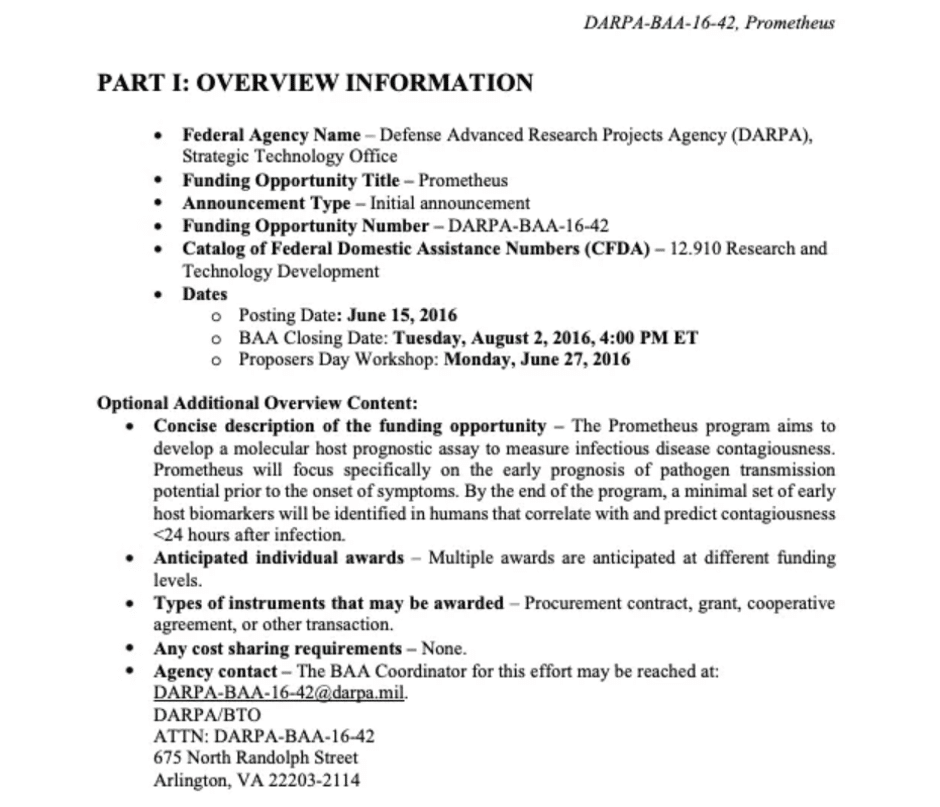
DARPA summarised the programme’s objective in unusually direct language. According to the agency’s Prometheus webpage: “The Prometheus programme aims to improve military readiness and force health through development of a prognostic that can determine if an individual is contagious before he exhibits symptoms of illness.”
The agency further explained: “DARPA’s goal is to develop a molecular test for determining if an individual is likely to spread disease following exposure to an infectious agent and predict within 24 hours of exposure if that individual will become contagious.”
According to DARPA, the capability would allow military planners to identify potentially contagious individuals before they transmitted disease within the close quarters common in military operations.
The accompanying Broad Agency Announcement (“BAA”) similarly states that the programme sought to: “… develop a molecular host prognostic assay to measure infectious disease contagiousness” and identify individuals “in advance of diagnostics or symptom reporting for potential interventions.”
Rather than waiting for symptoms or a conventional diagnosis, Prometheus proposed using molecular biomarkers to predict contagiousness before either occurred.
Looking Inside the Human Body
To accomplish that, DARPA proposed identifying a minimal collection of biological signals capable of forecasting contagiousness shortly after exposure.
According to the agency: “Prometheus specifically aims to discover a minimal set of biological signals in a person recently infected with disease that would indicate the potential for contagiousness …”
Those biological signals – or biomarkers – would be identified by characterising a person’s genetic and molecular immune responses over time.
The BAA describes measuring messenger RNA, host genetic mutations, immune-response proteins, cytokines, metabolites, genomics, proteomics, metabolomics, epigenomics and pre-existing immunity to identify early molecular signatures associated with future contagiousness. Those data would then be integrated using advanced computational modelling.
According to the BAA, “The DARPA Prometheus programme seeks to advance our understanding … by … performing advanced, integrative analytics and predictive modelling …”
DARPA claimed to seek “95% accuracy with minimal set of biomarkers for predicting contagiousness within 24 hours of exposure to a pathogen.”
Predicting Who May Never Appear Sick
One of the least-discussed objectives appears in DARPA’s own programme summary. The agency stated that researchers aimed to: “… develop advanced analytics to predict which individuals will become contagious and whether or not they will show symptoms.”
In other words, the programme was not limited to forecasting contagiousness.
It also sought to predict whether a person would ever become symptomatic. That objective reflects DARPA’s view that some individuals may spread respiratory infections before – or even without – developing observable illness.
The BAA echoes this concern, stating, “The spread of many acute infections is caused by people who are contagious prior to developing symptoms.”
DARPA argued that waiting for clinical diagnosis or symptom reporting produced incomplete surveillance because many contagious people either had mild symptoms or never sought medical care.
From “Prediction” to Quarantine
DARPA did not present Prometheus as simply an academic research project. The agency explicitly described how it believed the capability could be used operationally: quarantining symptomless individuals.
According to DARPA, “A successful prognostic capability would enable early treatment of infected individuals or the initiation of other mitigating steps (e.g., quarantine) before a disease can be transmitted to others.”
DARPA further stated, “Technologies developed in this programme could enable the earliest possible clinically actionable information and extend infectious disease forecasting into a real-time, accurate support tool for military planners.”
The BAA similarly states that identifying people before diagnostics or symptom reporting would enable “potential interventions” and improve outbreak response.
In other words, Prometheus was designed not merely to forecast disease transmission, but to produce information intended to support drastic disease-response decisions before symptoms appeared.
The Larger Questions
Prometheus raises questions that extend well beyond military medicine:
• If governments develop the capability to identify people as likely contagious before symptoms or conventional diagnosis, what evidentiary standard governs those determinations?
• When does a computational prediction become sufficient to trigger quarantine or other public health interventions?
• If someone feels healthy, exhibits no observable illness, and has not received a conventional diagnosis, what evidence could they present to challenge the prediction?
• Would they have access to the underlying algorithm?
• Would independent researchers be permitted to examine the model and the reference datasets on which it was trained?
• What mechanisms would exist to identify false positives before interventions are imposed?
• Could the prediction itself eventually become the operative evidence?
Like many military-developed technologies, Prometheus also raises questions about dual use:
• Could capabilities initially developed for military force health eventually migrate into broader civilian public health systems?
• Could similar predictive tools eventually be adopted by employers, schools, transportation systems, insurers or other institutions?
• If so, what safeguards would prevent mission creep?
These questions do not depend on whether the technology ultimately succeeds. They arise from the capability DARPA proposed building.
Bottom Line
Prometheus represents a notable evolution in DARPA’s approach to infectious disease response.
Rather than waiting for observable illness or conventional diagnosis, the agency proposed identifying genetic signatures in a computer capable of predicting contagiousness before symptoms appeared and using those predictions to justify earlier treatment, quarantine and operational planning.
Viewed alongside DARPA’s broader biotechnology portfolio – including PROPHECY’s effort to anticipate future viral evolution, ECHO’s effort to infer past exposures from the human epigenome, and PREPARE’s effort to transiently modulate the body’s own protective genes – Prometheus reflects the agency’s broader shift toward using computational models of human biology to generate actionable determinations before they can be established through conventional clinical observation.
As governments continue developing technologies capable of making alleged biological predictions before those predictions can be independently observed or conventionally verified, one question becomes increasingly difficult to ignore.
When public health decisions begin with algorithmic predictions rather than observable evidence, what mechanisms ensure those determinations remain transparent, independently verifiable and accountable?
Further reading from Jon Fleetwood:
- DARPA’s 2018 ‘PREPARE’ Project Sought to Program the Human Body, Using Claims of Pandemic, Chemical, and Radiological Threats as Justification
- DARPA’s ‘ECHO’ Project: A Computer System That Declares You’ve Been ‘Exposed’ to a Biological or Chemical Threat—With No Physical Evidence
- DARPA’s 2001 ‘Biofutures’ Study Reveals the In-Silico Philosophy That Later Reappeared Across Its Pandemic Portfolio
- Beyond Lab Leak and Natural Spillover: The ‘In Silico Theory’ of Pandemic Orchestration
- DARPA Project ‘PROPHECY’ Reengineered Vaccine Development by Building Future Pathogen Blueprints First and Systems to ‘Validate’ Them Later
- DARPA’s Pandemic Stack: Building the Pandemic Operating System Before COVID
- DARPA’s 2018 ‘PREEMPT’ Program Sought to Build the Wildlife Alibi for Future Pandemic Pathogens
- DARPA’s 2010 Operation ‘PROPHECY’ Funded Ralph Baric’s UNC Network to Generate the Genetic Blueprint of Future Pandemic Coronaviruses
- 2018 DARPA/EcoHealth ‘DEFUSE’ Proposal Documented All Three SARS-CoV-2 Spike Anomalies Before the Pandemic
- Drones Spray ‘Self-Spreading’ COVID-19 Vaccine for ‘Large-Area Inoculation of Humans’ in ‘DEFUSE’ EcoHealth/DARPA Project
- HHS Quarantines Symptomless American Against Her Will Even After Testing Negative for Hantavirus
About the Author
Jon Fleetwood is an American investigative journalist, author and independent analyst known for his work on health policy, biotechnology and political narratives. He publishes articles on his Substack page ‘Jon Fleetwood’. You can also follow him on Instagram HERE and Twitter (now X) HERE.
He is the author of ‘An American Revival: Why American Christianity Is Failing & How to Fix It’ and co-author of ‘What We’re Afraid to Ask: 365 Days of Healing for Adult Survivors of Childhood Abuse’.
The Expose Urgently Needs Your Help…
Can you please help to keep the lights on with The Expose’s honest, reliable, powerful and truthful journalism?
Your Government & Big Tech organisations
try to silence & shut down The Expose.
So we need your help to ensure
we can continue to bring you the
facts the mainstream refuses to.
The government does not fund us
to publish lies and propaganda on their
behalf like the Mainstream Media.
Instead, we rely solely on your support. So
please support us in our efforts to bring
you honest, reliable, investigative journalism
today. It’s secure, quick and easy.
Please choose your preferred method below to show your support.

Categories: Breaking News, Latest News, World News
This goes against the latest science which says matter appears within consciousness, not the other way around. The DARPA’s approach hinges on the molecule (matter) not on the consciousness.
The military people are dangerous, not so much because of their power, but mainly because of their ignorance.
H Serge Grenier, you say “the latest science which says matter appears within consciousness.” Which “latest science” are you referring to?
I initially laughed at this article, then realised the catastrophic consequences of this clown show. The bottom line is that contagion is a myth, thus, you can’t test for it.
FYI, tests utilising mRNA and immune-response proteins are ‘indirect’ markers of illness. Couple this fact with the former myth, and you have 100% false positives.
Pamdemics can and will be even easier to manufacture!
“The spread of many acute infections is caused by people who are contagious prior to developing symptoms.”
Wrong! This has been falsified many times. There’s no such thing as asymptomatic spread of any disease in history between humans.
One only has to look up all the ‘Challenge Studies’ to realise this simple, but very inconvenient fact.
Correct, If was true, the majority of humanity would be sick or dead. This is all about keeping the WHO agenda alive.
Does this model account for the variation in people’s immune system? People are not all the same and fight infections differently. I can’t see this model being accurate at all.