





Flock Safety operates approximately 120,000 automated license plate readers (“ALPRs”), also known as automatic number-plate recognition (“ANPR”) systems, across 49 US states. Its network of cameras includes contracts with over 7,000 organisations, including over 5,000 law enforcement agencies.
Flock cameras promise easier policing by destroying the Fourth Amendment – creating a permanent, searchable, warrantless database of everywhere Americans go, Tanner Turnpaugh explains.
Let’s not lose touch…Your Government and Big Tech are actively trying to censor the information reported by The Exposé to serve their own needs. Subscribe to our emails now to make sure you receive the latest uncensored news in your inbox…
Flock Cameras vs. Freedom: Welcome to the Warrantless Panopticon
By Tanner Turnpaugh, as published by the Daily Economy on 13 August 2926
Last weekend, I drove from Massachusetts to Washington, DC. Somewhere along those 450 miles, my license plate was almost certainly photographed, time-stamped and logged into a private database maybe ten, or even a hundred, times. I honestly can’t tell you how many I passed – and that’s the problem.
Flock Safety, the (nominally private) company behind most of the cameras, operates in more than 2,000 cities. No warrant, no suspicion, and no notice was required to record my trip. I did nothing wrong. I was tracked anyway.
This is not a speed camera or a red-light camera. When Atlantic City expanded its license plate readers, the department put fixed cameras on every entrance and exit to the city so that every vehicle coming in or out gets scanned. Parking lots, expressways, and intersections have become de facto police stops. Networked across thousands of towns, those individual snapshots stop being individual occasions. They become a record of your life, a “literal and intimate roadmap of private life” – where you work, where you shop, which doctor you see; whether you attend worship or a protest or a firing range. As one respondent in the research put it, wholesale surveillance “is not simply a more efficient way for the police to do what they’ve always done. It’s a new police power.”
Now, do the cameras help solve crimes? Sometimes. But the evidence here is a lot weaker than the sales pitch. That same Atlantic City expansion, one of the only rigorous evaluations we have, found that blanketing the city’s entrances did not reduce violent crime. There were some reductions in shootings and car thefts, and the technology mostly sat siloed in a few investigative units.
A 2025 review by some of the biggest names in evidence-based policing concluded that after decades of research, we still cannot establish whether license plate readers are cost-effective at all, because the effect depends entirely on how a department implements them. So, taxpayers are compelled by city councils to pay a recurring subscription for a system whose returns are unproven – but whose violations are constant.
Accountability normally disciplines surveillance. Private companies that misuse our data lose our trust and our patronage; they can be sued and fined. Government data collection is disciplined by the Constitution: warrants, courts, elections. Flock is a hybrid that slips both checks, and that is exactly what makes it dangerous. The people being watched are not the customers. Drivers cannot opt out of being scanned and the police department or city council decides whether you’ll be a user. And there is no constitutional discipline because a private company does the collecting, so the government gets the data without the Fourth Amendment process to constrain it. Legal scholars have a name for the government buying its way around the warrant requirement: data laundering.
No regulatory discipline is waiting to fill the gap, either. Adoption of this technology has completely outpaced the rules. Researchers who interviewed police leadership and Flock representatives found no standardisation, no independent audits and policies being worked out long after the cameras were already tracking citizens. The agencies themselves admit they are running on “best practices” because there is no law. An ACLU lawsuit revealed that Immigration and Customs Enforcement (“ICE”) was using a private license plate database containing billions of scans to target people for deportation – after a similar project by the Department of Homeland Security was scuttled as clearly unconstitutional.
Police are quick to say Flock cameras make investigations easier and some citizens say they have nothing to hide and have done nothing wrong, but the definition of “wrong” can be changed. Freedom is not just being left alone today. Living under someone’s arbitrary power to track you whenever they choose is itself the harm, even before the power is abused (which it absolutely is, everywhere, every day). Jeremy Bentham’s panopticon, designed for prisoners, is now pointed at everyone. People who know they are being watched start policing themselves; they surrender autonomy. They think twice about the gun store, the clinic, the protest, the mosque. Surveillance itself is a blow to freedom.
The constitutional debate continues. Courts have so far said a license plate in public carries no reasonable expectation of privacy, and for one officer seeing one plate once, fine. But that logic was built for the world before the nationwide mass surveillance network and endless, near-free logging of data. A permanent, searchable record of every trip you take is a difference in kind, not in degree. The Supreme Court already recognised in Carpenter that tracking the whole of a person’s movements is a search and generally requires a specific warrant. In Chatrie, SCOTUS recently ruled that accessing cell phone location history is a search. A camera grid that can collect and reconstruct geographic location for every driver, without reasonable suspicion or probable cause, violates individuals’ reasonable expectation of privacy under the Fourth Amendment. Collecting mass data is not an exception to the rule. It is a direct violation.
Every query of a Flock database should require a judicial warrant. Independent audits should be a condition of any contract, and contracts that won’t meet those terms should be voided. A free society can live with some unsolved crimes. It cannot live with an unaccountable, permanent, searchable registry of constitutionally private and protected activities.
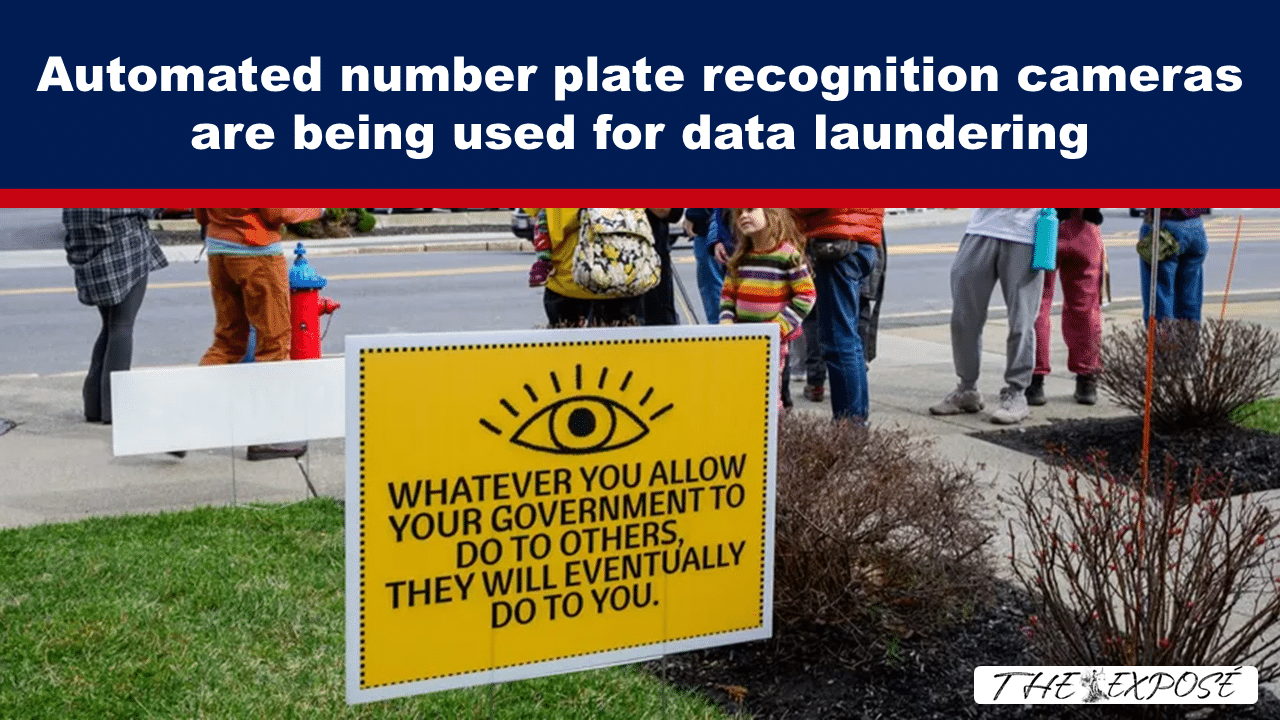
Featured image: People around the US have been protesting Flock cameras, saying that the technology is creating a surveillance state. Source: CNN
The Expose Urgently Needs Your Help…
Can you please help to keep the lights on with The Expose’s honest, reliable, powerful and truthful journalism?
Your Government & Big Tech organisations
try to silence & shut down The Expose.
So we need your help to ensure
we can continue to bring you the
facts the mainstream refuses to.
The government does not fund us
to publish lies and propaganda on their
behalf like the Mainstream Media.
Instead, we rely solely on your support. So
please support us in our efforts to bring
you honest, reliable, investigative journalism
today. It’s secure, quick and easy.
Please choose your preferred method below to show your support.

Categories: Breaking News, Latest News, US News
Worse than that is they may not read the plate accurately. During CVD, I got a ticket for crossing a bridge in San Francisco w/o paying the toll. I live in Orange County in S California. had never been on that bridge in my life or been in SF in at least a decade. Fortunately, there was a phone number I could call and talk to a real person who determined the F on my plate had been misread as an E. The ticket was dropped and I did not have to pay the fine. What a relief.
All this surveillance and data harvesting needs storage which is why all the datacentres are popping up everywhere in the world. Data centres are unwanted by all people, regardless of political orientation, race, culture, religion, and gender because they are harmful to all living organisms, robs the environment of resources (water, power and land). Stop surveillance to stop data centres. This is not about right or left, it’s about tyranny vs freedom.
Don’t worry, they’ll tell you, only guilty people have any cause for concern. Of course they might misidentify you and convict you of someone else’s crime. But that will happen to someone else, won’t it?