





Dr. Carl Heneghan, a UK urgent care general practitioner, called an ambulance for a patient using a dedicated clinician line.
In the past, his clinical assessment of the patient would have been sufficient for an ambulance to be dispatched. But something has changed.
The NHS is now remotely assessing the need for an ambulance response requested by doctors using a score, a number. This number is replacing the requesting doctor’s patient examination, experience, pattern recognition, context and knowledge of the patient’s history.
Related: Numercide: When doctors use numbers to prescribe medicines to healthy people
Let’s not lose touch…Your Government and Big Tech are actively trying to censor the information reported by The Exposé to serve their own needs. Subscribe to our emails now to make sure you receive the latest uncensored news in your inbox…
Tales from the Front Line: Computer Says NEWS2
By Carl Heneghan, as published by Trust the Evidence on 1 September 2026
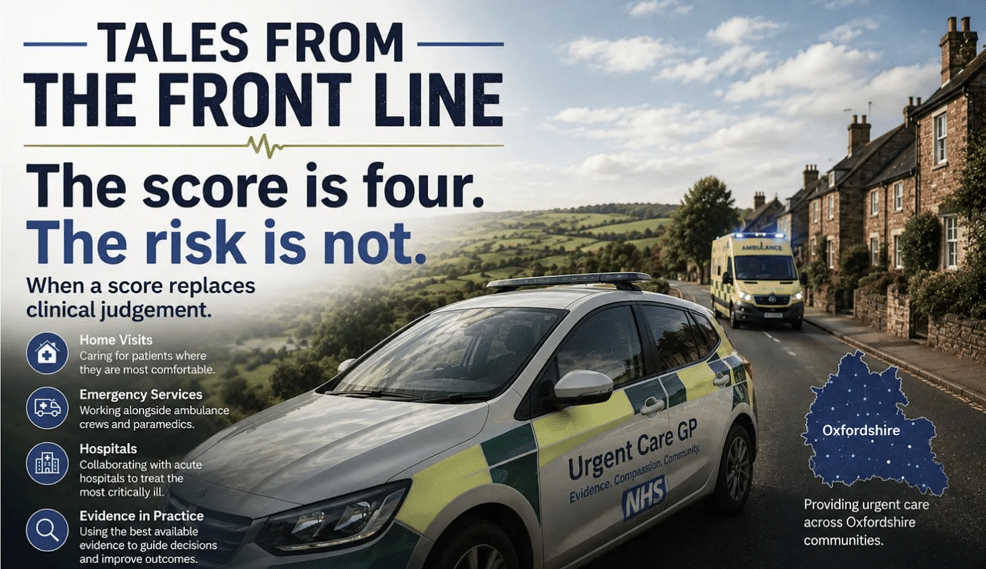
“What time response do you need?” the ambulance call handler asks.
“Level 2. An 18-minute response,” I reply.
“What’s wrong with the patient?”
“He has urosepsis on a background of myelodysplasia, and needs admission.”
We go through the usual details: Age, address and location.
Then something unusual happens.
“I need to refer you to someone else,” the call handler says.
I wait on the line. A second person answers and introduces himself as a consultant paramedic. He wants to discuss whether the patient really requires the Level 2 response I have requested.
That’s new, I think to myself.
Telephone triage is necessary when nobody has assessed the patient. That is one of the purposes of 999: someone has to establish what has happened, how sick the patient might be and what response is required.
Yet, somewhere between my clinical assessment and the dispatch of an ambulance, another assessment had been inserted. A health care professional who hadn’t seen the patient was now being asked to validate the judgement of the clinician who had.
But I hadn’t called 999.
I had called the dedicated number for healthcare professionals – the route that allows a clinician who has already assessed a patient to request an ambulance response. And this patient had been assessed by me. I had taken the history, examined him, reviewed his medical background and decided that he required urgent admission.
“What is his NEWS2?” I’m asked.
“Four.”
And suddenly, four seems to become the most important fact about the patient.
Except there is a problem: I can’t record his blood pressure because it’s unrecordable.
NEWS2 gives clinicians a common language for describing physiological deterioration. But it isn’t a diagnosis, and it isn’t a replacement for examining a patient.
A NEWS2 of four means one thing in an otherwise healthy person with an infection. It may mean something quite different in a patient with myelodysplasia, suspected sepsis and a blood pressure I cannot even record. The score is the same; the risk is not.
Then there is something NEWS2 cannot know: Myelodysplasia can cause low white blood cell counts, leaving patients vulnerable to serious infections such as sepsis and pneumonia. Infection accounts for up to 1 in 4 deaths in patients with myelodysplasia.
NEWS2 doesn’t know the patient’s neutrophil count, the consequences of their bone-marrow failure, or how dangerous an apparently modest physiological disturbance might be in this particular patient. Unless the health professional on the other end of the telephone knows the patient’s history and understands its significance, neither will they.
Yet here I am, standing beside an acutely unwell patient whom I have examined, explaining to someone who hasn’t seen the patient why the number on the scorecard doesn’t adequately describe the person in front of me.
Previously, the process was straightforward: I assessed the patient, decided they needed hospital admission, explained the clinical problem and requested the appropriate ambulance response.
But all of a sudden, another clinical layer has appeared between my assessment and the ambulance.
Why? Presumably, the answer is demand.
Ambulances need to go to the patients who need them most. But there is an important distinction between triage and re-triage.
There is also something increasingly seductive about healthcare numbers: Scores look objective and reproducible, and they can be entered into boxes, audited, and incorporated into protocols.
However, clinical judgement is messier; it involves experience, pattern recognition, uncertainty and context. It includes noticing that the person in front of you looks considerably sicker than their observations suggest.
What worries me is a system in which clinical validation gradually becomes demand management, in which a numerical score begins to acquire greater authority than the clinician who has seen the patient.
There is a particular irony in using NEWS2 this way. The score exists to help us recognise the deteriorating patient; it should not become a reason for failing to recognise one.
There is a brief pause.
“Oh, that’ll be a Level 2 response then,” he says.
“I’ll hand you back to the call handler.”
And on I go.
About the Author
Carl Heneghan is a professor of Evidence-based Medicine at the University of Oxford, Director of the Centre for Evidence-Based Medicine (“CEBM”) and NHS Urgent Care general practitioner (“GP”) who regularly appears in the media. Together with Tom Jefferson, he publishes articles on a Substack page titled ‘Trust the Evidence’.
The Expose Urgently Needs Your Help…
Can you please help to keep the lights on with The Expose’s honest, reliable, powerful and truthful journalism?
Your Government & Big Tech organisations
try to silence & shut down The Expose.
So we need your help to ensure
we can continue to bring you the
facts the mainstream refuses to.
The government does not fund us
to publish lies and propaganda on their
behalf like the Mainstream Media.
Instead, we rely solely on your support. So
please support us in our efforts to bring
you honest, reliable, investigative journalism
today. It’s secure, quick and easy.
Please choose your preferred method below to show your support.

Categories: Breaking News, Latest News, UK News
By the time the ambulance arrives the person can be beyond rescuing! this is wrong, just like judging someone just by the numbers (blood pressure, cholesterol, heartbeat etc. differ second by second but are judged at the moment a doctor has 3 minutes for you)
I don’t agree, they are killing people, your best chance of survival is to be left alone and you either make it or not. But you wrote it yourself, their method are wrong, then add the rest, lack of knowledge, lack of wish to save lives (remember the same staff punished the not-jabbed?) then the poisoned blood supply, the lack of UltraSound (happened with me they want to cut me open in a situation when the most underdeveloped countries use US for diagnosis first) – do your best to stay away from them.
I am sorry to say this but I never seen as barbaric and as undereducated country as the UK but with sky-high arrogance – for nothing to be proud of.
‘and when the ambulance arrives at A&E? Another queue? Another assessment? Another opportunity to delay or deny admission? Then there’s the corridor, the trolley in the corridor. How long will you be held there I wonder? Still, arriving by ambulance is better than arriving personally in the A&E waiting room, crammed full of ethnic people who are given higher priority than you if you’re white English, as a matter of policy, a racist policy. Us white English are now given a back seat in the institution we have all paid for throughout our lives only to find we are somehow unworthy of the best treatment. Not to worry too much though, this disgusting state of affairs is tragically unfair but perhaps it’s for the best. They’ll only kill you when you get in anyway.
Horrified. Who do we contact about it? M.P.?
Had a dreadful experience in 2020 with a blocked liver duct from liver stones when the ambulance men arrived after the G.P. had called them they suggested I get a friend to take me. They thought I had dementia as I was 80 years old and could only get my words out extremely slowly from the pain. Contempt for the patient and contempt for the doctor.
I have watched the NHS go down the drain from around 1990 I have watched all the registered nurses leave and be replaced by agency staff most of them foreigners. I watched the most awful video from somewhere in England where this poor woman was handed across the a private hospital she was then let out of Hospital in the dark with nightgown on and housecoat over her arm and her things she was put in what is really a van ambulances private hospitals use and the man supposed to be driving her home dropped her off at the bus stop dressed like that and clearly in no state to be left on her own she did not seem to know where she was it was deeply distressing but this is the cold hearted way things are done now and I am old enough to know it was so much better 50 years back with matrons well run wards and some humanity.
This changing over to the digital system does not sit well with me it is leaving the old and vulnerable behind who have no devices and no technical experience. The last thing these people care about is the patient they expect you to know they have changed everything they do not let you request a prescription any other way but through the digital hub. Leaving AI to run a customer service of any kind is a disaster that leads to all kinds of problems that the creature has no clue about it is ABC and nothing in between no person to talk to. This video shows exactly what I am saying. You get any doctor there for have no connection to the doctor you are speaking to. I think it is truly dreadful it is all about money and there is no care in it. It all needs to go back to where it was 50 years ago .
Just another aspect of the ‘Black Nobility’s’ DEPOPULATION-GLOBAL DIGITAL SLAVERY AGENDA.
Brits would be wise to rid the nation of the City of London with its Central Bank Family Mafia.
The Monarchy/Aristocracy, Corporatists/Philanthropaths over the NGO Complex are those with the Bankers behind this horror. They literally believe they can do whatever they wish to their ‘OWNED HUMAN CATTLE HERD’ just as they did throughout time until the U.S Declaration of Independence defined UNALIENABLE RIGHTS granted by God as opposed to ‘Human Rights’ granted by
PSYCHOPATHIC Monarchs and the rest of the ‘Black Nobility’ behind the chaos, crises and upheaval in the U.K to bring the people to their knees begging to be slaves to regain normalcy.
What doctor??? What clinical judgement? 15 years ago or so I had to visit a GP in the UK, with a weird skin eruption and stiff neck and pain. It turned out it was singles.
He did GOOGLE it.
Then he gave an anti-viral medication and I did my research. Shingles is an early-cancer state, allegedly 1/3 with shingles would have cancer in 3-4 years – and tend to be come back – because it is the natural depoisoning effect of the limp system, but if you change on nothing the process will fail and start again and again.
It means that antiviral – not as if there would be any virus in reality- drugs are not your friends, they might surpass syndromes but on the long term they work against to you.
I mean I can’t see the big uncovering of this article.
The UK heath system and their so called professionals are all like as if they would be bring to here from the movie – or rather documentary – of Idiocracy.
I never ever saw worse, more undereducated, self-proclaimed nasty ididots before ‘meeting’ the UK’s NHS staff.
If you want to be killed for sure, don’t miss them. Even ex communists countries or far-away Chinese had far more superior professionals and care systems. Rainbow or clapping for the idiots or not.