





The Fischer–Tropsch process is a collection of chemical reactions that converts a mixture of carbon monoxide and hydrogen, known as syngas, into liquid hydrocarbons. It is a key technology in gas-to-liquids (GTL) and coal liquefaction, enabling the production of synthetic fuels and lubrication oils from non-petroleum sources such as coal, natural gas, or biomass.
The process was first developed by Franz Fischer and Hans Tropsch at the Kaiser Wilhelm Institute for Coal Research in Mülheim an der Ruhr, Germany, in 1925, and has since been used to produce low-sulphur diesel and other hydrocarbon derivatives.
In the book ‘The Great Oil Conspiracy’, Jerome Corsi describes the history of the development of the process and how it was used during and post-WWII to produce synthetic oil.
Let’s not lose touch…Your Government and Big Tech are actively trying to censor the information reported by The Exposé to serve their own needs. Subscribe to our emails now to make sure you receive the latest uncensored news in your inbox…
The Great Oil Conspiracy: How the US Government Hid the Nazi Discovery of Abiotic Oil from the American People by Jerome R. Corsi, 2014 edition
Please note: The following has been summarised by an AI programme. AI programmes are prone to inaccuracies and “hallucinations.” We advise readers to refer to the original book to check the accuracy of information. A copy of the book can be downloaded HERE and you can listen to the audiobook HERE.
Chapter 1: The Nazi Secret Science of Synthetic Oil
Table of Contents
- US Army's Post-WWII Investigation into German Synthetic Oil Production
- The Fischer-Tropsch Process and Germany's Synthetic Fuel Development
- Synthetic Fuel Production and Its Strategic Importance in WWII
- Operation Paperclip and the Recruitment of Nazi Scientists
- Helmut Pichler: Background, Contributions, and Nazi Affiliations
- The Great Oil Conspiracy and Post-War Scientific Collaboration
- Leonhardt Alberts: Controversial Recruitment and Security Concerns
- Security Risks and Bureaucratic Conflicts Over Alberts' Admission
- The Fischer-Tropsch Process and Its Post-War Applications
- Post-War US Synthetic Fuel Projects and Their Commercial Failure
- Shift in US Energy Policy and Decline of Synthetic Fuel Research
- Confiscated German Documents and Hidden Knowledge of Synthetic Oil
- The Abiotic Origin of Oil and the Fischer-Tropsch Process
- Challenging the Fossil Fuel Theory: Abiotic Oil Origins
- Allied Bombing Impact and Soviet Adoption of Nazi Petroleum Secrets
- Soviet Energy Independence and the Deep Abiotic Petroleum Theory
- Russian-Ukrainian Theory of Deep Abiotic Petroleum Origins
US Army’s Post-WWII Investigation into German Synthetic Oil Production
The US Army had over 10,000 investigators, including industrialists, engineers, scientists, and technicians, who visited thousands of enemy factories, scientific institutions, and businesses in Germany to conduct top-secret interviews and gather documents as World War II drew to a close.
These investigators, who were actually intelligence operatives, were tasked with uncovering the secrets of Germany’s strategic materials production, including advanced weaponry such as jet airplanes and rockets, and were particularly interested in the country’s ability to produce synthetic oil.
According to Professor Arnold Krammer, a historian at Texas A&M University, the US Technical Oil Mission to Europe in 1945 was a significant effort to acquire German technology and knowledge, with tons of records being hauled out of bombed-out factories and German scientists being questioned by American officers.
Germany had invested heavily in scientific research to develop a strategic advantage, including the production of synthetic oil, which was crucial due to the country’s lack of petroleum deposits, as noted by Anthony N. Stranges of the Department of History at Texas A&M University.
The Fischer-Tropsch Process and Germany’s Synthetic Fuel Development
The Fischer-Tropsch process, developed by German chemists in the early twentieth century, was a key discovery that explained the origin of oil as a naturally occurring phenomenon and allowed for the production of synthetic oil from coal, which was abundant in Germany.
The development of synthetic oil was essential for Germany’s fuel requirements, which had shifted from coal to gasoline and diesel oil with the increasing use of automobiles, trucks, airplanes, and diesel oil-powered ships, including the country’s navy, and the Fischer-Tropsch process provided a solution to this problem.
The US investigators were interested in acquiring this knowledge and technology, not only to understand Germany’s war efforts but also to gain insight into the production of synthetic oil, which had significant implications for the global oil industry and the understanding of the origin of oil as a natural resource.
The development of the Fischer-Tropsch process by German chemists Franz Fischer and Hans Tropsch in the 1920s enabled the production of synthetic gasoline and diesel fuel from coal, which was crucial for powering a competitive national industrial economy and a strong military operation.
The German industrial giant I.G. Farben, with support from the Luftwaffe and the Nazi high command, utilized the Fischer-Tropsch process to produce high-quality aviation fuel, and by 1936, the company was no longer independent but a government-private enterprise.
The Fischer-Tropsch process played a significant role in Nazi Germany’s ability to launch World War II, as the country had fourteen synthetic fuel plants in operation and six more under construction by the time Hitler attacked Poland on September 1, 1939, producing approximately 95 percent of the aviation fuel used by the Luftwaffe.
Synthetic Fuel Production and Its Strategic Importance in WWII
By 1943, Nazi Germany was producing almost three million metric tons of gasoline by hydrogenation of coal, and adding diesel fuel, aviation fuel, and lubricants produced synthetically from coal, the country was able to satisfy up to 75 percent of its fuel demand through coal conversion.
Imperial Japan also adopted the Fischer-Tropsch process, aiming to produce 6.3 million barrels annually of synthetic gasoline and diesel fuel by 1944, but the country’s ambitions were thwarted by the economic demands of waging war, and only fifteen synthetic fuel plants were constructed, reaching peak production of 717,000 barrels in 1944.
Operation Paperclip and the Recruitment of Nazi Scientists
After the war, US Army intelligence officers, along with British, Canadian, and Russian intelligence, focused on understanding how the Nazis had produced synthetic petroleum products so successfully, and under the auspices of “Operation Paperclip,” hundreds of Nazi scientists and engineers were secretly brought to the United States to share their knowledge.
The “Operation Paperclip” initiative allowed the United States to acquire the Nazi secrets of synthetic oil production, which was made possible by the equations developed in the Fischer-Tropsch process, and this knowledge has had a lasting impact on the development of synthetic fuel production.
The United States allowed many Nazi scientists to enter the country after World War II, despite their involvement in horrific war crimes, including using political prisoners for scientific experiments and employing slave labor in war-machine factories.
An examination of the declassified Operation Paperclip files reveals that seven German synthetic fuels scientists were brought to the United States, including Helmut Pichler and Leonard Alberts, who were two of the most prominent scientists at the time.
Helmut Pichler: Background, Contributions, and Nazi Affiliations
Helmut Pichler, born on July 13, 1904, in Vienna, Austria, worked as a research assistant to Franz Fischer at the Kaiser Wilhelm Institute, a prestigious pre-war scientific institution in Germany, and had published fifty scientific articles and held nineteen patents related to synthetic fuels by the end of the war.
Pichler boasted of being the “co-inventor” of the benzene-synthesis process, which was used to produce synthetic gasoline, and was considered one of the most knowledgeable and accomplished synthetic fuels scientists in the world at the time.
A letter from Franz Fischer, dated June 23, 1947, credits Pichler with numerous scientific accomplishments, including developments in the synthesis of gasoline and the conversion of methane to more complex hydrocarbon chains, and describes Pichler as “one of the best co-workers I ever had”.
Pichler became a member of the Nazi Party in 1933, after being urged to become a German citizen by Fischer in 1932, and his “Statement Concerning Past Political Affiliations” was submitted as part of his interrogation by US military intelligence.
The documents also reveal that Pichler was appointed head of the division for synthetic fuels at the Kaiser Wilhelm Institute in 1936 and was nominated to become a permanent scientific member of the institute, highlighting his significant contributions to the field of synthetic fuels.
The Great Oil Conspiracy and Post-War Scientific Collaboration
The book ‘The Great Oil Conspiracy’ discusses the involvement of scientists in the Nazi regime, particularly those who contributed to the development of synthetic oil, and how they were later recruited by the United States government after World War II.
One such scientist, Pichler, gave lectures on air defense in 1934, allegedly out of fear of reprisals, and later claimed that his work was solely focused on scientific research, not political reasons, which led the Truman administration to overlook his Nazi affiliations and allow him to immigrate to the United States.
Pichler joined Hydrocarbon Research Inc. and helped construct a commercial Fischer-Tropsch plant in Brownsville, Texas, and in his later years, he stated that German scientists and engineers did not divulge all they knew to US intelligence operatives at the end of World War II.
Leonhardt Alberts: Controversial Recruitment and Security Concerns
It was discovered that German scientists and engineers, with the consent of the Nazi government, had been providing technical information about the Fischer-Tropsch process to a consortium of six companies, including Standard Oil, which had also been purchasing common stock of Hydrocarbon Research, Inc.
In contrast to Pichler, Leonhardt Alberts was a dedicated Nazi who required a US government cover-up to gain clearance to enter the United States, despite being an expert in operating and managing synthetic fuel plants, having worked as the plant manager and technical director of Ruhchemie, A.G. from 1929-1943.
Alberts’ background, including his membership in the Nazi party, SS, and SA, raised concerns among top officials in the Truman administration, but he was ultimately hired by Bechtel Corporation, where his arrogant and domineering attitude caused disagreements with his supervisor, H. T. McBride.
The US government’s recruitment of these scientists, despite their Nazi affiliations, highlights the importance of synthetic oil production to the Nazi war effort and the willingness of the US government to overlook past allegiances in pursuit of scientific knowledge and expertise.
The involvement of companies like Standard Oil and I.G. Farben in the development of synthetic fuels dates back to the 1920s and 1930s, demonstrating a long-standing interest in this technology and its potential applications.
The story of Pichler and Alberts serves as an example of the complex and often controversial history of scientific collaboration and recruitment during and after World War II, raising questions about the ethics of working with former Nazi scientists and the extent to which their past actions should be taken into account.
Security Risks and Bureaucratic Conflicts Over Alberts’ Admission
The subject of the report, Alberts, was deemed non-cooperative and exhibited poor behavior in regards to expenses, travel, and leave arrangements, leading Mr. McBride to believe that he was “a true Nazi” and “wholly undesirable for citizenship”.
C. W. Frye, personal manager at the Bechtel Corporation, shared a similar opinion, characterizing Alberts as “non-cooperative and disagreeable” with an “overbearing demeanor”, and advised the FBI that he had few qualities necessary to become a good citizen.
Major Robert E. Humphries, Quartermaster Corps, US Army, also expressed concerns about Alberts, stating that he was “poorly regarded” due to his “insufferable and pompous attitude” and that he showed no remorse for his past connections in Germany, leading Humphries to believe that Alberts “would be a dangerous man” to admit into the United States.
Alberts attempted to justify his membership in the Nazi party by claiming that it was for political expediency, stating that he joined in 1938 after being denied job offers due to his lack of party membership, but this explanation was met with skepticism.
Peyton Ford, assistant to the US attorney general, wrote to Colonel Daniel E. Ellis, director of the Joint Intelligence Objectives Agency, expressing concerns that Alberts’s presence in the United States represented a risk to internal security, citing his past service in the Abwehr, the German Intelligence, and the misgivings of several individuals who had known him.
The collective opinion of these individuals and the available information led to the conclusion that Alberts was not a good security risk and should not be recommended for permanent admission into the United States.
The Fischer-Tropsch Process and Its Post-War Applications
The individual in question, Alberts, appears to be a pro-Nazi with unscrupulous activities, but possesses valuable technical knowledge, particularly in the Fischer-Tropsch process for producing synthetic fuels, which caught the attention of the US government.
A bureaucratic fight ensued within the government between those who wanted to utilize Alberts’s technical skills and those who were concerned about the security risks he posed, with Acting Secretary of Commerce Thomas C. Blaisdell strongly favoring Alberts and dismissing the security concerns.
Blaisdell emphasized the importance of the Fischer-Tropsch process in a letter to Attorney General J. Howard McGrath, dated July 14, 1950, stating that it could be a significant item in the US national defense, and H.H. Storch, research and development branch chief of the Office of Synthetic Liquid Fuels, also praised Alberts’s work in a letter dated February 24, 1949.
Despite initial security concerns, Alberts was eventually given permission to enter the United States along with his family, as part of the Operation Paperclip program, which allowed Nazi scientists to work in the US.
Post-War US Synthetic Fuel Projects and Their Commercial Failure
In the post-war period, the US government invested in synthetic fuel plants, including a demonstration plant in Louisiana, Missouri, operated by Bechtel, and a plant in Brownsville, Texas, built and operated by Hydrocarbon Research Inc., but these projects ultimately failed to reach commercial viability.
The production of synthetic fuels was considered too costly to pursue commercially, especially when traditional crude oil and natural gas reserves were abundant and reasonably priced, leading to a decline in government interest in synthetic fuels by the 1960s.
Shift in US Energy Policy and Decline of Synthetic Fuel Research
The US government’s focus shifted away from synthetic fuels to the “fossil fuel” program, and taxpayer funding for Fischer-Tropsch research was transferred to different departments, including the Office of Coal Research and the Energy Research and Development Administration.
In 1977, Congress created the US Energy Department, and in 1980, the Energy Security Act was signed into law, establishing the United States Synthetic Fuels Corporation to provide financial assistance to the private sector for synthetic fuel production.
The Nazis had developed a process for producing synthetic fuel, known as the Fischer-Tropsch process, but only one plant was actually built, and the technology was not fully utilized due to the emphasis on using abundant fossil fuel resources.
Confiscated German Documents and Hidden Knowledge of Synthetic Oil
After World War II, hundreds of thousands of pages of German scientific papers on the Fischer-Tropsch process were confiscated and remained classified until the late 1970s, with many documents still deteriorating and untranslated in archives today.
In 1975, the Texas A&M University’s Center for Energy and Mineral Resources initiated a project to locate and retrieve German World War II industrial records, including the Fischer-Tropsch documents, and by 1977, they had collected over 310,000 pages of documents, but many remain unsummarized, unabstracted, and untranslated.
The German Document Retrieval Project concluded in 1977 that the knowledge contained in these documents was not available to the industry, government, educational institutions, or the public, and as a result, the Fischer-Tropsch process was relegated to a secondary role, with many considering it only useful for liquefying coal to produce gasoline and diesel fuel.
The US petro-scientists and petro-geologists have been slow to study the Fischer-Tropsch equations and have instead focused on the biological production of fossil fuels, with many considering synthetic oil production a waste of time, and as a result, the Nazi synthetic oil secrets have remained hidden from the public view.
The Abiotic Origin of Oil and the Fischer-Tropsch Process
The true secret of Nazi synthetic oil is not about liquefying coal, but rather about understanding the code of how hydrocarbons are produced, which the German synthetic fuel scientists had cracked, and this knowledge has been kept hidden, possibly intentionally, by US oil companies and the US government, with scientists like Helmut Pichler and Leonhard Albert potentially keeping some secrets unrevealed.
The Fischer-Tropsch process is a method of producing gasoline and diesel fuel from coal, and it also suggests that hydrocarbons can form naturally in the earth’s mantle through the combination of hydrogen and carbon compounds in the presence of a catalyst, such as iron ore or cobalt, under extreme heat and pressure.
Challenging the Fossil Fuel Theory: Abiotic Oil Origins
The Fischer-Tropsch equations challenge the traditional fossil fuel theory of the origin of oil, instead proposing that all hydrocarbon fuels are abiotic in origin, meaning they are produced naturally in the earth’s mantle on a continuous basis without the involvement of any organic material.
The Soviet Union, under the leadership of Joseph Stalin, was the primary beneficiary of the confiscated Nazi petroleum secrets, and Stalin sought to make Russia oil self-sufficient to avoid dependence on foreign oil and to further his plans for communism and Soviet domination.
Allied Bombing Impact and Soviet Adoption of Nazi Petroleum Secrets
The United States Strategic Bombing Survey, conducted after World War II, revealed that the Allied bombing of German oil and chemical production plants had a significant impact on the Nazi war effort, as the production of aviation gasoline from synthetic plants decreased dramatically, from 316,000 tons per month in 1943 to 5,000 tons in September 1944.
The survey also found that the bombing of German aircraft plants had a limited impact on the production of aircraft, as the Germans were able to adapt and disperse their manufacturing operations, allowing them to continue producing planes despite the destruction of their plants.
Soviet Energy Independence and the Deep Abiotic Petroleum Theory
The understanding of the Fischer-Tropsch process and its implications for the origin of oil was not fully appreciated at the time, and it was not until later that the significance of this knowledge became clear, particularly in challenging the traditional fossil fuel theory of the origin of oil.
The Soviet Union’s determination to become oil self-sufficient was driven by Stalin’s desire to avoid dependence on foreign oil and to further his plans for communism and Soviet domination, and this goal was achieved through the application of the knowledge gained from the confiscated Nazi petroleum secrets.
The Soviet Union, under the leadership of Stalin, initiated a comprehensive scientific examination into the origin of oil, including the Fischer-Tropsch process, in an effort to become energy independent, despite the differing views of American scientists.
Russian-Ukrainian Theory of Deep Abiotic Petroleum Origins
Between 1940 and 1995, Russian scientists published 347 scientific publications and obtained 170 patents related to the Fischer-Tropsch process, which ultimately led to the development of the Russian-Ukranian Theory of Deep, Abiotic Petroleum Origins.
This theory, articulated by Professor Nikolai Kudryavtsev in 1951, posits that petroleum products are abiotic in origin, meaning they are not formed from the remains of ancient plant and animal life, but rather are a natural product of the earth itself, manufactured at deep levels.
The Soviet scientists concluded that abundant oil could be found in Russia if wells were drilled deep enough, and today, Russia rivals Saudi Arabia as the world’s leading producer of crude oil, contrary to the predictions of US petro-scientists and petro-geologists at the end of World War II.
The argument presented is that all oil and natural gas produced by the earth are abiotic in origin, and that the oil and natural gas found in sedimentary rock structures near the earth’s surface were formed at deep-earth levels and migrated to these locations through cracks in the earth’s bedrock structure.
The theory also suggests that hydrocarbon fuels produced naturally by the earth are never “fossil fuels” produced through biologic materials, but are instead always abiotic in nature, and that the synthetic fuel equations developed by German chemists, such as Franz Fischer, can produce petroleum without the need for organic material.
The Russian-Ukranian Theory of Deep, Abiotic Petroleum Origins challenges the traditional view of oil formation, which holds that oil is formed from the remains of ancient plant and animal life, and instead proposes that oil is a natural product of the earth’s chemical processes.
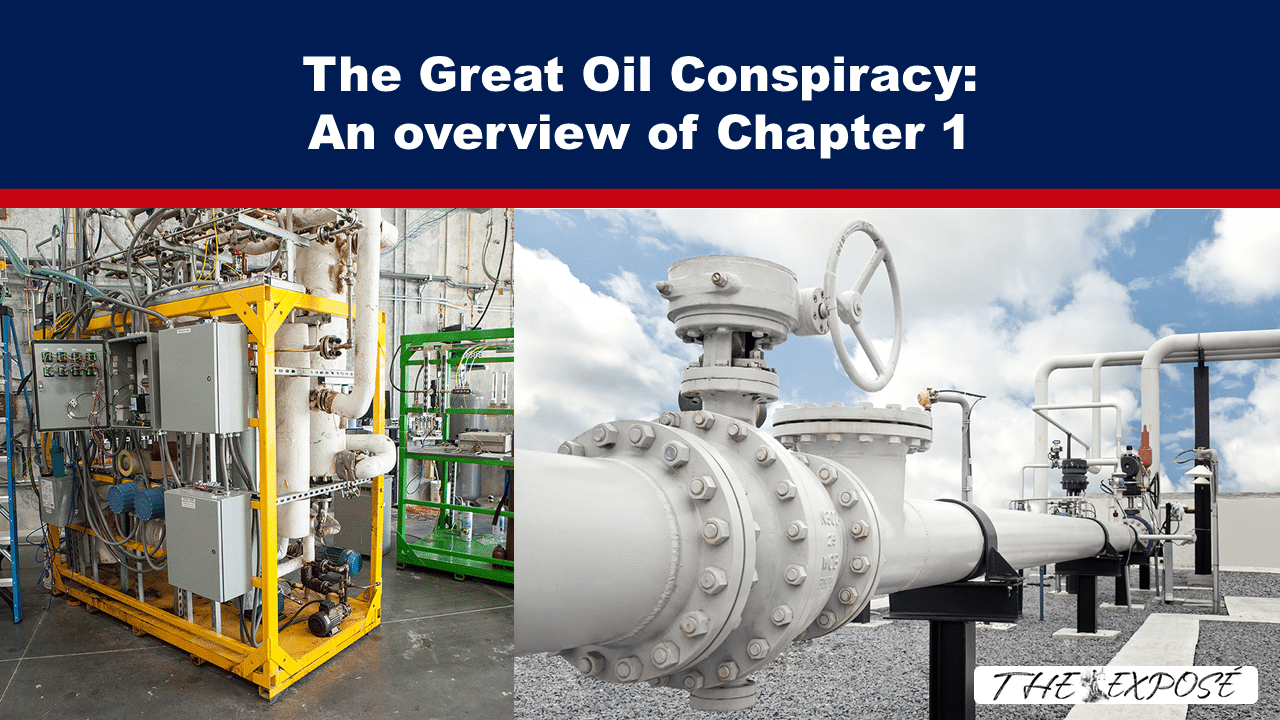
Featured image: Fischer Tropsch Reactor, OxEon Energy
The Expose Urgently Needs Your Help…
Can you please help to keep the lights on with The Expose’s honest, reliable, powerful and truthful journalism?
Your Government & Big Tech organisations
try to silence & shut down The Expose.
So we need your help to ensure
we can continue to bring you the
facts the mainstream refuses to.
The government does not fund us
to publish lies and propaganda on their
behalf like the Mainstream Media.
Instead, we rely solely on your support. So
please support us in our efforts to bring
you honest, reliable, investigative journalism
today. It’s secure, quick and easy.
Please choose your preferred method below to show your support.

Categories: Breaking News, World News
Is that the reason that they use CCS to produce new oil to let us pay endlessly?
Hi Htoslav, is it true that more Epstein files have been released.
How many of our UK MP’s are on the list ?
Hi Htoslav, is it true that Ryan Dawson has tea shirts with lots of names on?
Hi Rhoda,
Another important article, well done.
I have stated several times the Germans had no oil, so made it out of coal.
You have given a good account of how they did it, which I did not know.
There were no fossils near the coal, where I worked, in various mines.
So is coal, solidified oil, like I have stated several times.
We have been lied to for a long time, by the elites.
The idea that petroleum is sourced from dead dinosaurs is ridiculous on its face. Mama earth is cookin it up for us.
The the traditional view of oil formation is not merely “challenged”. It has been conclusively proven wrong decades ago starting here: https://onepetro.org/PETSOCCIPC/proceedings-abstract/04CIPC/04CIPC/PETSOC-2004-301/4465
Duplicating the exact geology found in different oil wells, crude oil was formed in the laboratory with exactly the same spectrum of oil composition found in the respective wells.
Oil is formed from Calcium carbonate, Iron oxide and water. This means oil is in fact a renewable resource. Limestone is produced by marine animals, subducted beneath the earth’s crust, and eventually is subjected to enough heat and pressure to produce oil. The fact that this is not widely known is indeed proof there is a conspiracy to hide the truth, which seems to accompany ANY truth these days.
I do remember a big left-wing friend telling me about 7 years ago of the concept of “Peak Oil”, that oil production supposedly peaked in around the 1960s/70s and has been getting lower since, since oil is a limited resource.
However, the car manufacturing industry has continued to grow worldwide and there is still no indication to me of oil reserves running out. It does make you wonder if the whole “oil is a limited fossil fuel” was just propagated by Rockefeller so that he could raise the price whenever he wanted to, as has been theorised before…
Who writes the lies that AI spews. I refuse to read ANY BS by AI.
………..20 seconds and…………..OUT! KMA!
This website has been rejected due to censorship in the comments section.