




On Friday, May 1, the United Arab Emirates (UAE) formally left OPEC and the wider OPEC+ alliance, ending nearly six decades inside one of the most consequential economic groups in modern history. The UAE was one of OPEC’s biggest producers, and boasts substantial spare capacity which has long frustrated the country as group quotas suppressed its global output. But this is about more than just oil: Abu Dhabi is seeking more room not just in policy around the commodity, but is also reassessing how and with whom it does business in general.
This marks a new chapter in the stories about power in the Gulf, the weakening cohesion of OPEC, and the long-term erosion of the US dollar’s privileged position in the greater oil trade.
UAE Forced to Limit Output by OPEC to Manage Prices
The official break was announced on April 28 and took effect on Friday. Reports say the UAE left without prior consultation with the group, dealing a heavy blow to OPEC and especially to Saudi Arabia, which remains its de facto leader. Before the war-related disruptions in the Gulf, Abu Dhabi had been producing around 3.3 to 3.4 million barrels per day, while its broader capacity was estimated at 4.5 to 5 million barrels per day. Having its production restricted has been a source of tension for years, as the UAE sought more freedom to monetise what it had invested heavily into developing. OPEC+, however, required its output to be limited in support of “price management”.
While the decision to leave the group cannot be explained by the war alone, it certainly sharpened the timing. The closure of the Strait of Hormuz in recent months and broader regional disruption severely constrained Gulf exports and exposed deeper power issues between Abu Dhabi and Riyadh. The UAE’s output and exports were hit by the crisis, but the current situation also reduces any near-term benefit of leaving OPEC. UAE can’t immediately capitalise on its new freedom to flood the market while Hormuz remains constrained. The medium-term picture, however, is much different, and as soon as exports normalise, Abu Dhabi can raise output without permission from OPEC.
OPEC: Its Origins and Global Power
The Organisation of the Petroleum Exporting Countries (OPEC) was founded in Baghdad in September 1960 by Iran, Iraq, Kuwait, Saudi Arabia and Venezuela as a way for major producers to coordinate policy and push back against the pricing power of international oil companies. The UAE joined in 1967. In the 1970s, OPEC became one of the central forces in the global economy, at one stage producing more than half of the world’s crude.
Its 1973 embargo helped trigger recession, inflation and a strategic reordering of the relationship between oil-producing states and the West. Even after its relative dominance faded, it remained a pivotal force in managing supply, shaping prices and signalling geopolitical intent.
The Petrodollar is Born: US Secures Global Currency Power
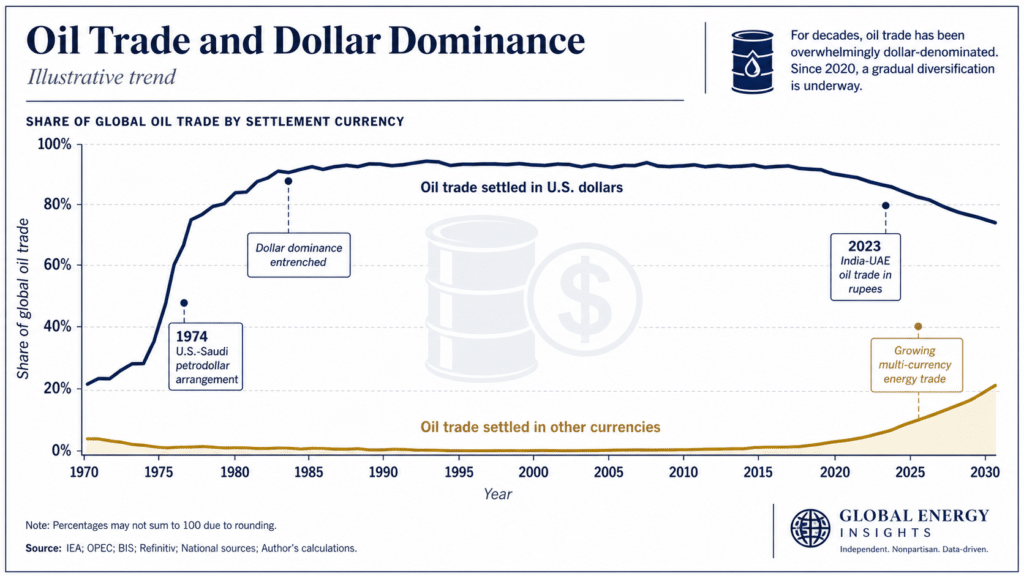
The petrodollar was built in the aftermath of the 1973 oil shock, when Washington moved to stabilise both energy markets and demand for the US dollar after the collapse of the Bretton Woods gold system. The key relationship was not OPEC as a whole, but the US-Saudi bargain that took shape in 1974: Saudi Arabia would continue selling oil in dollars and recycle a large share of its surplus into U.S. financial assets, while the United States provided security, arms and political backing.
That arrangement helped make the dollar the default currency for global oil trade and, by extension, strengthened its wider role in trade, reserves and finance. The benefit to the United States was substantial. If oil is priced and settled overwhelmingly in dollars, countries need dollar reserves to buy it, dollar markets become deeper and more indispensable, and Washington gains a structural advantage in borrowing costs, sanctions power and global financial influence.
How UAE’s OPEC Exit Threatens US Economy
The UAE has already begun settling some trade outside the dollar: in 2023, Indian Oil made its first crude payment to ADNOC in rupees, part of a broader India-UAE push for local-currency settlement, and India’s central bank is encouraging more rupee-dirham trade with the UAE. The UAE is not alone, however. Russia and China have expanded energy trade as Moscow shifts away from the dollar under sanctions pressure, while Saudi Arabia joined the BIS- and China-led mBridge central-bank digital currency project in 2024, alongside the UAE, in a move that could reduce the dollar’s power in parts of global oil trade.
While none of these individual moves means the dollar has lost its global dominance right now, it certainly indicates that major producers and buyers are already building channels that weaken the old assumptions that benefited the US.
So, Is It Over for the US Dollar’s Global Dominance?
Not yet. The dollar still dominates global reserves and remains deeply embedded in energy trading, and even the Atlantic Council’s assessment is that the dollar’s dominance will remain for the foreseeable future. But the direction of travel is certainly becoming harder to ignore. More local-currency settlement, more strategic autonomy in Gulf capitals, and more willingness to test alternatives to US-centred financial plumbing all point to a gradual loosening of habits that once looked permanent.
The UAE leaving OPEC does not in itself dethrone the dollar. It does, however, remove one more reason for Abu Dhabi to subordinate its oil strategy to a collective framework long associated with Saudi leadership and, by extension, the older architecture of Gulf energy politics.
Final Thought
There is an obvious irony in the UAE’s departure. OPEC was founded so oil producers could gain more control over price and supply by acting together, yet one of its most capable members has now decided it may have more control outside the organisation than within it. If that instinct spreads to other producers with spare capacity or long-running frustrations over quotas, the result could be a looser, less disciplined oil market, sharper swings in supply, and prices driven more by unilateral decisions than by coordinated management.
Saudi Arabia would be left carrying more of the burden of restraint, while the wider system built around OPEC cohesion and dollar-priced oil would come under growing pressure. If more exporters begin selling outside the dollar as well as outside cartel discipline, the implications would reach far beyond crude markets, touching the financial order that helped give Washington such enduring leverage in the first place.
The Expose Urgently Needs Your Help…
Can you please help to keep the lights on with The Expose’s honest, reliable, powerful and truthful journalism?
Your Government & Big Tech organisations
try to silence & shut down The Expose.
So we need your help to ensure
we can continue to bring you the
facts the mainstream refuses to.
The government does not fund us
to publish lies and propaganda on their
behalf like the Mainstream Media.
Instead, we rely solely on your support. So
please support us in our efforts to bring
you honest, reliable, investigative journalism
today. It’s secure, quick and easy.
Please choose your preferred method below to show your support.

Categories: US News, World News
A big reason for the war on Iran is to replace the dollar with digital currency. Trump is leading the charge in partnership with the UAE to create an NGO to do just that – IMEC.
https://secularheretic.substack.com/p/imec-trump-tears-a-page-from-the
UAE pulls out of OPEC as a national decision. The US under Trump has withdrawn from several global organizations. If the UAE wants to increase its oil output for sale and receive other currencies besides the USD, that is ok. The US cannot continue to create friction and force others to use only USD. There must be global fairness. The USD is almost worthless. Considering the historical hypocrisy of the US, if you live in a glass house don’t throw stones
Where does tiny UAE propose to keep its money surplus? In the BIS in Basle converted into its new digi-currency? In a rupee account in an Indian bank? What plans does it have for spending the surpluses on local infrastructure? “Money is what money does” after all. Will they tell us?
Your analysis misses the most essential information:
Patrick Wood, Apr. 28, 2026 – Boom! United Arab Emirates (UAE) exits OPEC. The End of The Petrodollar and The Rise of India Middle East European Corridor (IMEC). How the UAEs circumvents the Strait of Hormuz, tokenizes its oil through Trump’s and the UAE’s sheikh’s (Tahnoun bin Zayed Al Nahyan) World Liberty Financial (WLF) and settles it in its USD1 stablecoin private blockchain, which is pegged to the dollar. See what role Gaza plays in IMEC and WLF tokenization “payment” system. https://patrickwood.substack.com/p/boom-united-arab-emirates-exits-opec?publication_id=721283&post_id=195810843&isFreemail=true&r=15fr2h&triedRedirect=true
Whitney Webb, Unlimited Hangout, Mar. 10, 2026 – First Friends: How Andrew Farkas and an Emirati Sultan Helped Epstein Build a Smuggler’s Paradise. A deep dive into the relationship shared by Jeffrey Epstein, Andrew Farkas, and one of the top Emirati executives in the UAE reveals the infrastructure Epstein used to smuggle whatever, and whoever, he wanted with impunity. Related to Wood’s article above; See how the same names pop up, such Kushner, Wittkopf, Lutnick and Trump and their ties to the Emirates’ “royal” families. https://unlimitedhangout.com/2026/03/investigative-series/first-friends-how-andrew-farkas-and-an-emirati-sultan-helped-epstein-build-a-smugglers-paradise/