





Voters were told that leaving the EU would trigger recession, mass unemployment and lasting economic decline. It didn’t happen.
In the following, John Phelan compares Britain’s performance with its G7 peers before covid and after covid. Why use the covid operation to demarcate two separate periods?
Phelan explains: “Britain’s economy stubbornly refused to collapse after the referendum, and when it did, it did so for the same reason every other economy did: covid-19.”
Let’s not lose touch…Your Government and Big Tech are actively trying to censor the information reported by The Exposé to serve their own needs. Subscribe to our emails now to make sure you receive the latest uncensored news in your inbox…
Brexit 10 Years Later: The Economic Collapse That Never Happened
By John Phelan, as published by The Daily Economy on 19 June 2026
When Britain voted to leave the European Union (“EU”) on 23 June 2016, there were dire predictions for its economy. Prime Minister David Cameron and Chancellor George Osborne cited a Treasury analysis forecasting that “a vote to leave will push our economy into a recession that would knock 3.6 per cent off GDP and, over two years, put hundreds of thousands of people out of work right across the country, compared to the forecast for continued growth if we vote to remain in the EU.”
This doomsday scenario did not come to pass. Britain’s economy stubbornly refused to collapse after the referendum, and when it did, it did so for the same reason every other economy did: covid-19.
If we compare the British economy’s performance pre- and post-Brexit with that of its peers in the G7, it is hard to see the prophesied economic meltdown.
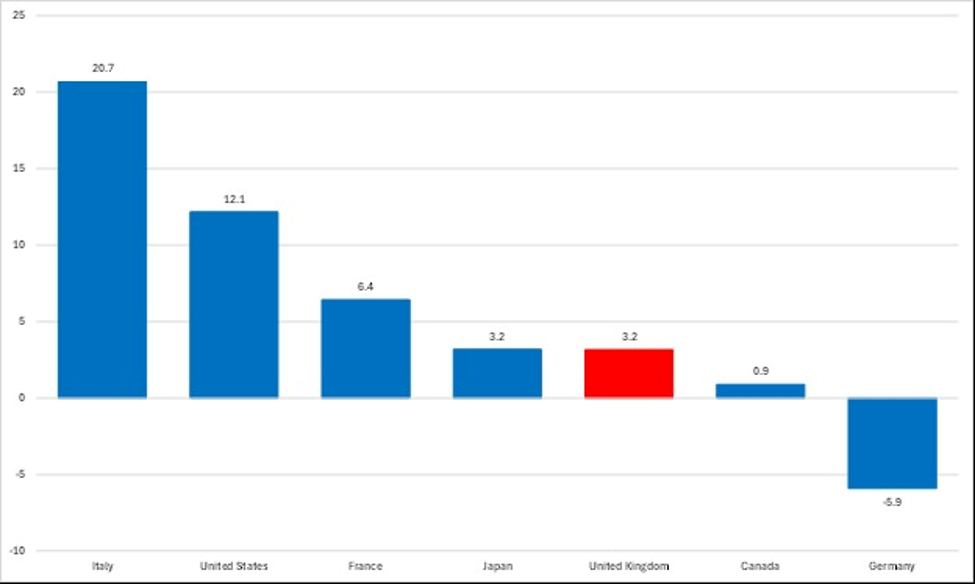
Figure 1 (see below) shows the percentage point change in per capita GDP growth – the measure that really matters for economic welfare – among the G7 in the pre- and post-Brexit periods. We see that Britain’s per capita GDP growth was 3.2 percentage points higher in the period after Brexit (2016 to 2025) than in the period before (2007 to 2016) a better performance than in two other G7 countries, Canada and Germany, and on a par with a third, Japan; hardly an economic catastrophe.
Even so, some researchers argue that there was a significant economic hit from Brexit. Economists Nicholas Bloom, Philip Bunn, Paul Mizen, Pawel Smietanka and Gregory Thwaites with the National Bureau of Economic Research (“NBER”) recently estimated that by 2025, Brexit had reduced UK GDP by six and eight per cent, relative to 2016.
There are reasons to doubt this.
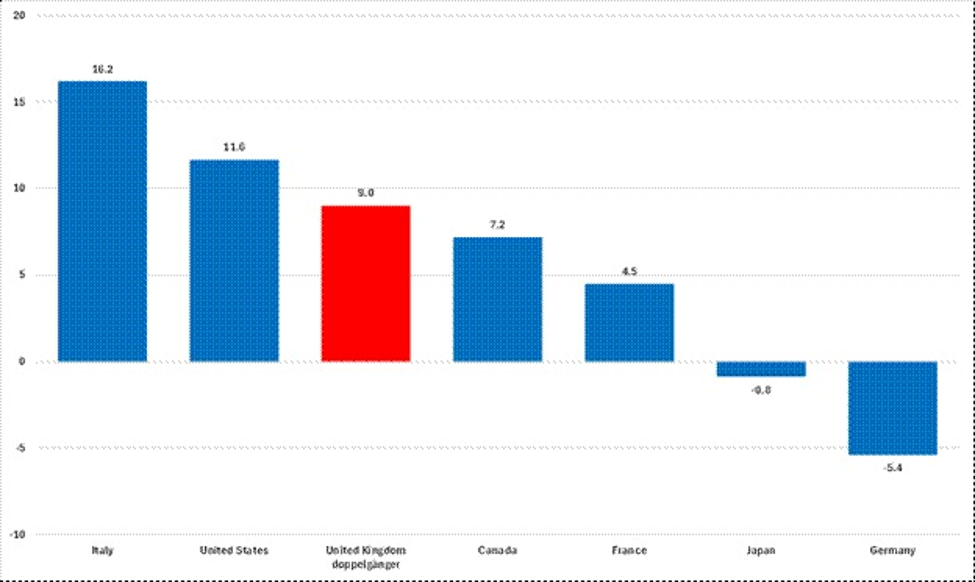
First, the NBER paper, like others, does not compare Britain’s post-Brexit economic performance to the post-Brexit performance of these other countries but to the post-Brexit performance of a constructed “doppelgänger,” which, as economist Julian Jessop notes, is rather puzzlingly assembled. The eight countries it is built from include neither France nor Germany, but does include two Baltic states and the United States. It is hard to see the rationale for these choices.
Second, it ascribes all of Britain’s underperformance relative to the doppelgänger to Brexit. Yet the G7 member with the steepest fall in both per capita and total GDP growth pre- and post-Brexit is Germany, which remained in the EU. Much of its dismal economic performance in recent years can be ascribed to its “green energy” policies, but if we must account for factors besides EU membership when assessing Germany’s underperformance, why do we not do so for Britain?
Under the post-Brexit Conservatives and Labour since 2024, the British economy has been strangled with ever-higher taxes and regulatory burdens, which would have hampered its growth even if the country had voted to remain in the EU. This must be accounted for when assessing the economic impact of Brexit.
These methodological problems perhaps account for the striking results. If the British economy really had grown by another seven per cent, it would have climbed from the fourth fastest growing G7 economy in the period 2007 to 2016 to the third fastest in the period 2016 to 2025, which is certainly possible. But, as Figure 2 shows, the performance posited by the NBER economists implies that, if Britain had remained in the EU, its GDP growth in the ten years after 2016 would have been 9.0 percentage points higher than in the ten years before 2016. This would be an improvement better than all but two other G7 countries: Italy, whose economy, from 2016 to 2025, was recovering from a collapse in GDP of 6.7 per cent between 2007 and 2016, and the United States, which is the G7’s leader in terms of GDP growth.
Is this likely? Was the British economy really poised for such a robust performance in 2016? Those who recall the jeremiads about the economic damage wrought by the Cameron government’s “austerity” will be surprised.
Why did Brexit fail to live down to the economic warnings?
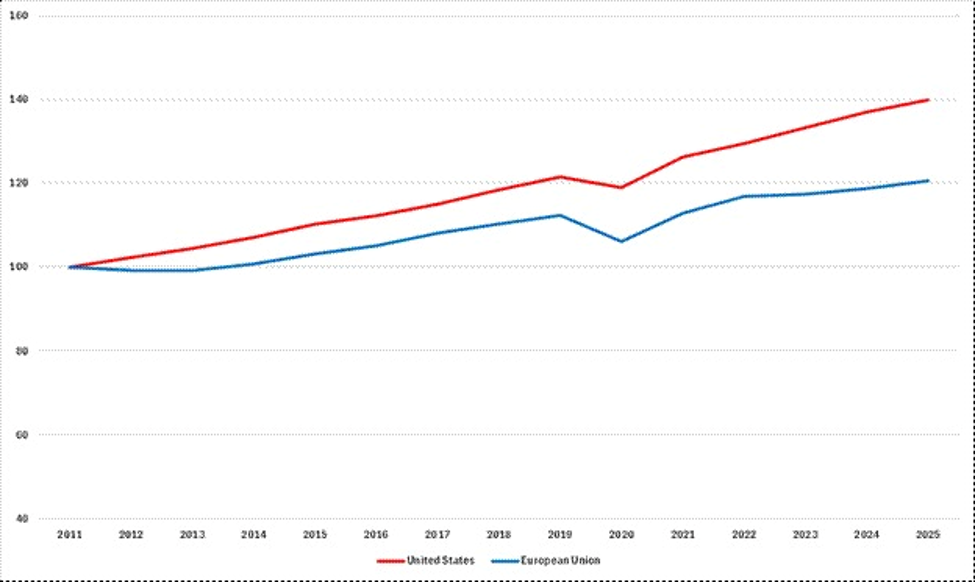
First, the EU is an economic laggard. As Figure 3 shows, since 2011, the EU’s economy has grown by 20.6 per cent while the US economy – the second biggest destination for British exports after the EU in 2016 – grew by 39.9 per cent, nearly double the rate.
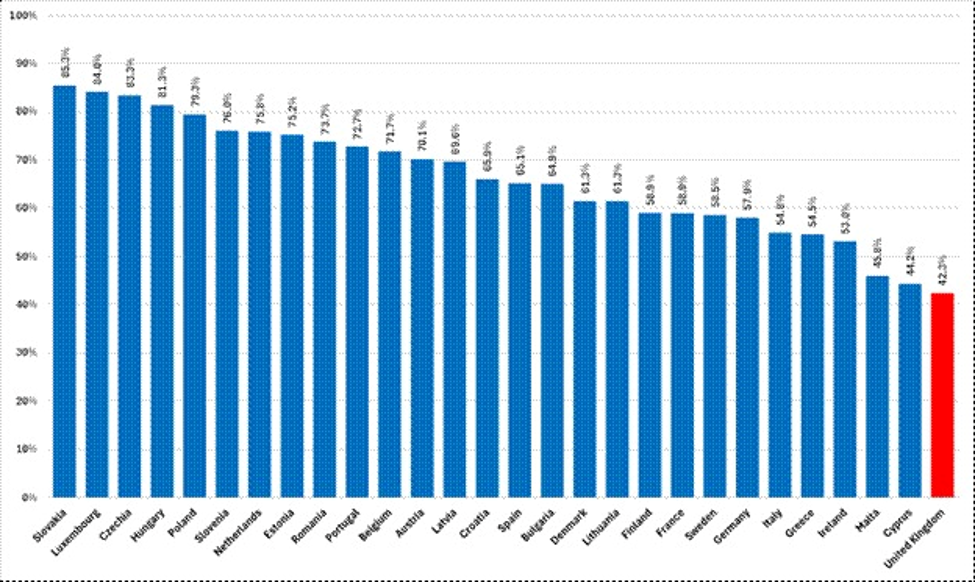
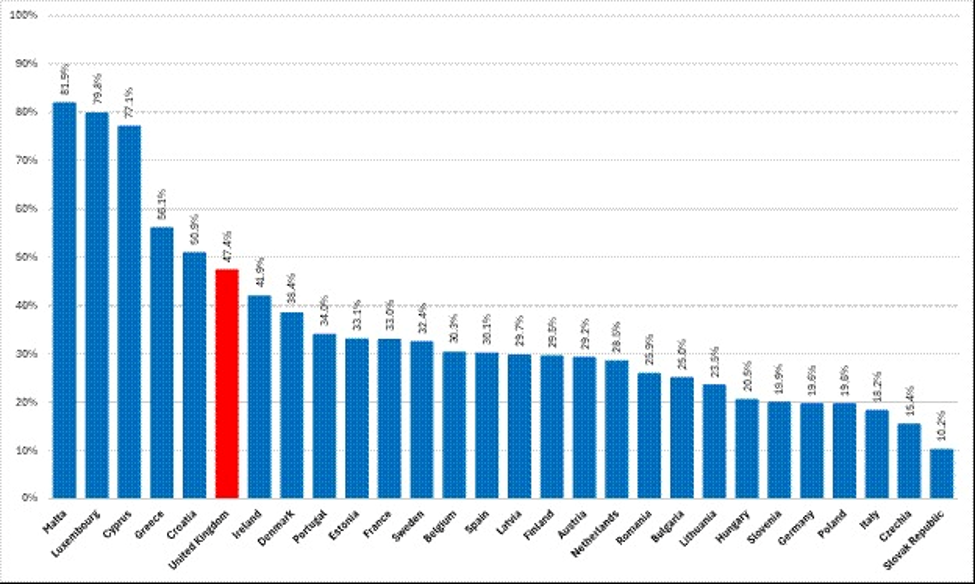
Second, Britain’s economy was one of the least reliant on its EU colleagues. As Figure 4 shows, in 2015, just 42.3 per cent of British exports went to the EU, a share lower than in each of the 27 other members. This is partly because, as Luis Garicano, a former member of the European Parliament, noted recently, the “Single Market” is largely a myth.
“The IMF puts the hidden cost of trading goods inside the EU at the equivalent of a 45 per cent tariff,” he writes. This is especially so for services where “the figure climbs to 110 per cent, higher than Trump’s ‘Liberation Day’ tariffs on Chinese imports.” This is a particular issue for Britain, where, as Figure 5 shows, services accounted for a greater share of exports in 2015 than in 22 of the 27 other EU countries.
A decade on, these facts are little changed, and hopes that Britain’s economy can be boosted by closer ties with – or even rejoining – the EU are doomed to disappointment. As with other “exits,” whether the British economy flourishes will largely depend on what happens in Britain. And if you wrote in 2016 that “we doubt that Britain’s long-term economic outlook hinges on [EU membership],” you might be feeling rather vindicated.
But perhaps this is missing the point. For most, Brexit was never really about economics at all. That was merely a proxy for the debate people wanted to have but were afraid to openly; the more elemental one of identity. In the decade since Brexit, they have become less afraid.
About the Author
John Phelan is an Economist at the Centre of the American Experiment. He is a graduate of the London School of Economics and worked for ten years at Capital Economics in London. He has been widely published on economic topics in popular media and in the journal Economic Affairs.
The Expose Urgently Needs Your Help…
Can you please help to keep the lights on with The Expose’s honest, reliable, powerful and truthful journalism?
Your Government & Big Tech organisations
try to silence & shut down The Expose.
So we need your help to ensure
we can continue to bring you the
facts the mainstream refuses to.
The government does not fund us
to publish lies and propaganda on their
behalf like the Mainstream Media.
Instead, we rely solely on your support. So
please support us in our efforts to bring
you honest, reliable, investigative journalism
today. It’s secure, quick and easy.
Please choose your preferred method below to show your support.

Categories: Breaking News, Latest News, UK News
All Economic problems in the U.K. are due to the Mislim invasion, not to the BREXIT.
Blaming the BREXIT is just an excuse to hide the real issue!
I agree entirely.
The eurozone / parliament remains a fake economy held together via tax fraud.
No nation actually benefits from this partnership , they just lose autonomy of their economy.
No foreign prince prelate state or potentate may have power over this realm. That’s the Bill of Rights 1689, part of our written constitution. It forbids our membership of the EUSSR. If we rejoin the monarchy is null and void as is anything with HM in front of it. Brexit would have gone even better if scum hadn’t tried to interfere like the traitor Miller.