





When Kate was 12 years old, a group of three men grabbed her off the street, forced her to the ground, pinned down her arms and legs and took turns to orally and vaginally rape her.
When it ended, the men hit her repeatedly and threatened to find her, kill her and harm her loved ones if she ever told anyone what had happened.
Later that year, Kate received a video of the assault via a message from the men on social media. They threatened to share it with her friends and family if she did not comply with their demands. This was the start of a cycle of frequent rape and abuse by not only these three men but other men in their network. The rapes and abuse were filmed and shown online, in some instances livestreamed, to make money for the abusers.
Over the years, until her late teens, things only got worse.
The demographics of the men abusing Kate were mixed. The first group who trafficked and exploited her were primarily white British or from Gypsy, Roma and Traveller backgrounds. As she got older and was trafficked more widely, the primary abuser demographics were Pakistani, Bangladeshi and Bengali Muslims.
The other victims she encountered were almost exclusively white British.
Let’s not lose touch…Your Government and Big Tech are actively trying to censor the information reported by The Exposé to serve their own needs. Subscribe to our emails now to make sure you receive the latest uncensored news in your inbox…
Last year, Rupert Lowe MP (Restore Britain) launched a campaign to raise funds to hold an independent national inquiry into the UK’s Muslim rape gangs. This year, the victim-led Rape Gang Inquiry was held, during which testimonies from victims, parents, carers, politicians, a variety of experts and whistle-blowers were heard over ten days, from 2 February to 12 February. On 16 June 2026, the Inquiry released its report.
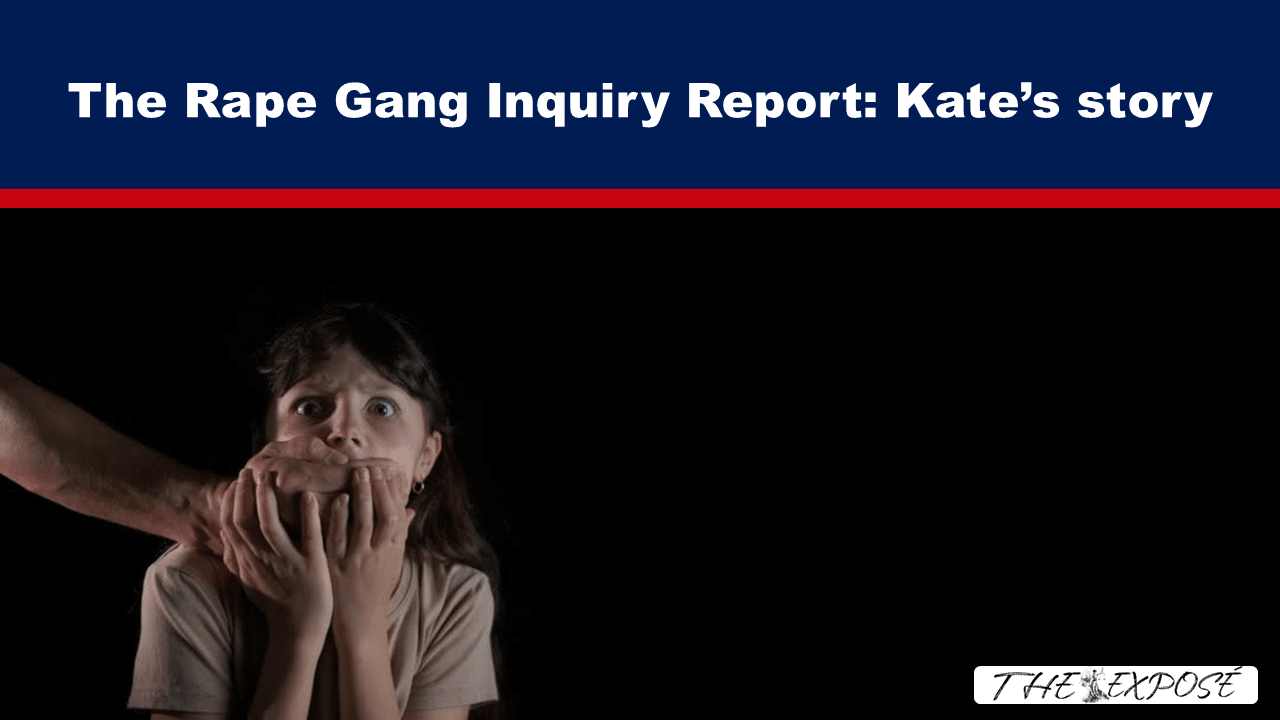
Thousands of rape gang victims and family members volunteered their testimonies to the Inquiry. On pages 18 to 101, the Inquiry’s report provides a summary of some of them. The following is Kate’s testimony. Kate is not her real name. “Some of the witnesses have to remain anonymous for their own safety,” the report says. You can read the full report HERE.
‘Kate’
‘Kate’ grew up in a deeply dysfunctional and unsafe household where violence, sexual abuse, and neglect were commonplace. Social services had been involved with the family since before Kate was born, primarily due to the neglect of her siblings by her parents and the behaviour of her older half-brother, who was physically violent. He, along with Kate’s father, sexually abused Kate from a young age – something that was not identified by social services for several years.
When she was around the age of five, Kate and her two brothers were removed from the care of their biological parents and placed in a foster home. It was determined that they could not return to their parents’ custody, and they were adopted by a couple from a town around 50 miles away. Kate and her brothers settled well into their new home and family environment, and for the next seven years, Kate’s life was happy and stable, with her adoptive parents providing the love and support that her biological parents had failed to give.
Kate’s adoptive parents were committed Christians and the family attended the local church every Sunday. Much of Kate’s social life outside of school revolved around church activities, including youth groups and spending time with other families within the church community. At school, she performed exceptionally well, and was identified as “gifted and talented” across a range of subjects. She rarely got into trouble and, despite suffering from low self-esteem, was well-regarded by teachers and peers alike. Kate maintained a limited circle of friends, and directed most of her energies into her studies, which provided her with a sense of achievement, structure, and self-worth.
Kate was highly ambitious and optimistic about the future. She held herself to very high standards, and aspired to attend university, complete a PhD, and pursue a career in archaeology or paramedicine. She was also driven by a strong sense of family, and looked forward to getting married and having children of her own.
Around the age of twelve, Kate began to receive sex education at school. She found these lessons upsetting as, up to this point, her understanding of what had happened to her during her early childhood was very limited. Social services had failed to identify the abuse at the time, and so it had never been acknowledged, discussed, or explained to her. She entered adolescence confused about what had happened to her and without a clear understanding of healthy boundaries and inappropriate behaviour. She lacked the confidence to confide in an adult, and this left her vulnerable.
Kate came to realise that the abuse she had suffered at the hands of her biological father and half-brother was not normal or legal. She began to experience a growing sense of shame, fear, and self-blame, and felt a deep uncertainty about her identity, body, and relationships with others. She soon began to experience suicidal thoughts.
Still just twelve years old, Kate decided to take her own life. One Saturday night, after her family had gone to sleep, she left her home in the early hours and walked to a secluded location where she intended to commit suicide, hoping she would not be found. She paused beneath a tree to shelter from the rain, and after a while she heard a group of men approaching. By their tone Kate suspected that they were drunk, and when they saw her they began jeering. They called her a “no-homer” and suggested that she could “stay warm on their dicks.” Kate, terrified and regretful, waited for the men to pass before attempting to return home – but as she was walking, she was grabbed from behind by one of the men.
Kate was overpowered by the three men, forced to the ground, her arms and legs were pinned, and the men took turns to orally and vaginally rape her. When it ended, the men hit her repeatedly and threatened to find her, kill her and harm her loved ones if she ever told anyone what had happened. So violent was the assault, Kate’s clothes were left bloodstained.
Traumatised, she walked across the town to her family’s church, knowing that her parents would be there in a few hours. She sat on the porch and cried for several hours before deciding to return home. While she was walking, both a van and a taxi driver stopped to ask if she was okay given her dishevelled appearance and visible distress. She replied that she was. When she arrived home, she hid her bloodstained clothes and went to sleep.
Kate did not disclose the assault to anyone and her mental and physical health rapidly deteriorated. She began self-harming and her suicidal thoughts intensified. She attempted to take her own life on multiple occasions over the following months and was admitted to hospital many times as a result. She started getting bullied at school. Concern for her welfare escalated, but Kate resisted every attempt by her parents and teachers to intervene. She was assigned a Child and Adolescent Mental Health Services (CAMHS) practitioner by the local authority with whom she started regular counselling sessions, but Kate did not find this either effective or helpful and she continued to keep the assault hidden. The professionals concluded that her deteriorating health was linked to her early-life trauma.
Later that year, Kate received a message on social media from one of the abusers. To this day, Kate does not know how they found her. The message was a video of the assault, and they threatened to share it with Kate’s friends and family if she did not comply with their demands. Kate feared that if they did so the bullying would worsen and she would get into trouble. Once again, she did not disclose the incident to anyone, and – believing she could resolve the blackmail – she went to meet them.
She was instructed to come to a house in the local town centre. She was taken inside, and all three abusers were present. They proceeded to rape her again, this time making clear that she was being filmed. Following this, they told Kate that she now “worked” for them and was expected to do what she was told, for otherwise the footage would be leaked. She was given a phone and told always to remain contactable.
In the period that followed, Kate was required to meet the two chief abusers frequently. They introduced her to other men in their network and she was repeatedly subjected by them as well to sexual abuse. Kate was also forced to participate in webcam abuse sessions, which generated revenue for the abusers. If the livestream did not generate what they considered to be a satisfactory amount of money, Kate was punished. The constant shifting of expectations was used as a method of control.
Kate gradually became more open with her counsellors. Though she still did not disclose the full extent of what was happening to her, she began to refer to the initial assault as “the event,” and they soon worked out that she had been raped – though they did not suspect ongoing abuse. They shared their concerns with Kate’s parents and, almost a year after the initial assault, Kate’s mother confronted her about the suspicions that she, Kate’s father, and the social services professionals had formed. Kate confirmed to her mother that she had been raped. Soon after the disclosure, Kate was taken to a Sexual Assault and Rape Centre (SARC) for further counselling.
The SARC therapists encouraged Kate to report the initial assault to the police. Kate hoped that doing so would lead to an intervention that would stop the ongoing abuse, but was too frightened to name the perpetrators, fearing reprisals from the gang. Nevertheless, she reported the assault to the police, providing them with as much information as possible, and was brought in for questioning with her mother.
At the police station, Kate was taken into the interview room. Before the interview began, and without Kate’s mother present, Kate was told that this was her “last chance” to say that her report was untrue. She was warned that if any part of her account could not be supported by evidence, she could and would be arrested. For an extended period of time, both officers repeatedly told her how much trouble she would be in if any detail of her statement was disproved, and that she could withdraw the allegation before the interview started with no further consequences. They also suggested that her parents would be relieved if she said the incident had not happened.
Still just twelve years old and already deeply traumatised, Kate became overwhelmed by the pressure she felt the officers were placing on her, and said what she believed they wanted her to say: that the rape had not taken place. This interaction occurred before the recording began and, as a result, the formal interview did not reflect the coercion that took place. Kate felt unable to disclose anything further, including the abuse that was ongoing at the time, because she felt she was not being believed or taken seriously. The police report recorded the incident as a withdrawal of the complaint. Following this experience, Kate again attempted to take her own life.
Shortly afterwards, Kate’s mother found content in Kate’s diary describing the rape. She encouraged Kate to speak to the police again, but Kate explained that the police had previously pressured her to withdraw her complaint. Nevertheless, Kate returned to the police station and, this time, completed the interview.
Some weeks later, Kate’s parents discovered sexually explicit messages in her phone between Kate and several adult men, including sexual photographs. These were reported to the police, but it was concluded that Kate was engaging with these men consensually, despite being just 13 years old. Kate, still afraid of retribution from the gang, denied all knowledge of these exchanges, and was not questioned further.
Over the course of the following year, Kate went missing on numerous occasions, including during school hours and late at night. She alleges that no record was made of her absence. The gang was blackmailing her into doing what they called “jobs” – sexual abuse by gang members and their associates, for which the gang received payment. These included webcamming, gang rapes, “parties,” “cop nights,” and “red rooms.” Kate was raped multiple times a week, sometimes 2 to 4 times a day.
During this time, Kate encountered another girl whom the gang was exploiting. Kate – then 14 – suspected that the girl was younger than her. On the night that they met, Kate had been instructed to meet two of the gang members in a secluded location late at night. When Kate arrived, they were holding the girl “tightly” around the neck. One of the gang members told Kate that the girl was being “broken in” that night, and that the men she would be “servicing” were particularly “brutal.” Kate attempted to intervene, telling the gang members that she would take on the “jobs” instead. In response, the gang members beat and raped her. Kate went on to “work” with this girl on numerous occasions, and they became very close.
Throughout the first half of the next year, the exploitation intensified, and Kate made another attempt to take her own life. Shortly afterwards, she entered into a relationship with a relative of one of the gang members, leading to a temporary pause in the abuse. The relationship lasted for almost a year, but when it came to an end, the exploitation resumed almost immediately.
Later that year, Kate – then 16 – experienced the most significant missing episode to date. During this incident, the gang trafficked Kate to a town far from her home where she was restrained and raped repeatedly on a canal boat – including, she alleges, by a police officer. At one point, Kate tried to escape, but was caught, and the gang beat her and cut off much of her hair as punishment.
Kate attempted to escape a second time and was successful. She reached a nearby house and knocked for help. The woman who lived there took Kate in and gave her clothes, as Kate’s own clothes had been badly damaged by the abusers and she was partially naked. The woman called the police, who attended the property. The woman attempted to remove the rope that remained around Kate’s wrists, but was instructed by the police to leave them in place as they were considered evidence.
Kate was hesitant to speak to the police given both the recent alleged abuse by a serving officer and the wider context of threats, coercive control, and physical and sexual violence that she had been experiencing. Nevertheless, she disclosed what had happened on the canal boat – but not the historic exploitation, fearing reprisals – to the police. She also did not report that she had been raped by a police officer.
The investigation did not progress and the police accused Kate of lying about the exploitation. This represented a turning point in Kate’s dealings with the police, as she thereafter felt that she could not turn to them for help, fearing she would not be believed.
Kate was placed on a Child Protection Plan by the local authority. She shared a diary with one of the social workers containing details about the sexual abuse she had been suffering, though once again she was not believed. During this period, Kate was diagnosed with dissociative identity disorder. Soon after, Kate alleges that she was raped in a hotel by a man she believed to be a doctor. The police were called to the hotel as the staff were concerned that she was a prostitute. When the police arrived, she was found alone and naked in the room, having been left there by the abusers and instructed to wait for more men to arrive.
At this point, both Kate’s family and the professionals involved in her care began to express frustration with what they perceived to be her “lifestyle choices.” They did not believe that she was being exploited and instead assumed that she – still 16 – was willingly meeting adult men.
This “misinterpretation” of Kate’s situation had a profound impact on how professionals responded to her in the following months and years. Because they believed her behaviour was voluntary, subsequent incidents – such as unexplained absences, being found in hotels, receiving inappropriate messages, or associating with adult men – were treated as matters of personal choice rather than indicators of ongoing exploitation. As a result, these events were not treated as safeguarding concerns. Instead of exploring the possibility that she was being coerced or controlled, professionals increasingly framed the issue as one of behavioural difficulty, risk-taking, or non-compliance.
This perspective, Kate alleges, influenced decision-making across agencies. Referrals were closed prematurely, safeguarding meetings did not lead to protective action, and disclosures or partial disclosures were not pursued with the seriousness she felt they required. The assumption that she was engaged in consensual activity meant that professionals did not intervene effectively, even when the circumstances strongly indicated exploitation. This perspective reinforced her isolation, reduced her ability to seek help, and ultimately allowed the exploitation to continue and escalate.
On one occasion around this time, concerns were raised at Kate’s school. She was escorted to an office where the Assistant Headteacher, the Designated Safeguarding Lead (DSL), a PCSO, a police officer, her social worker, the school nurse, and her Head of Year were present. They prevented her from leaving the room and pressed her for names and details about the individuals involved in the abuse. At that time, due to fear, coercion, and the threats she felt she was under, she did not feel safe or able to provide the information they were requesting. Instead, she provided the nicknames of some of the individuals involved. Kate was visibly shaking and repeatedly asked to leave, explaining that she would be in significant danger if she revealed further information.
After the meeting concluded, Kate was allowed to leave but no protective measures were put in place. She was not supervised, safeguarded, or provided with any immediate safety planning. Despite indicators of fear and coercion, she was permitted to return home and continue her usual routine. No follow-up action was taken to monitor her well-being in the days that followed.
After the meeting at the school, Kate’s abusers made it clear that they knew she had spoken to the police. They told her that they were aware of every time she spoke to the police, as “they had people on the inside.” They accused her of “snitching,” telling her that she would “pay for it.” Shortly afterwards, she was taken to a remote, wooded location. The young girl whom Kate had met before was also present. Initially, Kate believed they had been taken there for another “job.” The men then subjected the girl to extreme sexual and physical violence while Kate was forcibly restrained and made to witness what happened. Kate alleges that the girl was then murdered in front of her.
Following the incident, Kate reports that the abusers used what had happened as a direct and ongoing threat to ensure Kate’s silence. They repeatedly told her that the murder had occurred because she had spoken to the police and insisted that it was her fault. This message was delivered consistently and became a central part of their coercive control. They made it clear that the same thing could happen to Kate or to others if she ever disclosed anything again.
On another occasion, Kate reports that she was taken from her local church at a Sunday morning service. She was taken to a nearby city, an hour away, to do “jobs.” She alleges that she was raped in the car on the way to the city. She eventually managed to get away from her perpetrators, but they followed and caught up with her and dragged her off a canal path and raped her. After the perpetrators left, Kate left the structure and attempted to walk back along the canal path. She was visibly injured, distressed, and her clothing was damaged. A group of men who were fishing nearby saw her in this state and contacted the police. Emergency services attended, and she was taken to the hospital for medical attention. Kate reports that no effective safeguarding measures were put in place following this incident.
When Kate turned 17, she joined a local college. This transition created a significant change in her routine. She had more independence, fewer supervised hours, and less direct oversight from adults compared with her previous school. This increased her vulnerability, as the individuals exploiting her were able to take advantage of the additional freedom and reduced monitoring associated with college life.
Kate’s parents found it increasingly difficult to keep her safe and was placed in Edge of Care Services under the age of 18. She stayed at the care home 2 nights a week as ‘respite care’ for her family. During this period, she reports that she was trafficked by the gang to London. While there, she was subjected to repeated sexual exploitation. At one point, she managed to contact the care home and inform them of her location. A colleague provided guidance over the phone and directed Kate to a place where she could remain safe until help arrived.
The police attended and collected her from the location. She disclosed the exploitation that had occurred, and, on this occasion, the officers took her account seriously and responded with what she felt was appropriate concern. They advised that she should not return immediately to her local area due to the risks to her safety. However, Kate’s local authority did not agree with this and insisted that she be returned home. Staff from the care home travelled to London to collect her and return her to the placement.
During this period, a retired police officer became aware of Kate’s situation through a mutual connection. A friend got in touch with him on Kate’s behalf and he got in touch with Kate. He travelled to meet her in person the next morning and came to her college. He expressed an intention to support her and stated that he believed he could assist, but explained that, due to her age, he would need to liaise with my allocated social worker before taking any formal action.
Kate’s social worker declined to engage with him. The situation quickly became confusing and overwhelming for Kate – the lack of cooperation from professionals, combined with the ongoing exploitation and her deteriorating mental health, led to a significant emotional crisis. Kate became extremely distressed and expressed intentions to end her life while at college. As a result, she was sectioned under the Mental Health Act and taken for assessment.
Shortly after this incident, Kate was taken again by the individuals exploiting her. They told her that they knew she had spoken to the police. She was removed from college and taken to “a Red Room setting.” Another girl, Meg, was also present. During this incident, Kate alleges that she was forced to witness extreme violence that resulted in Meg losing her life. This, she says, was done deliberately, and the perpetrators made it clear that this was a direct consequence of their belief that she had disclosed information to the police after her sectioning.
Before Kate was due to start university, she reports that she was taken to London during the Notting Hill Carnival and made to engage in “street-based sex work.” At one point, Kate found the nearest police officers and attempted to explain that she was not safe, that she had been trafficked, and that she was worried her abusers would find her. They confirmed that she had been reported as a missing person and contacted Kate’s father, who told the officers that she was lying and refused to come and collect her.
The officers then transported her to a police station. When she arrived, she was told that she could not remain there and that, because her father had declined to collect her, she would need to leave the station. No safeguarding measures were put in place, and she feared that the individuals exploiting her would find her again. She felt entirely abandoned by the adults and professionals who should have kept her safe and, overwhelmed and distressed, again attempted to take her own life.
Soon after, she started university – a goal she wanted to achieve as she thought it would be a route out of the abuse. However, the increased independence and reduced oversight associated with university life created new opportunities for the individuals abusing her to extend the exploitation beyond Kate’s local area. This, she reports, marked the point at which her trafficking became national in scope, with the abuse occurring across multiple regions of Britain.
Over the course of this academic year, Kate alleges that she was regularly taken to a range of cities across Britain. These movements were frequent, often unplanned, and carried out with little notice, making it impossible for her to establish any stability or predictability in her daily life. The level of violence during this period increased significantly. My injuries became more frequent and more visible. On several occasions, Kate’s university lecturers and friends noticed bruises and other marks, which reflected the severity and regularity of the abuse. Despite these indicators of harm, no effective safeguarding intervention took place, and the exploitation continued.
On one occasion, Kate was taken by her abusers from an area close to the university. They told her that she was “in trouble” because she had not been available for “jobs” due to a recent hospital admission. She was transported to a remote location, and held in a caravan for “approximately nine days.” During this period, she reports that she was subjected to repeated sexual violence, severe physical assaults, and sustained torture – including being raped by a dog as the men placed bets on whether it would penetrate her vagina or her anus, filmed, and forced to rewatch the footage. This was “the most extreme and prolonged” incident she experienced and represented a significant escalation in the level of harm and control being exerted over her. The duration, isolation, and intensity of the abuse during this period had a lasting and profound impact on her physical and psychological well-being.
Over the following year, Kate went missing for several extended periods and was subjected to continuous trafficking and rape across the country. When the COVID-19 lockdown began, her day-to-day movements and university activities were restricted in line with national guidance. However, the individuals controlling her exploitation continued to expect her to attend “jobs” throughout this period. The lockdown did not reduce the level of contact or demand placed on her.
Following this period, the trafficking began to reduce gradually. Kate received a positive ‘Conclusive Grounds’ decision through the National Referral Mechanism, confirming that she was a victim of trafficking and exploitation.
The grooming behaviours to which Kate was subjected did not follow the “boyfriend model” or grooming tactics that are often associated with child sexual exploitation. Instead, the abuse she experienced was based primarily on blackmail, coercion, and threats. From the outset, the individuals involved used fear, intimidation, and control rather than affection or persuasion to entrap and exploit her.
The demographics of the men abusing Kate were mixed. The first group who trafficked and exploited her were primarily White British or from Gypsy, Roma, and Traveller backgrounds. As she got older and was trafficked more widely, the primary abuser demographics were Pakistani, Bangladeshi, and Bengali Muslims. The other victims she encountered were almost exclusively White British. Kate was repeatedly subject to racially and religiously motivated, and “being white was repeatedly used as a justification for the abuse or to minimise or dismiss the harm being inflicted.” Kate was verbally attacked and demeaned because of her religion, including being mocked for wearing a cross and being told that “her Christian faith offered her no protection.” The abusers regularly suggested that “her God had abandoned her.” Comments were constantly made suggesting that white girls and Christian girls were viewed as having degraded moral character or lower value, whereas Muslim girls were described by some of the men as having dignity and higher moral standing.
Kate has participated in this Inquiry because she feels “a personal responsibility to speak up for the many girls across the country who are unable to do so” and to “help ensure that the realities of this form of exploitation are understood, and that meaningful change can be achieved.” The systems that should have protected Kate did not recognise the risks she was facing, did not respond effectively when concerns were raised, and in some cases, she feels, “contributed to the harm by dismissing or disbelieving what was happening.”
The Expose Urgently Needs Your Help…
Can you please help to keep the lights on with The Expose’s honest, reliable, powerful and truthful journalism?
Your Government & Big Tech organisations
try to silence & shut down The Expose.
So we need your help to ensure
we can continue to bring you the
facts the mainstream refuses to.
The government does not fund us
to publish lies and propaganda on their
behalf like the Mainstream Media.
Instead, we rely solely on your support. So
please support us in our efforts to bring
you honest, reliable, investigative journalism
today. It’s secure, quick and easy.
Please choose your preferred method below to show your support.

Categories: Breaking News, Latest News, UK News
Thankyou for reporting on this ‘ it is very shocking indeed that this child was abused bybso manybfor so lonely including her fanily and fir many years after she keft their home. The details are evil beyond belief and tge death penalty needs to be brought back for all paedophiles. I hope this woman has a lot of hel and love to survive.v
Help and love i meant to say
Millions of Muslim men were deliberately shipped into Europe, to do this to European girls. WHY?
Is it to deliberately create intense HATE ? Then, to use the HATE for ?