





Dr. Philip McMillan increasingly believes that the cancer epidemic in recent years cannot be explained by any single cause. One of the causative factors that cannot be ignored is an imbalance of the gut microbiome.
He believes that an explanation of the post-covid cancer epidemic will involve the convergence of immune dysfunction, viral persistence, altered cellular metabolism and a damaged gut ecosystem.
Note from The Exposé: The cancer epidemic has been noted after the mass rollout of the so-called “covid vaccines.” Because the disease-causing agent (spike protein) of the man-made, bioengineered SARS-CoV-2 (covid) virus is in the “vaccines,” when Dr. McMillan refers to a covid infection, we should assume this includes infection by injection, even though he does not state or indicate that the main method of a covid infection is through vaccination.
Let’s not lose touch…Your Government and Big Tech are actively trying to censor the information reported by The Exposé to serve their own needs. Subscribe to our emails now to make sure you receive the latest uncensored news in your inbox…
The Gut–Cancer Link We Are Still Failing to See
Note from The Exposé: there is a video that accompanies this article that has been uploaded onto Substack. We are unable to embed the video here. If you wish to listen to the video, please do so HERE.
By Dr. Philip McMillian, 4 August 2026
A doctor friend recently said something I suspect many people have been thinking: it cannot be normal that so many people we know are being diagnosed with cancer.
I hear versions of this repeatedly. Friends, colleagues and patients all seem to know someone recently diagnosed, often with a disease that is already advanced. Cancer feels as though it is suddenly everywhere. But I think we need to be precise about what we are observing.
I am not convinced the main change is a dramatic rise in the total number of people developing cancer. Some cancers are increasing, particularly in younger people, but that may not explain what people are noticing.
What concerns me more is the frequency of late-stage first presentation.
I am seeing patients who are not diagnosed while a tumour is still localised and potentially curable. They present once the cancer has already reached the liver, lungs, bones or brain. By then, surgery may no longer offer a cure, and treatment shifts to slowing the disease with chemotherapy, radiotherapy or immunotherapy rather than removing it. That difference changes everything.
When someone has an early breast cancer removed, they may simply tell friends they were treated successfully. Someone diagnosed at stage four is more likely to talk about it, because the prognosis is immediately different.
That may partly explain why cancer feels more visible. It does not explain why so many cancers are presenting in an unexpectedly aggressive form.
The Gut Study That Caught My Attention
I have repeatedly warned people not to underestimate the gut microbiome.
I do not regard the gut as a separate digestive compartment that matters only when someone has bloating, constipation or diarrhoea. I see it as a major immune organ that shapes inflammation, metabolic signalling and the body’s ability to recognise and control abnormal cells.
A recent study led by Dr. Sabine Hazan examined stool samples from 60 adults, comparing people without cancer against patients with either aggressive or non-aggressive cancers. The study was small, and I do not believe it should be treated as final proof of anything. But the pattern was striking.
[Related: Dr. Sabine Hazan: Gut bacteria that are key for immunity are killed by covid injections]
The patients with aggressive cancers had substantially lower levels of several bacteria generally associated with a healthier intestinal ecosystem, including Bifidobacterium, Faecalibacterium and Collinsella. They also had higher levels of Bacteroides.
The most dramatic difference involved Bifidobacterium, whose average relative abundance was far lower in the aggressive cancer group than in the controls.
I do not read that as proof that losing Bifidobacterium directly causes cancer. That would go well beyond the evidence. I read it as a marker that the intestinal ecosystem, and possibly the wider immune environment, has changed. That distinction matters.
See: Hazan, Sabine, et al. “Gut Microbiome Alterations in Cancer and Non-cancer Adults: A Cross-Sectional Metagenomic Study.” Technology in Cancer Research & Treatment 25 (2026): 15330338261470516.
Why Bifidobacterium May Matter
I have been interested in Bifidobacterium for some time, because it appears to sit at the intersection of the gut barrier, immune regulation and resistance to infection.
These bacteria help support the intestinal lining and foster an environment in which immune cells can respond appropriately without becoming chronically activated. They also appear to influence dendritic cells and antitumour immune responses.
When Bifidobacterium is depleted, I suspect the problem is not merely the loss of one bacterial genus. I think it may signal that the entire mucosal environment has become less resilient: weaker barrier control, altered microbial metabolites, more inflammatory signalling and poorer coordination of the immune response.
This may also help explain why similar low-Bifidobacterium patterns have appeared in some studies of SARS-CoV-2 infection. I am not saying low Bifidobacterium proves someone has had covid. It clearly does not, and many factors can alter these bacteria.
What I am suggesting is that low Bifidobacterium may identify a person whose gut and immune system are less able to contain repeated viral exposure. That is where the cancer study becomes more interesting.
The CD147 Connection
I recently examined a major study showing that SARS-CoV-2 infection can increase the expression of a cell-surface molecule called CD147.
Most people know ACE2 as a route the virus uses to enter cells. CD147 is another. The study showed that viral exposure activated the aryl hydrocarbon receptor, or AHR, which then entered the nucleus and increased the transcription of CD147. I think of this as the virus inducing the cell to build additional doors through which further infection may occur.
The paper also showed CD147 rising while membrane-bound ACE2 fell, potentially allowing infection to continue through a different route and across a wider range of cells. What makes this especially relevant is that CD147 is not simply an infection receptor. It is also deeply involved in cancer biology, and many aggressive cancers express it at high levels because it helps them survive the metabolic conditions they create.
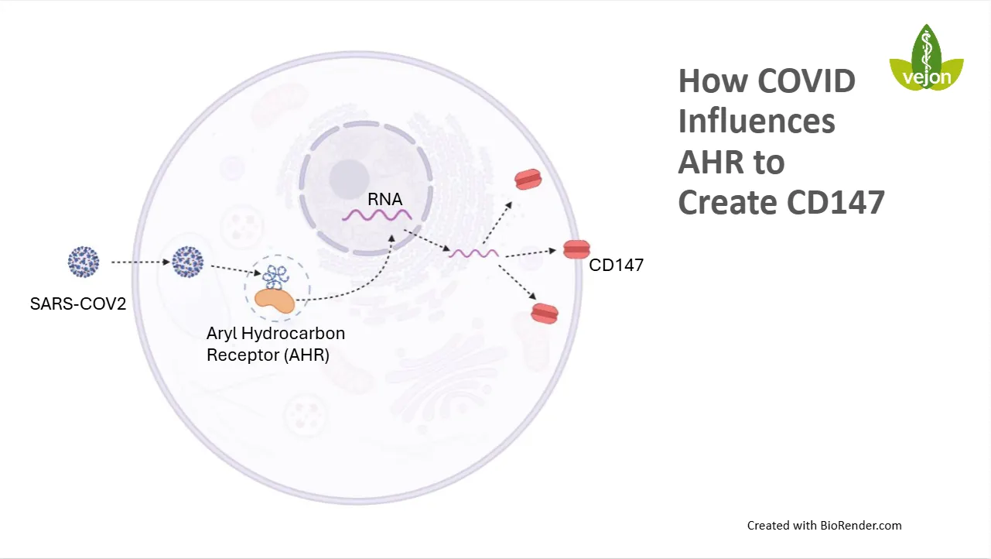
See: Wang K, et al. Inducible CD147 up-regulation boosts extended SARS-CoV-2 infection triggering severe COVID-19 independent of ACE2. Signal Transduction and Targeted Therapy. 2026;11(1):42.
Why Cancer Cells Depend on CD147
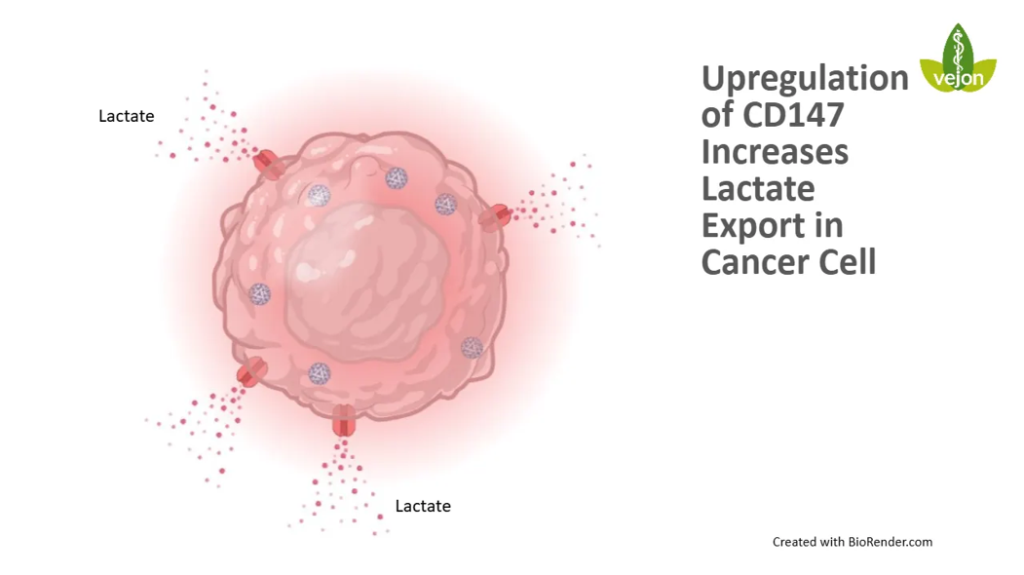
Cancer cells often rely heavily on glycolysis, consuming large quantities of glucose and generating lactate as a by-product. That lactate must leave the cell; if it accumulates internally, it restricts further growth.
CD147 helps stabilise lactate transporters at the cell surface, allowing cancer cells to export lactate into the surrounding tissue. I do not regard that as a minor biochemical detail. Once lactate accumulates outside the tumour, it helps create an acidic microenvironment that can weaken tissue barriers, suppress immune-cell activity, support new blood-vessel growth and make invasion easier. In other words, CD147 can help a tumour secure the conditions it needs to grow, invade and spread. This is why I believe the finding may be relevant to aggressive cancer presentation.
I am not arguing that SARS-CoV-2 enters the body and creates a cancer from nothing. That is not what the evidence shows and it is not the mechanism I am proposing.
I am asking a different question. What happens when a person already has a small, clinically silent cancer that expresses CD147, and then experiences repeated viral exposure against a background of a damaged gut microbiome and reduced immune resilience?
My Working Hypothesis
I suspect several processes may converge.
I think a damaged intestinal microbiome may make some people more vulnerable to repeated or prolonged infection. I think SARS-CoV-2 may then activate AHR and increase CD147 expression. I think the same CD147 pathway may simultaneously support viral entry, impair immune control and improve the cancer cell’s ability to export lactate and remodel its surroundings. If that sequence is correct, the virus would not necessarily initiate the cancer. It could accelerate an existing one.
A tumour that might previously have stayed localised for longer could become more metabolically active, more invasive and better able to escape immune surveillance. The patient would not necessarily develop a new cancer. They might instead present earlier in life, or at a far later stage than expected, because a previously controlled tumour had begun to behave aggressively.
That, to me, is a more biologically coherent explanation than reaching for the term “turbo cancer,” which generates more heat than understanding.
I prefer to ask whether ordinary cancers are beginning to behave more like melanoma: invading tissue, recruiting a blood supply and spreading before they become clinically obvious.
What the Research Does Not Yet Prove
I need to be clear about the limits. The microbiome study did not measure CD147. It did not prove that the patients had persistent SARS-CoV-2 infection. It did not show that restoring Bifidobacterium would slow cancer. It did not establish that the microbiome changes preceded the tumours becoming aggressive. And the CD147 study did not demonstrate this full chain inside human cancer patients.
I am connecting separate pieces of research because the biology appears to fit. That is an inference, not a proof.
The proper next step would be to study tumour tissue, microbiome profiles, viral markers, AHR activity, CD147 expression and cancer behaviour within the same patients. Until that is done, the mechanism remains a serious hypothesis, not an established clinical conclusion.
But I do not think the absence of a completed study should stop us from asking the question.
Why I Keep Returning to the Gut
The practical message I take from this is not that people should panic about every digestive symptom or assume a probiotic will prevent cancer. That would be a dangerous oversimplification.
My message is that persistent gut dysfunction should not be casually ignored.
When someone has ongoing bloating, altered bowel habits, food intolerance, chronic inflammation or repeated infections, I think it is reasonable to ask whether the gut ecosystem and barrier have lost resilience. I believe we need to understand what is driving that disruption, whether diet, medication, infection, impaired bowel clearance or chronic inflammatory signalling.
I also believe we need to stop treating the microbiome as a fashionable accessory to medicine. It is part of the immune terrain in which cancer either stays controlled or begins to escape.
The study does not prove that low Bifidobacterium causes aggressive cancer. What it does is point towards a pattern that deserves far more serious attention.
I increasingly suspect the post-pandemic cancer problem will not be explained by any single cause. I think it will involve the convergence of immune dysfunction, viral persistence, altered cellular metabolism and a damaged gut ecosystem.
The critical task now is to test that model properly. Until then, I will keep saying the same thing: I do not think we can protect long-term health while continuing to ignore the gut.
About the Author
Philip McMillan is a British medical doctor and consultant physician who is focused on covid-19, long covid and chronic health conditions such as dementia and arthritis. He is the co-founder and executive director of McMillan Research and CEO of Vejon Health. He publishes articles on a Substack page titled ‘Vejon COVID-19 Review’. As well as on his Substack page, he uploads videos onto his Rumble channel HERE and YouTube channel HERE.
Featured image taken from ‘Gut Flora and Cancer – The Link Exposed!’ The Truth About Cancer, 27 May 2016
The Expose Urgently Needs Your Help…
Can you please help to keep the lights on with The Expose’s honest, reliable, powerful and truthful journalism?
Your Government & Big Tech organisations
try to silence & shut down The Expose.
So we need your help to ensure
we can continue to bring you the
facts the mainstream refuses to.
The government does not fund us
to publish lies and propaganda on their
behalf like the Mainstream Media.
Instead, we rely solely on your support. So
please support us in our efforts to bring
you honest, reliable, investigative journalism
today. It’s secure, quick and easy.
Please choose your preferred method below to show your support.

Categories: Breaking News, World News
I know six people who died after getting the Covid shot. Two died from aggressive cancer. The poison shot did what the mass murderers hoped it would do – depopulate.
NOT hoped. Knew Damn Well… They KNEW.
1200 known diseases from the Pfizer jab, for example.
If you still believe in the virus hoax…there is no hope for you.
I’m much more prepared to believe that it’s the vaxx causing cancer than the “virus”.
You’d be correct… there was no virus, it was literally made up on a computer database!
A virus for which the genetic code was tweaked on a computer program, is still a virus.
Why no mention of EMF exposure? We know it affects humans at a cellular level, and it’s a registered carcinogen.
Swap out ‘infection’ with ‘detox’ and everything will make more sense. The body doesn’t get ‘infected’, it gets toxified. The observed symptoms is the body detoxing itself.
If this doctor could kindly keep the word Terrain out of his writing, that’d be great. He got one thing right (kinda): your diet is everything. Not just what you eat but the entirety of what you CONSUME.
Ahem…
VIRUSES HAVE NEVER BEEN PROVEN TO EXIST.
Neither has contagion…
Neither has DNA…
Neither has an Immune System, pumps, channels, etc…
Neither has the “billiard balls” atomic model…
Because none of them can be directly observed!
All of these things follow a theme: “There is no God save Science, Fear = Safety, Everything in Nature is trying to Kill you, and Trust Us to Manage the Resources due to Scarcity…”
If you put your trust in those that tout mathematical modelling as TRUTH, and beg you not to believe your own lying eyes, what you eventually get is chemotherapy. Studies that draw conclusions based on the foundational claims of a previous study… it is an assumption circlejerk. Or maybe a theoretical orgy.
Base your knowledge on what you can observe, built out from that foundation. Trace claims back to the ORIGINAL study and read the methods section- you’ll laugh, you’ll cry, then you’ll get pissed like me.