





Last month, the European Commission published a report about the demographic changes that are fundamentally reshaping Europe.
In it, Epimetheus points out, the Commission is admitting that the massive social engineering project of the past 2-3 decades – called invariably mass migration, migration crisis, climate refugees or whatever – hasn’t only been a sh*tty idea based on flawed assumptions; it’s a train wreck if there ever was one.
Another startling admission in the report is that without mass migration, Europe’s population is projected to be at least 32% lower, giving an indication of the huge number of people they are planning to import into Europe before the end of the century.
Let’s not lose touch…Your Government and Big Tech are actively trying to censor the information reported by The Exposé to serve their own needs. Subscribe to our emails now to make sure you receive the latest uncensored news in your inbox…
Please note that throughout the article below, Epimetheus makes a play on the acronym for the World Health Organisation’s (“WHO’s”) Public Health Emergency of International Concern, PHEIC (pronounced “fake”).
Peak EU (Population) is Nigh – in 2030
By Epimetheus, as published by Die Fackel 2.0 on 9 August 2026
Table of Contents
Introduction
A few weeks ago, in the midst of summer, the EU Commission’s number-crunchers (lol, yes, they claim to have some) published this gem:
Europe’s population is set to shrink and age, creating challenges for the labour market, healthcare, care systems and public finances. But longer, healthier [sic, sure] lives also offer opportunities to boost participation, innovation and growth. Through targeted policies on skills, care, housing and regional development, the EU is helping Member States mitigate the effects of demographic change.
European population declining, but living longer than ever
The report, drawn up by the Joint Research Centre, confirms that Europe’s population is currently at its peak; with 450.6 million people today, the EU’s population is projected to be around 445 million by 2050, and 398.8 million by 2100, representing an overall decrease of about 11.7%, to a level experienced in the 1970s. [Emphasis added]
News Announcement: Demographic transformation in the EU: challenges and opportunities, European Commission, 14 July 2026
So, first up, isn’t this what virtually everybody would celebrate as a good thing for a variety of reasons, incl. anti-European hatred, Climatology and, of course, notions deriving from a fundamental failure to understand what the EU Commission has just admitted to: The massive social engineering project of the past 2-3 decades – called invariably mass migration, migration crisis, climate refugees or whatever – hasn’t only been a sh*tty idea based on flawed assumptions; it’s a train wreck if there ever was one.
Remember when we were told that the mass in-migration of often incompatible foreigners (strangers) would, somehow, save the welfare state and our way of life?
Related: Dutch Researchers Reveal the True Cost of Mass Immigration, Die Fackel 2.0, 22 January 2024
And now, somehow, in mid-July 2026, the EU Commission said the quiet part out loud(er) than usual; here’s the direct link to the report, with several choice quotes below. [Note from The Exposé: if you are unable to view the report on the European Commission’s website, you can read it on the Internet Archive HERE. For convenience, we have attached a copy of it below.]
The original is in English, hence I merely added emphases and [snark].
On (Net) “Migration“
From pp. 13-14:
On average, the EU population increased by about 0.89 million people per year between 2005 and 2024, compared with around 3.03 million people per year during the 1960s. Natural population change (the difference between births and deaths) remained positive but declining until 2011, and has been negative since 2012. This means that since 2012, more people have died each year than have been born. As a result, overall population growth has been driven by positive net migration [with the accompanying footnote reading: “Net migration represents the balance between the number of people moving into a country (immigrants) and those moving out (emigrants) over a given period. For more information, see the Eurostat glossary on migration.”]
Two things.
First, it’s fashionable, especially among the retarded, self-styled Dissident Right™, to simply point to 2015 – the opening of the borders by Angela Merkel’s fiat – and claim that all will be well, once again, if we only turned back the time to 2014; it’s a PHEIC Truth™, but true enough to obscure the root cause being (drum roll) the abandonment of EU-internal border controls, widely understood*, which is one of the four core pillars of the EU as a whole. I’ve yet to hear anyone from the retarded, self-styled Dissident Right to call for an end of “free movement of people” (the next time anyone talks about winding down another one of these pillars, the “free movement of capital,” will be the first time ever, including by the self-styled Dissident or Mainstream Left™, which is equally retarded on this issue). See these two exemplary, detailed enquiries into my home country’s misfortune:
- Replacement Migration in Practice: Official Data show Austria took in 3.34m Immigrants Since 2000
- The Biggest Policy Blunder of All Times
Second, note the PHEIC definition in the EU Commission’s footnote: “Net migration represents the balance between the number of people moving into a country (immigrants) and those moving out (emigrants) over a given period.” This deliberately conflates everybody moving across the border in the EU/EEC area, including, of course, yours truly: I’ve been an immigrant at least 2-3 times in my lifetime, moving from Austria to Switzerland (in 2010) and from thence to Norway (in 2020). Seen thus, the definition doesn’t make a lot of sense, especially as I’m paying a sh*tload of taxes (44% this year) and not getting a whole lot back via transfer payments. That doesn’t make me better or worse than others in most regards, but in regard to the issues discussed by the EU Commission, it does.
I’ll now throw in a third item, which is quite the outcome of sh*tty EU policies and very telling about the true nature of the PHEIC covid sh*tshow since 2020. The most damning bit may be this graph, found on p. 15 – squeeze your Mk. 1 eyeballs and look at the turquoise line (“net migration”) from around 2020 onwards: remember, moving outside your 6 ft. circle and/or across borders (heavens forbid) would “spread the virus” (or whatever), yet for some strange, inexplicable reason, “net migration” actually took off like never before:
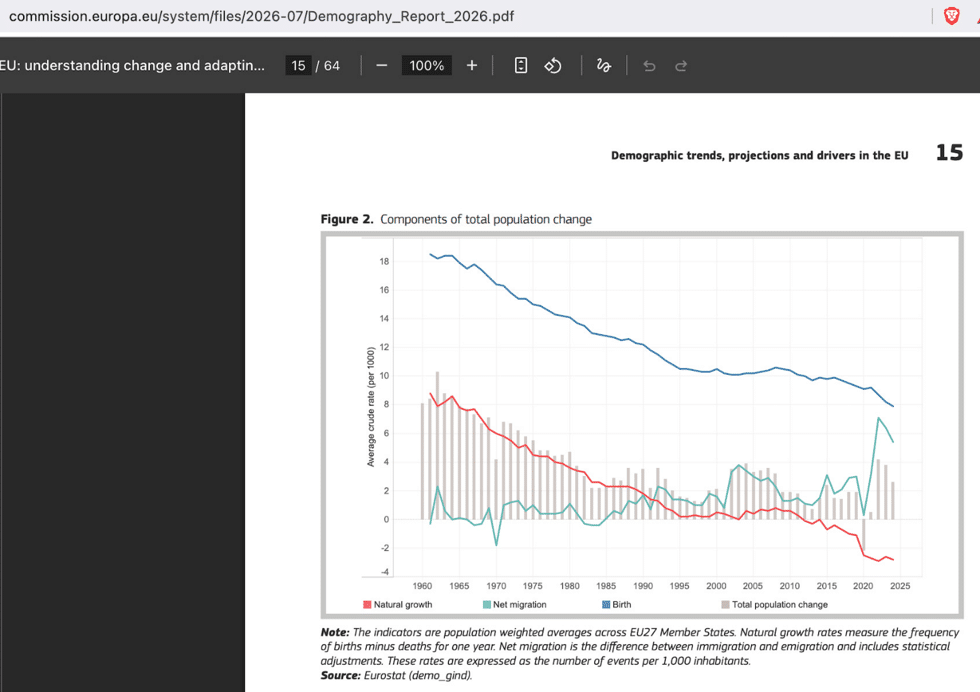
But, sure, the mandates worked, they were sooper-dooper relevant, and, needless to say, nothing associated with “(net) migration” has to do with anything else. Or just pretend to PHEIC ask an expert.
On “Ageing“
Next up, ageing, discussed in the report right after the EU population’s composition. These snippets are from pp. 18-19:
Population ageing is one of the most significant long-term demographic transformations affecting the EU … Increased life expectancy has transformed ‘old age’ from a relatively short final life stage into a longer and more diverse phase of life. Most of the projected population ageing is expected to occur until about 2045 [this is where much of the taxes of everybody who’s of working age right now is gonna go] …
Longevity is not just about living longer – it is about living healthier, more active lives. Rising life expectancy is a major achievement reflecting advances in healthcare, living standards and social conditions. However, longevity is not merely about living longer. It is about living healthier, more active lives with greater opportunities, participation and wellbeing across generations.
One brief comment: sure, kinda fine, but the social security, or pension, systems were all set up between the 1930s (in the US) and the late 1950s (in Western Europe) when “old age” was “a relatively short final life stage” – and thus not horribly expensive for the taxpayers – do whatever you wish to label this right now.
With life expectancy estimated to rise to around 90 years by 2100, two major changes are inevitable: first, the retirement age will go up, slowly at first and then all of a sudden (I’m a university professor and according to current legislation, my retirement age is 72). Second, payments and entitlements will have to shrink as the share of seniors continues to mushroom while, at the same time, the share of people of working-age declines from 2030 onwards. It’s not my opinion or anything like this; if you have a problem with this statement, take it up with maths.
The ongoing demographic shift means societies must reconsider how they support individuals across longer life courses [told you so], while also safeguarding the sustainability of territorial and social systems. It also necessitates adapting policies, institutions and social attitudes to new realities of work, retirement, learning, care and intergenerational solidarity. The transition towards a longevity society also unlocks substantial opportunities. Longer, healthier lives expand the potential for personal fulfilment, civic engagement and continued contribution to society well beyond traditional retirement ages, giving rise to the silver economy – a rapidly growing market for products and services tailored to the needs and aspirations of older citizens [good luck with that, especially as energy, food and living costs are spiralling out of control].
I’d merely add one more thing to consider here: it’s the same virtually everywhere outside sub-Saharan Africa, with perhaps the US, due to a stronger pro-immigration ethos, being the one exception to population decline (for the time being). Truth be told, since this means, for the time being, that the US absorbs a sizeable share of able and willing young people, doing so, naturally, exacerbates the demographic woes of the countries of origin.
On “Fertility Trends“
Funny enough, the fact that the same report also discusses this is absent from the Commission’s press release is telling in and of itself. The relevant passages I’m citing here are found on pp. 19-22:
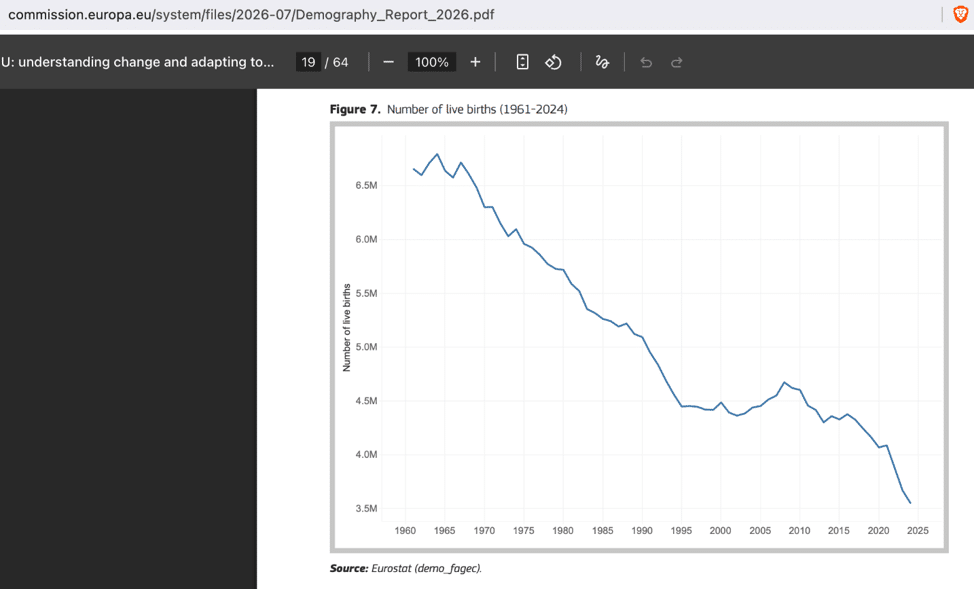
In 2024, 3.55 million children were born in the EU. Between 1961 and 2024, the highest annual number of live births in the EU was recorded in 1964, when 6.8 million children were born. From this comparatively high level, the number of live births in the EU declined at a steady pace, reaching 4.36 million in 2002. This was followed by a modest recovery, peaking at 4.68 million live births in 2008, after which a general downward trend was resumed, with small increases in 2014 and 2016. Live births in the EU fell to 4.07 million in 2020, rose slightly to 4.09 million in 2021 and have been declining since 2022. The crude birth rate was 7.9 in 2024. In comparison, the EU crude birth rate was 10.5 in 2000, 12.8 in 1985 and 16.4 in 1970.
Expressed in graphical form, this looks as follows:
At the beginning of the 2000s, the TFR [total fertility rate] in the EU increased from 1.43 in 2001 to 1.57 in 2010. It then decreased to 1.51 in 2013, followed by modest rebounds up to 2016, after which it started to decline again, reaching 1.46 in 2022 and 1.34 in 2024.
The fertility rates in the EU are projected to recover slightly by the end of the century, but remain below the replacement level …
Analysis of the link between family policies and fertility outcomes shows considerable variation across countries, periods and policy measures. Some studies question the effectiveness of measures expressly aimed at boosting births, noting mixed impacts on fertility and possible unintended effects on sexual and reproductive health, human rights and gender equality. Others suggest that well designed family support initiatives such as parental leave, childcare provision and financial assistance can influence fertility levels and timing, although the effects are typically modest and unlikely to return fertility to replacement rates. Fertility may also be supported indirectly by policies that promote work-family balance, gender equality, job stability and affordable housing [who would’ve guessed that].
Another set of explanations focuses on the gap between the number of children people would like to have and the number they actually have. Structural and economic factors such as perceived economic uncertainty, infertility related struggles, longer and more complex education and career pathways and high housing costs may [sic] prevent individuals from achieving their ideal family size. In addition, evolving social norms related to values and attitudes around having children, partnership, work life balance and gender roles are also influential. For example, the fact that Nordic countries, despite having advanced welfare states, high gender equality and strong support for families, are also experiencing declining fertility rates, suggests that deeper societal transformations may [sic] be underway. [line break added]
Declining fertility in different world regions with diverse socioeconomic, cultural and religious contexts is a process still poorly understood and analysed, affecting the global population [that means it’s a global thing].
Note, in particular, the issues about Nordic countries and their, of course, exemplary welfare state policies.
We’ve discussed the nonsensical nature of these policies recently: ‘With Fertility as Low as Never, Norway’s Birth Rate Committee Meets’.
On “Migration Trends“
These passages are found on pp. 22-25, and they aren’t mentioned in the report either (go figure).
On 1 January 2025, an estimated 46.7 million people born outside the EU were residing in an EU country, accounting for 10.4% of the EU population. Additionally, an estimated 18.0 million people born in an EU country were resident in another EU country, accounting for 4.0% of the EU population. According to the latest projections until 2100, the EU will continue to attract migrants. The projections suggest that net migration into the EU will be positive for every year from 2025 to 2100.
At this point, that last sentence is adorned with footnote (xv), which reads in full:
Migration is the most volatile and least predictable component of population change. The EUROPOP2025 model breaks migration down into four main flows: immigration and emigration to and from other EU countries, and immigration and emigration to and from non-EU countries. Each flow is projected by age and sex. For the short term (2025–2031), the model uses recent country-specific trends. From 2032 to 2100, assumptions gradually converge towards common EU-wide emigration hazard rates and per capita immigration levels, in line with the partial convergence hypothesis. A working-age ‘feedback mechanism’ is also included: in each year in which the working-age population (15–64) shrinks, an additional modest pull factor for non-EU immigration is assumed, reflecting the likely labour-market response to labour shortages. This additional inflow is set at 10 per cent of the annual decline in the working-age population.
Make of the following prognostications – really: reading of tea leaves – what you wish, I suppose, but this is what the EU is working with:
Even sustained [!!!] immigration is expected to prove insufficient [!!!] to fully offset natural population decrease stemming from low fertility …
Under a zero-net-migration scenario, the EU population would be 32% smaller – equivalent to approximately 130 million fewer persons – by 2100 compared with the baseline …
Migration can ease the pace of population ageing but not alter its trajectory …
While migration affects the size of the population, it cannot alter the fundamental shift towards older age structures. Settled migrants also grow older and eventually form a part of the older generations. Over time, the fertility levels of migrants also tend to converge with those of the host country, especially if they integrate and settle in the host society [we’ve seen this “already,” as the above-linked data from Norway and Austria show; I do think the EU’s demographers are a tad over-optimistic on this issue]. Thus, over generations, immigrants contribute to the same demographic patterns as the host society …
This is not a temporary disruption, but a permanent transformation in the conditions under which European societies evolve. This reality underscores the need for policies to adapt to – rather than seek to reverse – these fundamental changes.
Bottom Lines
Yet more evidence of the massive problems bedevilling politicos, legacy media and most experts.
Sure, fertility and child-rearing are touchy issues for many, but the single best one-stop treatment I’ve found is the work by Stephen J. Shaw (X profile).
Involuntary celibacy leads to involuntary childlessness.
Then there’s the apparent impossibility of politicos, experts and journos to both do what would be their jobs – which is compounded by their unwillingness to admit past mistakes, such as the family policies of the past half-century. Or the failures of welfare statism.
We’re, in fact, living through the long tail-end of a demographic crisis that commenced some time ago (around 1900, give or take) and that we’re seemingly incapable of understanding.
Our entire social welfare institutional complex is built on the demographic foundations of the 1920s and 1930s, as modified by the communising experiences of the Great Depression (US) and the two world wars (Europe).
These days, the social welfare complex is little more than a kind of charade that keeps going by mostly momentum (as it really exists): the current labour force is expected to contribute to retirees, with the remainder of contributions deriving from employers (payroll taxes) and government subsidies.
These funds are then pooled and poured into what is the functional equivalent of an escrow (social insurance or pension funds) that is, often, legally mandated to invest these funds in secure assets. While real estate has been historically the most secure asset (other than physical gold), guess what happens if these demographic realities – way more housing stock than future renters or owners – will manifest itself in the cubicles of lending institutions (commercial banks) … and if that thought revolves around, well, if real estate prices will have to come down as there’ll be a mis-match of supply (an inflated housing stock) and future demand (population decline), do venture a step further and consider what this realisation will do to financial institutions, social insurance and pension funds, government-as-we-know-it, and your personal future (no particular rank-order is implied).
I humbly suggest that authorities et al. stop pushing anti-life policies, such as offering synthetic hormones to teen girls upon their routine check-ups; stop pushing “Pride” stuff down the throats of society, which glorifies hedonism and normalises sexual fetishes over family values.
Penultimately, I suppose that the re-segregation according to the sex binary for career choices, trajectories – generous support for women in the 20s and delayed entry into higher education and the labour force without disadvantages vs. keeping the current model for men – might go a long way towards changing these very bad trajectories. I think doing that, by removing a sizeable chunk of women from the labour market, would do wonders for real wage growth and stable employment for men, which in turn is a clear incentive to start a family, perhaps coupled with low-interest home loans for families.
Finally, let’s consider the rule-of-holes: the sooner politicos, experts and journos admit their mistakes, the better off we’ll be at some point. The longer we continue down these worn-out paths, the ruder the awakening.
Hence, here’s my prediction:
- Less welfare state transfers and services will come, with higher contributions and higher retirement ages, a given.
- Cost-of-living spiralling out of control, reducing freedom of action for more and more people, which in turn fuels economic decline and financial distress (setting aside energy-related aspects for a moment).
- The attractiveness of the EU for migrants will decrease with less generous welfare payments forked over to new arrivals, to say nothing about too-big infrastructure (everything), especially as projections of population decline range between -12% (best case) to -32% (net-zero immigration) by 2100.
So, the main issue is: what gives first; EU politicos abandoning ship faced with massive electoral discontent over the crapification of everything, or the greatest-ever depression resulting from over-capacity meeting population decline setting in by 2030.
About the Author
Eipmetheus is a pseudonym for a professor of early modern and modern European civilisation at a public university “somewhere in the Old World.” He/she is the author of the Substack page titled ‘Die Fackel’. Die Fackel is a “webzine” which began in autumn 2021 with a few lines, mostly as a kind of diary or personal journal, to document at least part of the madness that engulfed Austria during the WHO-declared, so-called covid pandemic.
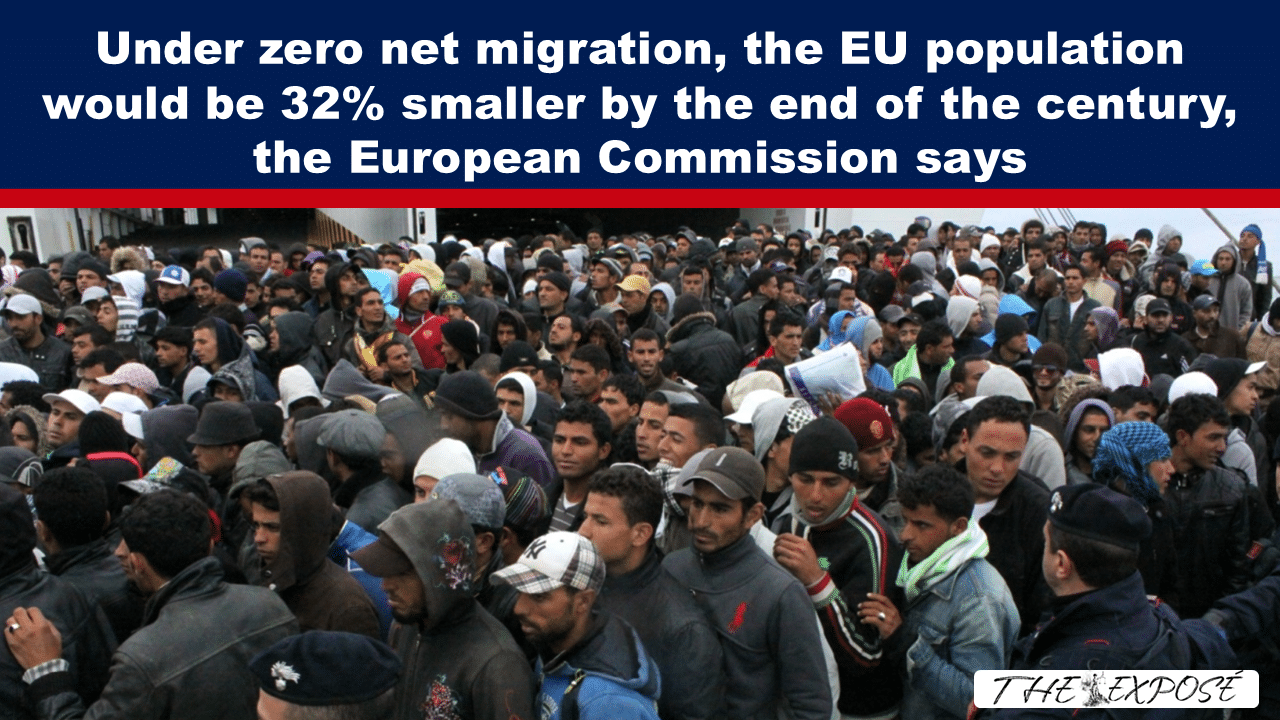
Featured image: Emergency African and Asian migrants and refugees on a ship in the port of Taranto, Puglia, Italy, 29 March 2011. Source: The National Interest
The Expose Urgently Needs Your Help…
Can you please help to keep the lights on with The Expose’s honest, reliable, powerful and truthful journalism?
Your Government & Big Tech organisations
try to silence & shut down The Expose.
So we need your help to ensure
we can continue to bring you the
facts the mainstream refuses to.
The government does not fund us
to publish lies and propaganda on their
behalf like the Mainstream Media.
Instead, we rely solely on your support. So
please support us in our efforts to bring
you honest, reliable, investigative journalism
today. It’s secure, quick and easy.
Please choose your preferred method below to show your support.

Categories: Breaking News, Latest News, World News
Thanks for this informative article. There is one factor which influences fertility rate that has been left out. This big elephant is called childhood vaccinations, which cause fertility problems as well as neurological damage, so these children grow up to be childless. Childhood vaccines are definetly a systemic depopulation strategy that has been taken place for decades, if not centuries. It would be interesting to see some data on how number and types ( ingredients and production process) has changed over time and superimpose this data on live births.
Every agenda by the globalists always have pros & cons.
Pros: Unchecked population growth, overpopulation will be major problems just like breeding a rats that consumes too much resources (useless-eater).
Cons: Overly-checked population, together with greedy human to make profits off the controlled breeding will ended up species instinction.
The problems always comes with greedy human that tilted the balanced in everything.
The root of all problems, the mass media (TV & other video based platform) that always showing, advertising, influencing & indoctrinating human brain to feels never satisfied or never had enough with what we owns. Indoctrinated to running & chasing paper-money entire life.
Always need to be bett-er, rich-er, high-er, glamour-er & viral-er at the cost of stopping our own humane-nature living (symbiosis) with moderate living lifestyle.
Are we carved a path of our own INDOCTRINATED destruction..?
Yes.
Short & precise answer, thanks!
Honest human are rare these days.
This breed or perish delusion has to stop. Years ago a study found 30% of women thought they had been conned into having a child. Which they blamed on themselves by believing the hype that a family is so rewarding no other issues would bother them etcetera. Out of all our friends only two couples had kids. Point is it not the only answer to life. Furthermore 8 billion is a tad too many given the devastating effect we are having on the biosphere globally. Secondary more people doesn’t increase the average IQ of any region. The greatest breakthroughs had been when our population was one tenth if that. The inventive Chinese for instance. Or Renaissance Italy followed by a very low population base in Holland and their scientific discoveries. Even the Industrial Revolution in Europe achieved its engineering concepts with the gifted among the many. But more many doesn’t mean more gifted even proportionally. So Europe going back to say even more like 300 million is plenty. When we can see what the US achieved with 200 million in the last century is proof or plucky Scotland and its engineers or the scattered geniuses in central Europe like Euler or a few other great mathematicians in tiny principalities thinking great concepts into realisation is currently missing.
One only has to look at some places with their overpopulation struggling to survive surely ought to remind us our responsibility to all life on this planet. UN platitudes won’t work since they are the cause of most of the misery which is another mess we could do without when we return to a better balanced equilibrium.
The answer to declining population is NOT INVASION OF FOREIGN OCCUPANTS unwilling to assimilate into western Constitutional Republics attacking families of the west.
The ANSWER is to eradicate regulations and taxation feeding the Luciferians and Pagan Demon Worshiping Pedophiles, Cannibals and Vampires running the same Central Banks as well as their associates reported upon here.
Time to bring ‘FAMILY INTO FOCUS’ as the most vital and imperative aspect of life…To make it wonderful to have CHILDREN raised in Christianity and to eradicate those running the banks with the others of their ilk.
Since we all know the Luciferians and Pagan Demon Worshipers are Demons Camouflaged as Humans…We also know their only purpose is THEFT OF GOD’S CREATION FOR HELL; thus the correct answer is not possible.
That means the only option is CIVIL WAR.
The models of these governments are always flawed. Their estimations on population cannot account for the unknowable. At the turn of the last century, could they have foreseen both the massive losses of life in WWII and the following boom of population post WWII? Of course not.
The simple fact is they are megalomaniacs who must try to micromanage everything. This is done to appease bigger, and far more monsterous magalomaniacs such as Rockefeller, the Rothschilds, Bill Gates, George Soros, just to name a few.
To correct course at this point would require a reset.
Hard or soft, but a reset would be required to turn back to production over progressivism in all aspects.
A stronger societal drive for productivity in resource harvesting, agricultural, and industrial growth, without a bloated beauracracy in the way at every step and excessive taxation supressing every aspect of life, all to fund their bloated numbers and socialist programs. These are the backbone of a strong economy, strong society, strong nation, and more reasonable governance.
Encouragement for a national pride, classical education, a shared and healthy fundamental belief system, and all this working to build an underlying need and desire for a national birthrate that is sustainable.
Nations converted into unwatched mixing pots of multiple cultures and peoples always boil over eventually. Always.
Simply looking at history. The rise and fall of nations, this is evident. But with the dumbing down of modern education and abandonment or outright suppression of classical education by self-declared communists in educational institutions and governments, most are left unaware of this simple truth.
We would need to turn over all the things that have been deliberately done to cause low fertility. As well as all the obvious things mass immigration and open borders will stop women from wanting to have children because it creates and unsafe hostile environment. All these globalist programmes created to erase the western civilisation must be stopped close the border and keep hostiles out of the country that will improve things. Clean up the soul the air the sea The west is not the only country where fertility has gone down. These evil eugenicists have been killing off the populations of the world for their globalist agenda.
It is up to the modern indigenous native white, Caucasian, people, the locals, to decide whether they marry and have children and to decide their own population size and way of life and not to be dictated to by foreigners and some unelected giant corrupt globalist – communist mafia in Brussels !!! The trends and predictions of these characters reminds me of the extreme and totally unrealistic and unscientific IPCC computer model predictions of +8.5 °C “global” (whatever that is) average temperature rise until the end of the century. You have to consider modern technology and the coming influence of AI, quantum computers and robotics which will allow greater productivity with less human labour. All their globalist – communist claims of industry and businesses needing more and foreign labour is bullshit! Europe and the west can continue being strong and productive with a smaller population. Our ancestors managed very well thank you very much with much smaller populations! We fought big wars and defeated enemies and had flourishing economies and created and discovered great things with a much smaller population !!! There seems to be a trend, at least it is much broadcast, towards going back to normality and getting back to our Judaeo – Christian and religious roots and for people to once again put God and family and patriotism front and centre in their lives. So the de-population scare mongering and excuses made by the globalists and communists and Islamo-fanatics for flooding Europe and the west with 3rd world savages and barbaric historically debunked violent and Satanic Muhammadans, is going to be shown to be wrong. White people are resourceful and innovative. We adapt, we create and we overcome. Our choice, not he choice of unelected traitors and outsiders !
The dont talk about what it costs to simply have a child, some nations have kindergardens at prices that shocks even me, and humpe that with jobb problems, insane expensive education, and a housing marked that simply makes it impossible to save anything.
And to make it much worse, as in Norway, a City like Bergen, used half a billion to buy houses, thru the years, and made the housing marked sky rocket and now, its so expensive only few can buy a house, and it just gets worse and worse.
Then I would never belive anything they claim, declining population comes from declining society, despite the denying in political and medias description or manufactured consents, the lie about decline was their golden calf to convince the nations policy makers we need more people to somehow secure an financial growth.
The answer to that, is:
Hang them all.
Get ridd of private banking.
There is a reason usury have been banned by ALL religions since the dawn of man, and if you dont see that, regarding the present problems, incl the insane level of uh…. refugees, and its effect, you are in deep dodo, hell, we all are, incl our grand children.
And my last advice, I know this will sound eh… way out of line.
While I can.
I belive, most of our human problems, comes from parasites.
That, ranges from Cancer, to Multiple scleroses aka MS, joint issues, etc, I even start to belive Autism specter, comes from some parasits ability to enter our brain and/or attach it self to our central nerv. system.
I base that on one simple narrative, in this days of electron microscopes, etc, they stil can fight most of this issues, incl cancer.
Because they know.
Just as they lie about Ivermectine, etc, and their lies about cancer.
Tobacco was banned, not because of the scam cancer, but because it protects you from respiratory problems, like flu.
Tobacco dont cause cancer.
It never did and never do.
peace