





In an article last month, The New York Times documented the US electric vehicle bust. But then it goes onto spin a false narrative about global sales of electric vehicles booming.
In the following, Robert Bradley Jr. comments on excerpts from the article.
Let’s not lose touch…Your Government and Big Tech are actively trying to censor the information reported by The Exposé to serve their own needs. Subscribe to our emails now to make sure you receive the latest uncensored news in your inbox…
The Weak EV Narrative (fix is in with NYT essay)
By Robert Bradley Jr., as published by Master Resource on 13 August 2026
Table of Contents
Introduction
Matthew Shaer’s 5,500-word New York Times essay, ‘The American E.V. Has Been Crushed. Will It Take the US Auto Industry with It?’ (15 July 2026), documents the US electric vehicle (“EV”) bust. Very useful. But then he spins a false narrative. And for credibility, the article comes with a statement: “Matthew Shaer spoke with dozens of autoindustry analysts and academics for this article” … but not anyone who challenges the EV narrative in light of the failed domestic policy.
Shaer’s essay is a Malthusian masterpiece: doom-and-gloom with a prediction waiting to be refuted. Its subtitle: “The largest US automakers have backed away from electric vehicles, even as global sales are booming. The decision may make them obsolete.”
The first sentence is factual and correct. The second sentence is wrong – and missing the other side of the story. Overall, Matthew Shaer refuses to consider:
- The consumer imperative (and “social justice”) of affordability.
- Automaker decision-making in a subsidy-neutral market.
- The improvements in ICE (internal-combustion engine) technology, including emission reductions.
- China’s EV buildup as a money-losing, central-planning blunder.
Quotations follow below with my comments and added subtitles.
EV Losses, EV Crash: Correct
Doug Field, the head of Ford’s EV unit … had good reason to be optimistic. Buoyed by billions of dollars in federal investment in charging infrastructure and a generous $7,500 consumer tax credit, the electric vehicle market in the United States had recently hit historic highs, climbing from annual sales of roughly 490,000 in 2021 to more than 800,000 in 2022 – an increase of approximately 60 per cent.
Yes, it was government-enabled and woke-driven. A false boom – and a colossal economic mistake in retrospect.
[Ford’s early EV model] seems to have been cursed from the outset. Unlike many of the earlier Ford EVs, the “bullet train” was not merely a retrofitted version of an existing vehicle with an internal combustion engine … It was an entirely new car, requiring a large and complicated battery to match the vehicle’s projected heft.
The early reaction to Ford’s ambition (wokeness) was green-is-great and the auto-transition-is-on. But reality set in.
In April 2024, Ford pushed back the sale of the “bullet train” by two years, to “enable Ford to take advantage of emerging battery technology”; that August, it confirmed it was killing it entirely. “These vehicles need to be profitable,” Ford’s chief financial officer, John Lawler, explained in a conference call with reporters. “If they’re not profitable, based on where the customer is and the market is, we will pivot and adjust and make those tough decisions.”
No kidding! And the verdict of losses was industry-wide.
At the time, his comments went relatively unnoticed. But it soon became clear that Ford – which went on to retire the Lightning, an electric variant of its best-selling F-150 pickup – was not the only manufacturer to have suddenly developed a case of cold feet. In July 2024, General Motors said it was delaying the introduction of a Buick EV SUV, and the following September, Volvo dialled back plans for an all-electric lineup of vehicles that would have debuted in the United States. In 2025, Dodge followed suit, axing a battery-powered Charger and its long-anticipated EV Ram pickup truck. Two plug-in hybrid Jeeps were sent to the scrap heap in the sky, as were several e-sedans that Honda and Nissan had designed for the US market. Acura pulled the plug on an electric SUV built at a GM plant in Tennessee.
A total fail ….
The cancellations accumulated at such a rapid clip that the industry press often struggled to keep up: Late last year, for example, MotorTrend published an effusive review of the BrightDrop, a cutting-edge electric van from Chevrolet. The cargo hold of the vehicle was “cavernous,” the magazine’s writers noted approvingly, and the pedal feel supple. As for visibility, it was akin to “looking out of a giant terrarium.” The only problem was that the BrightDrop was no longer available, having been discontinued by Chevy two weeks after its press team dropped the thing off at MotorTrend headquarters. (“Well, this is awkward,” the article begins.)
Bad went to worse with the pullback of subsidies, moving towards a government-neutral policy.
Under the second Trump administration, the EV tax credit was eliminated and tailpipe-emission standards were gutted, which more or less instantly drove down sales of new battery-powered vehicles and encouraged the so-called Big Three – Ford, GM and Stellantis North America, the maker of the Dodge, Chrysler, Ram and Jeep brands – to refocus their considerable resources on trucks and plus-size SUVs. Assembly lines at EV plants went dormant, and the battery plants that had sprung up around the country in the Biden years were unceremoniously closed or repurposed for other tasks, like the manufacture of industrial battery storage units. Thousands of workers lost their jobs. One of them was Doug Field, the brain behind Ford’s three-row “bullet train,” who departed the company this spring as part of an internal restructuring.
The overall malinvestment was huge, one of the greatest in US history.
In purely financial terms, the combined cost of this industry about-face remains nothing short of staggering: This year, Stellantis alone was forced to write down $26 billion in EV – related losses. (Ford reported a slightly less ghastly $19 billion loss.) But somehow, it’s the long-term repercussions that look worse. “The way I’d put it,” the auto journalist Martin Padgett told me recently, “is that we pulled a U-turn while the rest of the world was pushing forward.”
Global Growth, Loss Economics
Matthew Shaer then spins a narrative based on high global sales. But this “boom” is artificial, the result of government direction and special favour. Consumer affordability and taxpayer dollars get no mention in the article.
According to the International Energy Agency, a Paris-based policy group, one of every four vehicles sold globally in 2025 was battery-powered. Analysts with Bloomberg have predicted that in the next decade, that number will more than double, putting gas-powered cars – for the first time ever – in the minority of overall new vehicle sales. Overseas, Asian and European manufacturers have spent years preparing for this eventuality, dumping billions into the development of battery technology. With predictable results: China now makes 75 per cent of all EVs sold anywhere on earth. (The United States makes around 5 per cent.) Many of those vehicles are produced by BYD, a Chinese company that recently became the largest manufacturer of battery-powered cars in the world.
Help us, author. How is BYD doing? Is it losing money? AI answered:
No, BYD is not losing money on its overall EV sales in China, but its profit margins have shrunk significantly. A fierce domestic price war, cooling local demand and reduced government subsidies have heavily squeezed profits – causing sharp net profit declines – yet the company remains profitable overall, leaning heavily on its massive scale and growing international exports to offset domestic margin pressures.
Is China losing money with its solar buildout? Again, AI overview:
Yes, China’s solar manufacturing industry is losing substantial money on its solar sales. Severe overcapacity – with factories capable of producing double the total global demand – has triggered a punishing price war, causing leading manufacturers like LONGi, Jinko Solar, Trina Solar and Tongwei to post billions of dollars in losses.
This appears to substantiate the benefits of domestic free market policy versus foreign government intervention. But no, the narrative goes to a “technological gap” between the US and foreign nations.
“Already, the technological gap is getting dangerously wide,” says Stephen Ezell, a senior economist with the Information Technology and Innovation Foundation, or ITIF, a Washington-based non-profit. “Today, China can get a new EV from blueprint to launch about 33 per cent faster than a US company, give or take. But that will accelerate, right? The speed of innovation, the speed of the production cycles at these foreign companies, is just going to get faster and faster. And at some point, the gap will get pretty close to fully impossible for American automakers to close.”
Shaer then spins that EVs were/are the way forward to re-establish “the US auto industry’s once-dominant stake in the domestic car business.” “The timing could not be worse” for domestic automakers to have given up on EVs.
Since the 1960s, the US auto industry’s once-dominant stake in the domestic car business has been slowly chewed up by foreign manufacturers, sinking from a near monopoly of 92 per cent in 1965 to 46 per cent in 2015. As of 2024, Ezell estimates, only a third of new cars purchased in the United States were built by the Big Three. The EV revolution was seen by its proponents as a way to reverse that trend. It was an opportunity for Detroit to rediscover its capacity for ingenuity and to re-establish credibility in an industry it helped to create.
The narrative is fanciful. Shaer claims that a profitable, robust EV market exists in the United States!
Instead, whipsawed back and forth by shifting political headwinds and afflicted by all manner of self-enforced error, it appears to be in the process of sealing its own doom – at the precise moment interest in EVs is surging in the United States. In April, the analytics firm JD Power conducted a survey showing that 26 per cent of prospective buyers in the United States were “very likely” to consider an EV for their next car. And that was before the chaos in the Strait of Hormuz helped push the price of unleaded gasoline to a four-year high.
So, automakers do not know their market? Did the poll account for the up-front price premium for EVs over ICE and other issues?
“We’ve reached a genuinely existential moment,” Ezell told me. In a best-case scenario, Detroit manages to meet it by crafting a viable, long-term EV strategy while also servicing the still dependably lucrative existing market for ICE trucks. In the worst, it retreats onto what the economist Susan Helper calls a “shrinking island of ICE,” churning out outlandishly large trucks and not much else. At which point, the obsolescence of the mighty US automobile industry – a sector once inextricably associated with American know-how and economic might – would be all but guaranteed. As Ford’s chief executive, Jim Farley, recently acknowledged in a statement that could apply to any member of the Big Three, “If we don’t put our chips on the right number and the right colour, Ford could maybe not exist.”
What a poor, speculative conclusion. The problem with the domestic EV market is not so much the bust but government subsidies and bullying that created a false industry and resulting bust. And for the international EV market, characterised by anti-energy policies and loss economics: “Greater speed to the wrong destination is not a virtue.”
The rest of Shear’s article can be read HERE.
About the Author
Robert L. Bradley Jr. is an American economist and energy analyst. He is the CEO and founder of the Institute for Energy Research (“IER”), a senior fellow at the American Institute for Economic Research (“AIER”) and a fellow of the Institute of Economic Affairs in London and a Principal of Master Resource.
He is the author of eight books, including ‘Energy: The Master Resource’ (2004), ‘Edison to Enron: Energy Markets and Political Strategies’ (2011) and ‘Enron Ascending’ (2018). His current book project is ‘Energy and Leviathan: A Political Economy Primer’. His website, Political Capitalism, is dedicated to his multi-volume history of the rise and fall of Enron.
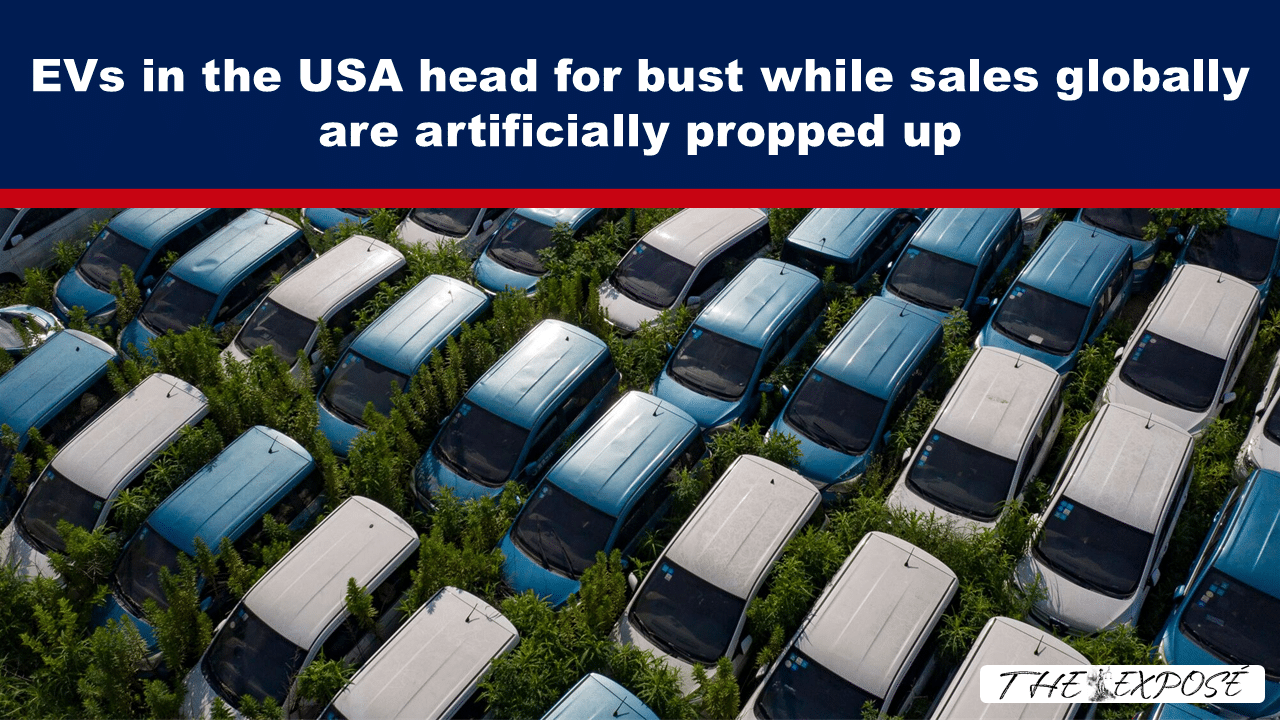
Featured image taken from ‘China’s Abandoned, Obsolete Electric Cars Are Piling Up in Cities’, Bloomberg, 17 August 2023
The Expose Urgently Needs Your Help…
Can you please help to keep the lights on with The Expose’s honest, reliable, powerful and truthful journalism?
Your Government & Big Tech organisations
try to silence & shut down The Expose.
So we need your help to ensure
we can continue to bring you the
facts the mainstream refuses to.
The government does not fund us
to publish lies and propaganda on their
behalf like the Mainstream Media.
Instead, we rely solely on your support. So
please support us in our efforts to bring
you honest, reliable, investigative journalism
today. It’s secure, quick and easy.
Please choose your preferred method below to show your support.

Categories: Breaking News, Latest News, World News