





Dr. Philip McMillan published a video questioning whether covid vaccination played a role in Dolly Parton’s ill health.
Hundreds of people commented on the video, many sharing their own experiences of cancer post-vaccination.
These comments are more important than trying to work out what happened to one famous singer. Because people are not merely asking what happened to Dolly Parton. They are asking whether anyone will take seriously what has happened to them, their families and their communities since the pandemic.
Let’s not lose touch…Your Government and Big Tech are actively trying to censor the information reported by The Exposé to serve their own needs. Subscribe to our emails now to make sure you receive the latest uncensored news in your inbox…
Dolly Parton, the Question I Hesitated to Ask – and the Response I Could Not Ignore
By Dr. Philip McMillan, 27 August 2026
I was hesitant to discuss Dolly Parton’s death.
There is an obvious danger whenever a public figure dies and only limited medical information has been released. Grief can quickly be overtaken by speculation. A few facts can be arranged into a compelling story, even when the evidence needed to support that story is missing. I did not want to use the death of someone so widely loved to make a claim that could not be defended.
But I also realised that remaining silent would not make the questions disappear.
Dolly Parton was not simply a celebrated singer and philanthropist. She became one of the most recognisable public supporters of covid vaccination. She donated $1 million to covid research at Vanderbilt University Medical Centre; Vanderbilt says the gift supported critical early work connected with the Moderna vaccine. In March 2021, she publicly received the Moderna vaccine and encouraged others to be vaccinated.
None of that makes her responsible for what happened during the pandemic. She acted according to what she believed would help people. But it does explain why, following her death after what her publicist described as a “brief battle with cancer,” many people immediately asked whether her later health problems could have been connected to vaccination, infection, reinfection – or some interaction between them.
That was the question I reluctantly addressed in the video below.
The Response Told Me This Was Not A Marginal Concern
The discussion resonated far beyond what I expected. When I returned to the video roughly sixteen hours after it had streamed, it had already attracted around 11,000 views, 1,700 likes and more than 450 comments.
Those numbers are not scientific evidence. Neither are the comments. But dismissing them would be a mistake because they reveal the scale and character of the unresolved public concern.
Some viewers immediately concluded that vaccination caused Dolly Parton’s cancer. That conclusion goes beyond the available evidence. Other viewers described friends or relatives whose cancer, cardiovascular disease or general health appeared to worsen after vaccination or infection. These are personal observations rather than controlled comparisons, but they show what families are trying to understand.
One viewer wrote: “I loved Dolly and feel bad that she passed, but knowing how she pushed the jab makes me sad.”
Another described believing that a friend’s cancer and death had been accelerated following vaccination. Others expressed broader concern about repeated vaccination, immune suppression and the lack of transparent investigation.
I cannot validate those individual conclusions from a comments section. But I cannot pretend that the underlying concern is imaginary either. Hundreds of people gathered beneath one discussion because they recognised something from their own experience: illness has changed, people are searching for explanations, and the institutions expected to provide clarity have not earned their confidence.
The top-liked comment was: “Dolly gave a million dollars to research the covid shots … Moderna gave her turbo cancer”
I would encourage readers not only to watch the video, but to spend time reading the comments. Do not read them as a medical dataset. Read them as a record of where public trust now stands.
What We Know – And What We Do Not Know
The correct starting point is not accusation. It is disciplined uncertainty.
We know that Dolly Parton’s representatives confirmed that she had cancer. We know that four days before her death she spoke publicly about ongoing health problems. She had previously discussed kidney stones, infection, dizziness, dehydration and several years during which her immune and digestive systems had been “out of whack.” We also know that at least one Moderna vaccination was documented publicly.
What we do not know is more important.
We do not know the type or stage of her cancer. We do not know when it was diagnosed. We do not know her complete vaccination, booster or SARS-CoV-2 infection history. We do not know which treatments she received. We do not know whether her renal, digestive and immune problems were related to the malignancy, its treatment or a separate condition. We do not know the immediate mechanism of death, and we do not know whether a detailed postmortem examination was performed.
The phrase “brief battle with cancer” does not fill those gaps. It could describe a recent diagnosis, a previously private diagnosis, an aggressive malignancy or a late-stage cancer discovered only after complications developed.
A person with cancer may die suddenly from pulmonary embolism, stroke, sepsis, bleeding, renal failure, metabolic disturbance, cardiac complications or treatment toxicity. A public video recorded shortly before death cannot establish the stage of a cancer or exclude sudden deterioration. The short timeline is therefore clinically interesting, but it does not identify the cause.
That distinction is essential. A sequence is not a mechanism.
The Two Dishonest Answers
There are two easy answers, and both are scientifically inadequate.
The first is to say there is no evidence vaccination contributed, so the possibility should be dismissed. That confuses the absence of case-level evidence with evidence of absence.
The second is to say that vaccination preceded her illness, so it probably caused or accelerated the cancer. That mistakes temporal association for causation.
The honest answer is that the public information is insufficient to adjudicate the question.
That does not mean both explanations are equally probable. Dolly Parton was 80, an age at which the background risk of malignancy is substantial. Vaccination was also widespread, making coincidence entirely plausible. Any causal argument would require far more than knowing that an exposure occurred before an illness.
But the weakness of a specific causal claim does not excuse the weakness of the research system. We should have been building the datasets and pathological programmes capable of separating coincidence from genuine signals.
I Am Asking A Wider Question Than “The Vaccine”
My concern has never been limited to vaccination in isolation. I use the term “covid storm” to describe a working framework in which infection, immune priming, vaccination, reinfection and individual susceptibility may interact to produce disease patterns different from the original acute infection.
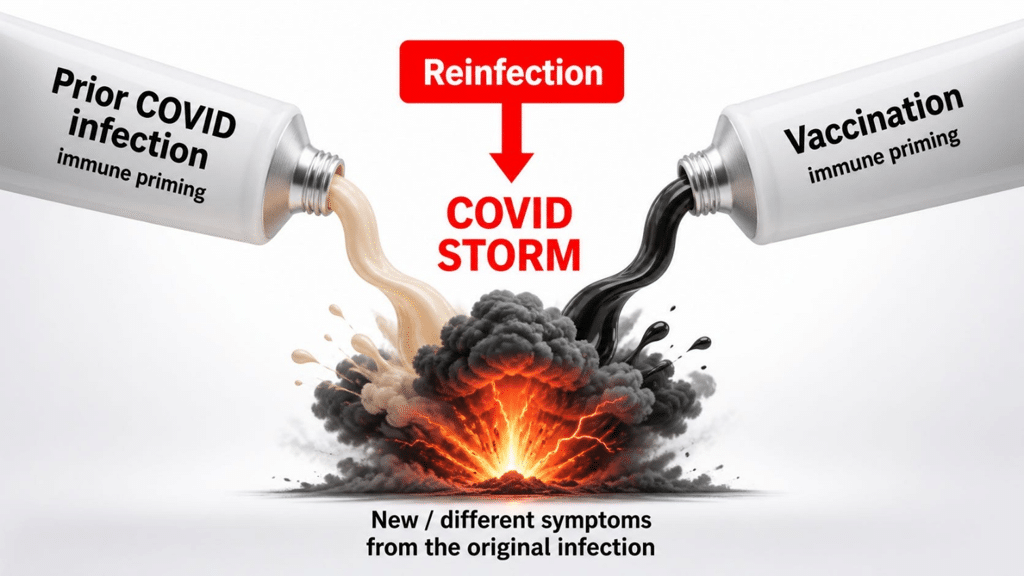
This remains a hypothesis that must be tested, not a diagnosis that can simply be attached to an individual case.
SARS-CoV-2 infection itself can affect immune regulation, vascular biology, coagulation and inflammatory signalling. Vaccination also alters immune responses by design. Most vaccinated people were subsequently infected, often repeatedly. Trying to separate those exposures years later is exceptionally difficult unless the research was designed prospectively to do so.
The useful scientific question is therefore not merely whether someone was vaccinated. We need to know which product they received, how many doses they had, when those doses were given, which infections occurred before and afterwards, what their baseline immune state was, and what changed before the eventual disease appeared.
Without that information, every discussion deteriorates into competing anecdotes.
What The Comments Are Really Saying
Shortly after publishing the video, I posted a broader question on X: “Imagine next year! When will families ask if lives may have been shortened? If there are no questions for the stars, then the average person will just be another statistic.”
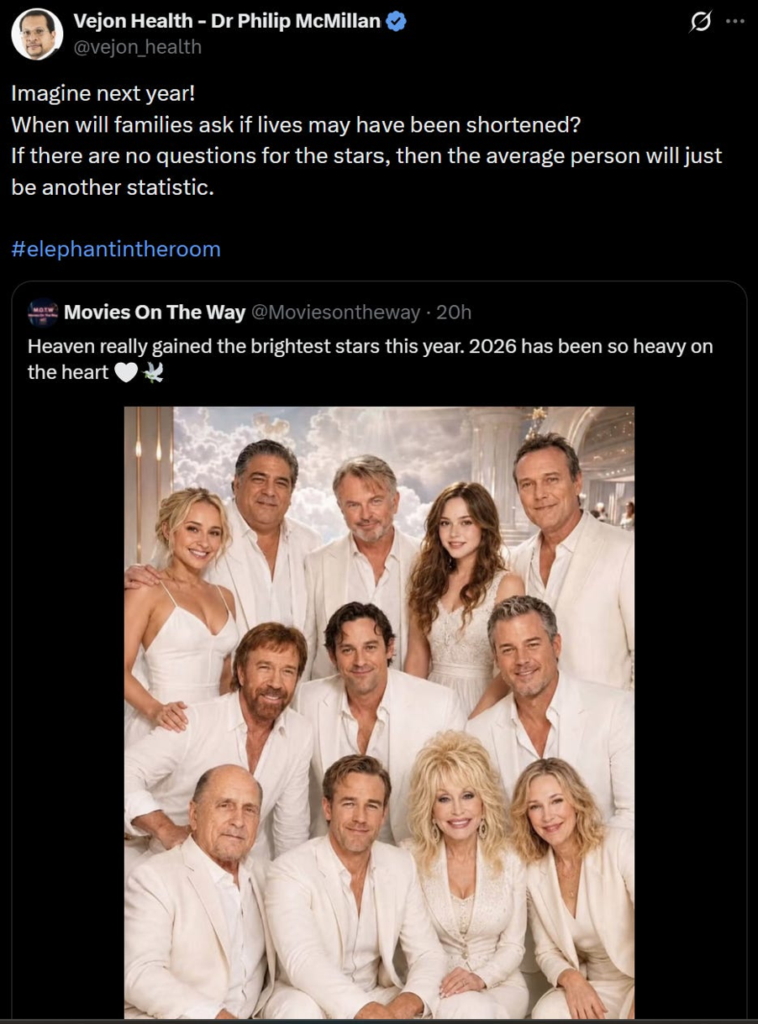
The point was not that every premature death should be blamed on vaccination. The point was that if difficult questions are not investigated in visible public cases, families will reasonably wonder what chance the average person has of being properly examined.
Public figures do not surrender their right to medical privacy. But high-profile deaths expose the same evidentiary failures affecting everyone else. If cancer type, disease trajectory, infection history and immediate cause of death remain unknown, the public is left to fill the vacuum. Some will fill it with certainty that is not justified. Others will insist there is nothing to investigate. Neither response advances medicine.
The comments beneath the video repeatedly return to personal loss. People are not debating an abstract regulatory question. They are trying to understand why a friend developed an aggressive cancer, why a relative suddenly deteriorated or why their own health has not recovered since the pandemic.
That does not make their preferred explanation correct. It makes the absence of serious investigation consequential.
What Proper Investigation Would Look Like
We need long-term studies linking brand-specific vaccination and dose records with documented infection history, cancer registries, serial laboratory findings and clinical outcomes. Researchers must distinguish new cancer formation from the unmasking of an existing subclinical malignancy, and both from acceleration or recurrence of established disease.
We also need systematic tissue and postmortem research. An autopsy can establish cancer burden, thrombosis, myocarditis, infection, renal injury and the immediate mechanism of death. It cannot, by itself, prove that vaccination or infection initiated a cancer. That requires validated assays, appropriate controls, clinical chronology and supporting epidemiology.
This is precisely why pathology matters. It does not give us permission to make sweeping claims; it gives us the opportunity to replace speculation with evidence.
The failure to perform or publish enough of this work has left a vacuum. That vacuum is now being filled by institutional dismissal on one side and overconfident causal claims on the other.
Why I Decided To Speak
I did not record the discussion because I believed I could diagnose Dolly Parton retrospectively. I could not. No responsible clinician could do so from the information available publicly.
I recorded it because the questions raised by her death are already being asked about thousands of less visible people. The response to the video confirmed that. The public is not waiting for permission to notice patterns, compare experiences or question whether pandemic-era exposures have had consequences that remain poorly understood.
The scientific community can respond defensively, insisting that people should stop asking questions until definitive evidence appears. But definitive evidence does not appear spontaneously. It emerges because researchers collect the right data, examine tissue, publish negative as well as positive findings and remain willing to test uncomfortable hypotheses.
I cannot say that Dolly Parton’s cancer or death was caused by vaccination, infection or reinfection. I can say that the available evidence is inadequate to determine whether any of those exposures contributed. I can also say that this uncertainty is not confined to one celebrity.
That is the real reason the video resonated.
People are not merely asking what happened to Dolly Parton. They are asking whether anyone will take seriously what has happened to them, their families and their communities since the pandemic.
Those questions deserve something better than speculation. They also deserve something better than silence.
About the Author
Philip McMillan is a British medical doctor and consultant physician who is focused on covid-19, long covid and chronic health conditions such as dementia and arthritis. He is the co-founder and executive director of McMillan Research and CEO of Vejon Health. He publishes articles on a Substack page titled ‘Vejon COVID-19 Review’. As well as on his Substack page, he uploads videos onto his Rumble channel HERE and YouTube channel HERE.
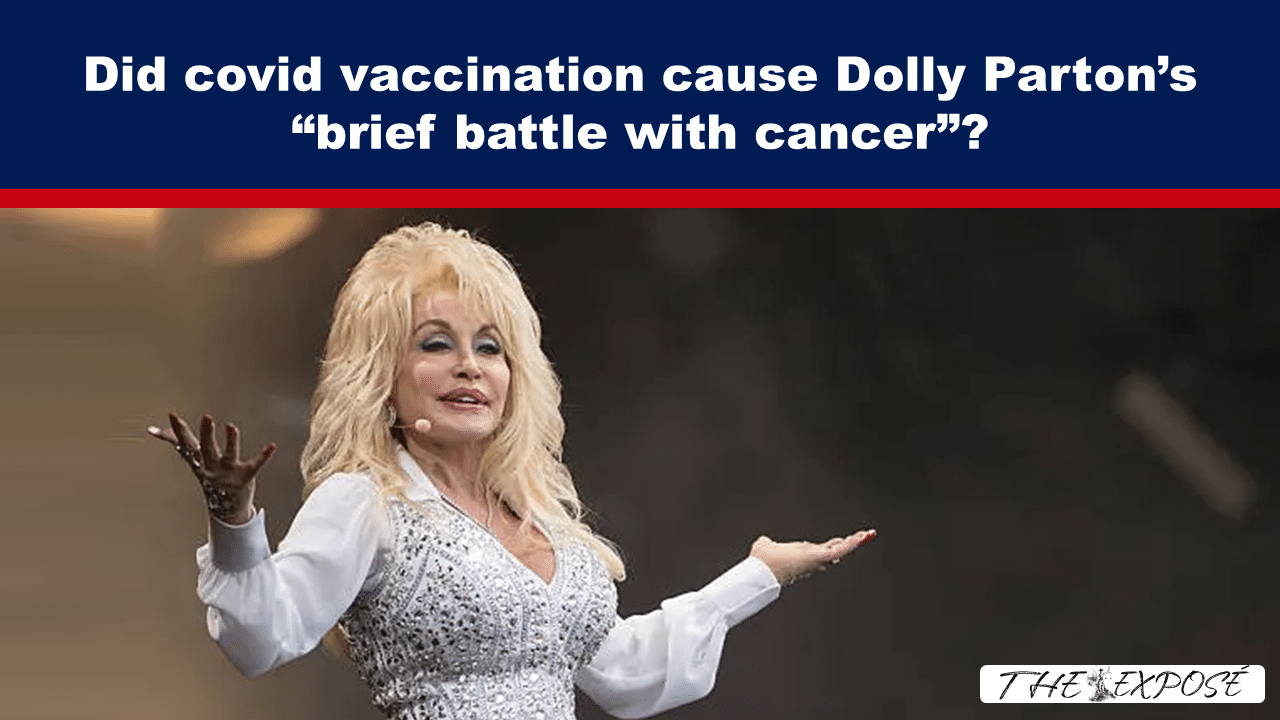
Featured image: Dolly Parton performs on the Pyramid Stage during Day 3 of the Glastonbury Festival at Worthy Farm on 29 June 2014 in Glastonbury, England. Source: Getty Images
The Expose Urgently Needs Your Help…
Can you please help to keep the lights on with The Expose’s honest, reliable, powerful and truthful journalism?
Your Government & Big Tech organisations
try to silence & shut down The Expose.
So we need your help to ensure
we can continue to bring you the
facts the mainstream refuses to.
The government does not fund us
to publish lies and propaganda on their
behalf like the Mainstream Media.
Instead, we rely solely on your support. So
please support us in our efforts to bring
you honest, reliable, investigative journalism
today. It’s secure, quick and easy.
Please choose your preferred method below to show your support.

Categories: Breaking News, Latest News, World News