





At the end of last month, The New York Times displayed blatant climate change catastrophe activism in an article about coral reefs.
The outlet made the false claim that coral reefs were in decline due to human-caused climate change and were running out of time to recover.
As H. Sterling Burnett explains below, The New York Times went off half-cocked, reporting on a single study’s findings about coral reef conditions without checking facts or looking at the data on coral reefs.
Let’s not lose touch…Your Government and Big Tech are actively trying to censor the information reported by The Exposé to serve their own needs. Subscribe to our emails now to make sure you receive the latest uncensored news in your inbox…
Follow Science, New York Times, Corals Are Doing Well Amid Modest Climate Change
By H. Sterling Burnett, as published by Climate Realism on 2 September 2026
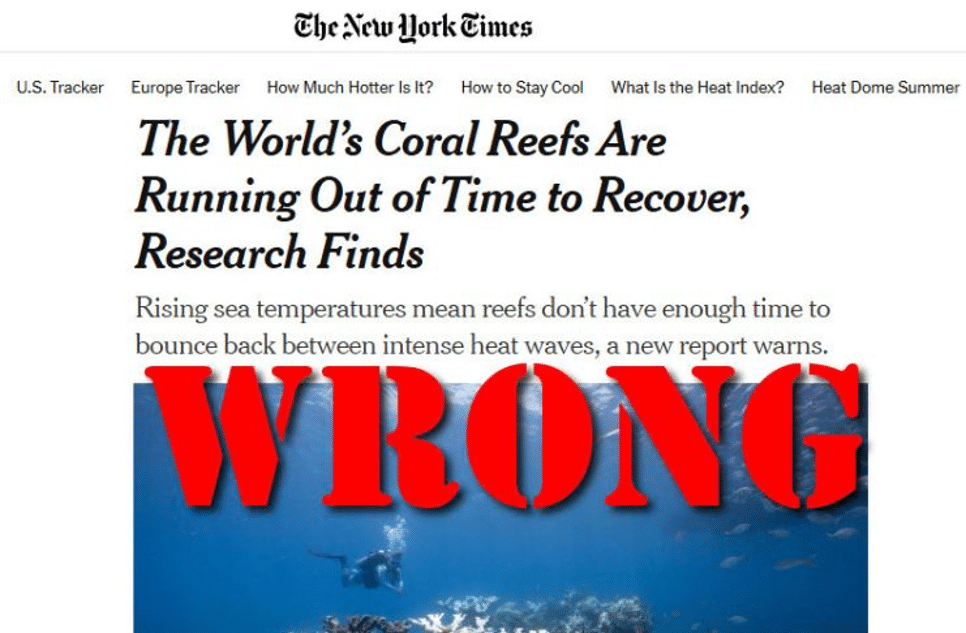
The New York Times (“NYT”) ran a story claiming climate change is threatening the survival of the world’s coral reefs. This is false. New coral colonies, adapted to warmer waters, are being found with regularity, and the largest coral reef in the world, Australia’s Great Barrier Reef, has set records for growth and extent in recent years, confounding climate model predictions of decline.
In the story, ‘The World’s Coral Reefs Are Running Out of Time to Recover, Research Finds’, climate reporter, Quinn Glabicki, writes, “[c]oral reefs around the world, struggling as climate change drives more frequent and more intense marine heat waves, are running out of time for recovery, according to a sweeping new report on the state of the world’s corals published on Monday.
“The comprehensive global assessment … found that the world’s coral reefs had declined by 9.5 per cent in the period from 2020 to 2024, compared with 1980 to 2009,” Glabicki continued. “The largest single-year coral decline on record, which affected 87 per cent of reefs worldwide, occurred in 2024.”
Glabicki and the NYT’s fact checkers should have exercised a modicum of journalistic curiosity instead of reporting this study as if it were the final authoritative word on the state of the world’s corals. The 2023 through 2024 decline the story reported on represented one bad year of bleaching, but even the underlying report admits that bleaching does not per se equal coral death. Of the 8.9 per cent of coral bleached, 6 per cent had recovered in just one year, and based on past bleaching events, more coral might recover over time, resulting in possibly no net loss in coral during the severe 2023 to 2024 event. In fact, science hasn’t tracked coral extent for long, and hasn’t mapped all coral reefs, and types of coral, in existence.
Corals first developed on Earth during an explosion of life during the Cambrian period more than 500,000 million years ago. At that time global temperatures, including ocean temperatures, were warmer than today, and carbon dioxide concentrations were 10 to 30 times higher.
In fact, as discussed in Climate at a Glance: Coral Reefs, coral thrive in warm water, not cold water. As a result, the recent modest warming has allowed coral to expand their range poleward, while still thriving near the equator and the tropics.
Evidence, that is coral responses to past bleaching events tied to warming, also clearly shows that coral bleaching is not tantamount to coral death. Subsequent to previous strong El Niño-induced recent bleaching events at the GBR, the coral reef repeatedly set new records for coral extent. That’s right, the coral not only recovered, but the coral colonies also seemingly adapted and expanded. This fact has been discussed in a number of previous Climate Realism posts, HERE, HERE, and HERE, for example.
In fact, warming seas are hardly the only and perhaps are not even the primary cause of bleaching. As discussed at Climate Realism, HERE and HERE, for example, inappropriate commercial fishing, terrestrial run-off and pollution from farms and urban development along the coasts, sedimentation, chemicals in some sunscreens, and periods of rapidly cooling waters have all been linked to bleaching events and declines in local coral populations.
In recent years, massive new and growing coral reefs have been discovered in places previously believed to be inhospitable to coral colonisation. In a story titled ‘This huge coral reef has only just been discovered, and it’s undamaged by climate change’, CBC reported on the discovery of reef, deeper than most, suggesting there may be more unknown large reefs in oceans. CBC wrote:
Scientists have discovered a pristine, three-kilometre-long reef of giant rose-shaped corals off the coast of Tahiti, in waters of the southern Pacific Ocean thought to be deep enough to protect it from the bleaching effects of the warming ocean.
The reef off Tahiti lies in the “twilight zone” 30 to 120 metres below the surface where there is still enough light for coral to grow and reproduce … The discovery off Tahiti’s shores suggests there may be many more unknown large reefs in our oceans, given that only about 20 per cent of the entire seabed is mapped, according to UNESCO scientists.
“It also raises questions about how coral reefs become more resilient to climate change,” UNESCO’s head of marine policy, Julian Barbiere, told Reuters.
And that’s just one recent coral discovery. In 2022, research reported in a Phys.org story titled ‘Half a trillion corals: World-first coral count prompts rethink of extinction risks’ found that number of corals in the Pacific Ocean alone exceed half a trillion with likely trillions more globally.
The scientists involved in the research say the sheer number of corals and coral species means the risk of extinction due to climate change is vastly lower than previously claimed.
“In the Pacific, we estimate there are roughly half a trillion corals,’ said the study lead author, Dr. Andy Dietzel from the ARC Centre of Excellence for Coral Reef Studies at James Cook University,” writes Phys.org. “This is about the same number of trees in the Amazon, or birds in the world.
“The findings suggest that while a local loss of coral can be devastating to coral reefs, the global extinction risk of most coral species is lower than previously estimated,” Deitzel continued.
It is unclear if the trillions of corals and newly discovered reefs disclosed in those two recent discoveries were included in the sampling conducted by the authors of the report discussed by NYT, but it is doubtful. The study purports to examine long-known, long-term coral reef systems. Throwing the newly discovered trillions of corals in a study that was already ongoing at the time of discovery would have necessarily resulted in disclosing an increase in coral, not the decrease reported.
In fact, just two weeks before the NYT went on its coral decline hype, The Guardian, a well-known liberal left-wing paper which covers climate change extensively and alarmingly, ran a story titled ‘The Great Barrier Reef isn’t dead yet. According to News Corp that makes climate science a ‘pseudo-religion’’ discussing both a news story and a commentary published in The Australian. The news report and the commentary discuss the fact that extensive surveys of the world’s largest coral reef, The Great Barrier Reef (“GBR”), reveal that coral cover has rebounded to near-record levels across all regions following a recent mass bleaching event, with research and data indicating that coral reef system maintains resilience and is able to bounce back from disturbance.
2026’s good news about the GBR followed closely on three straight years of record-setting extent of the GBR. (see the figure below).
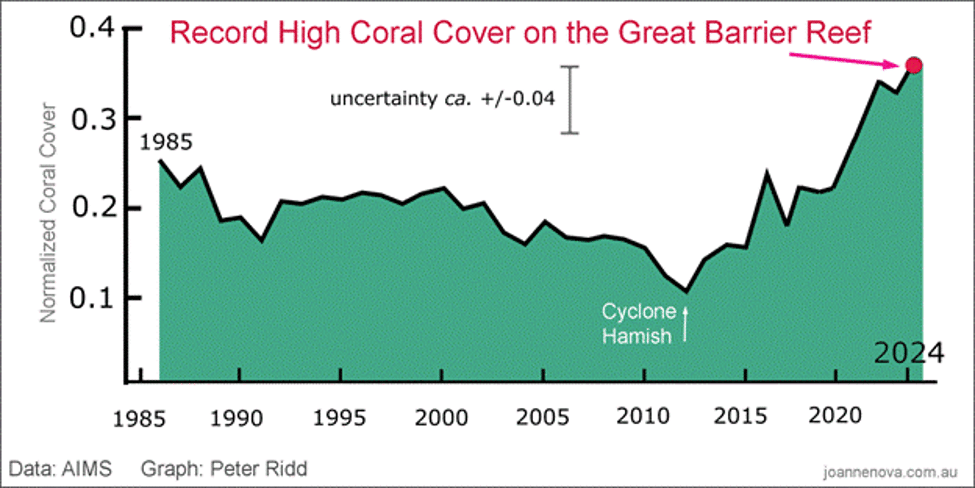
The GBR’s success is due to the ability of the corals which make it up to adapt and evolve in the face of various environmental perturbations. It is not just that coral are bouncing back; it is that the newly formed/recovered coral are evolving rapidly to adapt and flourish in warmer temperatures. There is no reason that what’s happening on the Great Barrier Reef shouldn’t also be happening in coral colonies across the globe, with newly formed corals showing plasticity and flexible responses in response to warming waters.
Even if it were the case that corals were undergoing decline, which is debatable, a decline caused primarily by warming oceans, also open to scientific debate, it is unclear whether anthropogenic warming is the cause. In fact, the authors of the report underlying the NYT story assume human-caused climate change is responsible for recent ocean warming, but not only is this connection not proven, other possible factors were ignored. The study reports on coral conditions, with the authors doing little or no original research into the cause of the present coral conditions they monitored. Yet other forcing factors, such as more sunlight reaching the sea surface as shipping emissions have been reduced or natural factors like the ongoing El Nino, discussed recently HERE and HERE, are also at play in ocean warming but have nothing to do with greenhouse gas emissions. In fact, recent bleaching events have coincided with recent strong El Ninos.
In the end, Glabicki and The New York Times went off half-cocked, reporting on a single study’s findings about coral reef conditions without checking them against other sources of data and research on coral. This makes for a scary story that advances the narrative that humans are causing catastrophic climate change, but doesn’t honestly report on the status of coral reefs and the various factors that affect them. Get back to reporting, The New York Times, not advocating for progressive causes like ending fossil fuel use to battle a purported climate crisis.
About the Author
H. Sterling Burnett, PhD, is the Director of the Arthur B. Robinson Centre on Climate and Environmental Policy and the managing editor of Environment & Climate News. In addition to directing The Heartland Institute’s Arthur B. Robinson Centre on Climate and Environmental Policy, Burnett puts Environment & Climate News together, is the editor of Heartland’s Climate Change Weekly email, and the host of the Environment & Climate News Podcast.
The Expose Urgently Needs Your Help…
Can you please help to keep the lights on with The Expose’s honest, reliable, powerful and truthful journalism?
Your Government & Big Tech organisations
try to silence & shut down The Expose.
So we need your help to ensure
we can continue to bring you the
facts the mainstream refuses to.
The government does not fund us
to publish lies and propaganda on their
behalf like the Mainstream Media.
Instead, we rely solely on your support. So
please support us in our efforts to bring
you honest, reliable, investigative journalism
today. It’s secure, quick and easy.
Please choose your preferred method below to show your support.

Categories: Breaking News, Latest News, World News