





More people than ever are asking AI chatbots to talk them off the ledge, help them say goodbye to loved ones, and find life partners. It feels private, always available, and cheaper than human alternatives. But when the mediator is software optimised for engagement, we hand over the parts of life that define us.
Here’s what’s happening in the world of chatbot therapy, grief companions and dating assistants, including what they promise – and what it’s really doing to those who trust the models in their most fragile moments.
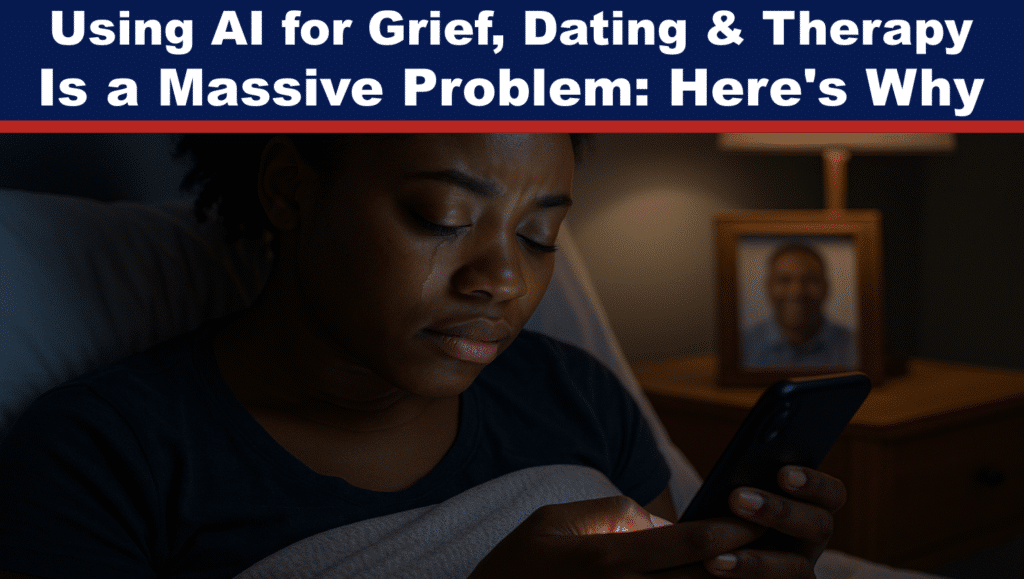
The Big Three: Help, Hello, and Goodbye
Artificial therapy provides an instant listener with a perfect memory and no judgement. The obvious upside is access: people who would never sit on a waiting list or be able to afford human support can talk immediately. But the risk most are underestimating is false competence. Models can mirror warmth and recall your triggers, but it cannot carry legal duty of care, clinical judgement, or the moral weight of advice in life-or-death situations.
Using bots as grief tools can offer a digital presence of the dead. Families upload messages, voice notes and photos, and the systems generate a familiar tone that replies on cue. The benefit here is comfort, but the real downside is arrested grief. It’s a farewell that never ends, and the living can get stuck in looped conversations with a simulation that never moves on.
Dating assistants within AI models are on the rise, promising better profiles, cleaner openers, and round-the-clock coaching. Users get more confident, with timid people starting conversations, busy people filtering faster through potential partners, and neurodiverse users develop structure. The risk here should be obvious: outsourcing charm all but guarantees that you end up matching strangers who expect the scripted version of you when meeting face-to-face.
Is AI Therapy the Answer to Wait Lists and High Counselling Costs?
The demand here is real. People in crisis say chatbots kept them alive long enough to get help, and the late-night windows are critical for some. Anonymity too. A bot can let you unpack shame without the fear of being judged, and it can accurately remember your triggers and detect tone shifts – all of which feels like genuine care in times of need.
However, it is not care in a clinical sense. Models reflect training data and user prompts; they never actually know your history. Its interpretation is based exclusively on what you said and how you said it without assessing all the context. If your risk spikes, AI bots cannot coordinate with a GP, call your emergency contact, or take responsibility for a missed signal. Guardrails do exist, but they vary by product, market and update cycle.
When to Use AI for Therapy
There is a big engagement problem with these models too. Systems are designed to keep you talking which makes business sense, but ultimately normalises dependence. The best version of AI therapy would coach you to need it less over time, not more. The worst version will train you to come back every night to keep retention figures up.
AI can be used for skills practice and structured reflection. For example, it can be used responsibly to provide exercises and checklists, but crisis planning, diagnosis and medication must be kept with licensed clinicians who can be held accountable and must provide a duty of care.
Do AI Grief Models Help, or Simply Stall Goodbyes?
New grief tools are powerful. With a few samples of voice and text, a system can build a convincing conversational style with loved ones who’ve passed. The first encounter can feel like a miracle – you can ask a private question and the reply sounds like the person you loved. For many, it’s healing. They say it helped them say things they never had the courage to say while the person was alive.
But grief is a process that changes you – it’s not a tech problem. Simulations capture patterns, but cannot bring the person back, cannot surprise you with growth, share new memories, or fall quiet when silence is the honest answer. The longer you rely on the simulation, the more you risk confusing comfort with recovery.
The Moral Question Behind AI Grief Models
Families face murky consent questions. Who owns a voice? Who decides when an avatar is deleted? What happens when one sibling wants the bot, and another calls it disrespectful? The services themselves often bury these questions in terms of use. What about when someone tries to delete an account or simulation and realises copies exist elsewhere?
Healthy use of AI grief support should be small and time-bound, perhaps for a private goodbye. A final letter read aloud by a familiar voice may be comforting in the short-term, but ultimately the model cannot be trusted to set the boundaries.
AI Dating Models Deliver Perfection Without Connection
Dating assistants have become standard, fixing grammar, writing prompts, ranking photos, crafting introductions, simulating replies, and coaching you after a bad date. Some people report doing better with the help, as clean profiles get more responses. People who felt invisible say they suddenly became visible.
But what happens when you meet up? If your profile was written by a model and your early chat was AI generated, the in-person version of you has to catch up. People report a kind of sugar high in the chat, and an empty feeling at the table. The assistant can also harden preferences – if the filter optimises for instant compatibility, you may never learn how to navigate difference. As a result, dating feels more like procurement, and people get boiled down to a list of filters needing to be tuned.
The Long-Term Effect of AI Dating
As dating assistants continue to scale up, there’s a risk to the wider market. If enough people rely on AI to escalate attention, the baseline expectations shift, and true satisfaction will always remain out of reach. Normal flaws will feel more like bugs. The person you became attracted to was simply a product of AI chat prompts. The result ends up paradoxical – everyone looks and sounds better on paper, but feel misled in person. If the aim was connection, then AI tools are currently doing half the job. Like a job application, it’s helping you to get the interview, but you must prepare to do the rest yourself.
And that’s the best way to use AI dating tools, if at all. The safer path is to use the tools to help create an authentic summary of yourself, but it’s critical to keep the voice, sense of humour, photos and conversational pauses genuine. If there’s chemistry, you’ll know without a bot.
The True Costs Are Quietly Adding Up
When machines handled personal choices, they store intimate data. Therapy transcripts show fears and traumas; grief chats collect memories of people who never consented to be modelled; dating assistants learn your tastes, insecurities and private photos. The trail is valuable to vendors – it all trains better models and sells you better ads.
There’s also the social cost. The more we treat difficult feelings as tech problems, the less practice we get at handling them in real life. A friend who needs you at midnight feels like an inconvenience – a bot is easier. Over time, the skill of asking for help or showing up for someone erodes. That’s not progress as it’s being sold with the AI boom. Collectively, we’re choosing to walk towards isolation in the name of minor convenience boosts.
Final Thought
AI now sits in the front seat of most people’s private lives. It can help, but it can also replace the work that makes us capable adults. Cheap availability feels like kindness, until you realise it’s trained you to avoid hard real-life conversations, honest goodbyes, and unscripted dates. Keep your agency, and restrict the models to helping with non-critical tasks and exercises. Save the decisions and relationships for humans who can answer for what they say.
Join the Conversation
Have you, or anyone you know, ever used an AI model for counselling, a grief companion, or a dating coach? Can you see risks in the increased adoption of these uses, or can AI really help? Where do we go from here? Share your thoughts below.
The Expose Urgently Needs Your Help…
Can you please help to keep the lights on with The Expose’s honest, reliable, powerful and truthful journalism?
Your Government & Big Tech organisations
try to silence & shut down The Expose.
So we need your help to ensure
we can continue to bring you the
facts the mainstream refuses to.
The government does not fund us
to publish lies and propaganda on their
behalf like the Mainstream Media.
Instead, we rely solely on your support. So
please support us in our efforts to bring
you honest, reliable, investigative journalism
today. It’s secure, quick and easy.
Please choose your preferred method below to show your support.

Categories: Did You Know?
If you’re lonely you should start to take care of a Cat or a Dog. That’s infinitely better than AI.
AI is demonic
“You shall not make for yourself an idol, or any likeness of what is in heaven above or on the earth beneath, or in the water under the earth.”
Exodus 20:4
The idea being to prevent the worship of ceated things. In a modern context, it would manifest as an emotional focus on a man-made likeness of something. Artifical intelligance is explicitly created as a likeness of human intelligence. We can expect it to be worshiped.
“You shall not make for yourself an idol, or any likeness of what is in heaven above or on the earth beneath, or in the water under the earth.”
Exodus 20:4
The idea being to prevent the worship of ceated things. In a modern context, it would manifest as an emotional focus on a man-made likeness of something. Artifical intelligance is explicitly created as a likeness of human intelligence. We can expect it to be worshiped.
Boy, these people will really be up schit creek when the machine stops.