





Children as young as three are scrolling social media feeds built for adults. New analysis has emerged suggesting almost a million UK children aged 3-5 years old are using platforms like Instagram, Facebook, Snapchat and TikTok. That includes an increase of 220,000 this year alone, with usage spiking despite application age limits and an ever-mounting pile of harmful evidence.
Former education minister Lord Nash calls it “deeply alarming”, and lawmakers now face a decision that most ordinary people would find obvious. Should the platforms and the overall “attention economy” be regulated for minors, or should we continue letting algorithms trained on adult engagement shape the developing brains of pre-schoolers?
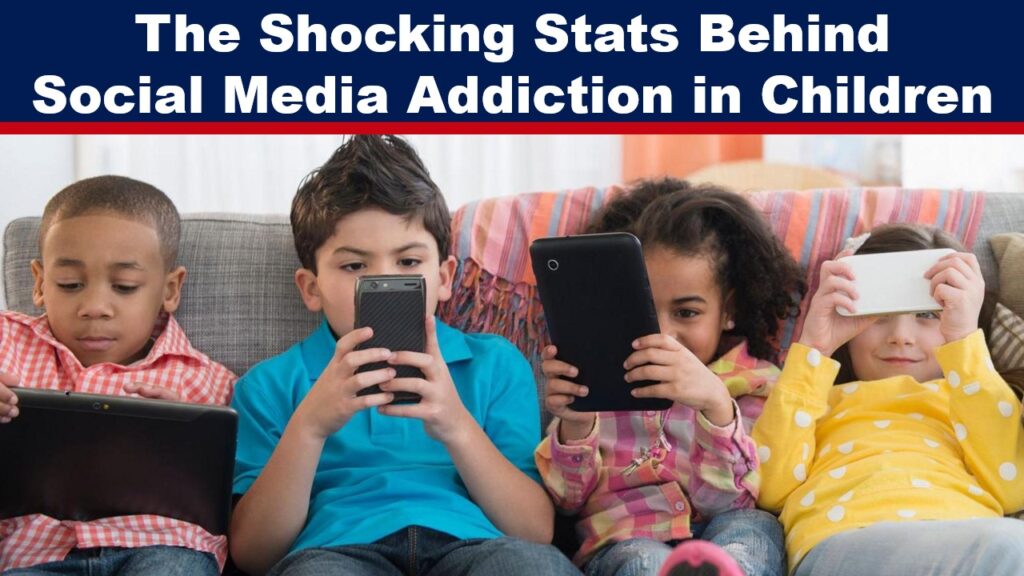
Shocking Stats Just Surfaced
Nursery-aged children are creating or accessing accounts on platforms designed to get adults addicted, and they’re being fed the same engagement-maximising content. This is not simply early adoption of phones and social media, or an increase in tech literacy. This is an enormous structural exposure problem. Unlike other media like kids’ TV, social feeds aren’t sequences for age or learning goals, but are instead optimised for increasing time spent on the platform.
Nine in ten UK children own phones before age 11, according to a House of Commons Library brief. Six in ten kids between 8-12 years old have their own social media platforms despite many minimum age restrictions being 13. If upper-primary children are already deeply embedded online, then pushing the start line as far down as the age of three means the attention economy is catching kids right as they learn to self-regulate.
The Real-Life Risks
Research keeps pointing in the same direction: as kids’ digital exposure gets earlier and heavier, their sleep gets poorer, anxiety worsens, and attention spans shorten drastically. Policymakers are gradually connecting the dots of social media usage in young people with school outcomes and behavioural problems – but it’s all happening too slowly. Hundreds of thousands of under-fives are swiping through adult-optimised feeds, and an entire generation is at huge risk.
Parenting Failures, or Addiction by Design?
Whether the finger can be pointed at the platforms or parents is up for debate. Many argue that parents rarely set out to deliberately hand their three-year-old a fully exposed adult-designed feed. But giving a child a logged-in device as a distraction that perhaps starts as a few cute videos quickly turns into an addictive habit.
However, others argue that the alarming trend is particularly worrying because it exposes that the platforms are working exactly as they are designed – they want to divert as much attention to their apps, and keep newcomers online regardless of age. So, rather than individual parents suddenly becoming reckless, the numbers indicate that the engagement-optimised platforms are actually trying to encourage this kind of usage. Over 800,000 pre-schoolers are on social media. 90% of kids own a phone by age 11. These numbers are no longer outliers based on irresponsible parenting – they are generational trends transcending all classes, upbringings and social circumstances.
What Are Governments Doing About It?
As of 10 December 2025, Australia will ban under-16s from accessing social media platforms. Instagram, TikTok, Snapchat, X/Twitter, YouTube, Reddit, Discord, and Threads must then block new sign-ups, remove any existing under-16 accounts, and require real age verification. Fines could stack up to $50 million for any platforms found to be non-compliant with the new rules.
Australia is the first major developed nation to go this far. Others have taken partial steps – such as France requiring parental consent for under-15s, parts of the US such as Florida banning under-14s, and Brazil and Malaysia discussing similar under-16 rules) but Australia is mandating a uniform, all-encompassing solution. The world will be watching the rollout while more damning statistics about underage social media usage ruining childhood development continue to surface. Many expect a bumpy launch, but eyes will be on the verification process and ensuring circumvention of the rules becomes difficult, if not totally impossible.
Older Children Also At Huge Risk
- The American Psychological Association deems tech use and social media – particularly within an hour of bedtime – strongly correlated with sleep disruption in teens, leading to shorter duration and poorer overall quality
- ScienceDirect reports significant associations between social media use, poorer sleep, and heightened mental health problems in adolescents, citing blue light, late-night engagement, and dangerous rumination
- A damning report by the US Surgeon General says using social media for more than 3 hours per day doubles the risk of mental health problems in young people – with the average US teen already averaging way more than this amount
- In the same Surgeon General report, 46% of 13-17s admitted that social media made them feel worse about their bodies. Higher levels of anxiety and depression were observed as a result, also leading to increased cyberbullying and self-harm in youngsters
- JMIR Mental Health reported higher depression, anxiety and stress in children and teenagers exposed to social media
- PubMed’s own studies found the same correlation of higher social media usage with increased symptoms of depression, worse sleep disruption, more online harassment, and lower self-esteem
Final Thought
We’re way past the point of kids simply dabbling online. Allowing children to access social media platforms is linked with a staggering amount of long-term physical and mental health problems. Between three and five years old, we’re risking their overall development; up to 16 they’re exposed to body image anxiety, bullying, self-harm, sexual harassment, stress and depression. Late-night scrolling undermines sleep – the single strongest and most consistent harm – and excessive screentime worsens attention spans and lowers test scores in school.
With Australia putting a stake in the ground as the first meaningful nationwide action we’ve seen anywhere in the world, other countries must follow urgently. We’re dicing with future generations’ cognitive abilities and mental health – and for what?
Join the Conversation
What’s the single most effective change that could help – real age checks, night-time curfews, or creating kid-only modes on social media? Do you blame the parents or the platforms? Add your thoughts below.
The Expose Urgently Needs Your Help…
Can you please help to keep the lights on with The Expose’s honest, reliable, powerful and truthful journalism?
Your Government & Big Tech organisations
try to silence & shut down The Expose.
So we need your help to ensure
we can continue to bring you the
facts the mainstream refuses to.
The government does not fund us
to publish lies and propaganda on their
behalf like the Mainstream Media.
Instead, we rely solely on your support. So
please support us in our efforts to bring
you honest, reliable, investigative journalism
today. It’s secure, quick and easy.
Please choose your preferred method below to show your support.

Categories: Did You Know?, UK News
Wow, “The Expose” going mainstream, huh? 🙂
So after decades of (I’ll be generous and say “arguably”) deliberating hooking kids younger and younger onto social media platforms like YouT. and TikT., we need to do what the Gvt. in Australia is doing and having identification for youngsters to use these platforms?
Hmm, well, they could, for one thing, do what they’ve been doing for decades (which, suddenly is considered inadequate by the Gvt.) of trusting the parents to parent what their children do online, instead of the Gvt.
Another point to consider is that there is some chance (as unlikely as some may think) that maybe the Govt. has ulterior motives and may later, for example, say, ‘Oh, actually, everybody NEEDS to have digital ID and facial recognition to PROVE they’re over sixteen to go on social media because your password isn’t sufficient anymore – hacking and all that, you know. We don’t want to do it but it’s to protect the children.’
Just playing disagreer’s advocate 🙃.
While we’re at it, considering the bit at the end of the article about “What’s the single most effective change that could help – real age checks, night-time curfews…”, I saw something on the telly recently that struck me as some possible predictive programming.
On my local TV, they have been hammering domestic violence like mad on the news for years, like it’s totally out of control. I notice they’ve got a newish TV show out now called “Curfew”, which is set in a society where men are restricted by a curfew from 7pm to 7am to prioritise women’s safety.
Of course, the woke society isn’t screaming discrimination because what we’ve all been told on the news for years has conditioned people to think that that’s a great idea and to watch the TV show. Personally, I’m wondering if the Govt. will watch the ratings of the show to figure out if the public would accept certain curfews.
OK, I’m veering off-topic but you can see I’m a big cynic of the telly 🙂.
I would form an army of those who say no to any curfew. We would take over. There would be enough of us to destroy anyone who tried to stop us.
Hopefully you’re right. But if it’s like the lockdowns of 2020 (some were only a fortnight or so long but cities like Melbourne in Australia were locked down for months), all they have to do is come up with some reason why it’s in our best interests and 99% of us might go along with it and the few dissenters dealt with separately by the Gvt.
You’re right, also most people have forgotten lockdowns ever happened!
Well, yeah. People are a bit ashamed that they took the whole thing so seriously at the time so now say, “It’s all in the past, forget about it”.
But the danger of that lies in the quote:
“Those who cannot remember the past are condemned to repeat it” – George Santayana
or a similar quote I heard in a sitcom or something once, something like:
“Those who cannot remember the past are condemned to have Santayana quoted at them” 😅
I never locked down at all, legislation or mandate is only law when both parties agree to it, I didn’t!
Hi Mark, firstly a quick definition, which you may be familiar with but others maybe not: Positive law refers to man-made laws enacted by governments or authorised institutions, such as statutes, regulations and court decisions, which govern behavior within a society. It is distinct from Natural Law, which is based on moral principles derived from divine will, i.e. from God (Yahweh, Adonai, Jehovah).
I’ve had a simple theory regarding positive law for decades, regardless where that positive law originates. If positive law is not in line with Natural Law then I have a duty to either ignore it or disobey it. I have a duty to obey God, not man. I’ll give an extreme example to explain what I mean.
If a government, for example, passes legislation into law that states we should kill one of our neighbours, I will disobey it because the positive law is immoral and goes against Natural Law, God’s Law. God commands “you shall not murder.”
Positive law in the UK has not reached that level of corruption or immorality … yet. But it is moving in that direction. Consider the euthanasia bill (The Terminally Ill Adults (End of Life) Bill), which will require doctors, nurses, patients and their family members and friends etc. to decide whether to follow an immoral, unGodly positive law that allows and promotes people to murder others. We all need to decide for ourselves what is the red line – which positive laws we will refuse to follow, without compromise – the sooner we do that the better.
Well said Rhoda. We all need to remind ourselves on a daily basis that we are sovereign beings under God’s Natural Law. Not the Corporate Maritime stuff as applied by our courts.
Rhoda,
As you ought well know, the term “natural law” is NOT biblical. Its origins are not from God.
My Bible says:
Let every soul be subject unto the higher powers. For there is NO power but of God: the POWERS THAT BE are ordained of God.
Whosoever therefore resisteth the power, resisteth the ordinance of God: and they that resist shall receive to themselves damnation.
For rulers are not a terror to good works, but to the evil. Wilt thou then not be afraid of the power? do that which is good, and thou shalt have praise of the same.
Romans 13:1-3.
TPTB is a phrase often bandied about on The Expose, but how many are aware that its origin emanates from thence? (Romans 13). Many have rephrased it as The Powers That shouldn’t Be, nevertheless, God has put them in place.
Submit yourselves to EVERY ordinance of man for the Lord’s sake: whether it be to the king, as supreme.
1 Peter 2;13.
You quoted from Acts 5:29: We ought to obey God rather than men.
These words were uttered before the previously quoted verses. Were Peter and Paul contradicting themselves?
Of course not-they were martyred for defending the Truth.
Many who visit here are not afraid to speak evil of dignities.
2 Peter 2:10, Jude 1:8.
I hear the wee frees trundling bibliotry through the eye of a needle !
Natural law is something observable ,but not directive .IE sun rises in east ,sets in west .
Now transfer that to observable flow of water in the sink ,say in outer hebridees ,scotland ..
Is it same direction of flow in New Zealand ,even in a wee free church there ?
If I were an ordained minister, I’d be a “hell, fire and brimstone Free Presbyterian preacher”. FYI, I am in the Outer Hebrides, not New Zealand…
I’ll check for you, just a sec…
Lol, it just goes straight down the sink – no real direction other than that. Not that I understand what that would have proven anyway 🙂.
“New analysis has emerged suggesting almost a million UK children aged 3-5 years old are using platforms like Instagram, Facebook, Snapchat and TikTok.” Where is the link to the original research please?
Hi Steve,
The data is based on findings which you can read about here.
Regards,
G Calder
Hi Steve,
The data is based on findings which you can read about here.
Regards,
G Calder
We have this ridiculous CHALLENGE 25 POLICY over here in the UK, ran by the retail supermarket the Co-Op-look it up. And yet under UK law you can purchase alcohol if you are 18!
As I was purchasing a bottle of wine (only 2 days ago), the cashier asked me if I had proof of id to show I was over 25-to which I indignantly (but politely) responded “I’m over 65!!!” To which she replied “I was only joking!” She obviously could tell that I looked well beyond 25. Nevertheless, the point is, what of someone who is 30 that could pass for under 25?
I know there are people (jobsworths!) in that store that would demand age verification for anyone of disputable age.
Lighten up…….she was joking.
“Lighten up” that’s something I won’t do- nevertheless thank you for the reply.
BTW-the dragnet is closing in-yet few see it.
Thanks for that – interesting.
I dunno about it all. It sounds a bit odd but I can see the point of it making sense to some degree because with or without the “Challenge 25” policy, it would be tricky for an employee to work out who and who not to ask for ID from.
But yes, like with other policies like the social media ban, there could be a big concern that they may later be used as justifications for broader policies, like with digital ID.
The BIG problem with all these nefarious think tank schemes such as CHALLENGE 25 is that they have inculcated people to think ID-to get people to challenge their fellow man.
Without schemes such as these that lady wouldn’t have dared questioned me (even though jokingly)-and how many others? Do bear in mind, this must be happening the length and breadth of the UK on a daily basis; normalising the ID agenda, brainwashing the population to accept it, and they will.
The digital ID system is here already (in its infancy) up and running, but how long before it is ‘perfected’ and we’re told we’re past our quota; be it petrol, food, or whatever?
Well yes. People are talking about the Australian under 16 social media ban (with people likely saying, “Oh well, worst case scenario, at some point, I just lose social media”) but quietly they are going to do another similar ban in Australia on 27th December, while many 9-to-5ers will be partying on Christmas leave and not paying attention.
If one asks a search engine about it, it says, “On December 27, 2025, the first part of Australia’s new online safety laws will come into effect, requiring search engines, social media, app stores, and AI services to protect children from age-inappropriate content like p0rn0graphy, high-impact violence, and self-harm material, with strict age verification measures and content filtering. This follows an earlier ban (Dec 10) on social media accounts for under-16s, placing responsibility on platforms to implement age checks, though implementation varies.”
Yes, the noose may very well be tightening!
100% correct, that’s if the gov hasn’t just made up a figure to justify their objective
Well yes, very possible. From looking at Govt. figures over the past few years, I eventually concluded that they do some ‘making up’ of official figures because they didn’t seem to me to fit.
There are several issues involved here. No, we don’t want censorship of material which a government subjectively considers “harmful” and legislation, as proposed in Australia, could lead to that. On the other hand, we do need to protect young people and children from the harmful effects of addiction to their devices. The solution could lie in forcing the internet giants to restrict their use of the algorithms and processes which fuel addiction, rather than imposing blanket bans on us all.
Irrespective of probable sinister agendas, societal degradation, the rise of the tech-kings etc., the one thing that is not yet totally under governmental control is the interraction – or lack of – between parents and their children. Babies and children learn from the world around them, from the direct influence of those closest to them. Children are mimics. This is how they learn to smile, speak, shout, hit out …
This Pandora’s box is well and truly open. Government control is REALLY NOT the answer. We are living in a moral vacuum, where people are encouraged to find the quickest ‘fix’ possible for the emptiness in their lives – be it addictions to food, alcohol, gambling, shopping, drugs, tv – and these patterns are copied by their offspring because they have no other example to follow. It is time society took a long hard look at where we are going, and then take a look BACK to a time when morals and ethics were built into our understanding of what it means to be human – by no means perfect, but not drenched with the dangers of misguided, misused, miserable ‘progress’ manipulating damn near every aspect of our lives.
That’s what we need to remember – children are ‘mimics’ and do what their parents and guardians do. We need to lead them by example and, as Datsy suggests, ‘ The solution could lie in forcing the internet giants to restrict their use of the algorithms and processes which fuel addiction, rather than imposing blanket bans on us all.’
Dr Goebbels would be proud of this attempt at more censorship. Governments need to back the fuck off of our lives. If parents don’t look after their kids in all respects and the kid gets messed up…tough. your children are not my responsibility
Hi Reverend Scott, your comment was initially blocked because it contained a swear word. We don’t want our comments section littered with swear words. Going forwards, please can you insinuate swear words (if you are unable to comment without them) rather than using them in your comments.
‘look after kids in all respects’ – we’re not living on a croft ,more’s the pity .
My son was walking Cruach Ardrain Horseshoe in winter with top(summit) 9 degrees warmer than valley (-22C) .No small avalanche risk ,plenty snow .
The day started with him ,at nearly 11 yrs – walking on a verglass rock which should have caterpaulted him over a sheer drop .Best climbing partner was other side of son .
Then followed a look at a daylit route ‘up to the top ‘ .
Said son thought he knew better ,quietly freaking out best climbing partner ,who subsequently refused to do anything but retreat down to base camp ,(1000ft) and build a roaring fire .
Muttering to me ‘he’ll kill us,if we let him’ .
So in total gemenoid meteor shower darkness ,I took him up the valley route ,which had 2 wolf tracks ,above treeline .
So I had memorised the contours over 2 weeks preparation – my son & I set off ,in moonlight & liminal darkness – to see how far up the valley to that approach if highest point on Ardrain Horseshoe might be possible .
Verglass on rocks more visible walking towards moon .Exellent progree ,because we didnt rely on 200m torchlight more than the safe tuning of ‘snow crunch’ .
We had tuned the footfalls on the snow to remain at a certain ‘pitch’ – that was our contour very nearly to the summit ,no safe approach unless the snow crunch had a certain timbre .
Kid liked what he saw as simple physics .
But on way down – into the -22C ; moon was behind ,verglass invisible .
Result? Son reckoned he’s try following his own ideas on seas of soft molten snow ,just under new ,fairly crunchy valley stuff .
-He would not follow my ‘crunch’ till he had experimented sufficiently to be convinced ,by my fall ,left knee well knackered .
After remonstrating with angels – 15mins later – knee was fine (shouldn’t have been!) – and he meekly waltzed the extra miles back to the hefty fire at 1000ft .
We all slept in the open that night – the kid did wonders in his zzz’s not even in an extreme bivvy at -22C .
Us two just checked on him every 15 mins throughout the night .
If you think you cant contain a kid’s curiosity – believe your ‘in all respects’ ,against ALL odds !
Also the ability to fall is part of love .
It’s the playfulness of prevention that keeps problem kids alive .
Probably more propaganda to justify the restrictions