




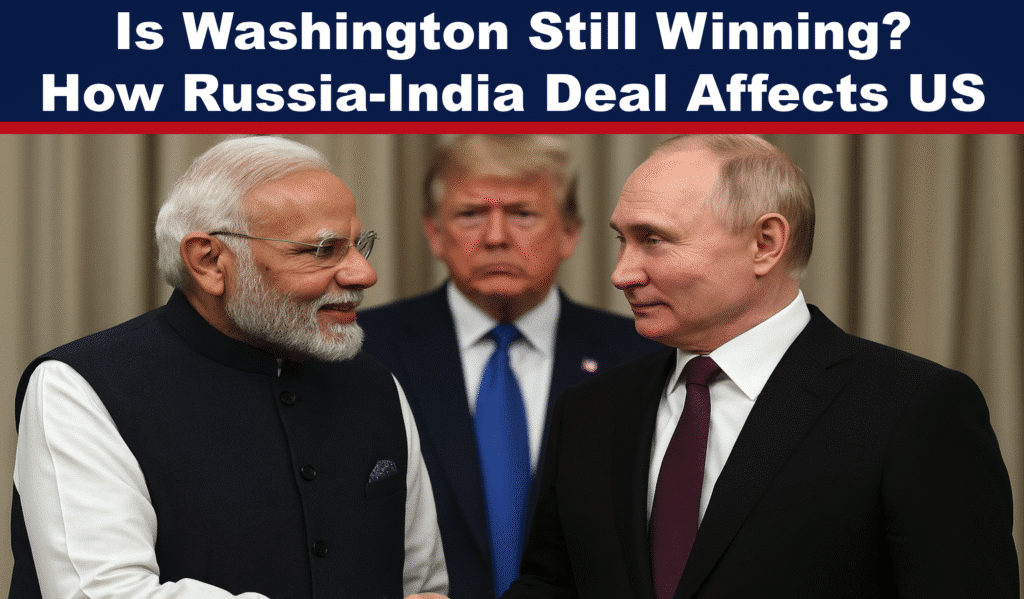
New Delhi and Moscow just plotted a new course together. Bilateral trade will hit $100 billion by 2030, Russian energy deliveries will be “uninterrupted”, defence co-production will be expanded on Indian soil, and Russia’s state media will gain fresh reach in the world’s most populous democracy. For the US, this should not be considered simply a diplomatic nicety between two emerging powers. This alters leverage in any Ukraine peace settlement attempts, affects prices for Americans, and accelerates a broader alignment between non-Western powers against Washington and Brussels. How does the Putin-Modi meeting affect the US?
What Changed in Delhi
Prime Minister Narendra Modi and President Vladimir Putin just met to agree an economic roadmap for the remainder of the decade. In the near-term, Russian oil, missile systems, fighter jets, and fertilizer will flow to India. Beyond energy and defence equipment, the countries will strengthen business ties including shipping collaboration, and together they will bolster “Make-in-India” co-production. Russia also made content agreements to boost its footprint in India’s media space, meaning its own state media can now attempt to shape – or correct – narratives on sanctions, Ukraine, and other US-formed headlines.
This doesn’t necessarily mean that India has “chosen” a side. New Delhi continues to deepen ties with the US, Japan and Europe on semiconductors, critical minerals, and defence objectives. But the India-Russia bond has just strengthened significantly, and that matters for US strategy.
Why It Matters for the US
US negotiators want Moscow to agree to a peace deal ending the war in Ukraine. Until now, much of the US’ bargaining power relied on restricting Russia’s economic oxygen and isolating them politically. In both regards, India’s deal helps Russia’s position. Agreements between Putin and Modi mean Russia’s economic posture will improve drastically, and their reliance on Western sanctions being lifted is therefore reduced. Politically speaking, Russia’s wider media presence may try to offer an alternative narrative to US messaging in a country of 1.4 billion people.
The Defence Deals
India is shifting from buying finished Russian weapons to building and sustaining them at home. Under the new roadmap, Indian plants will now assemble components, produce their own spare parts and ammunition, and overhaul any Russian-origin systems already in place.
The payoff for India centres around faster turnarounds, lower lifetime costs, and being more prepared for frontline activity. Previously, any repairs, maintenance or deliveries depended on Russia – and any sanctions or wartime complications caused delays. Ultimately, India gains strategic autonomy and gets supply chain certainty. But Russia sees gains too – the country’s industry keeps orders coming in and gains long-term relevance inside a G-20 defence ecosystem. In the meantime, the US’ sanctions and export blocks become blunter tools if India can service Russian gear domestically.
How It Progresses BRICS Objectives Against the West
As trade grows between the two countries, the dollar is expected to become decreasingly necessary. Rupee-ruble workarounds will take the USD’s place, with options for third-country clearing and local-currency settlement instead. It may not replace the overall primacy of the dollar, but as time passes, the payment currency will continue to lower the strength of sanctions.
Viewed through a BRICS lens, the summit is part of a wider pattern: large non-Western economies are building in optionality now, no longer depending solely on the US. More suppliers, routes, and circulating currencies all strengthen the group’s global position, increasing cover and convening power between the non-Western nations. Washington’s power play has mostly been to squeeze economies and politically isolate opponents – a tactic that gets less effective as BRICS collaboration grows.
In the Jogannesburg II Declaration (2023), BRICS explicitly “encourages the use of local currencies” in trade and tasks finance ministers and central banks to develop payment instruments and platforms. There’s no mention of a single BRICS currency, but non-dollar settlement is a key common goal that the India-Russia deal puts into practice.
Putin Questions US Actions Against India
President Trump’s administration says India’s purchase of cheap Russian oil helped finance Moscow’s war in Ukraine, and the US has been outwardly critical of India’s economic relationship with Russia. As a result, India’s crude imports are set to hit a three-year low this month following US tariffs on Indian goods tightening of sanctions on Russia.
Meanwhile, the US and European Union continue to import billions of dollars’ worth of Russian energy and commodities ranging from liquefied gas to enriched uranium.
Putin publicly stated, “the US itself still buys nuclear fuel from us for its own nuclear power plants. That is also fuel: uranium for the reactors operating in the United States. If the US has the right to buy our fuel, why shouldn’t India have the same privilege? This question deserves thorough examination, and we stand ready to discuss it, including with President Trump”
US Claims India Funds Russia-Ukraine War
Critics of India’s involvement in funding the Russia war point to one key statistic: before the expanded invasion of Ukraine in 2022, India was importing 2% of its oil from Russia – this, until recently, rose to 38%.
In August, President Trump implemented a 25% tariff on India, later increasing to 50% because India “continues to fund Russia’s war” through oil purchases. India has since made changes to sell less of its oil to the West but still buying as much or more from Russia. Previously, India bought Russian crude and refined it domestically before exporting it to Europe and the US. The US alone is reported to have been buying up to 500,000 barrels of oil – that was originally sourced from Russia – per day. This is how Russia has managed to rebrand its exports, as it can be sold as an Indian product distinct from the crude’s origin.
Is Washington Still Winning?
Russia can sell oil, but it can’t rebuild a modern war economy without Western tech and finance. The cutting-edge inputs including advanced chips and chip-making gear, precision tools, industrial software, and avionics all still sit behind US-led export controls. The dollar system still polices big transactions through Western banks and insurers, too. Washington, then, still holds key bargaining chips: if the US can squeeze the shadow fleets and grey financiers, raise compliance costs, and continue ratcheting pressure against Russia without destroying its own relationship with India – then they may still be winning.
India’s long game also points West. New Delhi wants growth in critical minerals, semiconductors, defence co-development, and key supply chains – all of which is tied to US, Japanese and European capital. The Russia deal may be a hedge for India, but it does not yet signal complete alignment. Russia may gain margins for now, but if the US competes with better offers to India, then Russia’s financial cushion remains short-term.
Final Thought
This is not India picking a side: the Putin-Modin deal is leverage rather than a realignment. For now, New Delhi has locked in cheap barrels and local defence sustainment at the exact moment the Washington wants Moscow to feel isolated. In the short-term, that limits US bargaining power, but it doesn’t yet flip the board in Russia’s favour. Key war-economy choke points still run through the US and its allies.
If the US can respond by making it cheaper and easier for India to diversify with the West rather than doubling down with Moscow, then the recent Modi-Putin alliance may simply be a tactical cushion for the Kremlin rather than a strategic escape plan – and the US keeps the leverage it needs to shape the endgame.
The Expose Urgently Needs Your Help…
Can you please help to keep the lights on with The Expose’s honest, reliable, powerful and truthful journalism?
Your Government & Big Tech organisations
try to silence & shut down The Expose.
So we need your help to ensure
we can continue to bring you the
facts the mainstream refuses to.
The government does not fund us
to publish lies and propaganda on their
behalf like the Mainstream Media.
Instead, we rely solely on your support. So
please support us in our efforts to bring
you honest, reliable, investigative journalism
today. It’s secure, quick and easy.
Please choose your preferred method below to show your support.

Categories: World News
But if you consider that the only real challenge facing the Forty Thieves (apart from subdued Germany ‘s not – for- profit community banking system, Sparkassen and Genossenschstsbanken) is China’ s public credit system, then all these realignments make sense in a medium – term strategy aimed at building the NWO without losing the private credit (money creation :read or listen to Richard A. Werner) system that is behind all of the Western psyops (a recent one : see the JB Fourtillan case in France), the outdated wars, and the drive toward global power itself. The connection between finances and media is well known, as also the control of the Central Bank of Russia by the Western – zionist bankers, and the lack of any serious criticism of private money creation in RT’s shows. It all makes sense and China (and Germany’s population more than their puppet government, like all of us who want freedom from the bankers ‘ chains) should and certainly will take note and remain vigilant.
https://www.youtube-nocookie.com/embed/MzCiEHGVMwA closer to home
Trump, do you have the balls to do this?
Deport the tens of thousands of Indian students, green card holders and H-1b workers in the USA. I think not!
Reading between the lines of Trump’s and Musk’s BS and you see…..AMERICA H-1B FIRST.
America doesn’t seem to learn from its mistakes. It was they who started this war, unlawfully deposing an elected government and placing their man into power, supporting the encrouchment of NATO towards Russia and sending the means of war to Ukraine to maintain the war. Now, they are desperate to end it. But if history repeats itself, they’ll do it all again somewhere else. Oh, and like the lapdogs we are, we’ll be in full support.
The world appears to be led by brain damaged egotistical psychopaths.
US ideology is an extension of the Roman Empire. We see segments of the divided Roman Empire in Britain and the US. Both segments conquered and exploited other nations such as India and the land of the First indigenous population, called Native Americans. Both Britain and America confiscated land and instituted slavery to build their economic wealth on free labor.
After India gained independence, it continued to grow as a predominantly Indian culture and built its economy and trade worldwide, including with Russia and the US. The difference between the British occupation of India and those who came from Europe to America was to eliminate the original people and institute slavery, primarily with people from Africa. By the time of President Lincoln’s mandate to end slavery, anyone living in the US was assimilated into American ideology. Major trade was conducted by European-owned businesses with the blessing of the US government.
US hypocrisy dictates its economic policy throughout the world. For example, India is punished by the US for trading with Russia, while the US has some trade relations with Russia. India is sanctioned by the US, even though it has committed billions to the US economy.
It is good that BRICS and its associates are bypassing US hegemony and rightfully conducting trade amongst themselves.