





The result of the UK’s pursuit of Net Zero CO2 emissions has been to offshore energy-intensive industrial production at the cost of 100s of thousands of jobs, billions of tax revenues, higher imports and lower exports.
Meanwhile, Global CO2 emissions continue to rise by more than the UK’s total emissions, making the Net Zero imposition a futile act of self-harm.
A wide array of legislation has embedded misguided climate and energy policies into law, GBBC says. “All this legislation must be unwound, starting with regulations and taxes that reduce [oil and gas] supply.”
Let’s not lose touch…Your Government and Big Tech are actively trying to censor the information reported by The Exposé to serve their own needs. Subscribe to our emails now to make sure you receive the latest uncensored news in your inbox…
On 1 April, the Great British Business Council (“GBBC”), a newly formed think tank, published a paper titled ‘Premeditated Industrial Destruction: How the UK Destroyed Its Industry and A Plan To Reverse This’.
The paper is authored by economist Catherine McBride, retired engineer and consultant David Turver and public relations consultant Brian Monteith. It demonstrates how the Government’s Net Zero policies are destroying the foundations of the UK economy and provides recommendations on how Net Zero could be reversed.
Because this paper is important in revealing some home truths, we are reproducing it in a series of articles, more manageable chunks if you will, so that, hopefully, more will read it, or at least read part of it. We have made some minor edits for readability purposes. For those who choose to read the paper in one sitting, you can do so HERE.
Executive Summary
By Great British Business Council, 1 April 2026
Table of Contents
- The long day’s journey into darkness
- Accounting for dummies to justify catastrophic restrictions
- Futile self-harm on a massive scale
- Whistling against the wind
- Abandoning our natural resources but burning everyone else’s
- Norway profits while Britain pays
- Onshore gas abundance and fracking dismissed – but imports welcomed
- Endless restrictions, laws and legal challenges
- Petrochemical decline
- Steel: priced out of existence
- Threatened aluminium and steel are at the heart of industrial exports
- Rejecting our coal but exporting it to competitors
- There is a case for new coal-fired power stations
- Obtaining geostrategic security from domestic oil, gas and coal
- New industries the UK will miss out on due to high energy costs
- Activists add to the cost of production and hold back UK GDP
- Reversing Net Zero
- About The Great British Business Council
The long day’s journey into darkness
Britain’s journey towards Net Zero began with Margaret Thatcher warning of the danger of global warming in 1990, following which John Major signed the Rio Declaration in 1992. By 1997, the Blair Government adopted the Kyoto Protocol in 1997 and Gordon Brown passed the Climate Change Act in 2008.
In 2019, Theresa May’s Government replaced the 80% CO2 reduction target with a 100% reduction by 2050. Irrespective of party colour, every government and regulatory authority has taken us further down the path of economic self-harm.
Accounting for dummies to justify catastrophic restrictions
The internationally accepted way of calculating man-made emissions is nonsensical, and only by the adoption of technology not yet invented could the UK ever reach Net Zero emissions.
The taxes applied to the oil, gas, and coal sector are draconian and Pigouvian in their obvious attempt to close down an industry that underpinned the entire UK economy.
UK financial regulations are also devised to limit investment in, capital for and insurance of new oil and gas developments.
UK Net Zero planning is imposed on all UK companies, adding to their costs, limiting their production and preventing them from applying for UK government contracts.
Futile self-harm on a massive scale
Despite all the additional taxes and regulations on hydrocarbons over the last twenty years, 78% of the UK’s energy needs are still met by oil, gas and coal. Electricity accounts for only 22% of final energy consumption in the UK, and 31% of that was generated using gas in 2025.
It is unfortunate that successive UK governments have chosen to encourage companies to import just under half of the oil the UK uses, half of the gas it uses, and almost 90% of the coal (mostly used for industrial processes).
The UK also imports approximately 10% of its electricity. The UK is dependent on imports for more than 40% of its total energy, including 10% of its electricity, even though it has ample reserves of coal, oil and gas. This outcome also negatively impacts the UK’s balance of payments.
The sum total of the UK’s pursuit of Net Zero CO2 emissions has been to offshore energy-intensive industrial production at the cost of 100s of thousands of jobs, billions of tax revenues, higher imports and lower exports.
Whistling against the wind
Global CO2 emissions continue to rise by more than the UK’s total emissions, making the Net Zero imposition a futile act of self-harm.
Global emissions are rising overall while UK emissions have remained nearly constant since 2022, resulting in the UK‘s share of global emissions falling from 1% in 2019 to 0.8% now. In short, the UK’s frugality is not affecting global emissions. It is just killing our industry, reducing high-paying jobs, with the country and its people all the poorer for it.
Because Net Zero calculations do not include emissions used in making imported goods or the supply of imported hydrocarbons, there is a perverse incentive to shift the UK’s industrial production and supplies overseas. Successive governments have relied on offshoring to meet their CO2 emissions targets, without recognising the devastation it has caused to UK industry.
Abandoning our natural resources but burning everyone else’s
Of 195 countries, Britain is one of only 40 with ample hydrocarbon reserves of coal, oil and gas – while over 100 have no hydrocarbons and the remainder have very small reserves.
Oil and Gas is a significant but dwindling source of tax revenue, delivering £4.5 billion in taxes in 2024/25 – down 27% from £6.1 billion in 2023/24. Tax revenue is declining because tax rates are too high and allowance for exploration and development costs has been reduced. So producers are bringing forward decommissioning, lowering tax revenue even more.
Offshore oil and gas are taxed at 78%: comprising 30% ring-fenced Corporation Tax (set separately from the main rate of Corporation Tax at 25%), 10% Supplementary Charge and 38% Energy Profits Levy.
200,000 UK direct or indirect jobs provide an estimated gross value added (“GVA”) of £25 billion per year, with PAYE/NIC contributions likely to exceed an additional £1bn/yr.
It is also estimated that unlocking additional resources from Britain’s coastal waters could add £150 billion of gross value on top of the £200 billion of economic value expected from current plans.
While this resource is being left in the ground, the UK endures higher taxes and annual trade deficits. Meanwhile, we import the coal, oil and gas we need while exporting industries and jobs to countries that are happy to let their manufacturers use them.
Norway profits while Britain pays
In stark contrast to the UK, where new exploration and development have ceased, Norway has made two new discoveries in 2026 (thus far) that will deliver its energy and wealth.
Norway’s Equinor announced a new find with preliminary estimates of recoverable oil equivalent amounting to 0.95–12.6 million barrels of oil equivalent.
Although oil and gas companies in both the UK and Norway face a marginal tax rate of 78% and assess Scope 3 emissions, developers are not leaving Norway because it has created a predictable environment that rewards investment.
Norway allows companies to deduct 100% of investment costs upfront (including exploration, R&D, financing, operations and decommissioning) and consolidate revenue, investment and losses between fields. Companies with no taxable income can receive cash refunds for losses, helping new and small operators to get started.
Most importantly, Norway continues to issue new licences and encourage drilling: 2024 saw 42 exploration wells completed, resulting in 16 new discoveries; while 2025 saw 49 exploration wells bring 21 discoveries with 67 million standard cubic metres of recoverable oil equivalents.
In 2025 alone, Aker BP found one of the largest commercial oil discoveries on the Norwegian Continental Shelf, while Equinor made two new discoveries of gas and condensate in Norway’s Sleipner area of the North Sea. There is no reason to believe that exploration on the UK side of the invisible border would not result in major new finds for Britain.
Onshore gas abundance and fracking dismissed – but imports welcomed
As well as North Sea oil and gas, the UK has abundant conventionally drilled onshore oil and gas, including a giant Lincolnshire gas field, Gainsborough, that could fuel the UK’s entire needs for a decade, reducing dependence on imports and generating thousands of jobs.
Deloitte estimated the Gainsborough Trough field could add up to £112 billion to UK GDP, yielding £27 billion in direct taxation and creating tens of thousands of jobs.
Interestingly, using domestic UK gas would also reduce the UK’s CO2 emissions by 218 million tonnes compared with imported liquified natural gas (“LNG”).
Separately, the British Geological Survey’s early assessment of fracking opportunities suggested UK shale formations might contain enough gas to supply up to 50 years of current UK demand, while a University of Nottingham study put the realistically recoverable resource at 10 years of current demand.
It is inconsistent with environmental principles for the UK to leave its gas in the ground while importing LNG that has been fracked, purified, frozen, transported thousands of miles by oil-fuelled carriers and regasified, or importing goods produced using coal in China or India.
Before the US fracked shale boom resulted in its gas price falling by at least half, UK natural gas was cheaper. That advantage has not existed since 2010.
US fracking caused gas production to increase by 36%, and prices fell. In the UK, production is restricted by limiting new well development, preventing fracking, and imposing massive additional taxes on oil and gas companies.
Lower-priced US gas not only reduced costs for US households and manufacturing but also fuelled economic growth. Cheap gas is credited with creating 725,000 jobs by 2014 and a 0.7% increase in US GDP by 2015.
Cheaper fracked gas lowered US electricity prices; encouraged a shift from coal to gas production that cut the associated CO2 emissions in half; and helped the US trade deficit by turning the US from a net gas importer (Canadian gas and LNG from Qatar) to becoming the world’s largest exporter by 2023.
Meanwhile, China, which depends on imported natural gas by pipeline and LNG shipping, has made major new shale gas discoveries in Xinjiang, adding to its reserves in Sichuan.
Although these new finds are important, they will not significantly reduce China’s dependence on imported gas, as gas demand is growing faster than domestic supply. China consumes over 400 billion cubic metres (m3) of natural gas per year, of which 230-240 billion m3 is produced domestically, and 160-180 billion m3 is imported.
Endless restrictions, laws and legal challenges
Even though Rosebank, the UK’s largest undeveloped oil field, was discovered in 2004, it took nearly two decades to receive government approval and its operation is still caught in legal planning challenges preventing its production some 22 years later. In the 1970s, oil and gas fields entered production within 5 years of discovery.
Fracking for gas has endured repeated obstructions: the Johnson Government introduced a moratorium in 2019 (adding to existing moratoriums in Scotland and Wales); the Truss Government lifted it in September 2022; the Sunak Government reintroduced it in October 2022; now the Starmer Government intends to ban all oil and gas licences by law despite evidence of a gas field in Lincolnshire that would last for a decade.
Some UK Ministers have claimed the Ministerial Code prevents them from breaking international treaties such as the Paris Agreement. The ministerial code is not a statute, however, and does not impose legal penalties. The Government removed the Code’s explicit reference to international law in 2015, which has weakened the obligation to comply with it.
Most County Councils in England have declared a Climate Emergency and require that business tenders for council work include carbon-reduction plans, Net Zero Commitments, emissions reports and low-carbon specifications. The Central Government also applies these requirements for major contracts worth over £5 million per year.
Petrochemical decline
In the 1970s, the UK had 18 refineries; now it has only 4. Refining is a high-volume, low-margin industry that is vital to national energy security and to supplying petrochemical feedstocks to the chemical, pharmaceutical, and plastics industries – contributing £3.7 billion in direct GVA to the UK economy in 2019.
Refining is highly productive – with only 12,000 direct employees in 2019, it supported over 100,000 supply-chain and related employment, and generated £5-£7 billion in tax revenues.
Since 2019, two of the UK’s six refineries at Grangemouth and Lindsey have closed, with the loss of 820 direct jobs. The closure of the Scottish refinery led directly to the closure of the nearby Mossmorran Ethylene plant and the loss of a further 180 direct jobs, as its feedstock had come from Grangemouth.
The separate petrochemical and plastics site at Grangemouth remains open after £120 million of support from the UK Government and £30 million from the owner INEOS, but relies on imported ethane from US LNG, which is cheaper than UK naphtha.
Steel: priced out of existence
The decline of British steel plants is not about Brexit. The closure of SSI Redcar in 2015, the reduction in production at Tata’s plants in Scunthorpe and Scotland since 2015, the mothballing and then closure of Liberty Steel, and Tata’s closure of its blast furnaces at Port Talbot in 2024 are all due to high UK energy costs, carbon charges, global competition from cheaper imports, financial instability and the transition costs of moving from coal-based blast furnaces to electric arc furnaces (“EAFs”) have led to production closures in the UK.
Scunthorpe’s blast furnaces survive with subsidies while the Government looks for a buyer.
The UK is planning to replace its blast furnaces with electric arc furnaces (“EAFs”), but its high industrial electricity and Emission Trading Scheme (“ETS”) costs will make this technology uneconomic. Only UK Electric Arc Furnaces that receive government subsidies or have a contract to supply steel to the UK’s defence department are currently in business. As the UK has the most expensive industrial electricity in the world due to our carbon taxes, we should not be surprised if the EAFs replacing the UK’s blast furnaces also close in the UK.
Threatened aluminium and steel are at the heart of industrial exports
The UK’s largest export industry, measured by value, is the production of machinery and transport equipment.
The UK has almost no primary aluminium smelting capacity left and produces only 5% of the aluminium it uses domestically. UK aluminium imports are used primarily in the manufacture of vehicle and aircraft parts. The UK government plans to implement a Carbon Border Adjustment Mechanism (“CBAM”) on imported aluminium in 2027, increasing the cost for downstream producers of vehicles and aircraft parts.
Yet these products must remain competitive in global markets – 80% of UK-produced cars and almost all UK-produced aircraft parts are exported – or they too will join the UK’s industrial graveyard.
The UK is the world’s largest supplier of aircraft parts, exporting 40% more than the second largest exporter, Germany, and almost twice as much as the US. The country cannot afford to lose this industry.
Rejecting our coal but exporting it to competitors
The UK still has approximately 77 million tonnes of proven, economically recoverable coal reserves that could be profitably mined and a further 4 billion tonnes of known hard coal deposits, although not all are currently economically viable.
Britain’s only remaining operational colliery is at Aberpergwm near Port Talbot, where a large proportion of its high-grade anthracite is exported.
Another Welsh mine with workable reserves, Ffos-y-fran at Merthyr Tydfil, was recently closed following campaigning by anti-coal activists.
A new metallurgical coal mine in Whitehaven, Cumbria, was approved in 2022 to supply the steel industry’s blast furnaces. Still, the High Court overturned its planning permission in September 2024, preventing it from proceeding.
Coal is a vital component of industrial processes that require temperatures above 1,400°C: the UK consumed 2.1 million tonnes of coal in 2024 to produce cement, glass and ceramics.
There is a case for new coal-fired power stations
Our gas power stations are ageing, and the last coal power plant was shut down in 2024.
Using data from the Digest of UK Energy Statistics and assuming a 35-year life for our gas fleet, we can see that firm power capacity starts to fall from 43.5GW in 2027 to just 25.5GW in 2035 (or 28.8GW if Hinkley Point C is online by then).
The National Energy System Operator (“NESO”) expects both total electricity demand and peak demand to rise over the period to 2030 and beyond. We will become increasingly reliant on intermittent renewables, but their output can fall to almost zero at night or during calm periods. This means we will need reliable baseload capacity available to meet the shortfall.
The UK will become increasingly short of reliable baseload unless new firm capacity is built quickly. New gas-fired power plants have an eight-year lead time, so even if we started building today, we would not get new capacity online before 2034. Thus, coal becomes a viable alternative, as it can be built quickly: construction times in China are under 2 years.
Coal-fired generation is also cheaper than gas and intermittent renewables – if carbon costs through the Emissions Trading Scheme and Carbon Price Support mechanism are removed.
Coal-fired generation is secure, especially if domestic coal is used. As recent events in the Middle East remind us, the security of LNG supply is subject to international politics, while the security of supply of intermittent renewables is subject to the whims of the weather.
Coal-fired generation is reliable and flexible. Most coal is used as a constant baseload power source; however, newer plants can operate at lower minimum loads and flex up and down in response to changes in demand and the output of intermittent renewables.
Storage of coal is cheap and easy. Sometimes intermittent renewables produce more power than demand, and at other times they produce less. While this problem can be partially solved by battery storage, it is very expensive. By contrast, coal can be stored in stockpiles near the power plant at very low cost – acting like a battery.
The main objections to new coal power plants relate to emissions. If CO2 emissions are discounted due to the US removal of the greenhouse gas endangerment finding, that leaves real pollutants such as particulates, sulphur oxides (SOx) and nitrogen oxides (NOx) to deal with. Fortunately, modern super-critical (“SC”) and ultra-super-critical (“USC”) plants in China have proven very effective at removing these pollutants.
The benefits of coal-fired power plants are obvious, and the downsides of coal have been largely eliminated through technological enhancements. The case for coal is becoming increasingly hard to ignore.
Obtaining geostrategic security from domestic oil, gas and coal
With UK import dependency rising from 40.3% in 2023 to 43.8% in 2024, energy security became central for the UK, especially after Russia’s invasion of Ukraine. Now, the US and Israel’s conflict with Iran has again made energy security front-page news.
Some commentators correctly argue that reliance on imports exposes the UK to geopolitical and economic risks. They call on the government to balance energy security from domestic production with environmental sustainability and climate concerns.
International economic theory assumes imports will always be available, and so it is economically rational to replace domestic production with cheaper imports, but this theory falls apart during an international supply squeeze, or when imported products are no longer available due to conflict (Qatari LNG), cyclones (Australian LNG), plant maintenance (Norway’s pipelines), or countries choosing to ban exports to ensure their own domestic supplies (the US 1975 to 2015).
During the 2022 hydrocarbon price spike, following Russia’s invasion of Ukraine, the price of UK and EU gas rose to 10 times the US price. The Conservative government’s response was to add an additional 25% Energy Profits Levy (the windfall tax) on the UK oil and gas industry. The government claimed the levy would raise £15 billion to subsidise UK gas consumers; this was entirely the wrong response.
The only effective cure for high prices is to allow the price to encourage increased supply and lower demand. Instead, subsidising demand by taxing supply led to the opposite: people continued to use gas while suppliers produced less to avoid the extra tax.
Consequently, UK production has continued to fall since the EPL (Windfall Tax) has been in place, and both the Conservative and Labour governments responded to the lower production by increasing the rate further from 25% to 35% and then to 38% – and extending the period over which the levy would be applied to 2030.
To add to the absurdity of the UK’s windfall tax, the EU’s sanctions on Russian oil and gas never fully materialised; only some of the supply chains shifted. Russia continues to produce oil and gas, and the EU continues to import it, only sometimes indirectly.
There would have been a massive geostrategic benefit if the UK had done the exact opposite to the Windfall Tax and instead lowered its taxes on UK oil and gas producers, encouraging them to increase production for domestic use or to sell to the EU, as most EU members have very little or no domestic oil and gas production.
Germany did not even have an LNG terminal in 2022. It had to build some so it could import LNG from the US, while the UK, which is connected to the EU’s gas pipelines, acted as a land bridge for US LNG rather than selling our own UK gas to the EU.
The Centre for European Studies identified that the Russian government invested £72 million in non-governmental organisations (“NGOs”) campaigning against shale gas. The former Secretary General of NATO, Anders Fogh Rasmussen, said the Russians, as part of a sophisticated disinformation operation, engaged actively with environmental organisations working against shale gas to maintain Europe’s dependence on imported Russian gas.
The UK must take seriously the risk that Russia could stop selling hydrocarbons to its adversaries. Russia has supplied about 10% of the UK’s total oil and gas product imports. Norway, our largest supplier, provides about 37%, and the US supplies just over 10%.
In 2021, we imported 5.7 million tonnes of petroleum oils from Russia. Over the 5 years before its invasion of Ukraine, Russia supplied between 15% and 26% of the UK’s refined oil imports.
There is a valid reason for the UK to continue producing virgin steel to ensure supply for the UK’s defence, construction and transport industries. With Houthi rebels able to prevent cargo ships from passing through the Suez Canal with a handful of cheap drones and Russia unlikely to rest on its laurels if it defeats Ukraine, this is not a hypothetical threat.
Closing the Suez Canal disrupts the supply of finished steel from China and India, as well as the supply of iron ore and coking coal from Australia. A permanent closure of the Suez Canal would raise the cost of supplies from North America and Brazil, as all European buyers would divert their purchases to the Americas. The only ways to avoid a shortage are to reopen the UK’s coking coal mines and import iron ore from Brazil or Canada.
Recycling steel in the UK is not viable while UK industrial electricity is so expensive. This will be made worse by adding more wind turbines to the grid.
Adding more gas-fired and coal-fired power stations will help, while we increase conventional nuclear production and deploy Small Modular Reactors or Thorium Molten Salt Reactors. These latter options will, however, take time to develop, so we should begin this process now.
New industries the UK will miss out on due to high energy costs
The Labour government has placed significant faith in the development of green jobs in the AI and data centre industries. However, these industries require dispatchable power from gas, biomass and nuclear sources. And they need it now.
Unfortunately, the UK plans to add another 50 GW of intermittent offshore wind by 2030 and 70 GW of intermittent solar and onshore wind; none of these sources will produce the dispatchable, constant power required by AI and data centres. The UK will need to increase gas production to meet the required energy demand.
The Construction of data centres requires large amounts of cement and steel. The American Cement Association predicts the US will need 1 million tonnes of cement by 2028 just for AI data centres. While a single hyperscale AI data centre requires up to 20,000 tonnes of Steel.
The full deployment of pledged AI investment in the UK hinges on critical infrastructure upgrades, especially in energy supply, energy costs and energy connections.
The UK AI Energy Council projects a 20-fold increase in compute capacity over the next 5 years. Typical data centres can consume up to 100 MW per site, equivalent to powering 75,000 homes. Microsoft’s planned supercomputer alone will use 23,000 NVIDIA GPUs, requiring hundreds of megawatts of sustained power.
In March 2024, Amazon bought a 960MW data centre powered by an adjacent nuclear station. Microsoft made a deal with US utility Constellation to restart the 835MW Three Mile Island plant to power its data centres. In late 2024, Sam Altman of ChatGPT proposed building massive 5GW AI data centres – each consuming about 1.5 times the output of the Hinkley Point C nuclear power plant under construction.
Jensen Huang, President, co-founder and CEO of Nvidia, has warned that UK electricity prices are the highest in Europe and that natural gas turbines will be required alongside nuclear power to meet AI and Data centre energy demand.
The UK must upgrade its grid connection process to enable the rapid onboarding of high-demand data centres and reform planning laws and grid access rules to accelerate deployment. Microsoft cited the UK’s stable and open regulatory environment as a key factor in its investment decision, but also warned that planning and energy reforms, as well as regulatory stability in the oil and gas sector, are needed to increase investment in this area.
Investment in AI and data centres is occurring as the UK mandates all new car purchases be electric and requires electric heat pumps for domestic heating. Meanwhile, grid connection bottlenecks are delaying critical infrastructure: more than 600 GW of proposed renewable energy generation projects are awaiting grid connection.
The National Energy System Operator believes this backlog can be reduced to viable projects aligned with national priorities, including data centres, EV charging hubs and heat pumps.
The National Grid also requires an annual investment of £18.4 billion for infrastructure expansion, transmission, distribution, new interconnectors, substations and digital grid upgrades, along with planning reforms for new nuclear and, possibly, new gas turbines.
Instead of EVs, the UK could invest in synthetic hyperdense hydrocarbon-based fuels and ultra-efficient internal combustion engines (“ICE”), which aim to improve fuel efficiency and reduce emissions.
Ultra-efficient ICE engines are next-generation internal combustion engines designed to use all the energy in a litre of fuel by targeting very high thermal efficiency, advanced combustion strategies and sophisticated turbo / supercharging. They are optimised for specific fuels made from hydrogen, ammonia blends or tailored high-octane / high-cetane liquids.
Considering the importance of vehicle, aircraft and defence manufacturing in the UK, it would be unwise for the UK to go all in on EV technologies when it lacks commercial battery production, while ignoring other developments such as ultra-efficient ICE engines and hyperdense fuels. Developing synthetic fuels plays to the UK’s strengths in chemical manufacturing as well as vehicle and aircraft manufacturing.
Activists add to the cost of production and hold back UK GDP
The Rosebank field was discovered in 2004, and it took nearly two decades to receive government approval in 2023. Environmental groups, such as Greenpeace and Uplift, played a pivotal role in challenging the approval.
Drilling has been delayed because the Supreme Court’s 2024 Finch v Surrey County Council ruling required that all new UK oil developments take their emissions into account when assessing their environmental impact. The Scottish Court of Session upheld this ruling as affecting the Rosebank application retrospectively in January 2025. This ruling was upheld by the Scottish Court of Sessions in January 2026.
Meantime, the Rosebank site had resubmitted its application, including emissions, in October 2025. The government has yet to make a final decision on whether to grant fresh approval for the projects, but has stated it is consulting on updated environmental guidance.
Activist groups such as ‘Stop Rosebank’ urged the public to inundate the earlier consultation with messages demanding that the project be halted, arguing that approving the field is incompatible with the UK’s legally binding climate goals and a liveable future.
Incredibly, some activist groups are complaining that the delay will allow Rosebank to produce oil after the UK’s additional Energy Profits Levy of 38% has expired, thereby avoiding an exorbitant tax bill. But this is the result of the activists’ attempts to block the development.
A group of activists worked to force the closure of the Ffos-y-fran coal mine. The group wants to “end coal use in power generation and steel production, coal extraction, and coal imports in the UK.” Their website complains about CO2 emissions from “global steel production” without noting that almost all virgin steel production is outside the UK.
The closure of the Ffos-y-fran mine illustrates how Britain was de-industrialised by “all-purpose” activists pressuring politicians. Neither the politicians nor the activists intend to live without the goods made from coal or steel, but they still want the mine closed for ideological reasons and don’t care if 180 miners lose their jobs.
Reversing Net Zero
It is imperative we change course in energy policy if we are to preserve what remains of our oil, gas, and energy-intensive industries. Unfortunately, a wide array of legislation has embedded misguided climate and energy policies into law. All this legislation must be unwound, starting with regulations and taxes that reduce supply.
• The Energy Profits Levy (“EPL”): Priority must be given to the abolition of the EPL (Windfall Tax), as it was a temporary tax introduced to tax extraordinary profits resulting from the Russian invasion of Ukraine, and is not connected to the Climate Change Act, the UK’s Paris Agreement targets, nor any of the UK’s trade agreements.
• Oil and Gas Price Mechanism (“OGPM”): The EPL was meant to be a temporary tax that ended in 2030. The Labour government intends to replace it with a permanent Oil and Gas Price Mechanism of 35% whenever oil and gas prices exceed $90 per barrel or 90p per therm. This tax is in addition to the 40% corporation tax levied on oil and gas producers, bringing their total tax rate to 75%. The OGPM ignores the fact that price spikes are generally caused by international shortages, and that encouraging increased production by lowering taxes could alleviate shortages for UK manufacturers and consumers.
• North Sea Future Plan: Introduced in November 2025, these regulations effectively ended new offshore exploration licences and new onshore oil and gas licences in England. This policy must be reversed to enable the UK operators to find more oil and gas resources onshore and offshore, as Norway has done.
• Credit risk assessments, lending and investing: Removing the financial services requirement to integrate climate risks into credit risk assessments will lower funding and insurance costs for the energy sector. Bank lending, insurance and pension fund investments should be based on a financial risk/reward basis over the life of the investment.
• Restart exploration and extraction licences: The UK should continue to issue exploration and extraction licences, requiring renewal at least every 5 years; unused extraction licences should expire, as current planning permissions for construction do.
• Simplify royalty charges on oil and gas extraction: High oil and gas taxation should be replaced with a simple royalty charge on extracted oil and gas on a volume or energy basis. Oil and gas company taxes and allowances should then be the same as those of all other industries, with exploration costs and other plant and equipment expensed immediately.
• Fracking moratorium / Petroleum Exploration and Development Licence (“PEDL”): Fracking is not tied to the UK’s international Climate Commitments or trade agreements. Reversal of the ban on onshore petroleum exploration and development licences could increase the UK’s gas supply and lower prices, as it has in the US. A new energy policy would lift the fracking moratorium and repeal any legislation introduced to prevent fracking.
• Encourage coal production for exports: Coal remains the world’s most used source of energy. The UK has large reserves of high-carbon anthracite and thermal coal, which should be used or exported. Domestic coal could also be used for back-up power stations for windfarms, as they are in China. The UK also has significant amounts of coal waste that should be processed to recover critical minerals.
• Simplify Environmental Impact Assessments: The EIA regulations, which require extensive analysis, consultation and mitigation before drilling can begin, should be reformed to make it easier to restart onshore and offshore exploration and development. Inclusion of Scope three emissions from new UK oil and gas production should be compared to the Scope 1, 2 and 3 emissions from imported oil and gas, given that the UK will continue to use imported oil and gas, which has a higher carbon footprint than that of domestically produced gas.
• Prevent Activists from blocking approved wells and fields. Other supply-side reforms would include making it more difficult for activists to block oil and gas fields that have been granted permission by the UK government.
• Abandon the EV mandate. The UK should abandon its EV mandate for producers and its fines for the sale of excess ICE vehicles. The UK should stop subsidising EVs, but could continue to install charging access in street lighting for city dwellers without driveways. If people want to buy an EV, they can, but without subsidies or market-distorting fines. Removing the EV mandate will stop the decline in demand for petrol and diesel.
• Abandon the heat pump mandate: The majority of UK housing is too old to retrofit a heat pump without extensive and expensive additional insulation. If people wish to install a heat pump and their homes are sufficiently insulated for it to work, let them install and pay for it.
• Encourage Data Centres to build their own electricity supply using gas, coal or nuclear. Data centres transfer information at the speed of light and can be sited anywhere with cheap electricity. About 40%-50% of a data centre’s energy use is for cooling. Scotland or the Orkney Islands would be ideal locations – if they could generate electricity with North Sea gas.
• Carbon emission calculations: If the next government intends to continue with CO2 emission charges and taxes, then all emissions associated with goods production should be divided by the product’s life expectancy.
• Carbon Price Support Mechanism: The Carbon Price Support (“CPS”) mechanism should be abolished. The CPS was introduced to discourage the use of coal in electricity generation; however, the last coal-fired power station closed in September 2024. This is an additional UK tax that is not applied by the EU and makes UK products uncompetitive in the EU. As the UK government plans to join the EU’s ETS, it would be unfair and anti-competitive for UK industries to continue paying both the UK’s CPS tax and the EU’s carbon tax.
• Abolish the Climate Change Levy (“CCL”): The levy is a tax on UK business use of electricity, gas and solid fuels designed to incentivise energy efficiency and is not tied to the UK’s Paris Agreement commitments or used to subsidise renewable electricity. CCL adds about 5%-7% to a typical non-domestic electricity bill and increases the electricity price by £7.75 per MWh. If carbon costs were removed, wholesale electricity prices would fall from December’s £78.45/MWh to just under £49/MWh, giving popular relief to businesses and households.
• Simplify Discounts for energy-intensive industries: Abolition of the CCL will remove the requirement for Energy Intensive Industries (“EIIs”) to apply for discounts by entering a Climate Change Agreement, reducing industry compliance costs and increasing their profitability.
• Reduce curtailment payments: Curtailment payments are not embedded in renewable contracts and are not guaranteed revenue streams through their CfD or RO contracts. The new government should redesign the system to make new generators responsible for co-located storage and firm power obligations, as there is no contractual barrier preventing this.
• Carbon Reduction Plan: The requirement for government contractors to have a Carbon Reduction Plan before they can apply for government contracts should be dropped. Contracts should be awarded based on the ability to provide the services at an appropriate price.
• The long Run: the UK must leave the Paris Agreement, and the European Court of Human Rights (“ECHR”) (for environmental reasons), as well as abolish the Climate Change Act, the Emission Trading Scheme and cut renewable subsidies and curtailment payments.
About The Great British Business Council
The Great British Business Council (“GBBC”) was established to enhance public and political understanding of the advantages a thriving business community provides to local security, standard of living and wellbeing. It aims to support British firms and small businesses by promoting well-crafted, practical, evidence-based policy reforms that foster enterprise and innovation. It is independent of any political party, as it hopes that all parties will consider adopting the straightforward, practical policy suggestions it proposes.
The GBBC is funded by private donations from concerned citizens who want the UK to thrive economically as it once did. If you would like to join us or donate to their cause, please contact in**@**BC.UK or follow them on LinkedIn, X (Twitter), Facebook, YouTube, TikTok and Bluesky.
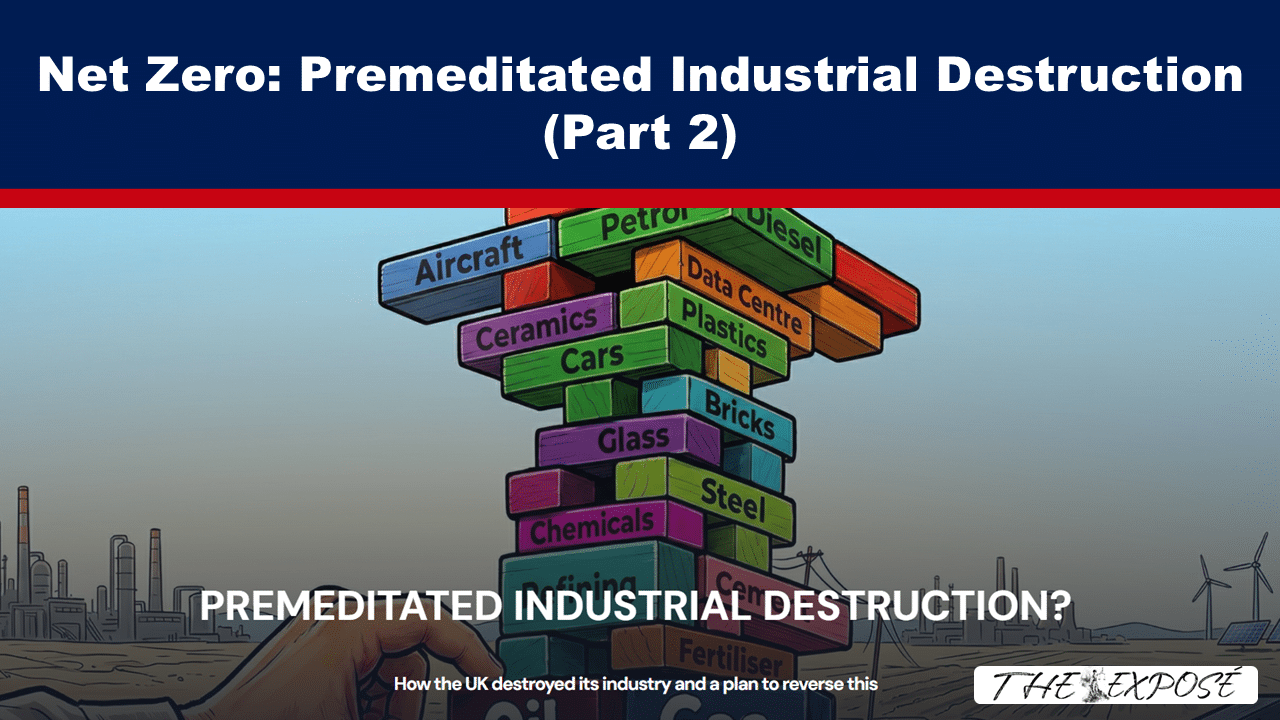
Featured image: Cover of the GBBC paper, ‘Premeditated Industrial Destruction: How the UK Destroyed Its Industry and A Plan To Reverse This’
The Expose Urgently Needs Your Help…
Can you please help to keep the lights on with The Expose’s honest, reliable, powerful and truthful journalism?
Your Government & Big Tech organisations
try to silence & shut down The Expose.
So we need your help to ensure
we can continue to bring you the
facts the mainstream refuses to.
The government does not fund us
to publish lies and propaganda on their
behalf like the Mainstream Media.
Instead, we rely solely on your support. So
please support us in our efforts to bring
you honest, reliable, investigative journalism
today. It’s secure, quick and easy.
Please choose your preferred method below to show your support.

Categories: Breaking News, UK News
It will end in Zero Industry and that’s their real objective.
Then what will the UK trade have to trade with. The UK GOV. has never supported its manufacturing industries, UK motorcycle manufacturing produced 90% of the worlds motorcycles, at the end of the 1960`s it had all gone. This all started far earlier than net Zero.
https://banned.video/watch?id=69dc3266415b02a9f1d074f1
Hi Petra, how about this.
🙏🙏
What the Holy Bible says of this horrific decade just ahead of us.. Here’s a site expounding current global events in the light of bible prophecy.. To understand more, pls visit 👇 https://bibleprophecyinaction.blogspot.com/