





UK government Net Zero policies and EU directives have forced the closure of UK aluminium smelters. Only one now remains.
This has made the UK reliant on imported aluminium for the car and aerospace industries. Imported aluminium will be subject to the EU’s Carbon Border Adjustment Mechanism from 2027, if the Government’s plan to rejoin the mechanism goes ahead, putting the UK car and aerospace industries at risk of being shunted into the industrial graveyard.
Let’s not lose touch…Your Government and Big Tech are actively trying to censor the information reported by The Exposé to serve their own needs. Subscribe to our emails now to make sure you receive the latest uncensored news in your inbox…
On 1 April, the Great British Business Council (“GBBC”), a newly formed think tank, published a paper titled ‘Premeditated Industrial Destruction: How the UK Destroyed Its Industry and A Plan To Reverse This’.
The paper is authored by economist Catherine McBride, retired engineer and consultant David Turver and public relations consultant Brian Monteith. It demonstrates how the Government’s Net Zero policies are destroying the foundations of the UK economy and provides recommendations on how Net Zero could be reversed.
Because this paper is important in revealing some home truths, we are reproducing it in a series of articles, more manageable chunks if you will, so that, hopefully, more will read it, or at least read part of it. We have made some minor edits for readability purposes. For those who choose to read the paper in one sitting, you can do so HERE.
Chapter 6: UK car and aircraft production relies on aluminium and steel
By Great British Business Council, 1 April 2026
The UK’s largest export industry, measured by value, is the production of machinery and transport equipment. Both require large amounts of steel and aluminium. Having addressed the steel sector in the previous chapter on construction, this section primarily covers aluminium.
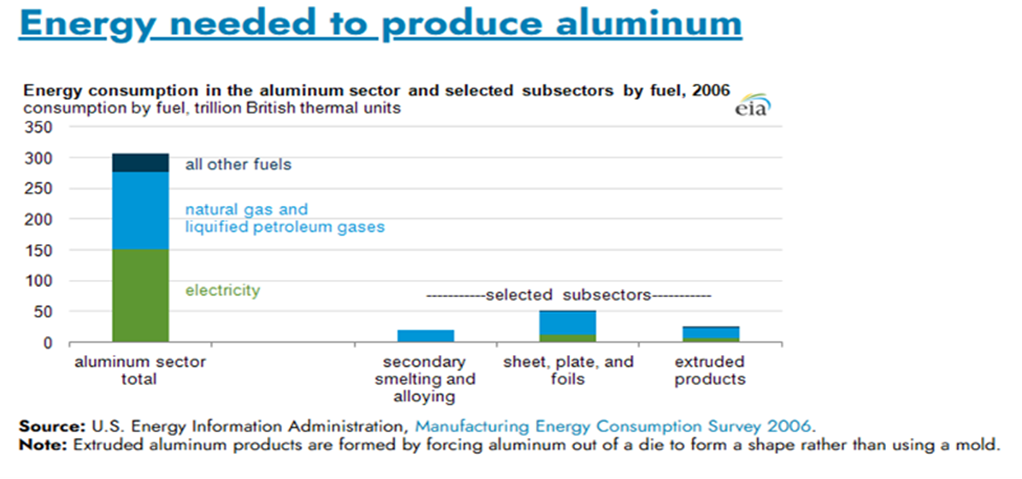
Aluminium production is extremely energy-intensive; approximately 40% of the energy used to make aluminium comes from gas and liquefied petroleum gas (“LPG”), with 50% provided from electricity, of which about a third is also produced from gas in the UK. In primary aluminium production, electricity also accounts for approximately 30-40% of total production costs and is the largest single input after alumina or bauxite.
The UK has almost no primary aluminium smelting capacity left and produces only 5% of the aluminium it uses domestically. UK aluminium imports were primarily rolled aluminium used in the manufacture of vehicle and aircraft parts. The UK’s aluminium exports consist of 60% scrap and 25% unwrought aluminium. The UK government plans to join the EU’s Carbon Border Adjustment Mechanism (“CBAM”) on imported aluminium in 2027, increasing the costs of downstream producers of vehicles and aircraft parts; some 80% of UK-produced cars and almost all UK-produced aircraft parts are exported. These products must remain competitive in global markets, or they too will join the UK’s industrial graveyard: The UK is the world’s largest supplier of aircraft parts, exporting 40% more than the second largest exporter, Germany, and almost twice as much as the US. The country cannot afford to lose this industry.
In 2000, the UK produced 320,000 tonnes of aluminium from three smelters. In 2009, the Anglesey Aluminium smelter in Holyhead, which produced 142,000 tonnes of aluminium per year, closed because its cheap electricity contract with the Wylfa nuclear reactor expired and EU state-aid rules blocked the contract’s renewal. In 2012, Britain’s largest smelter, Lynemouth in Northumberland, which produced 178,000 tonnes of aluminium a year, closed due to rising energy costs and the EU’s environmental directives, including the Large Combustion Plant Directive, which limits emissions from coal-fired power plants. The UK now has one remaining smelter, Lochaber in Fort William, Scotland. It produces just 48,000 tonnes of aluminium a year but has its own dedicated hydroelectric power supply, so it is not subject to Emissions Trading Scheme (“ETS”) or Carbon Price Support (“CPS”) costs.
In 2024, the UK imported 1.2 million tonnes of aluminium and articles of aluminium, 40% of which (by weight) were plates, sheets and strips greater than 0.2 mm in thickness, which will be used as raw materials by UK manufacturers. The UK also imports all its bauxite and alumina for the small amount of domestically produced aluminium. Aluminium imports have increased by 44% since 2005. More worrying is the 105% increase in imported structures made from aluminium: bridges and bridge-sections, towers, lattice masts, pillars and columns, roofs, roofing frameworks, doors and windows and their frames and thresholds for doors, shutters, balustrades, of aluminium; and plates, rods, profiles, tubes and the like, prepared for use in structures, of aluminium. These goods could have been produced in the UK if we had not forced the closure of UK smelters by applying the same emissions taxes, regardless of whether the aluminium is used in an aircraft that will last for 30 years or in a drink can that will last for a matter of months before being recycled.
The car industry
The UK car industry is one of the UK’s most valuable export industries, but it relies on imported steel and aluminium, both in raw form and as components. The UK government’s decision to mandate all new car sales to be electric vehicles (“EVs”) by 2030 has also had a devastating effect on the UK’s internal combustion engine (“ICE”) car producers. Smaller producers, such as Aston Martin, do not need to comply with the EV mandate. However, larger manufacturers not only have to convert their factories to produce EVs but also face substantial fines if they sell more than the allowed number of ICE vehicles in any month. In 2026, 33% of all new car sales must be zero-emission vehicles (“ZEVs”), with hybrids and ICE cars making up the balance. The fine is currently £12,000 for each ICE car exceeding the limit. The proportion of ZEVs that must be sold will increase each year. No solely ICE-powered cars can be sold in the UK after 2030, and no new hybrids may be sold after 2035. Only zero-emission vehicles (“ZEVs”) and hydrogen fuel-cell powered cars can be sold after that. Unfortunately, this mandate measures only tailpipe emissions, not total manufacturing emissions.
The Aerospace industry
The UK is the world’s largest exporter of aircraft parts: from jet engines to wings, seats and landing gear. The production of these parts also requires ample aluminium supplies. Unfortunately, as already discussed, the UK’s larger aluminium smelters were forced to close due to their high emissions costs. The UK’s only remaining smelter, located in Lochaber, Scotland, and powered by hydroelectricity, does not produce enough aluminium to meet the needs of the aircraft parts industry.
But the demise of the UK’s aluminium smelters is not solely due to the imposition of an ETS. The UK’s industrial electricity is more than three times as expensive as the average US industrial electricity, and more than five times as expensive as industrial electricity in the US states of Louisiana, New Mexico, Oklahoma and Texas, which have the lowest industrial electricity costs. Without access to bauxite or low-cost power, the UK will remain reliant on imported aluminium for car and aircraft production.
Aluminium production is energy-intensive and produces 15 tonnes of CO2 for every tonne of new aluminium produced. That said, it is readily recyclable, so its emissions should be amortised across multiple product generations, and, if used in vehicles and aircraft, its ETS should be divided by the product’s expected lifespan in Environmental Impact Assessments.
There is a report that the Germans are seeking to encourage one of the UK’s main aircraft firms, Rolls-Royce, to relocate the manufacture of the next-generation Ultrafan jet engine to Germany. If the UK continues to make manufacturing expensive and compliance-laden, it will be no surprise if companies seek more welcoming locations for their factories. While Germany has many of the same Net Zero regulations as the UK, it has not imposed a carbon tax on industrial energy, unlike the UK, but puts the cost of subsidies on general taxation.
UK policy costs include carbon prices and other policies to cover renewable subsidies. Network costs include balancing the system, such as paying electricity generators to turn on and off to maintain the grid’s frequency at 50 Hz. As the UK has the highest proportion of intermittent renewables in its grid, these network costs are also higher, and we need backup gas and coal-fired generation for when the wind drops. So effectively, the UK is running two electricity systems at once. According to the Global Warming Policy Foundation, the UK Network balancing cost (BSUoS) has increased from £300 million a year in the early 2000s to £2.7 billion a year in 2024/5. As the UK government continues to increase the number of wind turbines in the system, the network balancing cost will rise as well.


About The Great British Business Council
The Great British Business Council (“GBBC”) was established to enhance public and political understanding of the advantages a thriving business community provides to local security, standard of living and wellbeing. It aims to support British firms and small businesses by promoting well-crafted, practical, evidence-based policy reforms that foster enterprise and innovation. It is independent of any political party, as it hopes that all parties will consider adopting the straightforward, practical policy suggestions it proposes.
The GBBC is funded by private donations from concerned citizens who want the UK to thrive economically as it once did. If you would like to join us or donate to their cause, please contact in**@**BC.UK or follow them on LinkedIn, X (Twitter), Facebook, YouTube, TikTok and Bluesky.
Featured image: Cover of the GBBC paper, ‘Premeditated Industrial Destruction: How the UK Destroyed Its Industry and A Plan To Reverse This’
The Expose Urgently Needs Your Help…
Can you please help to keep the lights on with The Expose’s honest, reliable, powerful and truthful journalism?
Your Government & Big Tech organisations
try to silence & shut down The Expose.
So we need your help to ensure
we can continue to bring you the
facts the mainstream refuses to.
The government does not fund us
to publish lies and propaganda on their
behalf like the Mainstream Media.
Instead, we rely solely on your support. So
please support us in our efforts to bring
you honest, reliable, investigative journalism
today. It’s secure, quick and easy.
Please choose your preferred method below to show your support.

Categories: Breaking News, UK News
Hi Rhoda,
Another important article, which tells the truth.
I am going to repeat this again, because I think it needs looking into.
What Religion are the majority of our UK MP’s.
Because they seem to hate the majority of Christians in the country.
For years they have been destroying the Industry, this once Great Country created and developed.
Coal, Steel, Aluminium and Electricity production, being the most important.
And how do we make our voices heard, not by sending emails to our MP’s, that is a certainty.