




The Home Office’s decision to block Valentina Gomez from entering the UK ahead of a next month’s London rally has re-opened the debate over free speech and government overreach. Gomez, a US-based anti-Islam commentator, had planned to speak at the “Unite the Kingdom” march on 16 May. However, the Home Office has now revoked her electronic travel authorisation, saying her presence is “not conducive to the public good”. The ban followed pressure from Muslim organisations and political figures who pointed to her previous remarks on muslims and immigration.
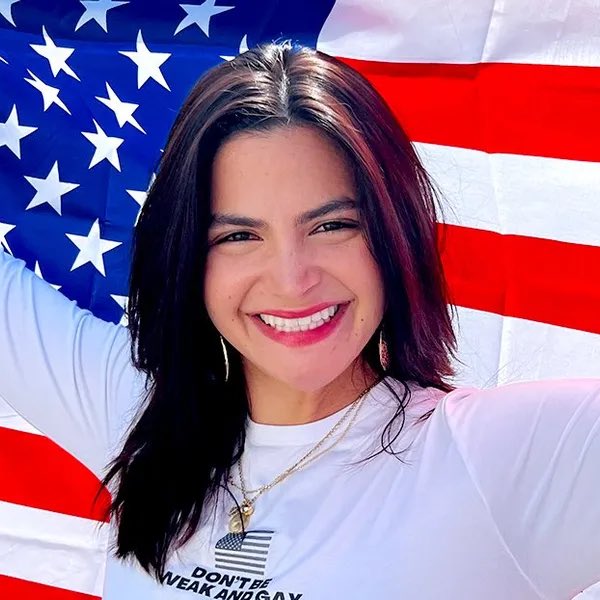
Gomez is a 26-year-old Christian conservative originally from Colombia. Last week, her Electronic Travel Authorisation was approved, but the Home Office revoked her permit on April 20th. Reports suggest that officials acted after renewed scrutiny of remarks she made during a similar appearance in London in 2025, where she delivered “inflammatory” comments about Islam and immigration. It’s also reported that Home Secretary Shabana Mahmood personally intervened to revoke the permission.
In its April 17 open letter, the Muslim Council of Britain urged the Home Secretary to revoke Valentina Gomez’s entry permission on the grounds that allowing her into the UK to speak at a Tommy Robinson rally showed “double standards” in how the government applies freedom of speech and entry rules. The MCB argued that Gomez’s past anti-Islam rhetoric risked making the UK’s streets “less safe”, and said others had previously been denied entry for inflammatory remarks aimed at different faith groups, making her case appear inconsistent by comparison. Its core case was therefore not only that Gomez was divisive, but that admitting her would signal uneven enforcement of the public-interest test used in immigration decisions.
The “Unite the Kingdom” marches have become a focal point for a growing anti-establishment constituency centred on immigration, Islam, public disorder and distrust of political institutions. The European Conservative reported that more than 100,000 people attended the September 2025 London march, presenting it as one of the largest demonstrations of its kind in recent years, though crowd figures at such events are often disputed.
The decision to exclude Gomez sits awkwardly with the UK’s self-image as a country committed to open political speech. It is one thing to prosecute criminal conduct or incitement; it is another to use border powers to decide which foreign political voices may be heard on contentious public questions. Once that principle is applied, the state is no longer merely keeping order. It is deciding, in advance, which arguments are too dangerous to enter the country. That is a serious threshold for a liberal democracy to cross.
Earlier this month, the UK also blocked Kanye West from entering the country after he was booked to appear at London’s Wireless Festival, prompting the event’s cancellation. Reports said the decision followed renewed outrage over West’s “repeated antisemitic statements and praise for Hitler”. The two cases are not identical in purpose or setting, but together they point to a government increasingly willing to use immigration control as a political filter where speech is judged hateful, inflammatory or destabilising.
Across the UK and much of Europe, governments have become more prepared to regulate speech through a wide mix of public-order law, online-safety rules, extremism frameworks and administrative controls. The stated rationale differs from case to case, but the trajectory is all too clear: a larger role for the state in deciding what kinds of expression are tolerable, and in what setting. Border control now appears to be part of that same arsenal.
For a government that still claims to value free expression, these recent cases should not be treated as minor administrative details. They are part of a broader shift in how democratic states manage public argument, increasingly relying on restriction. Essentially, states are becoming less willing to trust its citizens to hear “offensive” speech and make their own decision on whether to reject it, and more willing to prevent it being heard in the first place.
The Expose Urgently Needs Your Help…
Can you please help to keep the lights on with The Expose’s honest, reliable, powerful and truthful journalism?
Your Government & Big Tech organisations
try to silence & shut down The Expose.
So we need your help to ensure
we can continue to bring you the
facts the mainstream refuses to.
The government does not fund us
to publish lies and propaganda on their
behalf like the Mainstream Media.
Instead, we rely solely on your support. So
please support us in our efforts to bring
you honest, reliable, investigative journalism
today. It’s secure, quick and easy.
Please choose your preferred method below to show your support.

Categories: UK News
Every religion is a political vehicle of a race. The Muslim religion is the political
vehicle of the Semitic race. Therefor its racist.
Psst! All religions are fake! A means to control the masses. Race has nothing to do with it.
False. Christianity is not. ✝️
In order to gain entry, with a full turn out of Labour, LibDem, Green, SNP and Your Party officials, all she had to say was that she wanted to destroy the UK, overturn White Supremacy, replace all Right Wing activists or thinkers with a new population……..but instead, she wanted to express her right to Free Speech.
All she had to say is that she supports Israel all the way.
…oh the irony of revoking her visa on Hitler’s birthday.
The UK dropping out of the “Open” category
A major global index by Article 19 (their Global Expression Report) shows:
Countries are scored 0–100
“Open” = 80–100
“Less restricted” = 60–79
👉 The UK’s latest score:
79/100
Which is just below the 80 cutoff
That means it fell out of the “Open” category into the next tier down.
Send all Muslims and other dissidents home since they have nothing in common with our cultures or anyone else’s for that matter and are dangerous once assimilated into any other culture. The desert is where they came from so please return there ASAP. Japan and Cambodia both ridded themselves of Muslims and we should do the same before its too late.
its already too late….Home Secretary Shabana Mahmood !!!
Deport all muslims from the West, citizens or not, as the national security threats their own Quran very clearly states they are!
UK government hypocrisy!. 😡 It’s already not safe in UK ! So they speak LIES
The UK already block and ban speech, online and in print, they don’t want their citizens to be expose to, by imposing harsh penalties, now they are even barring foreigners who want to visit the UK to speak. It sounds like “1984”… and we can’t call them Democracies anymore.