





It is imperative that the UK changes course in energy policy.
A wide array of legislation has embedded misguided climate and energy policies into law. All this legislation must be unwound, GBBC says. All these policies have achieved is deindustrialisation, which is decimating the UK economy and jobs.
Due to government and EU directives, the UK has halved its production emissions compared to 1990. A large proportion of this emissions reduction has been due to deindustrialisation and the conversion of coal-fired electricity to gas.
To cut emissions further by 2030, as decreed by Boris Johnson, will require the UK’s population to lower its standard of living.
Let’s not lose touch…Your Government and Big Tech are actively trying to censor the information reported by The Exposé to serve their own needs. Subscribe to our emails now to make sure you receive the latest uncensored news in your inbox…
On 1 April, the Great British Business Council (“GBBC”), a newly formed think tank, published a paper titled ‘Premeditated Industrial Destruction: How the UK Destroyed Its Industry and A Plan To Reverse This’.
The paper is authored by economist Catherine McBride, retired engineer and consultant David Turver and public relations consultant Brian Monteith. It demonstrates how the Government’s Net Zero policies are destroying the foundations of the UK economy and provides recommendations on how Net Zero could be reversed.
Because this paper is important in revealing some home truths, we are reproducing it in a series of articles, more manageable chunks if you will, so that, hopefully, more will read it, or at least read part of it. This is the final article in the series. We have made some minor edits for readability purposes. For those who choose to read the paper in one sitting, you can do so HERE.
Table of Contents
- Chapter 12: Reversing Net Zero – costs and benefits
- Remove regulations and taxes that are reducing supply first
- Energy Profits Levy (Windfall Tax)
- Oil and Gas Price Mechanism
- North Sea Future Plan
- Fracking moratorium and the onshore Petroleum Exploration and Development Licence (“PEDL”)
- Remove the Financial Services requirement to integrate climate risks into credit risk assessments
- Simplify royalty charges on oil and gas extraction
- Encourage coal production for exports
- Simplify Environmental Impact Assessments
- Prevent Activists from blocking approved wells and fields
- Encourage Demand
- Other energy costs that reduce industrial profitability
- Other regulations to that lower UK productivity and increase costs
- International agreements, ETS and renewable subsidies to renegotiate or repeal
- Remove regulations and taxes that are reducing supply first
- Conclusion
- About The Great British Business Council
Chapter 12: Reversing Net Zero – costs and benefits
By Great British Business Council, 1 April 2026
It is imperative that we change course in energy policy if we are to preserve what remains of our oil, gas, and energy-intensive industries. Unfortunately, a wide array of legislation has embedded misguided climate and energy policies into law. All this legislation must be unwound, although some regulations will be harder to unwind than others.
Remove regulations and taxes that are reducing supply first
Energy Profits Levy (Windfall Tax)
Priority must be given to the low-hanging fruit with the highest returns to the industry. The easiest regulation to unwind and the one that should have the most impact on supply will be the Energy Profits Levy (“EPL”), as the EPL was a temporary tax introduced to tax extraordinary profits made by oil and gas companies due to the Russian invasion of Ukraine, not for climate reasons. Therefore, the tax is not connected to the UK’s Climate Change Act, it’s not a Paris Agreement target, nor any of the UK’s trade agreements.
Although this tax was not intended to reduce UK oil and gas production or emissions, it has had this result. The additional 38% tax disincentivises UK oil and gas production and currently raises very little revenue, as producers have reduced their North Sea Production.
The combined 78% tax rate has discouraged oil and gas production in the North Sea and raised only a fraction of the revenue originally envisioned by the Conservative Government that introduced it. Removing taxes is likely to boost production and increase tax receipts for the sector, benefiting downstream industries and, in turn, employment and further tax revenues.
Oil and Gas Price Mechanism
The Energy Profits Levy (Windfall tax) was meant to be a temporary tax that ended in 2025. Since then, it has been increased and extended twice and now the Labour government intends to replace it with a permanent, euphemistically named ‘Oil and Gas Price Mechanism’ (“OGPM”). The Price Mechanism is a permanent 35% tax on the operations of oil and gas producers in the UK and its Continental Shelf. It is currently planned to start if oil and gas prices go above $90 per barrel or 90p per therm. This tax is in addition to the 40% ringfenced corporate tax they already pay, which is 15% higher than the standard 25% corporate tax. The replacement of the “temporary” EPL with the Permanent OGPM will be the last nail in the coffin of the UK industry unless this is stopped.
North Sea Future Plan
Introduced in November 2025, these regulations effectively ended new offshore exploration licences and new onshore oil and gas licences in England. This policy must be reversed to enable UK operators to find more oil and gas resources, as Norway has done, and to enable companies to explore for additional onshore oil and gas supplies.
Fracking moratorium and the onshore Petroleum Exploration and Development Licence (“PEDL”)
A new energy policy would lift the fracking moratorium and repeal any legislation that Ed Miliband has introduced to prevent fracking. Fracking is also not tied to the UK’s international Climate Commitments or trade agreements. This was yet another own goal by the UK. The moratorium on fracking was introduced in 2019, briefly lifted under the Truss administration and reinstated under Sunak’s administration in 2022. Ed Miliband has pledged to implement a total fracking ban, meaning the gas resources in onshore shale formations will be effectively out of reach unless this is reversed. Reversal of the ban on onshore petroleum exploration and development licences could increase the UK’s gas supply and lower prices, as it has in the US.
Remove the Financial Services requirement to integrate climate risks into credit risk assessments
This will lower funding and insurance costs for the energy sector and allowing car manufacturers to produce vehicles that their customers prefer are three supply-side reforms that can be implemented quickly and are likely to yield results.
Simplify royalty charges on oil and gas extraction
Replacing high oil and gas taxation with a simple royalty charge on extracted oil and gas on a barrel of oil equivalent (“boe”) or energy basis. The UK should continue to issue exploration and extraction licences, which need to be renewed annually or, at the latest, every 5 years; unused extraction licences should expire, as current planning permissions for construction do, after 5 years if the project has not started.
In the 1970’s, oil and gas fields entered production within about 5 years of discovery – the UK needs to return to this type of efficient development. Oil and gas company taxes and allowances should then be the same as those of all other industries, with exploration costs and other plant and equipment expensed immediately.
Encourage coal production for exports
Coal could also be used for back-up power stations for windfarms, as they are in China, or could be built with carbon capture, utilisation and storage (“CCUS”). The UK has large reserves of high-carbon anthracite and thermal coal, which should be used or exported. The UK also has large amounts of coal waste, which should be processed to recover critical minerals.
Simplify Environmental Impact Assessments
Inclusion of Scope three emissions from new UK oil and gas production should be compared to the Scope 1,2 and 3 emissions from imported oil and gas.
Drilling for new oil and gas in the North Sea has been made more difficult after the Finch ruling in the Supreme Court that required regulators to consider the impact of burning oil and gas, Scope 3 emissions, in Environmental Impact Assessments (“EIA”) for new projects. In addition, the Court of Session in Edinburgh has ruled that the planning consent granted to the Jackdaw and Rosebank fields was unlawful for failing to consider the environmental impact of burning the extracted hydrocarbons.
However, the Finch ruling covered the Horse Hill site in Surrey, which is estimated to contain 3.3 million tonnes or ~24 million barrels of oil equivalent (“MMboe”). Jackdaw is estimated to contain 120-250MMboe and Rosebank is estimated to contain 300-500 MMboe. All three total 444-774MMboe or 4 to 5 days of global oil and gas consumption: a drop in the ocean. The assessment of Scope 3 emissions ought to be as simple as stating that their global impact will be almost undetectable. Moreover, the UK will continue to use imported oil and gas, and the carbon footprint of imported liquefied natural gas (“LNG”) is much larger than that of domestically produced gas.
The Environmental Impact Assessment (“EIA”) regulations require a radical overhaul to make it easier to restart onshore and North Sea exploration and development drilling. The EIA require extensive analysis, consultation and mitigation before drilling can begin. EIAs are required for seismic surveys, exploratory drilling, production drilling, pipelines and even decommissioning. The EIA is governed by the Town and Country Planning (Environmental Impact Assessment) Regulations 2017 in England, the Town and Country Planning (Environmental Impact Assessment) (Scotland) Regulations 2017 and the Offshore Petroleum Production and Pipelines (Assessment of Environmental Effects) Regulations 1999 (for offshore oil and gas in UK territorial waters), which implement the European Union’s (“EU’s”) EIA Directive. It is questionable why the EU would be so concerned about oil and gas production when the UK was, at the time, the only EU country with any sizeable production and Norway, which also follows the Directive as a European Economic Area (“EEA”) member, has never been an EU member.
Prevent Activists from blocking approved wells and fields
Other supply-side reforms would include making it more difficult for activists to block oil and gas fields that have been granted permission by the UK government. These activists are often funded by international groups that are not motivated by promoting the UK’s economic interests. Some, such as the anti-fracking groups, are funded by Russian interests, others are naive “Activists for Hire” that need a cause to justify their existence – regardless of whether their activism destroys other people’s jobs and livelihoods.
Encourage Demand
Abandon the EV mandate
The UK should also abandon its electric vehicle (“EV”) mandate for producers and its fines for the sale of excess internal combustion engine (“ICE”) vehicles. The UK should also stop subsidising EVs, but it could continue to install charging access in street lighting for city dwellers without driveways. If people want to buy an EV, they can but without subsidies or market-distorting fines. Removing the EV mandate will stop the decline in demand for petrol and diesel.
Abandon the heat pump mandate
Again, if people want to install a heat pump and their homes are sufficiently insulated so it works, let them install one and pay for it. The Majority of UK housing stock is too old to retrofit a heat pump without extensive and expensive additional insulation.
Encourage Data Centres to build their own electricity supply using gas, coal or nuclear
Data centres transfer information at the speed of light and can be sited anywhere with cheap electricity. While many Gulf countries hope to attract large data centres and artificial intelligence (“AI”) due to their cheap electricity, they face both political risks and heat-related challenges. About 40% to 50% of a data centre’s energy is used for cooling. Scotland or the Orkney Islands could be ideal locations for data centres – if they could use North Sea gas to generate electricity.
Other energy costs that reduce industrial profitability
Carbon emission calculations for goods
If the new government intends to continue with CO2 emission charges and taxes, then all emissions associated with goods production should be divided by the product’s life expectancy.
Carbon Price Support Mechanism
Abolish the Carbon Price Support (“CPS”) Mechanism. This is an additional UK tax that is not applied by other EU countries and makes UK products uncompetitive in the EU. As the UK government plans to join the EU’s Emissions Trading System (“ETS”), it would be unfair and anti-competitive for UK industries to continue paying both the UK’s CPS tax and the EU’s carbon tax. The CPS was introduced to discourage the use of coal in electricity generation; however, the last coal-fired power station closed in September 2024. There is no need for this tax. The CPS is currently £18 per tonne of CO2 and adds about £6 to £7/MWh to the cost of gas-fired electricity. Beyond being redundant, the CPS increases costs for businesses, thereby reducing their profitability and their international competitiveness.
Climate Change Levy
The Climate Change Levy (“CCL”) is paid by non-domestic energy consumers and is charged on electricity, gas and solid fuels. It is not tied to the UK’s Paris Agreement Commitments, and it is not used to subsidise renewable electricity. The CCL is just a tax on UK business energy use designed to make energy more expensive and incentivise energy efficiency. It has certainly achieved this aim, but mainly by encouraging UK businesses to relocate to countries with lower energy costs.
Removing these costs will help the UK’s remaining businesses survive. CCL costs to UK businesses have ranged between £1.8 and £2.2 billion in recent years. per year, adds about 5% to 7% to a typical non-domestic electricity bill and increases the electricity price by £7.75 per MWh.
In total, carbon costs made up 37.5% of the wholesale price of electricity in December 2025. If carbon costs were removed, wholesale electricity prices would fall from December’s £78.45/MWh to just under £49/MWh, giving welcome and popular relief to both businesses and households.
Simplify Discounts for energy-intensive industries
The benefit of removing the CCL will be that we can also remove the requirement for Energy Intensive Industries (“EIIs”) to apply for discounts of 92% for electricity, 86% for gas, 77% discount for liquefied petroleum gas (“LPG”) and an 86% reduction on coal or solid fuels, by entering a Climate Change Agreement. EII also gets an 85% discount on the Renewable Obligations and Contracts for Difference levy. This will reduce industry compliance costs and increase their profitability.
Curtail Curtailment payments
Curtailment payments are not embedded in renewable contracts, and they are not guaranteed revenue streams. Wind generators are paid for curtailment only through the balancing mechanism, not through their Contract for Difference (“CfD”) or Renewables Obligation (“RO”) contracts.
The new government should redesign the system to make new generators responsible for co-located storage and firm power obligations, as there is no contractual barrier preventing this. A new government should also introduce Locational Marginal Pricing that varies by location and reflects local demand and supply, transmission congestion and network losses. Generators currently pay a Transmission Network Use of System charge, but it is a fixed price that does not vary with real-time grid conditions.
Other regulations to that lower UK productivity and increase costs
Carbon Reduction Plan
Remove the requirement for government contractors to have a Carbon Reduction Plan before they can apply for government contracts. Contracts should be awarded based on the ability to provide the services at an appropriate price. The contract may require the company to manage the waste generated by the contract in accordance with the law, but it should not require the company to have a Net Zero plan before it can even apply for the contract.
Sustainability requirements in financial service regulations
The Government should remove the sustainability requirements from financial service regulations. Bank lending, insurance and pension fund investments should be based on a financial risk or reward basis over the life of the investment, not on what will happen if the investment is still in business in 100 years. (The average age of a UK-registered company is just 8.6 years.) The UK is a global financial services centre and cannot restrict its services to companies subject to arbitrary regulations.
Remove the “sustainable economic growth” duty from regulators
The Enterprise Act 2016 was revised in 2023 to replace the ‘Growth Duty’: having regard to the desirability of promoting economic growth, with the ‘Sustainable Growth Duty’, which explicitly requires all major UK regulators, including Ofwat, Ofcom, Ofgem, ORR, CAA, etc., to have a sustainability-aligned growth obligation. The statutory guidance on sustainable economic growth explicitly emphasises environmental impact, long-term environmental sustainability and supporting Net Zero-aligned investment.
The “sustainable” requirement should be removed from the regulator’s obligations. Some regulators already had sector-specific sustainability obligations, such as Ofgem, the energy regulator, which had a duty to reduce greenhouse gas emissions; this should be replaced by a duty to ensure there is always ample, affordable energy to meet the demands of current and future industry and domestic users.
Introduce anti-trust regulation to prevent collusion between financial service providers
Although the Glasgow Financial Alliance for Net Zero (“GFANZ”) group of financial organisations has been predominantly discredited, this was due to the US Congress, Senators, State Governors and US pension managers threatening it with an antitrust suit.
GFANZ started in the UK and was the brainchild of the then Governor of the Bank of England, Mark Carney, even though it undermined the UK’s main extractive industry and all the industries that flowed from it. Unfortunately, the UK government appeared powerless to stop, or even supportive of, the de-banking and de-insuring of the UK’s most important industry. The New government needs to introduce financial services regulations to prevent this type of collusion in the future, as well as prevent the de-banking of individuals for political reasons.
International agreements, ETS and renewable subsidies to renegotiate or repeal
Unfortunately, reversing other regulations will be trickier, as much of it is embedded in international agreements that will also need to be reversed, and this could require primary legislation. Additionally, reducing or eliminating renewable subsidies will be met with aggressive legal action from the beneficiaries of these contracts.
Paris Agreement and the UK’s “ambitious” Nationally Determined Target
Boris Johnson increased the UK’s Nationally Determined Commitment (“NDC”) Paris Agreement target from 55% reduction from 1990 emissions to an extremely ambitious 68% reduction by 2030. Although the Paris Agreement requires procedural duties of submitting a national climate plan, calculating and reporting emissions, there is, luckily, no punishment for failing to meet the NDC.
Even though the UK has halved its production emissions since 1990, if we ignore its imported emissions, the Climate Change Committee believes the UK is unlikely to meet its 68% reduction target by 2030. A large proportion of the UK’s emissions reduction was due to deindustrialisation and the conversion of coal-fired electricity to gas. But to cut emissions by another 18% will require the population to lower its standard of living by greatly increasing electricity demand without increasing the supply of dispatchable power.
The solution would be to lower the UK’s commitment back to the EU level of 55%, accept that we will fail to meet the lower target, or follow the US out of the Paris Agreement.
The Agreement was always nonsensical, as China and India were not required to reduce their emissions and so they now dominate global production and supply of high-emission goods that were once made in the UK, the EU and the US.
If the UK wants to revive its industry, it should consider both options, with the latter being the most comprehensive. The only sticking point will be the UK’s trade agreements with the EU and New Zealand, which both stipulate continued commitment to the Paris Agreement, even though both are reconsidering their positions on oil, gas and coal use. As the UK is one of the EU’s largest export markets, it would be very unlikely to walk away from the EU-UK Trade and Cooperation Agreement (“TCA”) if the UK left the Paris Agreement.
The ECHR
Although it was established for entirely different reasons, the European Court of Human Rights (“ECHR”) has interpreted inaction on climate change as a potential human rights violation. The next UK government may well leave the ECHR to remove the requirement to accept illegal immigrants, but it would also avoid activist groups claiming that leaving the Paris Agreement or encouraging new oil and gas developments is somehow affecting their human rights. The ECHR can pressure states to align with the Paris goals even though the Paris Agreement is not enforceable.
Emissions Trading Scheme
The UK’s Emissions Trading Scheme is part of the UK’s Paris Agreement commitment delivery programme. Although it is a domestic policy instrument designed to help the UK meet its Legally Binding Carbon Budget as defined in the UK’s Paris Agreement Nationally Determined Contribution (“NDC”).
The UK’s Emissions Trading Scheme (“ETS”) is levied on energy-intensive industries, the power generation sector and aviation. According to the ONS, the ETS cost £4,069 million in 2024. The cost of this is set to rise as the Government has pledged to align the UK and EU trading schemes, and EU carbon prices are even higher than ours.
However, the UK-EU Trade and Cooperation Agreement (“TCA”) and the UK-New Zealand Free Trade Agreement require the UK to maintain a carbon tax. Removing the ETS entirely could create problems for UK exporters to the EU and New Zealand if the EU or New Zealand can prove that it gives UK exports an unfair advantage.
However, trade with the US and China, the UK’s largest individual trading partners, would not be affected, nor would the UK’s service industry exports, which are now more than half of all UK exports. However, the ETS is a drain on the much larger domestic economy and removing it could increase tax revenue for other jurisdictions, as the UK would be a more competitive environment for establishing new businesses.
The Climate Change Act
The Climate Change Act 2008 (“CCA”) should be repealed, but this will take time and may require primary legislation. Fortunately, there are safeguards in the legislation that may allow the CCA’s effects to be defanged more quickly, enabling a twin-track approach to reform before eventual abolition.
Section 2 of the Act makes provision for changing the percentage reduction in emissions if there are significant developments in the scientific knowledge about climate change.
Section 10(2) sets out the matters to be considered when setting or amending carbon budgets. These matters include scientific knowledge about climate change; technology relevant to climate change; economic circumstances; social circumstances; and, the impact of carbon budgets on energy policy.
Section 21 covers the rules for amending carbon budgets after they have been set. Carbon budgets can only be amended if “there have been significant changes affecting the basis on which the previous decision was made.”
The latest science is less alarming than previously thought, and this ought to be grounds for reducing the emissions targets. The direct and indirect costs of renewables are far higher than estimated by the Climate Change Committee, which means the technical and economic basis for setting carbon budgets has changed since the decisions were made and there ought to be grounds for amending carbon budgets too.
Downgrading the onerous emissions targets and revising the carbon budgets should pave the way to reducing energy costs by focusing on measures that will deliver the maximum return for the least legal pain.
Cutting renewable subsidies
This will be controversial, and we should expect the contract counterparties to fight any attempt to change their contracts; however, there are ways to mitigate the costs:
• The most expensive subsidy scheme is Renewables Obligations (“ROCs”), which cost £7.8 billion in 2024/25 according to the Office for Budget Responsibility (“OBR”). This is a subsidy paid to renewables generators in addition to the market price they receive for the electricity they generate. This scheme has been closed to new entrants since 2017, so all beneficiaries have had plenty of time to recoup their initial capital. A range of measures should be considered to cut costs.
• The softest measure would be to stop indexing certificate values in line with inflation, or to index them in line with the Consumer Price Index (“CPI”) rather than the Retail Price Index (“RPI”). The Government has already announced this latter measure, which will begin in April 2026. This would at least cap costs until the scheme decays naturally as generators reach the 20-year subsidy limit.
• A more dramatic measure would be to effectively end the scheme altogether by repealing or amending the Renewables Obligation Order 2015, which is used to set the number of certificates licensed electricity suppliers are obliged to purchase. The annual obligation level is set by the government, and each ROC is worth one megawatt-hour. Electricity suppliers must purchase ROCs to cover all electricity purchases, whether renewable or not, unless the renewable generator sells the electricity with the ROC attached. Renewable generators can also sell their ROCs on the open market, where the government’s buyout price serves as a floor. If this were set to zero, the certificates would have no value, and the cost of the scheme would collapse, removing £7.8 billion from electricity bills – potentially another popular measure.
• Contracts for Difference (“CfDs”) are more difficult to tackle. The total CfD scheme cost £2.6 billion in 2025, with most of the subsidy going to offshore wind. This is a relatively modest sum in the grand scheme of things, but there are large additional costs in the pipeline from contracts awarded but not yet activated. The existing CfD contracts include clauses that provide compensation for Qualifying Changes in the Law (“QCiL”). It will therefore be difficult to change existing CfDs without breaching contract law. The Reform Party has committed to striking down the contracts awarded in Allocation Round 7 (“AR7”).
• Feed-in-Tariffs (“FiTs”) cost about £1.9 billion per year. The cost of these could be mitigated by stopping further inflation indexing and ceasing payments once the subsidies received exceed the installation’s capital cost. The Government has announced that FiTs will be indexed in line with CPI, not RPI, from April 2026. Again, the “scorched earth” approach would be to end the scheme altogether. Cut or eliminate curtailment payments and require renewable generators to install batteries or pumped-hydro storage to store power until it is needed.
Wind farm decommissioning
Cutting carbon taxes would have the greatest impact on ROC-funded generators and on merchant-based renewable generators. There will be no impact on FiT- and CfD-funded generators, as they receive index-linked fixed prices for their output. However, CfD units would receive a larger share of their income from subsidies than from the market.
Eliminating ROC subsidies would have an even larger impact on these generators. It is likely that the revenue cuts would be large enough to push many offshore wind and some onshore wind units into bankruptcy. This will lead to two second-order effects. On the positive side, if there is less operable wind capacity, there will be fewer instances when wind exceeds the grid’s capacity, so curtailment charges should fall, which would be a further benefit.
On the other hand, cutting carbon costs and ending the ROC scheme early risks these windfarms becoming financially unviable overnight. It is likely these companies do not have enough cash on hand to fund decommissioning liabilities, so the cost could fall onto the taxpayer.
To mitigate this risk, any new Government could, upon taking office, immediately tighten the rules governing decommissioning. All windfarms would need to hold ring-fenced cash in the operating company to cover the present value of the liability in the expected decommissioning year. They should set a rule that no dividends or other cash can be paid to owners until the decommissioning liability is covered. If the cash generated by the windfarms is not enough to cover the liability in, say, two years, then the owners should be forced to inject cash into the operating companies.
The biggest financial loss for ROC-funded generators will be the loss of their ROC certificates, so perhaps the Government could implement the cut to carbon costs immediately and then end the ROC scheme slightly later to give consumers an immediate benefit and time for decommissioning cash to build up.
Further legal barriers to change
The CCA is far from the only legal barrier to unwinding Net Zero.
The Energy Charter Treaty is a multilateral investment treaty designed to protect foreign investors in the energy sector, particularly in former soviet countries. Several EU countries have withdrawn from the treaty because it was being used by investors to prevent coal phase-outs and bans on offshore oil drilling. The EU sees the treaty as incompatible with the Paris Agreement.
The Conservative Government withdrew the UK from the treaty in February 2024, but it has a 20-year sunset clause, so UK investor protection will remain in place until 2045.
Setting the Renewables Obligation to zero might lead to a legal challenge under Article 10 of the Treaty’s Fair and Equitable Treatment provisions. Article 13 may provide grounds for challenge under indirect expropriation rules if the change renders investments uneconomic. However, there may be valid defence mechanisms that justify the change on public-interest grounds. Clearly, there is legal risk in such a move, and it will be a political decision, as the benefit of removing ROCs may outweigh the risk of having to award compensation.
The non-regression clauses in the UK-EU Trade and Cooperation Agreement (“TCA”) do not act as an obstacle to ending Net Zero unless the changes made by the UK specifically benefit UK trade with the EU. The TCA does not freeze specific Net Zero policies or targets set after 2020 (e.g., the UK’s tightening of its Paris Commitments to 68% reduction by 2030 from 1990 levels, or the 2050 Net Zero goal itself). The UK can adjust, relax or replace domestic policies as long as overall levels of protection do not fall below the 2020 benchmark in a trade-affecting way.
Article 764 of the TCA also contains provisions to respect the Paris Agreement and refrain from acts or omissions that would materially defeat the object and purpose of the Paris Agreement. In addition, Article 392 commits the UK and the EU to having effective carbon-pricing systems, such as the ETS. Taken together, the provisions in the TCA act as a barrier to backsliding on Net Zero commitments if this gives the UK or the EU a trade advantage. However, there are signs that EU member states are beginning to oppose draconian climate targets, so it may be possible to agree jointly to resile from Net Zero commitments.
The UK-New Zealand Trade Agreement has environmental provisions similar to those in the UK-EU TCA. The Parties cannot deliberately lower environmental standards to gain a trade advantage. The provisions cover pollution, biodiversity, environmental impact assessments, climate mitigation, carbon pricing and conservation. The agreement requires the UK to maintain carbon pricing but the UK’s ETS would be sufficient; the CPS could be abandoned without breaking the agreement. The agreement also contains an unusually strong explicit commitment to the Paris Agreement: to implement it, maintain their NDCs, and not withdraw from it. If either country were to withdraw from the Paris Agreement, it would be considered a breach of the FTA. This is one of the strongest climate‑related obligations in any UK trade deal. Unlike most trade agreements, the environmental chapters are fully binding, subject to dispute settlement and could lead to sanctions or penalties.
Conclusion
By Great British Business Council, 1 April 2026
The evidence presented in this paper demonstrates that a pragmatic reset of the UK’s oil and gas strategy offers substantial economic, industrial and fiscal benefits. Increasing domestic production – both offshore and onshore – strengthens national energy security, reduces exposure to volatile global markets and keeps value within the UK economy rather than exporting it through rising import dependency. Allowing new exploration, accelerating licensing and enabling technologies such as hydraulic fracturing where geologically appropriate would materially increase domestic supply, stabilise prices and support the resilience of the UK’s energy system during the transition to net zero.
The benefits extend far beyond the extraction sector itself. Oil and gas underpin a vast industrial ecosystem that remains essential to the UK’s economic base. Across upstream operations, refining, petrochemicals, plastics, pharmaceuticals, cement, ceramics, glass, steel and aluminium, these industries collectively support hundreds of thousands of high-skilled, high-productivity jobs. Many of these sectors cannot operate without secure supplies of hydrocarbons and they face international competition from jurisdictions with lower energy costs and fewer regulatory burdens. A competitive domestic energy supply is therefore not optional – it is foundational to the survival of the UK’s industrial core.
Reforming or removing carbon-related taxes and levies on energy-intensive industries would further strengthen this foundation. Current carbon cost burdens often exceed those faced by competitors in the EU, the US, the Middle East and parts of Asia, undermining UK competitiveness and accelerating industrial decline. A more proportionate, investment-friendly framework would help retain strategic industries, safeguard employment and support long-term decarbonisation through innovation rather than deindustrialisation.
The fiscal benefits are equally significant. Higher domestic production increases tax revenues from corporation tax, supplementary charges and employment taxes, while reducing the UK’s reliance on imported oil and gas. Every additional barrel produced domestically reduces the trade deficit, improves the balance of payments and keeps more economic value circulating within the UK. In a period of persistent fiscal pressure, these revenues provide a critical buffer for public services and national investment priorities.
Taken together, these measures form a coherent strategy for strengthening the UK’s economic resilience. By producing more of its own energy, supporting the industries that depend on it, and ensuring a competitive fiscal and regulatory environment, the UK can secure jobs, enhance tax revenues, reduce its trade deficit and maintain the industrial capabilities essential for economic strength.
About The Great British Business Council
The Great British Business Council (“GBBC”) was established to enhance public and political understanding of the advantages a thriving business community provides to local security, standard of living and wellbeing. It aims to support British firms and small businesses by promoting well-crafted, practical, evidence-based policy reforms that foster enterprise and innovation. It is independent of any political party, as it hopes that all parties will consider adopting the straightforward, practical policy suggestions it proposes.
The GBBC is funded by private donations from concerned citizens who want the UK to thrive economically as it once did. If you would like to join us or donate to their cause, please contact in**@**BC.UK or follow them on LinkedIn, X (Twitter), Facebook, YouTube, TikTok and Bluesky.
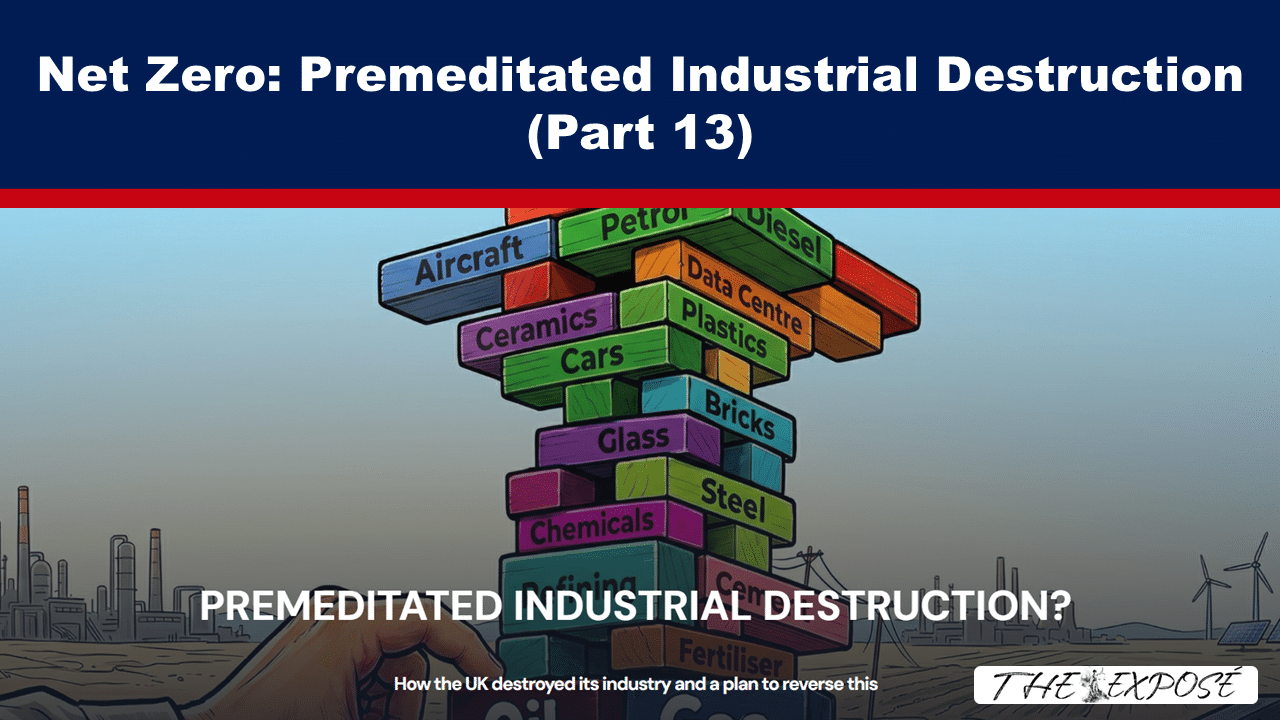
Featured image: Cover of the GBBC paper, ‘Premeditated Industrial Destruction: How the UK Destroyed Its Industry and A Plan To Reverse This’
The Expose Urgently Needs Your Help…
Can you please help to keep the lights on with The Expose’s honest, reliable, powerful and truthful journalism?
Your Government & Big Tech organisations
try to silence & shut down The Expose.
So we need your help to ensure
we can continue to bring you the
facts the mainstream refuses to.
The government does not fund us
to publish lies and propaganda on their
behalf like the Mainstream Media.
Instead, we rely solely on your support. So
please support us in our efforts to bring
you honest, reliable, investigative journalism
today. It’s secure, quick and easy.
Please choose your preferred method below to show your support.

Categories: Breaking News, UK News
Left to their own devises, without public oversight, or government regulations, corporations be they large or small have for several generations felt quite happy destroying beautiful habitats, polluting waterways and I could go on… Government legislation has proved so easily lobbied into any direction desired by large enough corporations; the devastation of large forests, the poisoning of farmlands, waters and the air all mooted as modernisation and progress hasn’t ceased. Despite government interference in industrial activities more and more damage to necessary environments has occurred, therefor it appears that as public participation and oversight is not apparently forthcoming yet, the best way to overcome the damages being done may be to let industry die, not that we really have much choice about that at the moment, to let the status quo collapse by not complying with anything else we perceive as stupid or draconian; to let more and more people start to really suffer from food shortages, what with the government paying farmers to let fields go fallow, which might start to wake the majority to the fact that if each individual doesn’t take responsibility for the shape of life around them, and co-operate with their neighbours in order to do so, they will have to continue living under the whims and vagaries of the power hungry, the greedy and fearful control freaks who have enabled both the rise of industrialisation and its’ demise here in the UK, but don’t worry, it’s alive and well in China where the destruction of Chinas natural habitats are going the way the Wests went; there’s now plenty of lovely pollution since the communist party realised there’s power in uncontrolled industrialisation, as long as it stays in ‘party’ hands, in their case.