





On 14 May 2026, a same-sex marriage contracted in Germany was officially recognised in Poland for the first time, despite Polish law itself forbidding gay marriage. This is thanks to a 2025 ruling by the European Court of Justice (ECJ), which forces Poland to recognise a gay couple’s foreign marriage regardless of their own country’s laws. Now the symbolic threshold has been crossed for the first time, many similar cases are expected to follow suit in the EU. Progressives celebrated a victory for equality, while conservatives denounced yet another step away from constitutional identity and national sovereignty. But this case reveals much more about the real power dynamic in Europe.
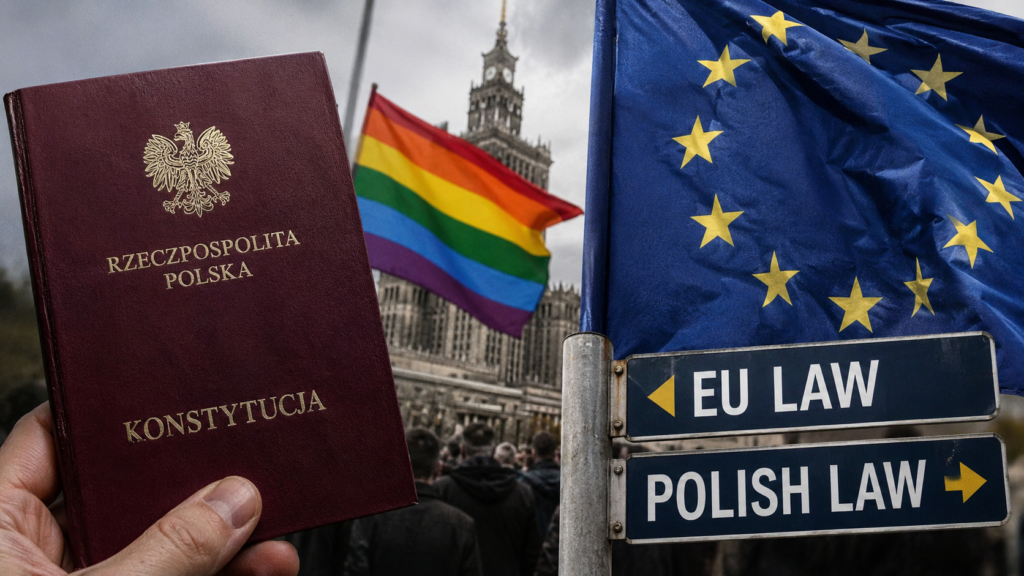
The ECJ’s ruling last year centred around two Polish men who married in 2018 in Berlin, where gay marriage is permitted. But when they returned to Poland and requested that their certificate be registered there, they were refused because it would contradict the nation’s existing laws. The court ruled that “such a refusal is contrary to EU law” and “infringes not only the freedom to move and reside, but also the fundamental right to respect for private and family life”.
Unsurprisingly, this interference from Brussels into a member state’s affairs received pushback at the time. A Law and Justice Party MP in Poland called the decision “a blatant violation of the principle of conferred competences and a perverse, but all the more scandalous, interference in the sovereign competences of member states in the area of family law and civil status acts”.
Zbigniew Ziobro, former Justice Minister, also publicly responded to the ECJ’s ruling with the following statement:
“The left is plundering our European Union for us! The ECJ, the most politicised quasi-court in Europe, whose judges are directly appointed by governments, once again wants to amend the EU treaties. In defiance of international agreements, in defiance of the Polish constitution and the will of the nation, they want to introduce same-sex marriages into Poland.
“I have always warned that the ECJ has as much to do with the rule of law as Tusk does with the truth, and Giertych with honesty. For the task of the Court is not to ensure compliance with EU law, but to completely subordinate the countries of the Union to the leftist agenda. And everything that stands in the way of achieving this goal, the ECJ deems incompatible with EU law.”
Celebrating the landmark case last week in Warsaw, the southwestern city of Wrocław quickly followed suit. Last Thursday, the original couple’s marriage was entered into Poland’s civil registry in Warsaw, with the second happening on Friday. Alina Szeptycka, the Plenipotentiary of the Mayor of Wrocław for Equal Treatment, welcomed the decision, calling it a “long-awaited change“. She emphasised that the recognition of gay marriages concluded abroad is consistent with European court rulings and the result of years of advocacy.
“We owe this primarily to the brave couples who took legal action, their lawyers, and the organisations and individuals who have been involved in advocating for LGBT+ rights and human rights for many years”, Szeptycka said. “Love is love! and besides, it’s about dignity, safety, and human rights” she added.
The lawyer of the Berlin couple, Artur Kula, described the ruling as a turning point. “We are very happy. This is very important. Our clients have won” he told TVP World. “Change has arrived. Today there is the first transcription, but more will follow”. Kula added that his law firm, which specialises in LGBT+ rights, is already working with numerous couples seeking to register foreign marriage certificates in Poland and predicted that the number of such transcriptions will “quickly become very noticeable.”
The registration of a gay marriage certificate is but a symptom of decades of European legal, judicial, and administrative creeping change. As such, what’s more important here is not whether someone supports or opposes gay marriage, but instead how the EU is overpowering the sovereignty and legal independence of its member states. So, how did we get here?
Arguably, the Treaty of Rome is where it all started in 1957. Linking free movement primarily to economic purposes involving services, capital, and workers, inevitably meant that family law would follow. In 1964, the Costa v Enel judgement established the primacy and power of European law in areas of transferred competence. That specific case, at the time, only seemed to concern the common market. However, in hindsight, it looks to have laid the constitutional foundation for broader future development, with some labelling that judgement over 60 years ago having “pulled the plug on national sovereignty.”
Another important milestone was the 1999 Treaty of Amsterdam. With its entry into force came the empowerment of the EU to “combat discrimination” on age, race, disability, sexual orientation, and religion. Essentially, it meant that matters once considered questions of national or constitutional matters became part of a supranational framework against discrimination. The Charter of Fundamental Rights followed soon after, bolstered by the Nice Treaty signed in 2001, and finally by the Treaty of Lisbon entered into force in 2009, effectively giving the original Charter binding legal value.
That sequence of bureaucracy changed how European integration works. Originally, countries derived legitimacy through electoral majorities operating within constitutional borders. But these introductions meant the EU could instead derive legitimacy not through elections, but by rights-based interpretation enforced by its many layers including the European Commission, the ECJ, and others.
Despite the ECJ, the Council of Europe and the European Court of Human Rights (ECHR) operating independently from each other and the EU itself, they increasingly reinforced one another’s decisions. The Council and ECHR, based in Strasbourg, expanded human rights standards through interpretation of the European Convention on Human Rights, while the ECJ, based in Luxembourg, integrated these non-discrimination principles and free movement into EU law.
In 2004, when countries such as Poland, Malta and Hungary joined the EU, they accepted participation in a dynamic legal order shaped by EU law primacy, the Charter of Fundamental Rights, and to enter the jurisdiction of the ECJ – not just standard economic integration with the Union.
The ECJ does not proceed through dramatic constitutional revolutions, but instead by incremental, case-by-case developments. For example, the Metock judgement bolstered residence rights in order to reunify families, and the Maruko judgement meant same-sex relationships must receive equal treatment reasoning. And in this specific gay marriage debate, a key case was Coman and Hamilton, in which the court ruled that Romania must recognise a same-sex spouse legally married abroad in order to respect EU free movement rights. It didn’t impose that the country must itself legalise gay marriage, but established that the circulation of rights in the Union prevailed over the nation’s own laws.
Whether or not someone agrees with the ideology being reinforced, it’s the operational sophistication and careful coordination that is concerning. In the past couple of decades, progressive legal activism has heavily invested in legal scholarship, NGO coordination, academic policy interaction, judicial training and strategic litigation. And slowly, conservative movements or those defending sovereignty have found that democratic politics are now almost useless. Electoral victories alone are insufficient if they are disconnected from long-term legal and administrative strategy introduced by the Union of which they are members.
A political movement seeking durable influence inside the EU needs to think across decades, not in single election cycles. European politics are decided now in courts, administrative agencies, commission working groups, academic faculties and legal doctrine, not by elected officials.
What this gay marriage ruling in Poland reveals is exactly how power now works within Europe. A member state can still decide its domestic language, constitutional formulas and political rhetoric, but if EU law and European courts don’t agree, those national positions lose almost all value. Poland’s law still says same-sex marriage is illegal, but its authorities are being made to act as though the opposite is true. As such, we now see a clear demonstration of who really gets the final word.
The Expose Urgently Needs Your Help…
Can you please help to keep the lights on with The Expose’s honest, reliable, powerful and truthful journalism?
Your Government & Big Tech organisations
try to silence & shut down The Expose.
So we need your help to ensure
we can continue to bring you the
facts the mainstream refuses to.
The government does not fund us
to publish lies and propaganda on their
behalf like the Mainstream Media.
Instead, we rely solely on your support. So
please support us in our efforts to bring
you honest, reliable, investigative journalism
today. It’s secure, quick and easy.
Please choose your preferred method below to show your support.

Categories: World News
So-called marriage is a legal contract between legal identity, like a business contract between any number of parties. Therefore its only a legal construct and can never be considered a human marriage.
So, does this mean anything?
Hi Staurt-James ,,,
Yes it Does something.
To explain it would be a bunch of words that Technically A Marriage Contract Lets the spouse of the other spouse have access to visiting the other spouse in a hospital room..
Why a marriage contract I don’t know in a few words But I do know why in Lots of words , : Meaning It’s Legalize Latin Word Jargon put together like a puzzle to give government power and control over the public..
The Human Marriage is a Slippery Slope also because it brings God into the Equation and Today’s Society wants to Squash The Real Not Loose Your Soul God…
Majority if contracts and other such legalize are full of Latin words that the average person has zero clue / concept that the true definition is actually harmful..
Example: The word Freedom actually means in Latin Slave / Slavery…
Free-To-Be-Dumb , Free-Dum , Get it ?
There was a very good website that covered all this But it’s scrubbed / gone / removed permanently off the internet….
These Laws get pushed into law by people who are pawns and some realize and some don’t know what damage it causes….
I’m sorry but I Must mention That The earth is the Devil’s Playground,,
And when you truly understand what that actually means , And I seriously mean exactly what it means ,
There’s a Devil calendar and it gets followed by those who Follow the devil…
Now add in Astrology like in the above article ,,
It mentioned 1959 Treaty of Rome..
1959 Regular normal and Chinese astrology is nothing to do with the devil’s calendar….
The Devil’s Calendar for those who don’t know : Is marked days during months that certain rituals happen such as a kidnapping / kidnap , sacrifice , age limit or range of sacrifice , and so on ,,
The year 1959 , Chinese astrology rooster year converts to Sagittarius ,
1964 , Converts to Cancer , 1999 Converts to Gemini ,, majority of the bad contracts come in years of water signs and fire signs , cause the water signs and fire signs are feelers ,, earth and air are thinkers signs…
My Grandfather was a high ranking freemason, I saw his paper / certificate That He Signed To Lucifer The Devil to become a High Ranking 33rd degree FreeMason..
It’s a messed up world And They are Setting The Stage ( world / earth ) To Bring The Anti-Christ….
Hi ,, My bad I was in hurry 1959 converts To Aquarius..
The easiest and Best way to remember correct conversion is :
Chinese Boar Equals Aries the Ram
Aries ram us first in American Astrology.
Me I’m born in 1966 Tear if Horse Converts to Virgo ,
1970 ,1982 , 1994 , years of the Dog
Converts to Capricorn..
You can look it up..
Astrology is ok cause The three wise men used Astrology to find baby Jesus when He / baby Jesus was born by following the star pattern in the sky…
It’s the other stuff ya can’t touch..
There is nothing wrong with legal contracts, the problem is the documents of identification that are the property of the author and publisher and not the man or woman that may benefit. Technically the entire scheme is meaningless unless the author or publisher disclose their legal position.
Marriage is a gamble game.
If some idiots think they have rights for same sex Marriage, just go ahead. These idiots doesn’t need descendants.
However, when they “play victim” saying they are been oppressed is the time bomb they’re playing with.
Worse, asking for same treatment and equal rights with everything from everyone.
These idiots won’t stop just with legal contract of same sex Marriage because they feels entitled for everything using ‘karen mentality’ to justify everything.
This is because there are HIDDEN HANDS behind the curtain orchatrasted all of this for selfish gain.
Normal marriage are protected because creating a family, a new generation to replaced ageing population to continue the legacy.
Gay marriage will adopt a innocent orphanage children and poison their minds with gay ideology. These orphanage will be the next abornation generation to continue gay ideology.
Unlike normal marriage always keep every sex life private, Gay marriage will interfere with a normal marriage. These idiots love to show off in everything including sexuality preferences.
Gay people love to messed up every single children minds to make these children be JUST LIKE THEM and having sex with children is okay.
This is a very sick minds of gay marriage.