





In the following, Joakim Book explains how taxes in Norway claim half of middle-class pay cheques, leaving households with subpar public services and less disposable income.
The claim that taxing the rich will fund the welfare state is false. Nordic welfare states are financed not by billionaires but by ordinary workers. The “free” benefits are bought with invasive and regressive consumption taxes, payroll taxes and income taxes on ordinary workers, he writes.
Let’s not lose touch…Your Government and Big Tech are actively trying to censor the information reported by The Exposé to serve their own needs. Subscribe to our emails now to make sure you receive the latest uncensored news in your inbox…
‘Free Stuff’ in Norway Still Costs Half of Average Pay
By Joakim Book, as published by the Daily Economy on 27 July 2026
Every few years, Americans rediscover Scandinavia.
Someone visits Norway or Denmark, returns dazzled and envious of parental leave and universal childcare and asks why America refuses to copy what obviously works. On the day dedicated to celebrating America, Nicholas Kristof, a Pulitzer Prize-winning journalist, wrote for The New York Times that America is so great that, in fact, it should be more like Norway. If American companies can pay high wages and generous benefits to workers there, Kristof observed, they could do so in New York, too.
If only America were willing to embrace a little more social democracy and bigger government, this popular and recurring story goes, perhaps it could enjoy the same prosperity and flourishing that Norway does – and have its population also routinely rank among the happiest on the planet.
I was born and raised in one Nordic country, have worked in another and for the last six years have lived in a third, so I’m fairly familiar with our way of life. I’ve also spent much time in America, stunned and enamoured of the way things are in the vast, diverse and unruly union of states. Europeans are simultaneously fascinated and bewildered by America.
Plenty of things are amazing about these United States, and quite a few things awful about the Nordics; I suspect American intellectuals, dreaming about Norway without understanding its nature and trade-offs, overlook both.
“You Want Security, Health Care and the American Dream? Look to Scandinavia”
Norwegian workers certainly have higher wages than those in many European countries, including those of its fellow Scandinavians. Hotel cleaners, retail clerks and construction workers often earn salaries that surprise visiting Americans. Thanks to Baumol’s cost disease, decades of well-managed petroleum wealth have pushed up industrial and service wages.
The first thing an American professional moving to Norway would notice isn’t the generous parental leave, but the great loss of disposable income and material well-being. Norwegian households average 30 percent less disposable income than those the US, and the cost of everyday items is much higher.
The Scandinavian bargain might look like free services, but it as trade-off: more public goods, fewer private goods.
When American politicians or intellectuals promise Nordic welfare states, most people imagine this happening automatically or by taxing the rich and everybody benefits. That’s not the case. The real Nordic model taxes earners more (45 per cent in Denmark, 40 in Norway, 41 in Sweden, compared to 25 per cent in the United States) and charging flat value added tax (“VAT”). Broad welfare states require broad tax bases; Nordic welfare states are financed not by billionaires but by ordinary workers. The “free” benefits are bought with invasive and regressive consumption taxes (up to 25 percent), payroll taxes and income taxes that reach well and that begin after just $10,000 (the first $16,000 is tax free in the US).
An American professional, pocketing the median earnings of about $65,000, would pay over $17,000 in Norwegian income taxes (compared to about $5,000 per the IRS calculator, naturally subject to state taxes and various deductions), with the employer forced to chip in another $9,200 for the privilege of merely hiring him/her. From what’s left over, he/she faces a high cost of living and sales taxes between 11 per cent and 25 per cent.
Were she/he in Sweden, a much poorer country with wages well below Norway’s, our middle-of-the-road American professional would land himself/herself in the top 20 per cent of earners – though not yet triggering the top 53 per cent (or 64 per cent) marginal tax rates.
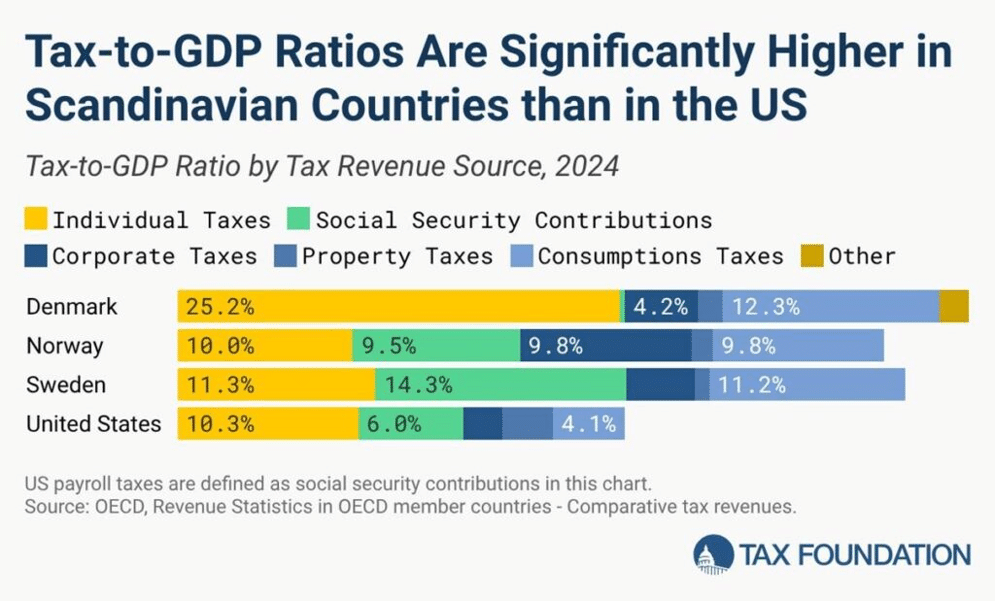
For the Tax Foundation, Cristina Enach summarised, “In 2024, Denmark’s tax-to-GDP ratio was 45.2 per cent, Norway’s was 40.2 per cent, and Sweden’s was 41.4 per cent. This compares to a ratio of 25.6 per cent in the United States.”
Some of that difference is accounted for by healthcare spending (private, not government) and pension contributions (401(k) or other retirement accounts) and other personalised options. The Nordics give you one option: the state.
In return, yes, our hypothetical expat would receive subsidised childcare, education, paid time off and health care. Those services would be of dubious quality, with waiting times stretching into months even for life-threatening conditions. For some, that’s a trade worth making, but it’s not obviously superior, as economist Noah Smith concluded in his comparison a few months ago.
Inequality is indeed lower in Norway, where a person in the top 10 per cent earns just three times as much as a person in the bottom 10 per cent. That means there’s less reason to strive, less room to grow. Looking to the future, investments in growth, employment and AI-fuelled opportunities are farmore attractive stateside than in stagnating Scandinavia. Suppressing growth at the top has suppressed everyone’s potential.
The Norwegian Story Isn’t the Nordic Story
The gap between the average person’s wellbeing in America and that of almost all European countries has widened dramatically over the past three decades. In income per capita, the United States has steadily pulled away from Europe over the last thirty years. The United States’ average income now exceeds every EU member except Luxembourg and Ireland. Citizens of fourteen EU nations earn less on average than residents of even the poorest state: Mississippi, and the EU as a whole ranks between Oklahoma and Maine.
Joseph Sternberg’s opinion piece in the Wall Street Journal earlier this year is illustrative: both Americans and Europeans are shocked when they learn how much materially better off America is. “Politically, bliss is ignorance,” concluded Sternberg. “European welfare states, by creating relatively comfortable lives for voters, conceal the full extent of Europe’s prosperity gap.”
Norway is an affluent country by European standards, but only average compared to America as a whole. Rough figures indicate that Americans, on average, enjoy material economic abundance on par with Iceland and Norway,but are 20 per cent to 60 per cent better off than the other Nordics. (The difference between the economic outliers and the other Nordics is the difference between New York State and Michigan.) While there are nuances in life, politics and economics between the five Nordic countries, it’s not like the tax rates, labour economics, public schooling, the overall welfare state or the generosity of parental leave are that different.
It’s no accident that Kristof reported from Norway; had he run this comparison with Sweden or Finland, the economic outcome would have been so unacceptably low that few Americans would be persuaded by the promise. People in the Norwegian and Icelandic success stories are significantly richer than the other Nordics. Even adjusting for purchasing-power-parity numbers via the University of Groningen-Penn World Table data for 2023, Americans are still a comfortable 15-20 per cent richer than most Scandinavians.
It’s Impossible Anyway, So Why Are We Dreaming?
The most immediate sticking point to inflated dreams about the Nordics is that nobody has figured out a way to effectively translate and recreate social and economic institutions elsewhere. To say nothing about a population’s values, behaviours and traditions.
Institutions emerge from particular and path-dependent histories. They’re not IKEA furniture to merely ship across an ocean and assemble at home. Academic or political observers often make the mistake of thinking you can just isolate a few desirable behaviours or economic institutions, retrofit them onto America, and effortlessly create better lives here.
Plus, America has long tolerated – indeed celebrated – a remarkable degree of eccentricity and ambition. Americans start improbable companies in garages and they love their “weirdos.” When they do things, they (over)do them properly – SpaceX. College football. Time Square. Las Vegas. Whatever you’re interested in or passionate about, some all-American oddball has built a community for that. It’s a nation of inventors and obsessive animal lovers. They build Burning Man in the desert and whole cities at sea. Their wide-open spaces connect a web of places-as peoples-as-philosophies: Hollywood, elite universities, Silicon Valley and Broadway, Nashville and Detroit, Amish meeting houses and evangelical megachurches, Hindu temples and Highland games from coast to coast. Our great hybrid culture thrives on liberty, not just lower taxes. Our cultural inheritance is the result of having astonishingly many different attempts thrown at the American wall to see what sticks.
The Nordics don’t have that. With the recent exception of fintech and startup wonders (riding on an early, high-tech boom from the ‘90s), trying new, eccentric things in those cold lands isn’t exactly welcome. The Scandinavian idea of Jantelagen, the expectation that nobody should think themselves special, results in a lack of opportunities and a disregard for novelty that most Americans see as both rude and discouraging.
The political equilibrium keeping Scandinavia afloat was, until recently, a mostly homogenous population on sparsely populated lands eerily willing to subjugate individual preferences and quirks to common, collective rules. America stands out in the exact opposite way: letting 15 times as many people pursue radically different lifestyles and individual ambitions with cheerful respect, but little regard for whether the neighbours approve.
Even if it were possible to transplant Norwegian economic and political institutions onto America, how can we be confident we won’t have a Swedish-level economic debacle instead of the wealthy, comfortable Norway a social reformer might dream of?
We can admire and learn from Scandinavian countries using the “Nordic Model,” which have achieved robust social programmes without sacrificing too much in the way of economic prosperity. That balance is fragile, and might not work forever: immigration troubles, stagnating growth and an overbearing regulatory state are exposing the cracks.
Scandinavia has built wildly successful societies for a few million very similar-minded people. But the United States has built something more impressive: a vast, messy republic of economic and social flourishing where hundreds of millions of people peacefully pursue wildly different visions of a good life.
Becoming more like Norway means becoming less American, with less of the opportunity, ingenuity and the entrepreneurship that made America great.
About the Author
Joakim Book is a writer, researcher and editor on all things money, finance and financial history. He’s the managing editor for Bitcoin Magazine Print; he holds a master’s degree from the University of Oxford and was a visiting scholar at the American Institute for Economic Research in 2018-19 and 2022.
He regularly writes for HumanProgress.org, Mises.org, and the Sound Money Defense League, and was the editor for Lyn Alden’s Broken Money as well as Nik Bhatia’s The Bitcoin Age.
The Expose Urgently Needs Your Help…
Can you please help to keep the lights on with The Expose’s honest, reliable, powerful and truthful journalism?
Your Government & Big Tech organisations
try to silence & shut down The Expose.
So we need your help to ensure
we can continue to bring you the
facts the mainstream refuses to.
The government does not fund us
to publish lies and propaganda on their
behalf like the Mainstream Media.
Instead, we rely solely on your support. So
please support us in our efforts to bring
you honest, reliable, investigative journalism
today. It’s secure, quick and easy.
Please choose your preferred method below to show your support.

Categories: Breaking News, Latest News, World News
Well referenced and well-written article which addresses the economic differences between the old world and the new. If only it was as easy to measure well-being as it is to count dollars.
I live in Norway, and I can say that this country is NOT “the land of milk and honey” that ‘everybody’ seems to think. We pay out our EARS in taxes and a million different fees, prices are high, and we do not have much left of our salary after the state has taken it’s share.
Also there are so many public regulations that it stifles creativity.
I am thinking of moving from this so called “paradise” to a country where the state does not interfere so much.
[…] https://expose-news.com/2026/07/27/socialism-failure/ […]