





Earlier this month, the UK’s Medicines and Healthcare products Regulatory Agency (“MHRA”) authorised the use of Kostaive (Zapomeran). This marks the first self-amplifying RNA (“saRNA”) vaccine to be approved in the UK.
In the same week, a new chickenpox-MMR combination vaccine, MMRV, was added to the routine childhood vaccine schedule, replacing the standard MMR vaccine.
This prompted Nick Hunt to write to the MHRA’s new CEO, Lawrence Tallon, begins role as new MHRA CEO “to make sure that [he is] aware of evidenced failings in MHRA’s safety management of the Covid vaccines and medicines in general.”
Related: UK’s approval of self-amplifying vaccines is a catastrophic “mistake”
Let’s not lose touch…Your Government and Big Tech are actively trying to censor the information reported by The Exposé to serve their own needs. Subscribe to our emails now to make sure you receive the latest uncensored news in your inbox…
Self-Amplifying mRNA Vaccines Coming Soon
By Health ethics Advocacy and Research Team (“HART”), 12 January 2026
On 2 January, the MHRA approved the first self-amplifying mRNA vaccine. If you thought the Pfizer and Moderna mRNA ‘vaccines’ were bad, this version of the new technology goes a whole step further … more to follow.
In the same week, a new chickenpox vaccine was added to the MMR, as MMRV, and recommended as part of the children’s routine vaccine schedule.
These two new products in quick succession and with the usual paucity of proper safety data, led Nick Hunt, spokesman for the Perseus group, to write to the new CEO of the MHRA. Nick’s letter is published in full below.
For the attention of Mr Tallon, CEO MHRA cc to Dr Hughes, Patient Safety Commissioner
Dear Mr. Tallon,
I wrote to your predecessor and your Chief Safety Officer several times in 2021/2022 (without the courtesy of any replies) about concerns about MHRA’s authorisation of Covid vaccines and its regulation of medicine safety in general. Subsequently, the Perseus Group, comprising medics and experts in safety management, submitted two Written Statements to the Covid Inquiry Module 4 (under a Rule 9 request). As a Core Participant, MHRA will have seen that evidence which I summarise in bullet point form below.
In recent weeks, MHRA has authorised a chickenpox vaccine and yet another new Covid vaccine. This has prompted me to write to you, as the new CEO, to make sure that you are aware of evidenced failings in MHRA’s safety management of the Covid vaccines and medicines in general.
Concerns about MHRA’s authorisation of the Covid vaccines:
- Clinical trials were far shorter than normal with little or no testing of pharmacology, pharmacokinetics, biodistribution, carcinogenicity or pharmacodynamics; severely limiting safety data.
- MHRA accepted without scrutiny manufacturers’ assessments of known problematical ingredients like ALC-0159, ALC-0315, PEG.
- MHRA failed to probe manufacturers’ claims of supposed unrelated deaths or adverse events in the trials, where deaths were higher in vaccine arms.
- MHRA had no trial evidence for the safety or effectiveness of the products (Pfizer, Moderna, AZ) actually authorised and rolled out (Process 1 vs Process 2).
- MHRA batch testing did not measure RNA integrity or DNA contamination or batch-to-batch variability relative to Yellow Card reports.
- Non-compliance with GMP (MHRA allowed “finishing” in unlicensed vaccination centres).
- No account taken of Number Needed to Vaccinate by age, ignoring low/negligible risk in younger groups and lack of transmission data.
- No assessment of population-level signals like excess deaths or ambulance calls.
- Failure to notify other Regulators (e.g., the Civil Aviation Authority) when Covid vaccine PASS reports highlighted increased incidence of serious heart conditions among the Covid vaccinated and hence increased risk of sudden incapacitation of operators.
Concerns about MHRA’s regulation of medicines in general:
• Lack of a documented Safety Management System (or any of the constituent parts) – standard in other safety-critical sectors.
• MHRA measures safety relatively, whereas ALL other safety-critical sectors do so in absolute terms against pre-determined threshold levels of risk tolerability:
- Authorisation is based on “benefit outweighs risk” (a relative assessment) when all other safety-critical sectors approve products based on absolute assessment of safety risk.
- Pharmacovigilance is based on disproportionality analysis for safety signals: harms relative to other similar drugs. This misses absolute risks and bakes undetected issues into baselines.
• No process for investigation/follow-up of Yellow Card reports, even just the serious/fatal ones; and passive acceptance of missing data like age, batch, temporal association; and no recording of probability of causation.
• Passively waiting for Coroner Regulation 28 reports, inquests, post-mortems or VDPS data.
• Reliance on quality audits (process-focussed) of pharmacovigilance instead of independent safety audits (risk-focussed) (as in ALL other safety-critical sectors).
• Organisational overlap: MHRA tries to be both a) the safety manager for the NHS which buys and dispenses medicines and b) the Regulator. Other sectors separate these roles.
• No processes for delegations of responsibility for Authorisation or escalation of safety decisions.
You will also wish to know about inaccuracies in oral evidence at the Covid Inquiry in January 2025 by and about the MHRA:
- Dame June Raine’s inaccurate claims about the similarity of pre- and post-authorisation manufacturing processes (Process 1 vs Process 2).
- She incorrectly assured the Inquiry that MHRA was not sitting on post-authorisation trial data when it was, at the time, withholding publication of Pfizer PASS Interim Report 5.
- Professor Sir Munir Pirmohamed, chair of the CHM, incorrectly assured the Inquiry that MHRA follows up all fatal Yellow Card reports and Coroners Regulation 28 reports.
I am copying this to the UK Patient Safety Commissioner. I look forward to your reply.
Mr N Hunt, https://perseus.org.uk
About Nick Hunt
Nick Hunt is a retired senior civil servant who worked in weapons safety regulation within the UK Ministry of Defence. He is a co-author of the Perseus Group report, a multi-disciplinary critique of the UK’s Medicines and Healthcare products Regulatory Agency (“MHRA”), published in April 2023. The report highlights serious failings in the MHRA’s handling of safety and efficacy data during the covid pandemic.
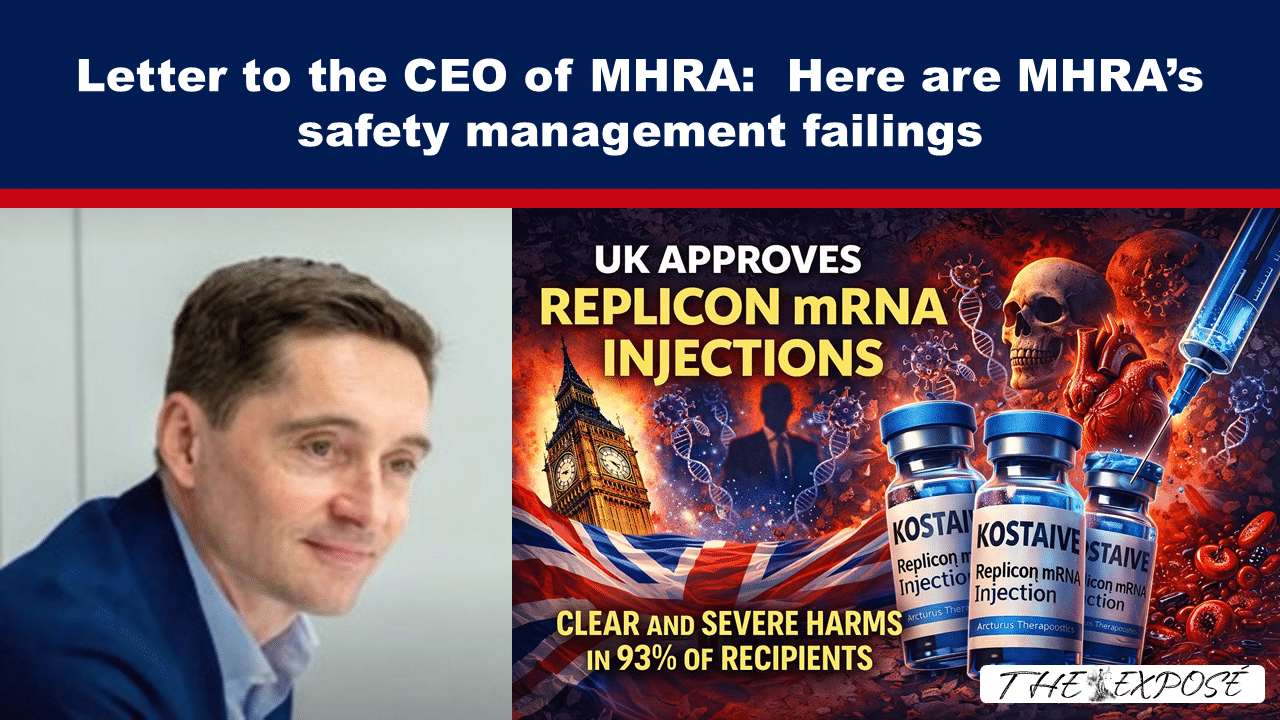
Featured image: Lawrence Tallon (left). Image on the right taken from ‘UK Approves Experimental Self-Amplifying mRNA (Replicon) Injection – Kostaive by Arcturus Therapeutics’, Focal Points, 4 January 2026
The Expose Urgently Needs Your Help…
Can you please help to keep the lights on with The Expose’s honest, reliable, powerful and truthful journalism?
Your Government & Big Tech organisations
try to silence & shut down The Expose.
So we need your help to ensure
we can continue to bring you the
facts the mainstream refuses to.
The government does not fund us
to publish lies and propaganda on their
behalf like the Mainstream Media.
Instead, we rely solely on your support. So
please support us in our efforts to bring
you honest, reliable, investigative journalism
today. It’s secure, quick and easy.
Please choose your preferred method below to show your support.

Categories: Breaking News, UK News
This is just more proof why the Greek word “pharmakeia”, from which the English word “pharmacy” is derived, is translated “sorcery” in the book of Revelation:
Pure From The Blood Of All Men | Sum Of Thy Word
Brilliant. I would like to see his face when he opens that….I want them all on trial for mass murder.
If I was one of these people pushing this eugenics program I would be sniffing the winds and trying to back away and distance myself if possible. Once their deadly game is finally over primarily thanks to President Trump and the few honest politicians like Andrew Bridgen their own citizenry are going to be coming for the perpetrators with blood in their eye as they justly deserve. I truly hope that in the end even though we as in the past we won’t get them all or perhaps even the worst of them it will haunt the rest wondering for the rest of their existence that someone is waiting for them around the next corner.