





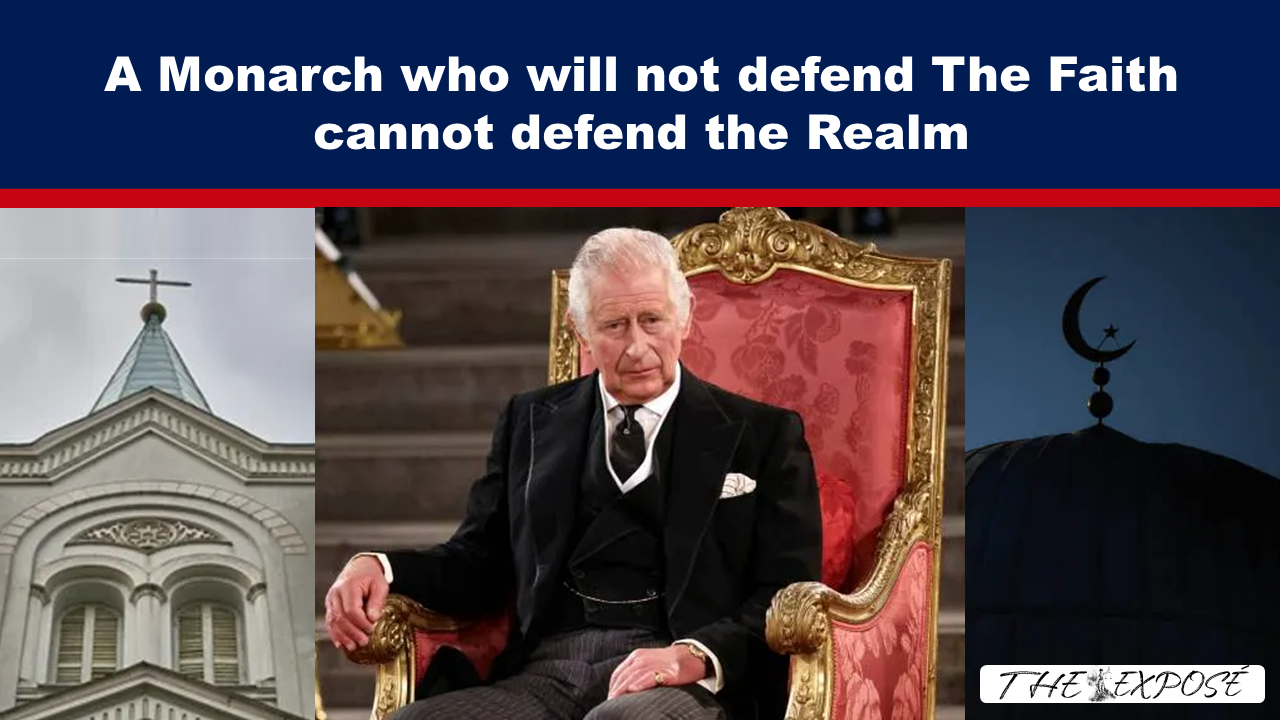
King Charles III’s engagement with Islam raises questions about his role as a Christian monarch and Supreme Governor of the Church of England. He has drifted from being a Christian monarch to a religious pluralist.
“The tragedy is not that King Charles respects Islam. The tragedy is that he appears increasingly unsure whether Christianity is true. And a Christian kingship without conviction is not progress – it is abdication,” Bishop Ceirion Dewar writes.
Let’s not lose touch…Your Government and Big Tech are actively trying to censor the information reported by The Exposé to serve their own needs. Subscribe to our emails now to make sure you receive the latest uncensored news in your inbox…
King Charles III, Islam, and the Unravelling of Christian Kingship
By Bishop Ceirion H. Dewar, 20 January 2026
The most serious constitutional shifts rarely announce themselves with fanfare. They emerge instead through tone, emphasis and the gradual re-ordering of loyalties – noticed first by those who understand what an office is for, and only later by the wider public. That is where we now find ourselves in relation to King Charles III: not confronting a single speech or gesture in isolation, but recognising a sustained pattern of theological softening that sits uneasily – indeed incompatibly – with the historic vocation of a Christian monarch and Supreme Governor of the Church of England.
This is not a question of personal manners, nor of racial or religious hostility. It is a question of office. Charles is not merely a private citizen with eclectic spiritual interests; he is the Supreme Governor of the Church of England – a role forged in blood, reformation, covenant and national history. What happens, then, when the man who embodies that role increasingly speaks as though Christianity is merely one voice among many, rather than the spiritual grammar of the realm he governs?
The recent interview with Lauren The Insider that has prompted renewed discussion – particularly the reflections offered by former royal chaplain Dr. Gavin Ashenden -did not create this concern. It merely named it. What many have sensed for years has now crystallised into a recognisable unease: Has the King drifted from being a Christian monarch to becoming a religious pluralist wearing Christian vestments?
A Journey That Did Not Begin Yesterday
To understand where we are, we must first understand how we arrived here.
Charles’s engagement with Islam did not begin with his accession to the throne. It stretches back decades, to his time as Prince of Wales, when he cultivated a reputation as an intellectual heir rather than a conventional royal. Unlike his mother, Queen Elizabeth II – whose faith was quiet, stable and unambiguous – Charles has always been a seeker. Ideas fascinated him. Traditions intrigued him. Systems of meaning drew him in.
In the late twentieth century, as Britain wrestled with post-imperial identity and increasing religious diversity, Charles began to speak publicly about Islam in unusually warm and admiring terms. He praised Islamic civilisation for preserving classical learning. He spoke glowingly of Islamic architecture, metaphysics and its vision of harmony between humanity and nature. In 1993, in a speech at Oxford, he lamented Western ignorance of Islam and suggested that Christianity had something to learn from Islamic spirituality.
At the time, these remarks were often defended as cultural diplomacy. Britain’s Muslim population was growing; tensions were real; bridges were needed. And to a point, this was true. Courtesy between faiths is not betrayal. Respect is not apostasy.
But over time, the tone shifted.
What began as appreciation hardened into preference. What began as dialogue shaded into theological relativism. Christianity was no longer presented as the lens through which Charles viewed the world, but as one tradition among several that had shaped his thinking.
From “Defender of the Faith” to “Defender of Faiths”
Perhaps the most revealing moment in this journey came when Charles mused publicly about altering the monarch’s ancient title. For centuries, English sovereigns have borne the designation “Defender of the Faith” – originally conferred by the Pope, later reclaimed in Protestant form. It is not merely an honorific; it is a declaration of responsibility.
Charles suggested instead that he might prefer to be known as “Defender of Faith” – or even “Defender of Faiths.”
The difference may appear subtle, but the theological implications are seismic.
“Defender of the Faith” assumes truth with content – Christian truth, expressed through creeds, sacraments and Scripture. “Defender of Faiths” assumes that all religions are functionally equivalent expressions of a shared spiritual impulse.
One vision presupposes revelation. The other presupposes relativism.
A Christian king may protect the right of others to worship freely; he may not dissolve his own confession into a multifaith abstraction without emptying his office of meaning. The Crown is not a chaplaincy to the world; it is a covenant with a particular people, formed by a particular history, baptised into a particular faith.
The Office Matters More Than the Man
This is where defenders of Charles often falter. They point to his sincerity, his learning, his good intentions. And none of these are in doubt. But kingship – especially Christian kingship – has never been about personal spirituality alone.
The monarch does not merely have beliefs; he represents belief. He stands as a living symbol of continuity between past, present and future. His coronation is not a personal milestone; it is a sacramental moment in the life of the nation.
At his coronation, Charles swore oaths that bound him to uphold the Protestant faith as established by law. He was anointed, prayed over and entrusted with a vocation shaped by Christian theology. And yet, outside the Abbey, his public language increasingly suggests that Christianity is simply one wisdom tradition among many.
This tension cannot be sustained indefinitely.
A monarch who speaks as a pluralist but reigns as a Christian creates confusion – not only among Christians, but among all citizens. Symbols lose coherence. Offices lose authority. Ritual becomes theatre rather than truth.
Islam as Theology, Not Just Culture
What intensifies concern is that Charles’s engagement with Islam is not merely sociological or diplomatic; it is spiritual. He has spoken admiringly of Islamic metaphysics, of its emphasis on divine unity, of its integrated vision of faith and daily life. He has suggested that Christianity, fragmented by modernity, might recover something by listening to Islam.
But here lies the heart of the problem.
Islam does not merely offer an alternative cultural expression of theism; it offers a rival theological claim. It explicitly denies the central truths of Christianity: the Incarnation, the Crucifixion, the Trinity. To “learn” from Islam in a way that relativises these truths is not enrichment – it is erosion.
A Christian king may respect Muslims without borrowing their theology. He may defend their civil rights without adopting their metaphysics. Once those boundaries blur, Christianity ceases to be the foundation of the realm and becomes merely one participant in a spiritual marketplace.
The Silence of the Church
Perhaps most damning of all is the response – or lack thereof – from the Church of England itself.
One might expect bishops, theologians and ecclesial leaders to articulate clearly the theological boundaries of Christian kingship. One might expect respectful but firm reminders of what the Crown represents and why it matters. Instead, there has been a near-total silence, punctuated only by vague affirmations of “dialogue” and “inclusion.”
This silence is not neutrality; it is abdication.
A Church uncertain of its own truth cannot correct a monarch drifting from it. A Church embarrassed by doctrine will always applaud pluralism, even when pluralism empties its own claims of substance.
The result is a feedback loop of decline: a king who relativises Christianity and a Church too timid to say otherwise.
A Kingdom Without a Centre
History teaches us that nations rarely collapse from external pressure alone. They hollow out from within – when symbols lose meaning, when offices lose definition, when leaders forget what they are for.
Britain today is not merely secular; it is post-confessional. We no longer know what we believe, only what we must not say. In such a moment, the monarchy could have served as a stabilising force – a visible reminder that this nation was shaped by Christian truth, even as it accommodates diversity. Instead, the Crown appears increasingly aligned with the very forces that dissolve that memory.
This is not about Islam per se. It is about direction. A king who cannot speak with clarity about his own faith cannot anchor a nation drifting into moral and spiritual incoherence.
What Is at Stake
The question before us is not whether King Charles is kind, intelligent or sincere. The question is whether he understands – or is willing to inhabit – the full weight of Christian kingship.
If the monarch becomes merely a facilitator of spiritual pluralism, then the Church of England becomes merely another non-governmental organisation (“NGO”) with vestments. If Christianity is no longer privileged in the life of the realm, then its displacement will not come through persecution, but through polite irrelevance.
And history will not record this as an act of tolerance, but as a failure of nerve.
A Final Word
There was a time when kings knelt before God so that nations might stand. Today, we seem to have a king who stands above traditions so that none may claim authority.
That may win applause in academic circles and interfaith conferences. It will not sustain a civilisation.
Britain does not need a monarch who mirrors its confusion. It needs one who reminds it who it is.
The tragedy is not that King Charles respects Islam. The tragedy is that he appears increasingly unsure whether Christianity is true. And a Christian kingship without conviction is not progress – it is abdication.
About the Author
Bishop Ceirion H. Dewar is a British evangelical bishop known for his outspoken sermons. He was raised in a High Church Anglican tradition but converted to charismatic Christianity at age 15. He identifies theologically with a blend of Anglican liturgy and Pentecostal charisma. Bishop Dewar continues to advocate for a return to Christian values in British public life, conducting mass baptisms and speaking at political rallies. You can read more about Bishop Dewar HERE. He maintains an active media presence through his CDTV platform, Substack, Twitter (now X), TikTok, Instagram and Facebook.
The Expose Urgently Needs Your Help…
Can you please help to keep the lights on with The Expose’s honest, reliable, powerful and truthful journalism?
Your Government & Big Tech organisations
try to silence & shut down The Expose.
So we need your help to ensure
we can continue to bring you the
facts the mainstream refuses to.
The government does not fund us
to publish lies and propaganda on their
behalf like the Mainstream Media.
Instead, we rely solely on your support. So
please support us in our efforts to bring
you honest, reliable, investigative journalism
today. It’s secure, quick and easy.
Please choose your preferred method below to show your support.

Categories: Breaking News, UK News
Islam is the doctrine of hate and clearly embodies the ANTI-CHRIST.
Showing any respect or interest in this doctrine should be enough for any member of the Royal family to directly lose their Royalty.
The Holi Bible doesn’t warn us for nothing regarding the false prophet Mohammed and the Beast, which islam obviously is.
We better take that warning seriously.
Royals can’t help but be narcissists. Clever Muslim manipulators must have seen their chance to advance Islam by flattering his apparent view of himself as an intellectual. Whatever he personally believes, he has a duty to the UK to maintain the national religion and fully perform his role in it. He is paid a lot to do that. But many royals believe it isn’t pay, it’s an entitlement.
They want to have their cake and eat it, too. Enjoy the perks but not be the role model that earns them the perks. Assert their personal feelings however much they vary from the average man’s and from national tradition. (That attitude seems to run in Charles’ family, with the notable and noble exceptions of Queen Elizabeth II and Princess Anne.) They have run right over a lot of other people.
His enthusiastic support helps Muslims overrun his country, rape and murder its native people, and pillage the culture the British have created over the course of more than 1,000 years. In the US, that would be called treason. But we don’t do anything about it, either, when our own elite do it.
Globalist shill like so many in postions of power.
Yes, but he is the most powerful globalist! (Maybe even the AC???)
I am a patriotic British atheist and it both saddens and enrages me that Charles has abdicated his responsibility to the British people.
Inbreeding in Europe over the centuries created mongrel monarchs..
Also, power corrupts. Royals and their aristocratic offspring have way too much.
They should be treated like the average man is. No more “your royal highness” and “your highness”. Just “sir” and “ma’am” like the rest of us.
They are not better than we are, merely richer.
Charles, like Diana said about herself, is as ‘thick as a brick’. He loves portraying himself as the warm, caring King of his subjects. But with Islam there is no compromise. He’s cuddling up with a snake; the Devils religion,
Rhoda,
Was Elisabeth II a good monarch? Many such as Dewar won’t have a bad word said against her. But what of her legacy? She signed same sex marriage onto our statute book! Preceded by many other ungodly statutes in her own signature! Many say “she had bad advisors!” I don’t doubt that, but she wasn’t stupid-she knew exactly what she was doing-paving the way for Charles III. (Abdication would have been a better route to take than have one’s name appended to such monstrous evil).
She was initiated into Druidry in a very public ceremony (Mountain Ash 1946); why would any true Christian do such a thing? Dewar says of her faith that she was “unambiguous”, does he know what he is saying?
The monarchy is a God ordained institution, nevertheless the Old Testament Scriptures plainly teach that there were good and bad monarchs back then-same today…
Yes, I agree with you. She was aware of all the goings on of her relatives, who are Free masons ( Michael, Frederick and possibly her husband Philip) and appeared to cover up for her son, Andrew, in addition to all the above.
Yes, his father said he wanted to reincarnate as a lethal virus to kill the masses – not the exact words but the identical effect…
But Charles isn’t a monarch!
He is a corporate employee.
The last king of England was James 11 who was forced to abdicate in 1688
Be as this may, or may not be, nevertheless he is presiding as ‘king’ over “the Realm”.
It has always puzzled me why Britain sometimes chose foreign people like Dutch and Germans as their monarchs instead of pure-bred British. Surely every British monarch died with relatives somewhere in Britain, however distant. An illegitimate child of a royal or his descendants be would better than going abroad. At least English would be his native language.
It’s good that the monarchy finally got the biological message and started choosing homegrown, British spouses.
Although, what we see next may be dark-skinned spouses whose parents are of foreign origin who came to Britain to have their baby. The Muslims got to Charles too late for that, but maybe his grandson has already been targeted.
Psst! All religions are false. Religions are means for leaders to control the masses.
Are you quite sure about that? Whether you call it a “religion” or faith, (and perhaps you are making a distinction there), being a Christian involves having a leader who is surely the truest and least controlling of each person in the world, in this age, before He comes again.
Atheism is itself a belief system and is therefore itself a religion… One that puts the self in the place of God.
One thing you are missing about Charles, is that he is very much linked to the Illuminati & Klaus Schwab. One member of the Illuminati has declared, that no one may become a member unless he is a Luciferian. There are videos of Charles with the Rockefeller/Rothschild Luciferians & I would be surprised if he is not one. For those unaware, a Luciferian is just an upmarket satanist.
Chaz thinks he’s going to be at the head table in the One World Government, whose one world religion will be Islam. Sorry but you are just another useful idiot chaz…and you will be got rid of when you are past your usefulness as they will see you as a threat
What an excellent, reasonable -and concerning – article!
Wouldn’t a person with integrity (and understanding) say ‘I am sorry, I cannot fulfill that role.’ ?
How many people have refused the job when it comes with millions in pay, easy if not luxury work, guaranteed job security and retirement, etc? Oh, but you did say, “with integrity”. I don’t think those who accept the job believe that anyone ever really does the right thing only because it is the right thing. They certainly don’t; therefore nobody does, or so they want to believe.
Sadly this is so true!
Charlie was best friends with Jimmy Saville, need we need know any more?
[…] A Monarch who will not defend The Faith cannot defend the Realm […]
Off with his Head.
Alice in wonderland. He’s a pawn.
Will he obey the koran which encourages ,maybe commands all infidel to be slaughtered? He is the head of the armed forces.