





Recently, radical depopulationist and energy authoritarian Paul Ehrlich died. Shortly after, Robert L. Bradley Jr. wrote a series of articles reminding us why his death was good news, but perhaps a little too late.
Paul Ehrlich and his protégé John Holdren went to war against energy consumption. In one Ehrlich formulation, that war would require an “enormous campaign,” including efforts to persuade consumers to “live below your means,” Bradley explains.
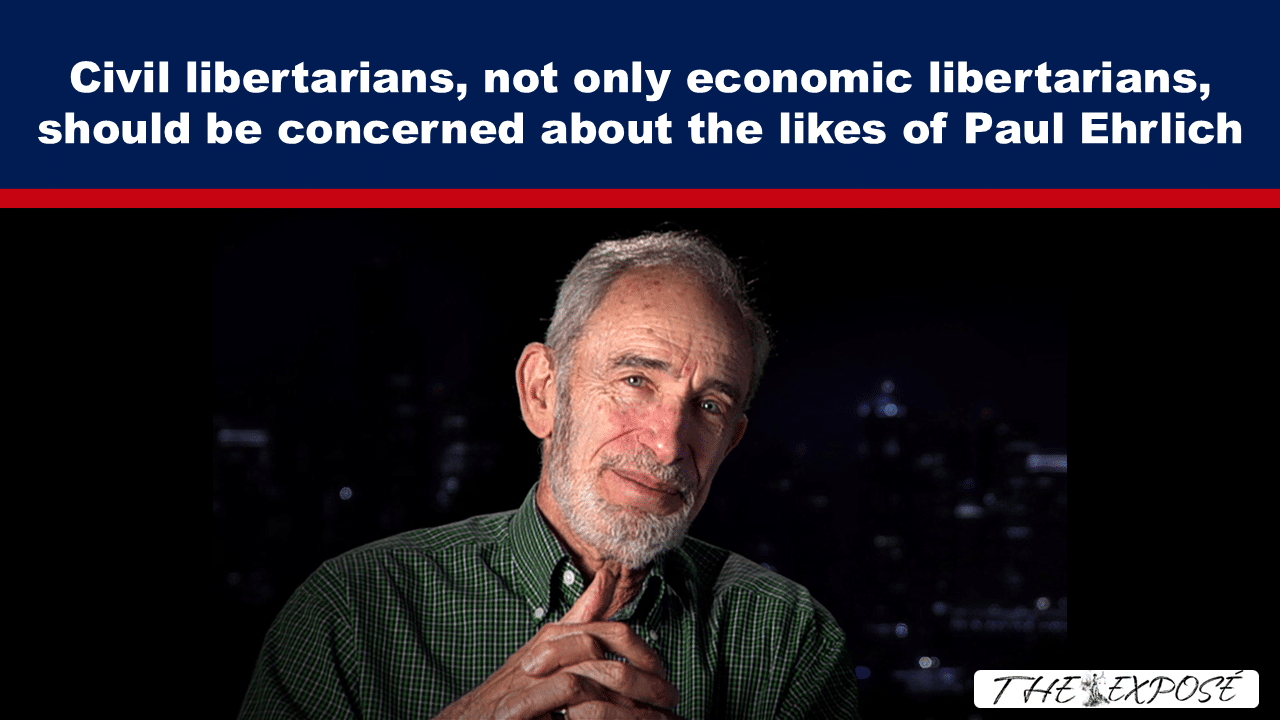
“Civil libertarians, not only economic libertarians, should be concerned about the likes of Paul Ehrlich.”
Let’s not lose touch…Your Government and Big Tech are actively trying to censor the information reported by The Exposé to serve their own needs. Subscribe to our emails now to make sure you receive the latest uncensored news in your inbox…
Ehrlich’s Energy Authoritarianism Part II
By Robert L. Bradley, Jr., as published by the Institute for Energy Research (“IER”) on 23 March 2026
Read part I of this series on the energy views of Paul Ehrlich.
Facing serious oil depletion, Paul Ehrlich and his protégé John Holdren went to war against energy consumption. In one Ehrlich formulation, that war would require an “enormous campaign,” including efforts to persuade consumers to “live below your means.” But, for their rival Julian Simon, paring one’s energy usage and living a poorer life were not only unnecessary; they wasted a truly depletable resource – a person’s time.
Transportation
Paul Ehrlich declared that smaller cars, alternative vehicles (even ones with “miserable pickup”), “slower coast-to-coast transportation” and an end to two-car families were part of “the cost of survival.” Ehrlich took on automobiles as status symbols with sarcasm:
Cars are for transportation, and proper use of the media could once again persuade American men to get their sexual kicks out of sex (not reproduction) instead of a series of automotive sexual surrogates. Restriction of families to ownership of single small cars also would put some pressure against over-producers.
His “auto-control programme” included a ban on motorised camping on public land so “people could be encouraged to regain an appreciation of their place in nature.” An exception was made “for those physically unable to backpack.”
The use of off-road vehicles (dirt bikes, dune buggies, all-terrain vehicles, etc.) was censured as devastating the environment. Government agencies could lease “special purpose vehicles … to provide whatever level of usage is determined to be ecologically acceptable” on public lands.
In the longer term, “America’s transportation system could be redesigned to minimise the need for automobiles and trucks and maximise the use of feet and bicycles for local transport.” Trains and planes as public transportation (“mass transportation”) were to be utilised for long distances. This makeover of the transportation system “means our settlement patterns must also change” toward urbanisation and away from “leapfrogging suburbs.”
So long as cars existed, their number, size, mechanics and fuel consumption had to be regulated to minimise oil usage. “The large automobile should disappear entirely, except for some taxis, and these could be designed to run economically.”
Lower speed limits were suggested. Cars should be designed to be recyclable. Consumers were invited to boycott “one or more” of the automobile manufacturers’ products. Consumers were also urged to buy used cars rather than new ones.
Automobile vacations were discouraged, as were three-day weekends responsible for “enormous jams on highways.” A monthly step-up in motor fuel taxes was recommended: “until gasoline costs $2.50–$3.00 per gallon, comparable to [1990] prices in Europe and Japan.” In the long run, Paul Ehrlich believed, cars would have to be powered by an energy source other than gasoline.
Electricity Usage
In ‘How to Be a Survivor’, Ehrlich and co-author Richard L. Harriman (a Stanford graduate student in political science) considered “the generation and use of electric power … [as] one of the prime activities that results in environmental deterioration.” They worried that at the usage growth rates encouraged by electric utilities, “every square inch of the United States would be covered with conventional power plants in two hundred years or so.” Consequently:
Except in special circumstances, all construction of power-generating facilities should cease immediately, and power companies should be forbidden to encourage people to use more power. Power is much too cheap. It should certainly be made more expensive and perhaps rationed, in order to reduce its frivolous use.
To promote this result, the Ehrlichs and John Holdren suggested a ban on utility advertising that advocated increased power demand.
Home Appliances
Numerous regulations and lifestyle changes were proposed to pare power demand. The most general strategy was to increase electricity rates. This could be accomplished in part through new rate designs by state public utility commissions.
Air conditioning “could in large part be closed,” except “where people must work around hot machines” or heat-sensitive electronics were present. Not to worry – “the summer heat can be beaten by most of us in many other ways (as it had to be beaten by all of us only two or three decades ago!).”
“Laws may well be passed strictly limiting the number of appliances a single family may possess.” One television per family, for example, would be “simpler than learning to live on a planet made uninhabitable by an unending quest for material possessions.”
Businesses should not “deface the nighttime sky of our cities” with “garish use of electric signs,” many of which “carry the kind of deceptive advertising that fuels our frenzied economy. Advertising signs on restaurants, motels and the like could be shut off by law at night when the establishment was not open.” In addition, “unnecessary lighting in offices and factories should … be banned.”
“It should immediately be made illegal to construct a building with windows which cannot be opened.” A reoriented economy away from goods toward services would also reduce energy consumption.
“Enormous displays of Christmas lights” were ridiculed. He implored readers to “eat cold meals.” Do laundry, ironing and dishwashing in the evening. Unplug instant-on television sets when they are not in use. Turn off unneeded lights when watching television. “Completely frivolous uses of power, such as gas yard lamps that are permanently lit, should be outlawed altogether.” Thermostats should be reset lower in the winter and higher in the summer.
What level of energy usage should a person or family have? The Ehrlichs answered this question when discussing the energy needs of the developing world:
On average each person should be able to achieve the basics of a decent life: clean water, adequate food and food storage facilities, energy for cooking, basic medical care, schooling and opportunities for work. Beyond these essentials, at least bicycles, transistor radios and access to communal TV viewing facilities could be made available to virtually everyone … This, of course, does not mean that every family in poor countries will (or should) immediately have a car, refrigerator, TV, VCR, microwave oven, washing machine and dryer.
What about the developed countries like the United States? The Ehrlichs and John Holdren advocated “a massive campaign… to de-develop the United States.” “The enemy,” the Ehrlichs said elsewhere, “is not only ‘us’ but virtually all human activities.” This said, “the United States could halve its energy consumption per person and enjoy a quality of life even higher than today’s.”
Conclusion
Civil libertarians, not only economic libertarians, should be concerned about the likes of Paul Ehrlich when it comes to planning the energy economy on false alarms and raw emotions. If Paul Ehrlich et al. are this stringent on paper, what would they be like if in government? Energy despotism anyone?
About the Author
Robert L. Bradley Jr. is the founder of the Institute for Energy Research. As one of the nation’s leading experts on the history and regulation of energy markets, he has testified before the U.S. Congress and the California Energy Commission, as well as lectured at numerous colleges, universities, and think tanks around the country.
Featured image taken from ‘Paul Ehrlich: ‘Collapse of civilisation is a near certainty within decades’’, The Guardian, 22 March 2018
The Expose Urgently Needs Your Help…
Can you please help to keep the lights on with The Expose’s honest, reliable, powerful and truthful journalism?
Your Government & Big Tech organisations
try to silence & shut down The Expose.
So we need your help to ensure
we can continue to bring you the
facts the mainstream refuses to.
The government does not fund us
to publish lies and propaganda on their
behalf like the Mainstream Media.
Instead, we rely solely on your support. So
please support us in our efforts to bring
you honest, reliable, investigative journalism
today. It’s secure, quick and easy.
Please choose your preferred method below to show your support.

Categories: Breaking News, World News
The bottom line in all these schemes is:
Force other people at gunpoint to do what they don’t want to. If they don’t comply, shoot them.