





On 10 April, the Associated Press made the ridiculously false claim that “climate change” is outpacing evolution, putting 1 million species at risk of extinction.
The claim was made to promote their “solution”: Genetic engineering of the natural world.
Conservation genomics, AP said, will help species adapt faster than evolution normally allows. And of course, so AP claimed, reducing emissions and protecting habitats is also necessary.
Anthony Watts explains why AP is talking a load of baloney.
Let’s not lose touch…Your Government and Big Tech are actively trying to censor the information reported by The Exposé to serve their own needs. Subscribe to our emails now to make sure you receive the latest uncensored news in your inbox…
Wrong Again, Associated Press, Climate Change Isn’t Overrunning Evolution
By Anthony Watts, as published by Climate Realism on 13 April 2026
The Associated Press (“AP”) claims in ‘Climate change is outpacing evolution. Scientists are using DNA to catch up’ that climate change is moving so fast that species cannot adapt quickly enough, forcing scientists to intervene genetically. This is ridiculous and false. The dramatic comparison between evolutionary timescales and modern warming is rhetorically powerful but scientifically shallow, and it ignores how evolution, ecological adaptation and climate variability actually work.
The article opens with the declarative line, “Evolution works over millennia. Climate change is moving far faster.” That framing sets up the entire scare narrative. It suggests an unprecedented mismatch between biology and climate that will inevitably result in ecosystem collapse.
But the time comparison AP made is completely irrelevant.
Species do not adapt only through slow, geological-scale evolutionary shifts. They respond through migration, phenotypic plasticity, genetic variability already present within populations, hybridisation and ecological reorganisation. The AP article describes a naturally occurring hybrid eelgrass in Mission Bay that “outperformed its parent species” under murkier conditions. That is evolution and adaptation in action, not failure.
The Earth’s climate has never been static. During the Holocene alone, temperatures have fluctuated, as seen in the graph below from Climate at a Glance:
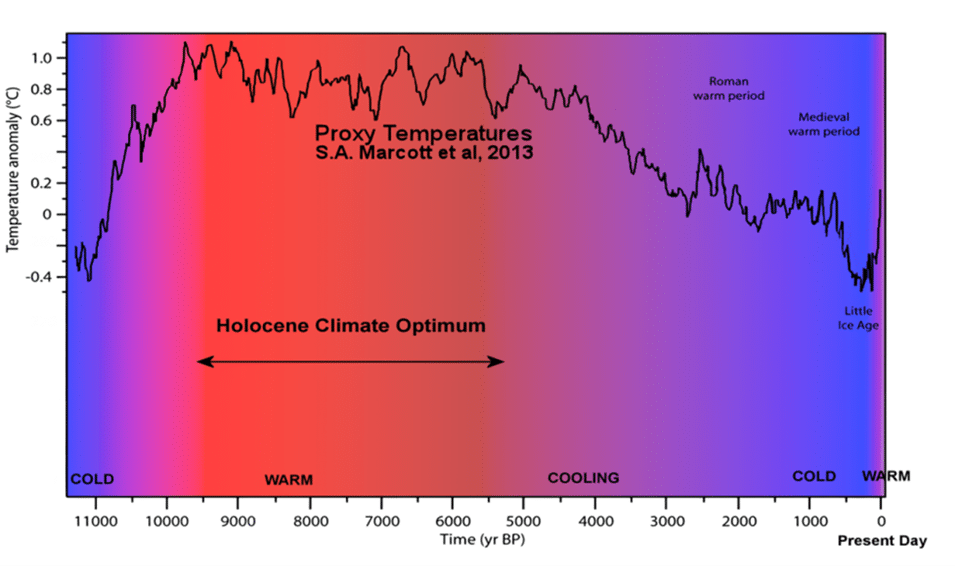
Drought regimes have shifted, sea levels have risen thousands of years before industrial emissions and ecosystems reorganised accordingly. Coral reefs expanded and contracted. Forest boundaries migrated. Species ranges shifted north and south. None of that required human-directed genomics.
The AP article also leans heavily on marine heat waves and wildfires, suggesting they are pushing ecosystems “beyond their limits.” Yet wildfire regimes in California, for example, are influenced heavily by poor forest management, fuel loads and land-use policy. The article even acknowledges that logging eliminated roughly 95 per cent of old-growth redwoods, drastically reducing genetic diversity. That is a land management issue first and foremost, not a minor temperature change problem.
Similarly, coastal development and sediment runoff are cited as stressors in Mission Bay. Urbanisation clouds water, reduces light penetration and alters habitat. Those impacts are local and mechanical. They are not evidence that “climate change is outpacing evolution.”
The evolutionary timescale comparison also ignores rates. Modern warming since the late nineteenth century is on the order of about 1 degree Celsius globally. That change has occurred over roughly 150 years, not instantaneously. During past deglaciations, regional temperatures shifted far more dramatically over centuries, yet ecosystems reorganised rather than universally collapsing.
Moreover, extinction narratives are frequently exaggerated. The article references a 2019 report suggesting one million species face extinction. That widely cited figure is a projection based on habitat modelling and scenario assumptions. It is not an observed count of species vanishing due to temperature rise.
The genomic work described in the piece is interesting and potentially useful. Sequencing corals, eelgrass and redwoods to understand genetic resilience is legitimate science. But presenting it as a necessary emergency response to an evolutionary crisis is unjustifiably alarming. There is no climate crisis that is shifting habitats or changing weather at unprecedented rates, so there is no climatic change in need of adapting to.
Even the scientists quoted in the article admit limits. “Conservation genomics alone cannot solve climate change,” one expert notes. Another acknowledges that engineering tolerance in one species “is not an ecosystem.” Those caveats undercut the apocalyptic framing of the headline.
The deeper problem is the spinning of a false narrative implying a biological catastrophe is underway. By declaring that climate change is “outpacing evolution,” the article implies that life on Earth is fundamentally unable to cope with gradual warming. Yet species have endured ice ages, volcanic winters, megadroughts and abrupt regional shifts long before fossil fuels existed.
Adaptation is not limited to modest changes over millennia, requiring radical new mutations. It includes range shifts, behavioural changes, hybrid vigour and ecological turnover. The eelgrass example highlighted by AP demonstrates precisely that natural adaptive capacity.
Climate change presents challenges. So do habitat destruction, pollution, invasive species and overharvesting. Conflating all environmental pressures into a single narrative of evolutionary collapse oversimplifies complex ecological dynamics.
Climate change is not a binary cliff presenting tipping points for species or ecosystems. Human habitat change has a far greater and more direct impact on species and ecological niches than gradual climate change and on a much shorter time scale.
The Associated Press has taken an emerging field of conservation genomics and wrapped it in an existential storyline that exaggerates the speed and uniqueness of current climate trends. That is false science reporting. Unfortunately, it is what we have come to expect from the Associated Press when it writes about climate change, a low-quality narrative largely bereft of facts and context.
About the Author
Anthony Watts is a senior fellow for environment and climate at The Heartland Institute. Watts has been in the weather business both in front of, and behind the camera as an on-air television meteorologist since 1978, and currently does daily radio forecasts. He has created weather graphics presentation systems for television, specialised weather instrumentation, and co-authored peer-reviewed papers on climate issues. He operates the most viewed website in the world on climate, the award-winning website Watts Up With That.

The Expose Urgently Needs Your Help…
Can you please help to keep the lights on with The Expose’s honest, reliable, powerful and truthful journalism?
Your Government & Big Tech organisations
try to silence & shut down The Expose.
So we need your help to ensure
we can continue to bring you the
facts the mainstream refuses to.
The government does not fund us
to publish lies and propaganda on their
behalf like the Mainstream Media.
Instead, we rely solely on your support. So
please support us in our efforts to bring
you honest, reliable, investigative journalism
today. It’s secure, quick and easy.
Please choose your preferred method below to show your support.

Categories: Breaking News, World News
Plant more trees!
Man Made Climate change is BS!
The Sun is warming, deal with it!
Always a problem, but hey, the idiot scientists always have the proud solution and that is to fiddle with God’s perfect works. A pox upon them.