





The UK’s steel production has significantly declined in recent years. The UK’s cement industry is also declining.
High industrial electricity prices and Emissions Trading Scheme costs render the steel industry uncompetitive with other countries, even in Europe. And the cement industry is highly regulated and faces various environmental taxes, including the UK Emissions Trading Scheme and the Climate Change Levy, which increase costs of production.
The ceramics industry and the glass industry are also energy-intensive and shifting these industries’ energy mix to electricity will substantially increase costs.
In short, the Government’s Net Zero policies are rendering these industries too expensive to survive in the UK.
Let’s not lose touch…Your Government and Big Tech are actively trying to censor the information reported by The Exposé to serve their own needs. Subscribe to our emails now to make sure you receive the latest uncensored news in your inbox…
On 1 April, the Great British Business Council (“GBBC”), a newly formed think tank, published a paper titled ‘Premeditated Industrial Destruction: How the UK Destroyed Its Industry and A Plan To Reverse This’.
The paper is authored by economist Catherine McBride, retired engineer and consultant David Turver and public relations consultant Brian Monteith. It demonstrates how the Government’s Net Zero policies are destroying the foundations of the UK economy and provides recommendations on how Net Zero could be reversed.
Because this paper is important in revealing some home truths, we are reproducing it in a series of articles, more manageable chunks if you will, so that, hopefully, more will read it, or at least read part of it. We have made some minor edits for readability purposes. For those who choose to read the paper in one sitting, you can do so HERE.
Chapter 5: Steel, cement, ceramics and glass require HEAT
By Great British Business Council, 1 April 2026
Table of Contents
Introduction
The government plans to build 1.5 million new homes, complete infrastructure projects, maintain industrial capacity, and build large numbers of data centres. The building blocks of construction are steel, cement, ceramics and glass. They are essential but require metallurgical coal and high-temperature heat from gas or coal to produce them, and industrial electricity to finish, shape and later recycle them.
Steel production (H3)
UK steel production capacity has fallen from 15 million tonnes to just 6 million over the last 10 years, while actual production has fallen further to only 4 million tonnes in 2024. The 2025 production figures will be even lower following the closure of the Port Talbot blast furnaces.
Crude steel is produced in a blast furnace using the basic oxygen process, with iron ore and coke as feedstocks. Approximately 70% of the world’s steel is produced this way and relies on coking coal. Steel is the backbone of modern infrastructure, including wind turbines.
A tonne of steel requires 1.7 tonnes of iron ore and 0.77 tonnes of coking coal. Coking coal has 60% to 90% carbon, low sulphur and phosphorous content, and is processed by baking in an anaerobic furnace at over 1000 °C to produce coke. That means about 2.5 tonnes of raw materials have to be imported to make one tonne of “virgin” steel.
The UK only produced about 4 million tonnes of steel in 2024, according to the World Steel Association, down from 5.6 million tonnes in 2023. They imported another 4.1 million tonnes of iron or steel, according to COMTrade.
The UK is planning to replace its blast furnaces with electric arc furnaces, but its high industrial electricity and Emissions Trading Scheme (“ETS”) costs will make this technology uneconomic. Only UK Electric Arc Furnaces that receive government subsidies or have a contract to supply steel to the UK’s defence department are currently in business. Electric arc furnaces (“EAFs”) do not produce steel; they require steel feedstock – either steel slabs produced in an offshore blast furnace and imported for shaping or, more generally, scrap steel for recycling. Recycled steel can contain residual elements from its previous use, which can alter its durability and strength. There is another problem with the UK’s steel production converting entirely to EAF steel production: global steel demand is approximately 2 billion tonnes per year, whereas the scrap supply is about a third of this, as steel used in vehicles, machinery and buildings remains in use for many years before it becomes available for recycling. As the UK has the most expensive industrial electricity in the world due to our carbon taxes, we should not be surprised if the EAFs replacing the UK’s blast furnaces also close at the first opportunity, or they will never be built.
Cardiff-based Celsa Steel UK is a small EAF steel recycler that produces about 1.2 million tonnes of mainly rebar for construction. It has survived by focusing on a single product: the domestic rebar market. Finnish-based Outokumpu Stainless – Sheffield is another EAF that produces 0.7 to 1 million tonnes of stainless steel and high-alloy grade steel annually. It survives because it produces high-value stainless products for UK high-tech and high-value engineering firms, as well as for export. The company is part of a large Finnish multinational with diversified operations. Sheffield Forgemasters is another small EAF, producing less than 0.3 million tonnes annually for the UK’s defence and nuclear industries. It is owned by the UK Ministry of Defence, which acquired it in 2021 to secure critical defence supply chains. This state backing shields it from both market forces and energy cost considerations.
The peak of the UK steel industry was in 1971, when it employed 320,000 people and produced approximately 28 million tonnes of steel.[1] By 2019, employment in the industry had fallen by 92.8% to 23,000 people, and production had fallen to about 7 million tonnes. The UK steel industry doesn’t have a divine right to exist, especially if the UK is not supplying either iron ore or coking coal. Had the Woodhouse mine in Cumbria been operational, virgin steel production could have been justified. However, the decision to close the blast furnaces was as much a political as an economic one.
Steel production is emissions-intensive: new steel made in a Basic Oxygen Furnace produces 2.33 tonnes of CO2 for every tonne of crude steel produced. Recycled scrap steel using an electric arc furnace produces an additional 0.67 tonnes of CO2 per tonne of steel recycled. Why DRI-EAF steel made by reducing iron ore with gas or hydrogen instead of coking coal (so-called green steel) still produces 1.47 tonnes of CO2 per tonne of steel.
NetZero Watch estimates that UK electricity prices for UK steel producers are £46.60/MWh, of which about 40% are policy costs, such as carbon-emission charges, and about 20% are network costs. France’s wholesale electricity costs are higher than the UK’s but when the network and policy costs are added, the UK’s prices are 62% higher than France’s. French steel producers pay £28.74/MWh for electricity and German steel producers pay £25.00/MWh; both have negligible network costs and their policy costs are about half of the UK’s. (See Figure 20, below.)
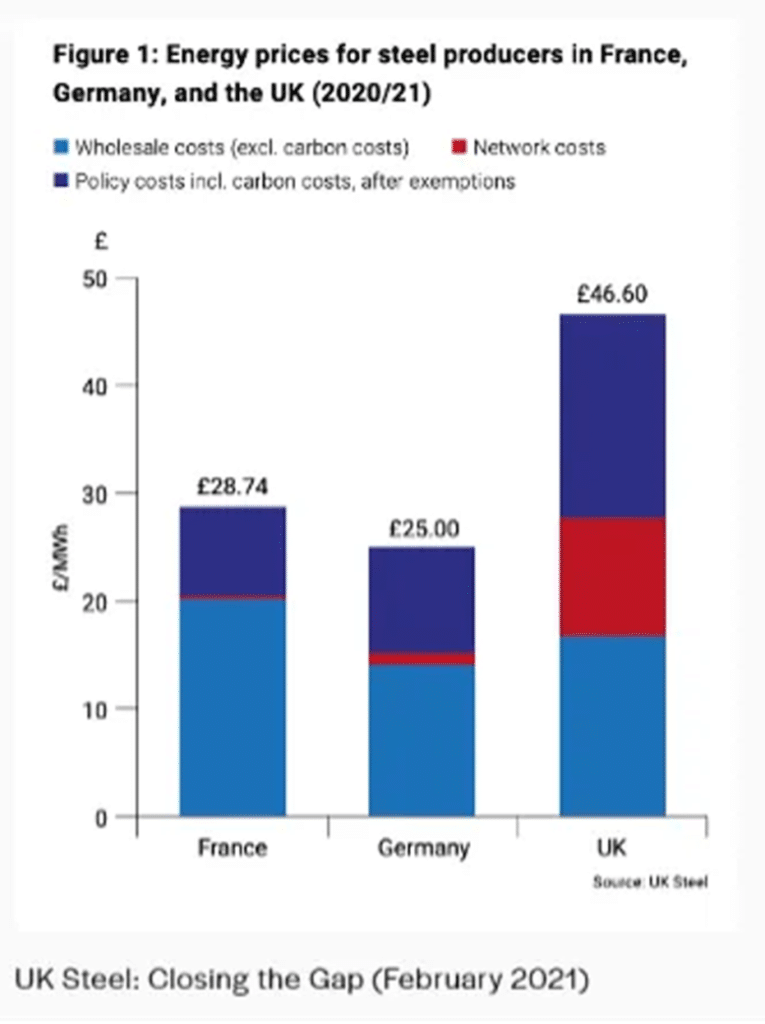
Policy costs include carbon prices and other policies to cover renewable subsidies. While network costs include balancing the system, such as paying electricity generators to turn on and off to maintain the grid’s 50 Hz frequency. As the UK has the highest proportion of intermittent renewables in its grid, these network costs are also higher and we need backup gas and coal-fired generation for when the wind drops. So effectively, the UK is running two electricity systems at once. According to the Global Warming Policy Foundation, the UK network balancing cost (“BSUoS”), has increased from £300 million a year in the early 2000s to £2.7 billion a year in 2024/5. As the UK government continues to increase the number of wind turbines in the system, the network balancing cost will rise as well.
CBAM is not a solution
The UK intends to join the EU’s ETS and Carbon Border Adjustment Mechanism (“CBAM”) scheme and will therefore be forced to add CBAM to iron ore and to virgin steel imports – unless the UK imports them from the EU. This would increase the costs for the Electric Arc Furnaces (“EAFs”) in the UK that reshape imported steel, as well as the production costs for UK vehicle and machinery manufacturers. The Standard International Trade Classification’s ‘SITC 7 machinery and transport equipment’ is the UK’s largest export sector, accounting for 43% of total UK goods exports in 2025, but it is threatened by increased costs of its input materials from the EU’s ETS and CBAM.
Joining the EU CBAM scheme would add emission taxes to: agglomerated iron ores and concentrates; all HS72 iron and steel, except for some iron-alloy and critical-metal alloys, and scrap iron and steel; and 13 of the 26 HS73 four-digit codes for articles made with iron and steel. This list includes many of the UK’s most imported iron and steel products, such as ‘HS7308: Structures, scaffolding, pit propping, towers, and lattice masts’; ‘HS7306: Tubes, pipes, hollow profiles, and cross sections’; and ‘HS7318: Threaded screws and bolts’.
What remains of UK virgin steel production
Scunthorpe-based British Steel has the capacity to produce 3-4 million tonnes of steel annually but is currently incurring daily losses of about £700,000. British Steel stated in March 2025: “The blast furnaces and steelmaking operations are no longer financially sustainable due to highly challenging market conditions, the imposition of tariffs, and higher environmental costs relating to the production of high-carbon steel.”
British Steel’s Chinese owners, Jingye, sought to close Scunthorpe, but it was “saved” and effectively nationalised in April 2025 by the current government to keep the blast furnaces operating. The government sought to sell the company to another operator, but the emissions costs and the need to import both iron ore and coking coal render it highly uncompetitive globally as a steel producer.
Cement production
The UK cement industry is one of the most concentrated heavy industries in the UK. It employs around 4,000 people, including plant workers, quarry operators and maintenance and technical staff, and supports an additional 16,000 jobs indirectly through logistics, the supply chain, equipment suppliers, contractors and services. The industry generates £1.8 billion in direct and induced Gross Value Added (“GVA”) and has a turnover of between £2.2 to £2.5 billion. There are fewer than a dozen major cement companies operating in the UK.
The UK still produces over two-thirds of the cement it uses domestically, approximately 7.3 million tonnes of cement per year (2024); however, this is roughly half the level produced in 1990. Despite the UK’s plentiful limestone supplies, cement production has steadily declined due to high energy costs, environmental regulations and rising imports, leaving output at its lowest level since the 1950s. UK cement imports have nearly tripled since 2008, rising from 12% of sales to 32% in 2024. The UK imported 4.14 million tonnes of the types of cement products covered by the EU’s proposed CBAM. For context, we exported less than 700,000 tonnes of the same products. 540,000 tonnes of which were ‘HS 25070080 Kaolinic clays (other than Kaolin)’. This is the UK’s largest cement export, yet the Government tells us we need to join the EU ETS and CBAM to help UK exporters. This will just make UK cement imports more expensive.
Traditionally, cement producers used coal as the primary fuel in cement kilns to generate the 1,450°C thermal energy required to convert the calcium carbonate found in Limestone to calcium oxide (CaO), which is then combined with various oxides to make clinker materials; coal has been increasingly replaced by gas, which has lower CO2 emissions per tonne of clinker. However, gas is more expensive than coal, so the savings on emissions allowances are partially offset by the higher gas price. Many producers have turned to Refuse Derived Fuels (“RDF”) and biomass. The clinkers are then cooled and ground using electricity to make cement powder.
Cement production is highly carbon-intensive, emitting up to 0.9 tonnes of CO2 per tonne of cement and is therefore subject to high carbon taxes. Producers must purchase UK ETS allowances to cover their direct emissions and pay the Climate Change Levy (“CCL”), which is added to their electricity bills. But producers must also pay the indirect Carbon Price Support (“CPS”) and ETS costs of their power suppliers, which are passed on in higher wholesale electricity prices. Cement production is classified as an electricity-intensive industry (“EII”), so it receives compensation for indirect CPS costs and partial compensation for indirect ETS costs, and receives a 92% discount on the CCL rate.
Most of the emissions from cement production are intrinsic to the process. Almost two-thirds of the emissions arise from the calcination process, which releases one CO2 molecule for each CaO molecule, regardless of the heating method used, although producers typically use coal, gas or RDF to provide the required heat input. Approximately 30% of the emissions come from the heat-source fuels and less than 10% from the electricity used for factory equipment, such as grinders, fans and conveyor belts.
In addition to the UK Emissions Trading Scheme (“ETS”), cement producers face several environmental taxes and regulatory obligations: the Climate Change Levy (“CCL”) on energy use, the Aggregates Levy on rock, sand and gravel used in concrete, the land fill tax on cement plant waste, strict Environmental Permitting Regulations limiting emissions of nitrogen oxides (NOx), sulphur dioxide (SO2), particulates and dust emissions, and compliance with the UK’s Net Zero 2050 targets. The UK industry is highly regulated; however, imported cement may not be subject to the same level of regulation. All of these taxes and regulations are designed to raise costs and push the industry toward decarbonisation, but the proposed CBAM will not compensate producers for these costs; it will only compensate for the differential between domestic and imported ETS costs.
Cement producers are under pressure to adopt Carbon Capture and Storage (“CCS”) and to use alternative fuels to meet Net Zero targets. There is currently a CCS project to build a high-pressure CO2 pipeline to transport captured CO2 from cement and lime plants in Derbyshire and Stafford to a geological storage site 121 miles away under the Irish Sea. Backed by the National Wealth Fund and currently in the pre-application planning stage, there are concerns about the pipeline’s safety: it will operate at high pressure, and leaked concentrated CO2 can displace oxygen at ground level, killing humans and animals in the vicinity. This actually happened in Satartia, Mississippi, in 2020, so it is not idle speculation. A pipeline carrying dense-phase CO2 at high pressure ruptured following a landslide, hospitalising 45 people. People couldn’t escape the area as cars and emergency response vehicles couldn’t operate in the oxygen-depleted air.
There are also concerns about whether the UK storage site in the Irish Sea can hold more than 10 million tonnes of CO2 per year. An alternative solution would be to accept that the dilute CO2 released during cement production is less dangerous than high-pressure, concentrated CO2 piped across farmland.
Ceramics production
The UK ceramics industry contributes more than £1.5 billion annually to the economy, generates £600 million in exports and employs over 20,000 people across more than 150 sites. It is a world leader, combining advanced recognised heritage brands.
Governments overlook the strategic importance of ceramics, which enable the production of steel, glass and other high-temperature products. Ceramics are also critical to aerospace, defence, IT, national security, housebuilding and electricity distribution. In 2012, 89% of production consisted of heavy clay construction products, and only 11% comprised refractories, whitewares and technical ceramics. Refractories, such as heat‑resistant materials for kilns, furnaces, steelmaking and technical ceramics, are used in electronics, aerospace and engineering, as well as in ceramic components for industrial processes. Construction products include roof tiles, floor tiles, bricks, sanitary ware and architectural ceramics.
Ceramics is an energy-intensive industry that requires kiln firing and drying. Kilns operate continuously at extremely high temperatures, often around the clock, and energy demand cannot simply be switched off. The energy used is predominantly natural gas, accounting for approximately 86% of the sector’s total energy use. There are also process emissions resulting from chemical changes in the raw materials during firing.
Analysis from Nottingham Trent University suggests that UK ceramics firms spend 70% of their turnover on energy costs and 14% on government and regulatory levies. Energy costs have increased by more than £330 million since 2020, reaching £875 million annually.
Ceramics companies must buy carbon allowances on the ETS market for every tonne of CO₂ emitted. Prices have ranged from £30 to £100 per tonne since 2021. This is an especially high cost for Heavy‑clay ceramics (bricks, tiles, pipes) because firing temperatures are high and firing is continuous. Ceramics companies also pay the Climate Change Levy (“CCL”) on every unit of energy unless they have a Climate Change Agreement, which can give up to 92% discount on the levy if firms meet energy‑efficiency targets. Reducing energy costs is essential to sustaining these industries and enabling them to thrive.
As energy-intensive industries, they will get discounts on their electricity bills, reducing the cost of contracts for the difference levy, the renewable obligation levy and the feed-in tariff levy. If they sign up for the Ceramics Climate Change Agreement and meet its energy-efficiency targets, they will also receive a 92% discount on the CCL for electricity and an 89% discount on the CCL for gas.
However, the ceramics industry’s primary energy source is gas, not electricity, and it must still pay for carbon emissions, comply with carbon reporting obligations (SECR and ESOS), and cover the costs of industrial emissions monitoring for NOx, sulphur oxides (SOx) and particulates, as well as permitting fees.
The government has proposed shifting some of its carbon taxes, currently applied to electricity, to gas to reduce electricity prices. This would likely be the final straw for the UK ceramics industry and other sectors that rely on high-temperature processes.
Glass production
The UK glass sector contributes over £2 billion to the economy, employs 6,000 directly and provides more than 120,000 jobs across the supply chain. The sector produces around 3 million tonnes of glass, including 2.2 million tonnes for container applications and 0.8 million tonnes for flat glass and wool. In 2024, UK glass exports were worth £1.14 billion, down 4% on 2023. The volume of exports was also down 8% to 803 thousand tonnes. The value of glass imports fell 4% to £2.1 billion, while the volume rose 3% to 1,215 thousand tonnes. Over a quarter of the UK’s glass imports by value came from China in 2024.
Glass is a highly energy-intensive industry, consuming approximately 6.2 TWh in 2024, with over 5 TWh from natural gas and almost all the rest from electricity. Over the period to 2050, the industry anticipates that overall energy use will decline and the energy mix will change dramatically. By 2050, almost all gas use will be eliminated, with the vast majority of energy coming from electricity and the balance from hydrogen and a small amount of biomethane.
The problem with this approach is that industrial electricity costs far more than industrial gas. In the first quarter of 2025, electricity for very large industrial users cost 22.91p/kWh, whereas gas for large users cost 4.69p/kWh (both including taxes), some five times less. Shifting the energy mix to electricity will substantially increase costs. Consequently, European glass manufacturer Ardagh’s next-generation electric-hybrid furnace, which achieves a 64% reduction in carbon emissions, will be located in Germany rather than the UK. It is hard to believe that this decision was not due to the UK’s higher industrial electricity costs.
The glass industry receives environmental policy reliefs worth about £158 million per year, including an exemption from the Climate Change Levy, an ETS allowance and a “supercharger enhanced package.” Effectively, the government recognises that its policies have made energy too expensive and offers partial relief by subsidising heavy industry to offset subsidies for renewable electricity.
Falling Employment
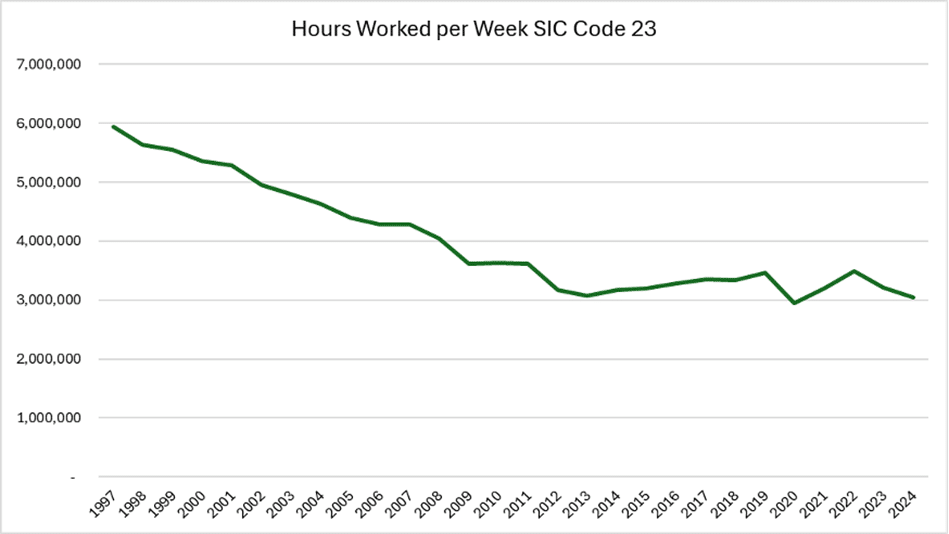
The impact of high energy costs can be seen in the hours worked per week across the ceramics, glass and cement industries, together making up Standard Industrial Classification of Economic Activities (“SIC”) code 23 in Office for National Statistics (“ONS”) statistics. From 1997 to 2024, hours worked per week have declined by 48.8%, while GVA has increased by just 6% in CVM [Chained Volume Measure], indicating an industry in decline. However, in 2021, GVA was 20% higher than in 1997. Indicating that when gas prices are low, the industry is competitive.
About The Great British Business Council
The Great British Business Council (“GBBC”) was established to enhance public and political understanding of the advantages a thriving business community provides to local security, standard of living and wellbeing. It aims to support British firms and small businesses by promoting well-crafted, practical, evidence-based policy reforms that foster enterprise and innovation. It is independent of any political party, as it hopes that all parties will consider adopting the straightforward, practical policy suggestions it proposes.
The GBBC is funded by private donations from concerned citizens who want the UK to thrive economically as it once did. If you would like to join us or donate to their cause, please contact in**@**BC.UK or follow them on LinkedIn, X (Twitter), Facebook, YouTube, TikTok and Bluesky.
Featured image: Cover of the GBBC paper, ‘Premeditated Industrial Destruction: How the UK Destroyed Its Industry and A Plan To Reverse This’
The Expose Urgently Needs Your Help…
Can you please help to keep the lights on with The Expose’s honest, reliable, powerful and truthful journalism?
Your Government & Big Tech organisations
try to silence & shut down The Expose.
So we need your help to ensure
we can continue to bring you the
facts the mainstream refuses to.
The government does not fund us
to publish lies and propaganda on their
behalf like the Mainstream Media.
Instead, we rely solely on your support. So
please support us in our efforts to bring
you honest, reliable, investigative journalism
today. It’s secure, quick and easy.
Please choose your preferred method below to show your support.

Categories: Breaking News, UK News
Hi Rhoda,
Another important article reducing the UK to Net zero in everything.
Because we cannot call a spade a spade, we cannot ask the right questions.
I do wonder what religion our UK MP’s are.
Mainly, because they delight in destroying this once great country.
Even my own MP, Ed Miliband never replies to my emails.
I wonder what religion he belongs to ?
With WW3 approaching fast what are we to build Ships and Aircraft and Tanks with ?