





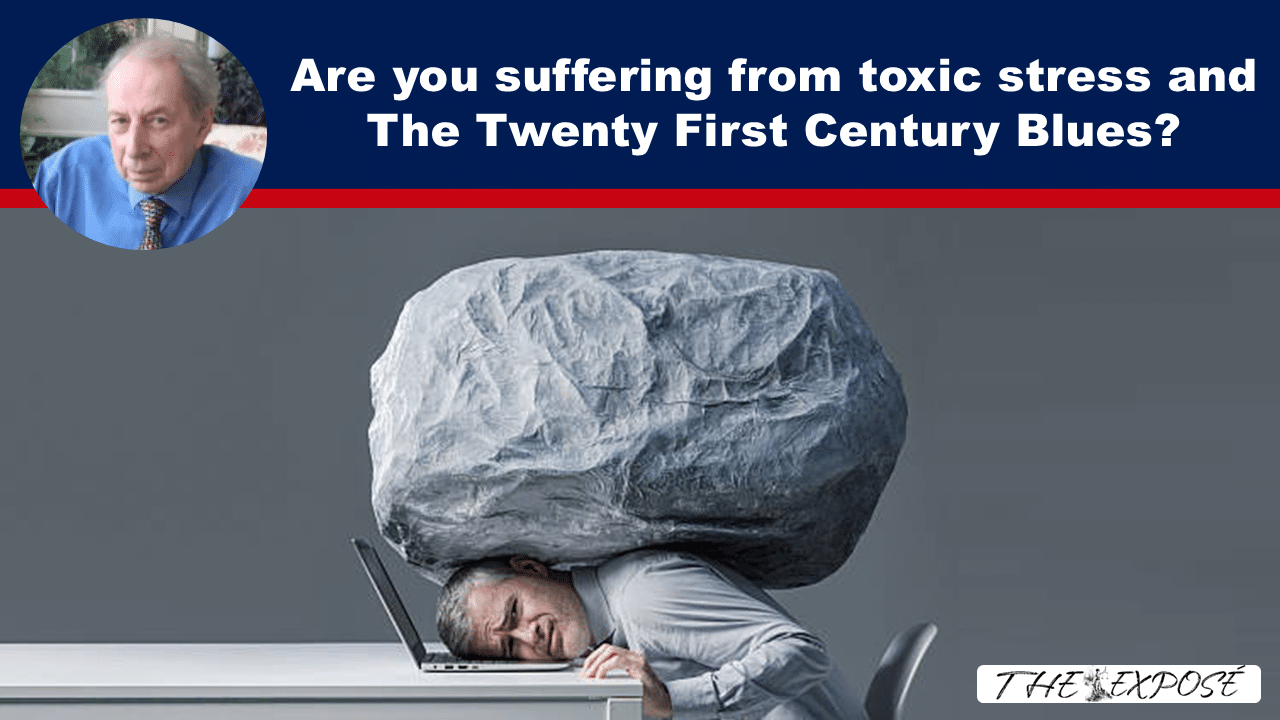
“The Twenty First Century Blues” is a term Dr. Vernon Coleman coined in the 1990s to describe one of the harmful effects of toxic stress.
“I believe that ‘The Twenty First Century Blues’ is almost certainly one of the commonest diseases in the developed world. I suspect that it is as common as tooth decay or the common cold. It is certainly far more damaging than any other common ailment,” he writes.
Diagnosing “The Twenty First Century Blues” is something that you have to do yourself, he advises and lists the symptoms associated with the condition.
Let’s not lose touch…Your Government and Big Tech are actively trying to censor the information reported by The Exposé to serve their own needs. Subscribe to our emails now to make sure you receive the latest uncensored news in your inbox…
Dr. Vernon Coleman introduced the concept of “stress” and its effect on health in a book called ‘Stress Control’, which was published in 1976. In 1996, he invented the term “toxic stress” to describe the types of stress which are unavoidable and which does most damage. Here is the first section from his book `How to overcome Toxic Stress and the 21st Century Blues’.
Toxic Stress
We live in strange, difficult and confusing times. In some ways, largely material, we are richer than any of our ancestors. In other ways, largely spiritual, we are infinitely poorer.
Most of us live in well-equipped homes that our great-grandparents would marvel at. We have access to (relatively) clean drinking water at the turn of a tap. We can obtain light to work by and heat to cook by at the flick of a switch. Our homes are stuffed with possessions. We have automatic ovens, washing machines, tumble driers, dish washers, food blenders, vacuum cleaners, television sets, DVD players, computers, mobile telephones and a whole host of other devices designed either to make our working hours easier or our leisure hours more enjoyable. If we want to travel anywhere, we can climb into our own motor cars or we can use public buses, trains or aeroplanes. We have become so dependent upon these “things” that when they break down, we become aggressive and irritable. We can’t cope without them.
We are surrounded by the gaudy signs of our wealth and the physical consequences of human ambition and endeavour, but loneliness, unhappiness, anxiety and depression are now commoner than ever before in our history. There has never before been so much sadness, dissatisfaction and frustration as there is today. The demand for tranquillisers and sleeping tablets has risen steadily throughout the last few decades as our national and individual wealth has multiplied.
We have access to sophisticated communication systems and yet never before have we been so aware of our ignorance. We have more power over our environment than our ancestors ever dreamt of having and yet we are regularly reminded of our helplessness and our vulnerability. We are materially wealthy and yet spiritually deprived. We have conquered our planet and begun to conquer space, and yet we are continually reminded of our woeful inability to live at peace with one another.
As the human race becomes materially richer and more powerful, so we as individuals seem to become spiritually poorer and more frightened. The more we acquire, the more we seem to need, and the more we learn, the more we seem condemned by our ignorance. The more control we have over our environment, the more damage we seem to do to ourselves. The more successful we become in financial terms, the more we seem to destroy the qualities and virtues which lead to happiness and contentment. The more we learn about our world, the more we seem to forget about our duties and responsibilities to one another.
As manufacturers and advertisers have deliberately translated our wants into needs so we have exchanged generosity and caring for greed and self-concern. Politicians and teachers, scientists and parents have encouraged each succeeding generation to convert simple dreams and aspirations into fiery, no-holds-barred ambitions. In the name of progress, we have sacrificed common sense, goodwill and thoughtfulness and the gentle, the weak and the warm-hearted have been trampled upon by hordes of embittered, miserable people who have been taught only to think of the future and never to think of the present or the past. Our society is a sad one; the cornerstones of the world are selfishness, greed, anger and hatred. Those are the driving forces we are taught to respect.
During the last fifty years or so, we have changed our world almost beyond recognition. Advertising agencies, television producers and newspaper editors have given us new aims to strive for, new hopes, new ambitions and new aspirations. At the same time, they have also given us new fears and new anxieties. With the aid of psychologists, clever advertising copywriters have learned to exploit our weaknesses and our natural apprehensions to help create demands for new and increasingly expensive products. Our world has changed dramatically. Values and virtues have been turned upside down and inside out. Tradition, dignity and craftsmanship have been pushed aside in the search for ever greater productivity and profitability.
It is hardly surprising that all these changes have produced new stresses and strains of their own. The pressure to succeed joins with the pressure to confirm and the pressure to acquire and as a result, we live in a world where the base levels of stress are fixed at dangerously high levels.
Each one of us is, of course, confronted with individual stresses on a daily basis. Everywhere you look, you come face-to-face with individual and personal stresses. There are stresses in your business life and stresses in your social life. But these are stresses that you can easily do something about. You can choose to avoid them if you want to. You can confront them or control them. You can share them or simply deal with them yourself. You have some freedom of action because these are personal stresses.
The stresses which are an inherent part of the world around you – the world in which you and I and all of must live – are quite different. These stresses – the ingredients of toxic stress – are not so easily avoided. These stresses produce difficult-to-define frustrations. They produce bitterness and a deep sense of ill-defined, unexplained despair.
The stresses created by advertisers and politicians, teachers and scientists, journalists and broadcasters are the stresses which, together, make up the unacceptable levels of toxic stress which are responsible for so much sadness, so much misery and so much despair. It is the existence of high levels of toxic stress which helps to explain why individual attempts to deal with stress have so often proved ineffective. It is the existence of toxic stress which explains why millions of people who believe that they have the stress in their lives under control are, nevertheless, suffering from stress-related disorders.
Toxic stress is the commonest, most far-reaching and most destructive force at work in Western society today. It is far more invasive, more damaging and more universal than any single infective organism.
Like personal stresses, toxic stress (which is primarily a social stress) can cause an enormous range of individual symptoms and well-defined diseases. It can cause headaches, skin rashes and bowel disorders. It can cause asthma, high blood pressure, heart disease and peptic ulceration. It can cause sleeplessness, backache and hair loss. It can cause depression, psoriasis and sexual problems. It can make existing diseases worse, and it can increase a sufferer’s susceptibility to infectious diseases, cancers and psychological problems.
But my researches over nearly 50 years has also convinced me that toxic stress is responsible for something else; something specific and something that has never before been recognised as an individual syndrome. I have named the disease caused by toxic stress “The Twenty First Century Blues.”
I believe that “The Twenty First Century Blues” is almost certainly one of the commonest diseases in the developed world. I suspect that it is as common as tooth decay or the common cold. It is certainly far more damaging than any other common ailment.
The range of people suffering from this discomforting and incapacitating disease is vast. The executive or company director who works for a large company (and who seems, on the surface, to have more control over his environment than his or her employees) is as vulnerable to the effects of toxic stress as anyone else. The student, the nurse and the librarian are all potential victims. The retired bank manager is as vulnerable as the young bank clerk and the junior shop assistant is as likely to suffer from it as is the chairman of the store.
The only common factor is that victims of “The Twentieth Century Blues” tend to be sensitive, considerate and caring people. The more thoughtful and imaginative you are, the more you are likely to become a victim and the more likely you are to suffer.
But not even the unintelligent and the uncaring are immune to the power of toxic stress. I believe that much modern hooliganism and vandalism are a result of toxic stress.
The sensitive and intelligent respond to toxic stress by becoming unhappy and confused. The insensitive and unintelligent respond to toxic stress by becoming angry, aggressive and violent. The deep sense of frustration commonly felt by the victims of toxic stress can lead one person to withdraw and become more alone. The same feeling of frustration can lead another person, with a different personality and living in a different environment, to become a dangerous sociopath.
Diagnosing “The Twenty First Century Blues” is something that you have to do yourself – the disease has yet to be recognised by the medical establishment (and in view of the fact that the disease cannot be treated with any of the traditional remedies favoured by orthodox minded physicians, I suspect that it will be some time yet before the disease is widely accepted within the medical profession).
To make it easy for you to diagnose your condition, I have listed below the symptoms which are associated with the syndrome. I have put the symptoms in question form, and you must think carefully before answering them. This is no ordinary quiz.
If you find that you can honestly answer “yes” to one or more of these questions, then you are, I suspect, one of the many victims of “The Twenty First Century Blues.” The more times you have answered “yes,” the more serious your affliction.
If you discover that you are toxic stress victim – and a sufferer of “The Twenty First Century Blues” – do not despair. In the third part of this book, I will explain how you can rebuild your strength and your resistance to toxic stress. The Twenty First Century Blues can be beaten.
• Symptom One
Do you often feel that you ought to be doing more with your life? Do you feel dissatisfied with yourself or your life without really knowing why?
• Symptom Two
Do you have an uncomfortable, and difficult-to-explain, feeling that control of your life is slipping (or has slipped) away from you?
• Symptom Three
Do you suffer a lot from symptoms and ailments for which there never seems to be any completely satisfactory treatment? Do your symptoms or ailments hang on apparently endlessly – never really disappearing completely?
• Symptom Four
Do you often feel nervous or anxious even though you know that you don’t really have anything to be nervous or anxious about?
• Symptom Five
Even though you have or may have a large family and lots of friends, do you ever feel strangely and inexplicably alone?
• Symptom Six
Do you constantly feel rushed – unable to find the time to do all the things you feel you ought to do, let alone the things that you would like to do?
• Symptom Seven
Do you frequently worry unreasonably about quite trivial, insignificant things that in your heart you know don’t really matter?
• Symptom Eight
Do you constantly feel tired, listless and short of energy – feelings for which there is no medical explanation?
• Symptom Nine
Do you ever feel an almost overwhelming and almost irresistible urge to run away from everything?
• Symptom Ten
Do you feel that life isn’t as much fun as it used to be or should be? Do you go for whole days without ever really feeling happy or feeling glad to be alive?
• Symptom Eleven
Have you ever felt a frightening and unnerving urge to be violent – either to someone close to you or to some complete stranger who has annoyed you? Have you ever gone cold after realising how close you’ve been to initiating a frenzied physical attack on another human being? Do you ever find yourself wishing you had a gun?
• Symptom Twelve
Do you ever feel a complete sense of despair about the future of the world? Do you ever feel glad that you’re not going to live to see the sort of world your children’s children will inherit when they grow up?
If you have decided that you are suffering from The Twenty First Century Blues, please do not despair. You are by no means alone. Half of the people you know probably feel exactly the same way. Outwardly they may appear strong and happy, but deep down inside, they are just as tormented as you. You may find this difficult to believe, but just remember that unless they know you very well, they probably don’t know that there is anything wrong with you either. You too have probably managed to put on a false front for several years now.
The difference between you and them is that you have now managed to find out what is wrong with you. And you can learn how to deal with the toxic stress which is causing your symptoms.
How can I describe the symptoms of The Twenty First Century Blues with such certainty?
That isn’t difficult to answer.
Over the last few decades, I have received letters and telephone calls from thousands of people who have described to me the symptoms which I now recognise as typical of The Twenty First Century Blues.
And there is one final symptom which is almost universal among sufferers from this syndrome: guilt.
People who suffer from The Twenty First Century Blues invariably feel ashamed of the fact that they feel unhappy, frustrated, bored or discontent. They feel that since they enjoy much better living conditions than their ancestors – or, indeed, millions of people around the world who are less fortunate than themselves – they ought to be grateful rather than dissatisfied. They feel guilty about the fact that they are miserable when their problems are relatively trivial and superficial when compared to the problems endured by families living in underdeveloped countries.
This deep sense of guilt makes The Twenty First Century Blues more destructive, more damaging and even more unbearable.
Why, if toxic stress and The Twenty First Century Blues are so common, have neither of them been recognised and written about by doctors before now?
It’s a simple question. And the answer is simple too.
Doctors are trained to look for physical causes for diseases – and to look for physical solutions too. Ever since the modern medical profession developed in the middle of the nineteenth century, doctors have tried to find anatomical, physiological or biochemical explanations for all health problems.
It took years for doctors to accept that psychological pressures could cause any sort of illness and the general significance of stress was only fairly recently recognised by the profession as a whole.
It is not by accident that doctors are trained to try and cure illness by prescribing pills, performing surgery or intervening in some other essentially practical way. Doctors earn their living by providing practical services and the links between the medical profession and the powerful drugs industry (which, of course, makes its massive profits out of the drugs that doctors prescribe) are extremely close.
Indeed, the sad truth is that although doctors have not yet recognised the existence of toxic stress of The Twenty First Century Blues, they have for several years now been attempting to treat the symptoms suffered by people who are toxic stress victims. And their attempts to treat such patients – usually by prescribing tranquillisers or antidepressants but sometimes by recommending electrical treatments or brain surgery – have frequently made things worse rather than better. Tranquilisers solve none of the fears or anxieties caused by toxic stress and they cure none of the problems associated with The Twenty First Century Blues. Indeed, because they are frequently addictive and because the list of side effects associated with their use seems endless, tranquillisers have created new problems.
The fact is that medical treatment isn’t the answer to toxic stress or The Twenty First Century Blues because neither toxic stress nor the syndrome it produces are essentially medical problems. The word “toxic” is used as a synonym for “poison” and toxic stress is an insidious, morally and spiritually destructive disease. It eats away at the soul, but it is not a disease that is ever likely to respond to pharmacological therapy. The Twenty First Century Blues is a disease of the soul rather than the mind; a disorder of the spirit rather than the body. There is no chemical or biochemical abnormality associated with it.
For the same reasons, the attempts by alternative practitioners to treat patients who are suffering from the effects of toxic stress have been similarly unsuccessful. During the last decade or two, millions of patients have turned to alternative practitioners for help. They have done so partly because they have been disenchanted by orthodox medicine, partly because they have been alarmed by the quantity and severity of side effects associated with modern medical remedies and partly because they have found alternative practitioners to be, on the whole, more sympathetic, more understanding and less hurried than their more orthodox counterparts.
But alternative healers have also failed to identify the existence of toxic stress or The Twenty First Century Blues and although their remedies may sometimes be safer and gentler, alternative practitioners still believe in the principles of interventionism. A study of the therapies recommended by alternative practitioners shows that they, like their orthodox colleagues, have made the mistake of trying to treat this problem, and the symptoms associated with it, as a medical problem. Some practitioners have gone so far as to define new syndromes in an attempt to explain away symptoms for which there is no convenient physical explanation. There has been much talk of allergies, hidden infections and ecological disasters. Inevitably, perhaps, new remedies have also been unearthed. I doubt if there is a mineral or a vitamin which has not, at one time or another, been recommended as a “cure” to patients suffering from what I now believe to be The Twenty First Century Blues.
The alternative practitioners have failed and their remedies have proved ineffective because toxic stress cannot be treated as a medical problem, and The Twenty First Century Blues cannot be cured with traditional, interventionist therapies.
The final and significant truth is that because toxic stress is a force which affects the soul and because The Twentieth Century Blues is an affliction of the spirit, the answer must lie outside all varieties of orthodox medical thinking.
Note: The above is taken from the introduction to Dr. Vernon Coleman’s book `How to Overcome Toxic Stress and the 21st Century Blues’ (first published in 1996 and subsequently revised). Vernon Coleman’s book explains the causes of toxic stress and also explains the cure. The book is available via the bookshop on his website
About the Author
Vernon Coleman, MB ChB DSc, practised medicine for ten years. He has been a full-time professional author for over 30 years. He is a novelist and campaigning writer and has written many non-fiction books. He has written over 100 books, which have been translated into 22 languages. On his website, HERE, there are hundreds of articles which are free to read. Since mid-December 2024, Dr Coleman has also been publishing articles on Substack; you can subscribe to and follow him on Substack HERE.
There are no ads, no fees and no requests for donations on Dr. Coleman’s website or videos. He pays for everything through book sales. If you would like to help finance his work, please consider purchasing a book – there are over 100 books by Vernon Coleman available in print on Amazon.
The Expose Urgently Needs Your Help…
Can you please help to keep the lights on with The Expose’s honest, reliable, powerful and truthful journalism?
Your Government & Big Tech organisations
try to silence & shut down The Expose.
So we need your help to ensure
we can continue to bring you the
facts the mainstream refuses to.
The government does not fund us
to publish lies and propaganda on their
behalf like the Mainstream Media.
Instead, we rely solely on your support. So
please support us in our efforts to bring
you honest, reliable, investigative journalism
today. It’s secure, quick and easy.
Please choose your preferred method below to show your support.

Categories: Breaking News, World News