





The covid “pandemic” led to a significant investment of over £400 billion in interventions with weak, uncertain, or no evidence bases. The result was a colossal waste of money and a huge increase in UK government debt.
The refusal of authorities to address uncertainty and the preference for “certainty theatre” over evidence generation has set a troubling precedent, where interventions are imposed without proper testing and evaluation, leading to harm and wasted resources.
Let’s not lose touch…Your Government and Big Tech are actively trying to censor the information reported by The Exposé to serve their own needs. Subscribe to our emails now to make sure you receive the latest uncensored news in your inbox…
The following article by Trust the Evidence is a follow on to their article ‘Notes on Emerging Precedents: Part I’, which describes the growing disconnect between the causes of illness and the allocation of resources, particularly in relation to infectious diseases. Please note: Part 1 is behind a paywall, but the introduction is free to read.
Notes on Emerging Precedents: Part II
By Carl Heneghan and Tom Jefferson, as published by Trust the Evidence
The next post in this series is relatively straightforward to write, as the recent pandemic provides the clearest example of colossal waste of our money.
The pandemic years exposed a dangerous shift in public policy: the normalisation of spending hundreds of billions of pounds on interventions supported by weak, uncertain, or – in some cases – virtually non-existent evidence.
The numbers are staggering: The Office for Budget Responsibility estimated that pandemic-response measures added around £344 billion to government borrowing by March 2021; Treasury figures suggest total UK covid support between 2020 and 2022 exceeded £400 billion, and Public borrowing reached £313 billion in 2020/21 – the highest peacetime level ever recorded.
These costs did not arise simply because a virus appeared. They were the direct consequence of political decisions to lock down the population to interrupt the transmission of SARS-CoV-2. Governments did not merely respond to disease; they imposed extraordinary restrictions on society, the economy, education, healthcare, and civil life, while simultaneously embarking on one of the largest spending programmes in modern British history.
And yet, throughout much of this period, the evidentiary foundations underpinning the interventions remained remarkably fragile.
Something that Trust the Evidence repeatedly highlighted was the uncertainty. The evidence for lockdowns preventing transmission at the population level was highly contested; school closures lacked robust supporting data and ignored known harms to children and mass asymptomatic testing was rolled out nationwide without clear evidence that it meaningfully altered outcomes. Also, mask mandates rested largely on low-certainty evidence from observational studies vulnerable to substantial bias, while rapid vaccine deployment occurred with limited long-term safety data and little clarity about the durability of the effect on transmission, and antivirals were purchased at enormous expense despite uncertain benefits in many patient groups.
There were exceptions: Steroids, subject to high-quality randomised trials, clearly benefited a subset of severely ill hospitalised patients. Regular handwashing remains one of the few interventions consistently supported by plausible evidence and common sense. But these were notable precisely because they stood apart from the wider evidentiary fog.
Perhaps most troubling was not the uncertainty itself, as uncertainty is inevitable during any emerging outbreak, but the refusal of those in authority to address it. At almost every stage, governments preferred certainty theatre over evidence generation. Policies were implemented nationwide before proper testing and randomised evaluations of non-pharmaceutical interventions were rarely attempted. Dissenting scientific voices were marginalised rather than engaged with, and the public was told that “the science” was settled precisely when it was at its most uncertain.
Wherever you look, there is little indication that policymakers have absorbed the central lesson: interventions imposed at vast societal and economic cost require equally robust evidence. Instead, the institutional machinery remains committed to repeating many of the same approaches, including earlier lockdowns, restrictions, mass behavioural controls and accelerated pharmaceutical rollouts, without establishing credible frameworks for rapid, transparent evidence generation.
The danger is not simply wasted money, although £400 billion of borrowed expenditure ought to concern anyone interested in public finances. The real cost lies in what accompanied it: missed cancer diagnoses, deteriorating mental health, lost education, fractured trust in institutions, weakened democratic accountability and a growing belief that emergency policymaking no longer requires rigorous assessment.
The purpose of evidence-based medicine is not to guarantee certainty; it is to protect populations from the harms of acting on assumptions, panic and political expediency. It is inevitable that we will face another pandemic. What remains uncertain is whether we have learned anything at all.
The precedent is now established: announce an emergency, produce alarming models, suspend normal evidentiary standards, spend billions and postpone proper evaluation until long after the money has gone. Evidence-based policymaking increasingly risks becoming evidence-generation-based policymaking.
Similar precedents exist outside pandemics. Large-scale spending on behavioural change programmes, NHS digital transformation projects, educational recovery schemes, stockpiling and some population screening initiatives has often proceeded despite uncertain evidence of effectiveness and limited long-term evaluation.
The recurring lesson is that political momentum frequently outruns scientific scrutiny, and a culture of intervening before evidence often means significant investment in interventions with weak, uncertain or no evidence bases.
This piece was written by two old geezers who still wash their hands regularly and, for the moment at least, have managed to avoid needing steroids.
This article is provided free of charge. In an era when billions can be spent on weak evidence with remarkably little scrutiny, independent analysis matters more than ever. If you would like to support this work, please consider a paid subscription [to Trust the Evidence].
About the Authors
Carl Heneghan is a professor of Evidence-based Medicine at the University of Oxford, Director of the Centre for Evidence-Based Medicine (“CEBM”) and an NHS Urgent Care general practitioner who regularly appears in the media. Tom Jefferson is a clinical epidemiologist and a Senior Associate Tutor at the University of Oxford. Together, they publish articles on a Substack page titled ‘Trust the Evidence’ (“TTE”).
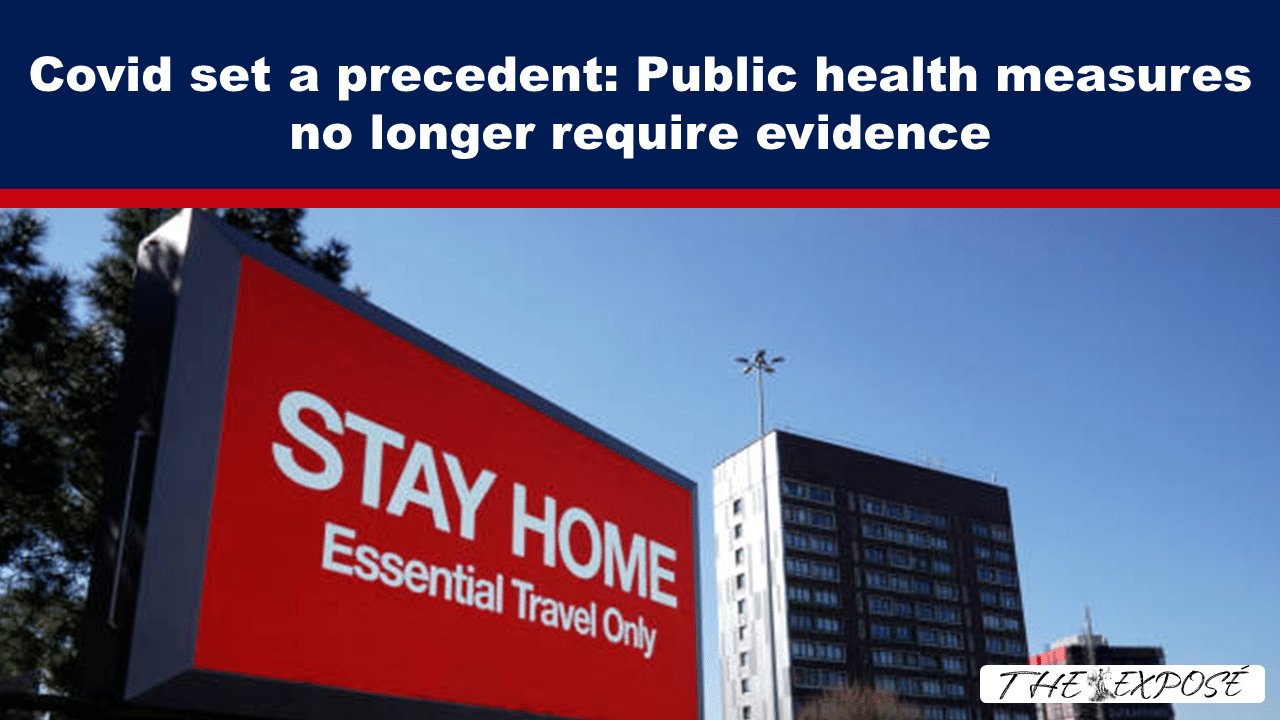
Featured image: A giant television over the A57 Motorway urges people to stay home on 26 March 2020 in Manchester, England. British Prime Minister, Boris Johnson, announced strict lockdown measures urging people to stay at home and only leave the house for basic food shopping, exercise once a day and essential travel to and from work. Source: GettyImages
The Expose Urgently Needs Your Help…
Can you please help to keep the lights on with The Expose’s honest, reliable, powerful and truthful journalism?
Your Government & Big Tech organisations
try to silence & shut down The Expose.
So we need your help to ensure
we can continue to bring you the
facts the mainstream refuses to.
The government does not fund us
to publish lies and propaganda on their
behalf like the Mainstream Media.
Instead, we rely solely on your support. So
please support us in our efforts to bring
you honest, reliable, investigative journalism
today. It’s secure, quick and easy.
Please choose your preferred method below to show your support.

Categories: Breaking News, World News
You can sum it all up and call it the totalitarian tiptoe. Psyop after psyop. Sadly, the vast majority don’t know the first thing about psychology and still have NO CLUE its being used against them.
But of course, they only require the victims to voluntarily comply. Unfortunately for them they do need to verify and validate their legal title to process.
Hi Rhoda,
Our UK MP’s and friends, were laughing all the way to the bank.
They all became Rubber Goods specialists, putting in all false quotes.
Then there was Boris having Party Time in parliament, whilst we were told to hide away and keep 60 foot apart for safety.
The rubber good were burnt in power stations because they were costing too much to store.
To be honest, the Plandemic, was just another step to destroy this Country of ours, and make us all pay for our own destruction.
The only time I wasn’t feeling well was after being around someone who received the covid shots.
Again ad nauseam, there was no pandemic. The virus said to cause covid-19 does not exist in nature.
Rhoda, please investigate the pseudo-scientific methods used to ‘prove’ the existence of viral pathogens – once you see the fraud, you can’t unsee it.
Hi Rhoda,
I have mentioned the Spanish Flu several times.
Where the Mormons and Amish in the US, refused the vax and survived.
I read an article where the US military were forced to have the vax.
The article said, 7 soldiers died instantly, after receiving the shot.
Just shows how we are lied to, for years, about safe and effective.