





The evidence from grooming gang convictions across Britain repeatedly shows a Muslim background among many of the perpetrators. When this is viewed alongside similar patterns of sex crimes observed both in countries of origin for immigrants and in Muslim-majority societies, it offers compelling grounds to consider that elements of Islam are contributing to the grooming gang scourge in our country.
Let’s not lose touch…Your Government and Big Tech are actively trying to censor the information reported by The Exposé to serve their own needs. Subscribe to our emails now to make sure you receive the latest uncensored news in your inbox…
Last year, Rupert Lowe MP (Restore Britain) launched a campaign to raise funds to hold an independent national inquiry into the UK’s Muslim rape gangs. This year, the victim-led Rape Gang Inquiry was held, during which testimonies from victims, parents, carers, politicians, a variety of experts and whistle-blowers were heard over ten days, from 2 February to 12 February. On 16 June 2026, the Inquiry released its report.
Beginning on page 116, the report describes the ‘Influence of Islam’ on rape gang members. We have republished a part of the section below, excluding details of the sources used. You can read the full report HERE.
The Influence of Islam
Muslim Treatment of Non-Muslims Worldwide
Britain is not a unique case. This sort of thing goes on anywhere that either welcomes mass migration from Muslim countries or contains long-established Muslim populations. There is a consistent pattern of sexual violence directed against non-Muslim minorities in settings where Muslims form the majority.
Across Britain, as we have noted, girls from Sikh and Hindu backgrounds have also been targeted by Muslim gangs. Unlike the White British majority, these non-Muslim immigrant populations were never prevented from organising as a collective to protect their own. In doing so, as was their duty, the Network of Sikh Organisations drew attention to the “appalling treatment” of non-Muslims in Pakistan:
“We need only look at the appalling treatment of girls from minority faiths in Pakistan – where Christian, Hindu and Sikh girls are kidnapped, forced to convert to Islam and married, to get an understanding of the underlying motivations. In 2018, around 1,000 girls in Pakistan’s Sindh province alone suffered this fate. In many cases, perpetrators are granted impunity due to corruption and connivance with local officials.”
In April 2024, UN human rights experts expressed serious alarm regarding the vulnerability of minority girls in Pakistan to forced religious conversions and forced marriages. Their press release highlighted that Christian and Hindu girls in particular face heightened risks of abduction, trafficking, child forced marriage, domestic servitude, and sexual violence.
Human rights groups and media reports, including a 2021 BBC investigation, have estimated that thousands of non-Muslim girls – primarily Christians, Hindus, and Sikhs – are abducted annually in Pakistan, compelled to convert to Islam, and forced into marriage with their abductors. One documented case involved Farah, a 12-year-old Christian girl abducted from her home in June 2020 by three Muslim men, raped, and forced to perform household labour as a slave.
A common sequence in these cases sees a girl abducted, coerced into signing a conversion certificate, and swiftly married to a Muslim man. Police in Pakistan frequently side with the abductors over the girl’s family. When parents pursue legal action, courts tend to uphold the legitimacy of the conversion. Birth certificates may be falsified to indicate that the girl is not a minor. Contact with her family is typically blocked. Following conversion to Islam, non-Muslim parents lose all authority over their child, as Islamic law prohibits non-Muslims from exercising guardianship over Muslims, including their own offspring.
The evidence from grooming gang convictions across Britain repeatedly shows a Muslim background among many of the perpetrators. When this is viewed alongside similar patterns of sex crimes observed both in countries of origin for immigrants and in Muslim-majority societies, it offers compelling grounds to consider that elements of Islam are contributing to the grooming gang scourge in our country.
While it is unsurprising that a religion can shape and regulate sexual behaviour, the suggestion that Islam might play a role in driving sex crimes remains deeply uncomfortable for some in the liberal West. Even so, the possibility of an Islamic influence on these crimes cannot be dismissed. The available data strongly points toward it as a hypothesis that merits serious examination.
The impact of any religion on individual behaviour is rarely direct and unmediated; it is heavily filtered through culture, which a religion can gradually reshape over generations. Not all Muslim communities or societies are influenced by Islam to the same degree or in the same manner. Minority Muslim populations may behave differently from majority ones. For instance, convictions of Indian-origin Muslim men in grooming gang cases across Britain are notably rare compared with those of Pakistani heritage. This disparity may relate to a demographic context: Muslims form only about 14% of India’s population (with Hindus comprising around 80%), placing them in a minority position where social and legal constraints differ markedly from Pakistan, where Muslims dominate overwhelmingly and non-Muslims constitute a small, often marginalised minority. In such a setting, exploiting non-Muslim neighbours becomes far easier.
At least eight theological aspects of Islam may contribute to cultural patterns that enable or normalise the sexual abuse of non-Muslim girls. These include (1) the doctrine of Muslim superiority, (2) the principle of loyalty and disavowal (al-walā’ wa-l-barā’), (3) male dominance over women, (4) enforced seclusion and veiling of women, (5) forced marriage combined with the absence of a fixed minimum age of consent, (6) the perception of female sexuality as inherently dangerous or fitna, (7) the historical sharia institution of slavery, (8) and the system of dhimmitude.
These are all rooted in classical Islamic theology, up to and including Islamic jurisprudence. But even in sharia-governed nations, adaptations are common, such as setting a minimum marriage age or restricting unilateral divorce by men in order to lessen the harsher effects on women.
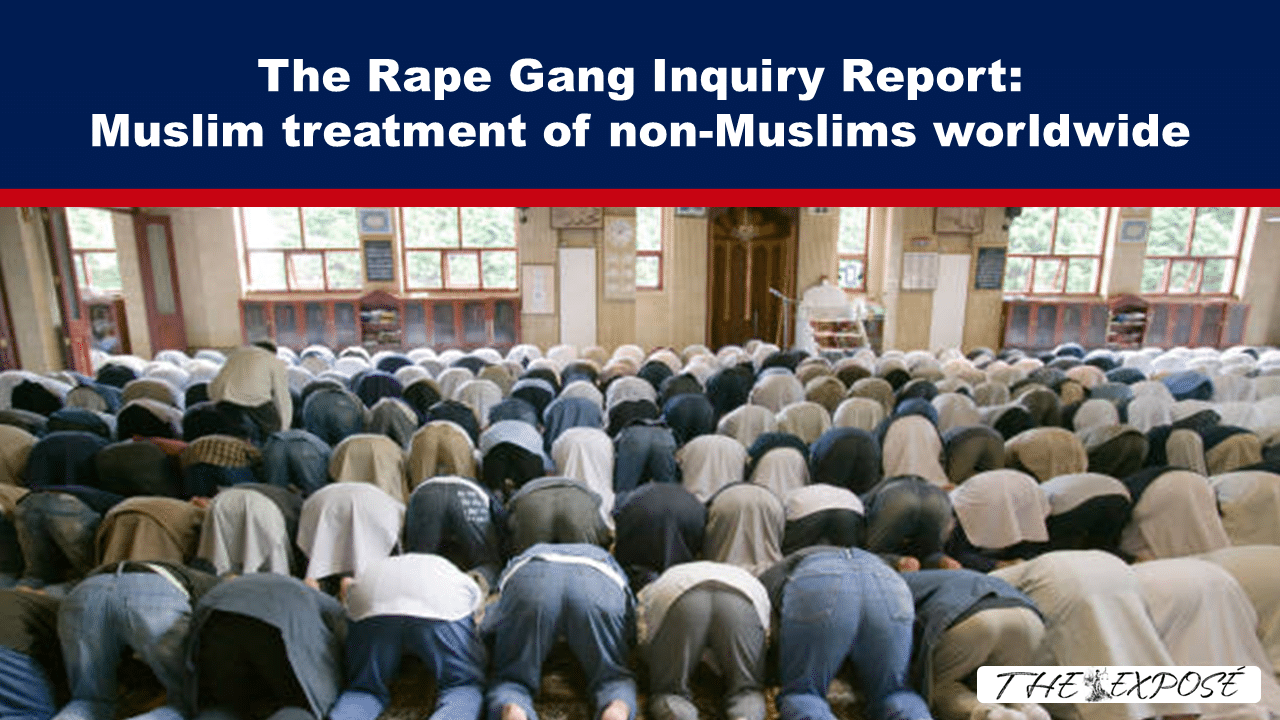
Featured image: Muslims in a Preston Mosque, Lancashire, UK. Source: Getty Images
The Expose Urgently Needs Your Help…
Can you please help to keep the lights on with The Expose’s honest, reliable, powerful and truthful journalism?
Your Government & Big Tech organisations
try to silence & shut down The Expose.
So we need your help to ensure
we can continue to bring you the
facts the mainstream refuses to.
The government does not fund us
to publish lies and propaganda on their
behalf like the Mainstream Media.
Instead, we rely solely on your support. So
please support us in our efforts to bring
you honest, reliable, investigative journalism
today. It’s secure, quick and easy.
Please choose your preferred method below to show your support.

Categories: Breaking News, Latest News, World News
Hi ,,
IF you are also curious to learn more about why rapes happen in the muslin culture ask European Soldiers and American Soldiers who fought in the Iraq War….
It’s very disturbing and disgusting what Muslim Grown adults do sexually to the little boys in muslim cultures in 6 middle east…
Typo 6 = the
Every single organized religion has been created to divide and control the population through the fear of death. Every one !!!
Organized religions do not get you closer to God. They stand in between you and God.
Having said that, I noticed an increase of articles against the Muslim religion. I suppose the suprematist zionist jews will be very happy about it. I do believe they are the ones fomenting (by means of wars) the illegal mass immigrations of Muslims into Christian nations. I also noticed that when the rapes are committed by white Christian people nobody talks about religion.
Hi Sergio, you say, “when the rapes are committed by white Christian people nobody talks about religion.” That’s because the rapes are not religiously motivated.
As for the irrelevant anti-Jewish rhetoric in your comment, it’s not going give Muslim rape gangs a “get out of jail free card.” Unless you live in a country ruled over by Islamists, the general public is not as obsessed or fanatical about Jews as you are, so they won’t fall for your diversionary tactics. I fear you have wasted your breath.
This religion should be banned worldwide for its crimes against humanity. This is a devilish concoction of pedos, rapists, killers, liars, cheats, crooked and corrupt individuals on the planet controlled by the devil himself. They were killing, raping, murdering for centuries in Europe & Africa. It is time to nip this in the bud now before it spreads like a contagion. Pastor Gary Boyd