





How many times have we heard that oil prices and inflation are increasing the cost of governments’ borrowing? How many times have we heard that this is because of events in the Strait of Hormuz?
You may be surprised, or not, to discover that they are not telling you the full story.
Oil prices and inflation are proximate causes, economist Peter C. Earle says. The real problem began several years ago during the so-called covid pandemic.
Let’s not lose touch…Your Government and Big Tech are actively trying to censor the information reported by The Exposé to serve their own needs. Subscribe to our emails now to make sure you receive the latest uncensored news in your inbox…
Bond Markets Are Losing Patience – And Putting Governments on Notice
By Peter C. Earle, as published by The Daily Economy on 3 September 2026
Something unusual is happening in global bond markets, and it is more consequential than the usual swings in yields. Government borrowing costs are rising across much of the developed world. The US 10-year Treasury is approaching 5 per cent and the 30-year Treasury yield is at levels not seen since 2007. “Meltdown” is too dramatic a word, but the bond market is clearly sending a message. Bond prices fall when investors demand higher yields, and global investors clearly want to be paid more for lending money to governments carrying large debts, running persistent deficits and still contending with above-target inflation.
Japan is perhaps the most striking case. Its 10-year government bond yield has moved through 3 per cent after spending most of a generation near zero, and its 30-year borrowing cost has risen above 4 per cent – a multi-decade high. Australia’s 10-year recently reached 5.16 per cent. Germany’s 10-year Bund has been trading around 3.3 per cent, with the 30-year above 3.8 per cent. Britain, France and other developed economies are seeing versions of the same thing. The particulars differ from country to country, but the direction does not.
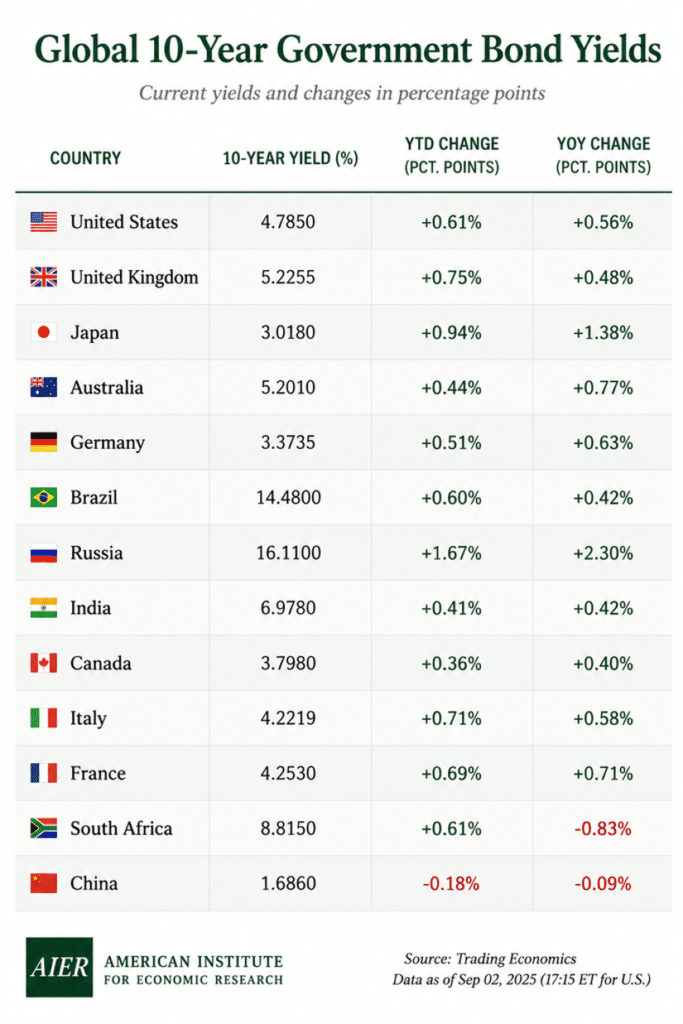
Oil prices and renewed inflation worries are part of the explanation, as is the growing possibility that central banks will have to keep monetary policy restrictive for longer than markets have expected. But these are proximate causes. The bigger story began several years ago. Governments entered the covid period already heavily indebted, then responded to the pandemic with enormous fiscal programmes supported by extraordinarily easy monetary policy. Central banks subsequently discovered that the resulting inflation was neither especially transitory nor easy to eradicate. Now, the consequently larger debts have to be financed and refinanced in markets where investors once again demand compensation for inflation, duration and fiscal risk.
For the United States, the arithmetic becomes daunting fairly quickly. Gross federal debt recently passed $40 trillion, with roughly $32.3 trillion held by the public. The weighted-average maturity of marketable Treasury debt is about 71 months, although roughly one-third matures within the next year. So, a 20-basis-point increase in the 10-year Treasury does not suddenly reprice $32 trillion of debt. But the government does not get to ignore higher rates, either. Something on the order of $10 trillion of marketable debt must roll over within a year. Meanwhile, Washington continues to borrow hundreds of billions more to finance new deficits.
A household analogy is useful here, with one qualification. Imagine an enormous mortgage that resets in pieces rather than all at once. A homeowner with a fixed-rate mortgage does not care very much if mortgage rates jump tomorrow: he cares about when he has to refinance. The US Treasury is constantly refinancing: some portion of the federal government’s enormous mortgage matures every day.
We can already see that process in the numbers. The average interest rate on interest-bearing Treasury debt was about 3.32 per cent in January. By July it was roughly 3.45 per cent. Thirteen basis points sounds like market noise, until the principal involved is measured in tens of trillions of dollars.
Using $32.3 trillion of publicly held debt as a rough base, every sustained 5-basis-point increase in the government’s average financing cost eventually means about $16 billion more in annual interest expense. Ten basis points means roughly $32 billion; 25 basis points, $81 billion; 50 basis points, $161 billion. A full percentage point works out to approximately $323 billion per year – about what the US spends on veterans’ support. Those are steady-state figures, not next-year budget estimates, because the existing debt has to reprice first. If roughly one-third of the debt rolls over within twelve months, a 10-basis-point increase would initially add something closer to $10–11 billion to the annual cost of the existing debt, before considering new borrowing.
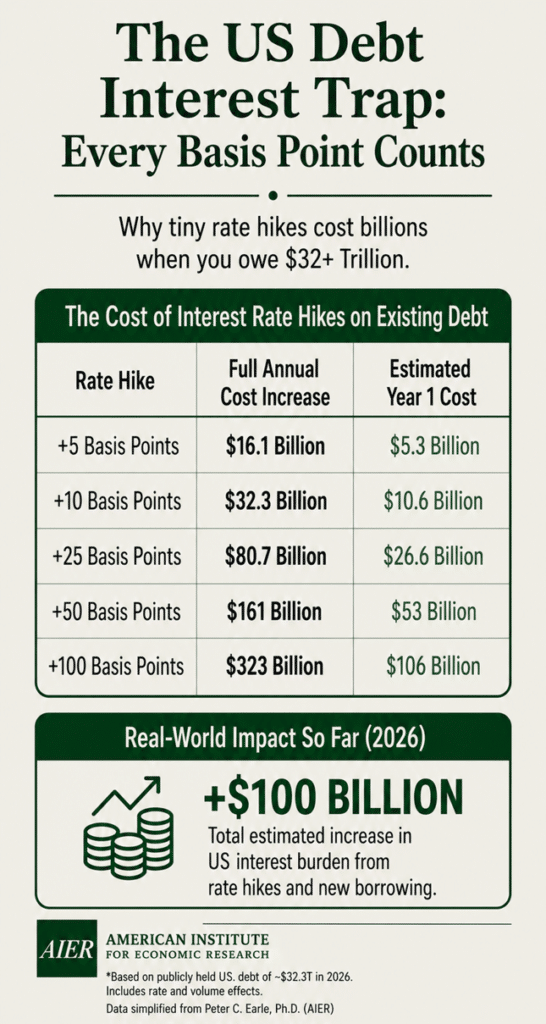
The change since January gives some idea of the scale involved. If the 13-basis-point increase in the US Treasury’s average interest rate were eventually reflected across today’s publicly held debt, the annualised increase would be around $42 billion. But the interest rate is only half of the problem: publicly held US Treasury debt has itself grown by roughly $2 trillion. Financing that additional principal at around 3.5 per cent adds another $65–70 billion annually. Put the two together, and the increase in the annualised interest burden is plausibly already in the neighbourhood of $100 billion. That is a run-rate calculation, not a claim about actual fiscal-year outlays, but it illustrates what happens when both the amount borrowed and the price of borrowing rise together.
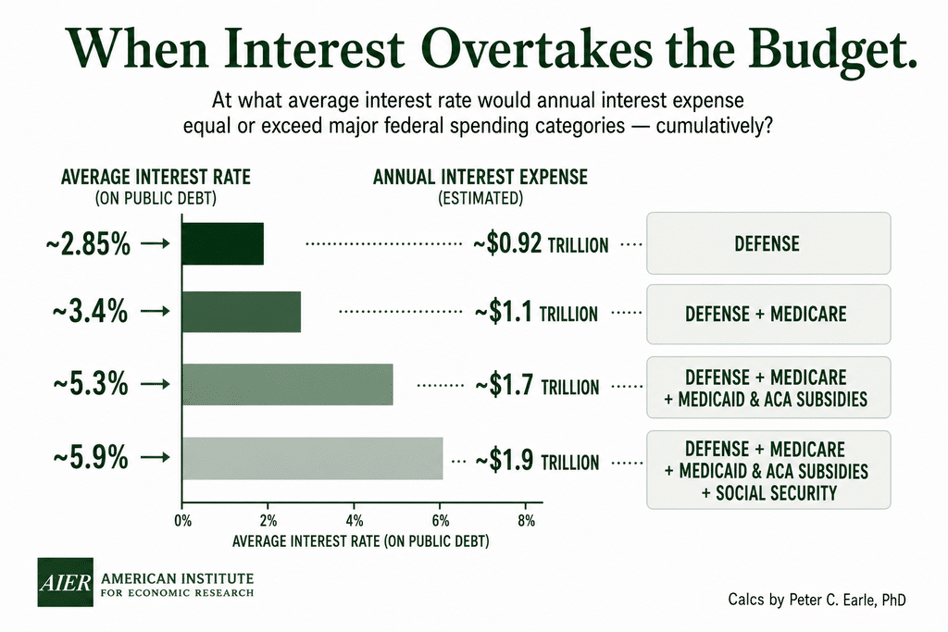
The budget implications are no longer theoretical. The US Congressional Budget Office (“CBO”) projects net federal interest expense above $1 trillion in fiscal 2026, against roughly $898 billion of defence spending. In other words, interest has already become larger than the defence budget. Medicare is roughly $1.1 trillion and Social Security around $1.7 trillion, with Medicaid and ACA subsidies representing another substantial expenditure.
There is another way to visualise the problem. Using the same $32.3 trillion debt base and deliberately simplified arithmetic, an average financing cost of around 2.85 per cent produces an interest bill roughly comparable with defence spending. Raise the effective financing cost and the interest burden becomes comparable with progressively larger combinations of defence, Medicare, Medicaid and ACA subsidies, and eventually Social Security. This is an illustration, not a forecast: Treasury debt matures at different times, inflation-linked securities complicate the calculation, the government receives some interest income and the debt stock will not remain at $32.3 trillion. But none of those qualifications changes the basic point: with this much debt outstanding, surprisingly small movements in average financing costs translate into very large amounts of money.
That is what makes the present bond selloff, and consequent rise in yields, significant. For years, developed-world governments operated as though enormous debt stocks and negligible financing costs could coexist more or less indefinitely. Covid pushed that experiment much further. And with the return of persistent inflation, the price of money changed.
Bond markets are now forcing governments to confront the change in circumstances. Yesterday’s deficit does not disappear when the fiscal year ends; it becomes part of the debt that has to be serviced tomorrow. Rising yields therefore work much like higher mortgage or credit card rates, except that governments are refinancing obligations measured in trillions. As more debt rolls over, the consequences migrate from trading screens into national budgets. Money spent servicing the debt is money that cannot be spent on defence, infrastructure, health care or Social Security without some combination of raising taxes, borrowing still more, or engaging in financial parlour tricks. At some point, the bond market stops offering commentary on fiscal policy choices and starts imposing limits. We appear to be approaching, if not at the early stages, of that phase.
About the Author
Peter C. Earle, PhD, is Senior Director of Research at the American Institute for Economic Research (“AIER”). He is an economist and financial market practitioner with over 30 years of experience in financial markets, macroeconomics and economic analysis.
Dr. Earle has written and edited eight books and authored hundreds of articles, op eds and research papers. He serves on the Editorial Board of Financial History (the quarterly journal of the Museum of American Finance), the Advisory Board of the Institute for Liberty and Economic Education (“ILEE”) and as an Associated Scholar of the Mises Institute. He is also the Managing Partner of Shadow Gamma, LLC. His work and commentary have been featured in The Wall Street Journal, Financial Times, Barron’s, Bloomberg, Reuters, CNBC, Grant’s Interest Rate Observer, NPR and numerous other media outlets and publications.
The Expose Urgently Needs Your Help…
Can you please help to keep the lights on with The Expose’s honest, reliable, powerful and truthful journalism?
Your Government & Big Tech organisations
try to silence & shut down The Expose.
So we need your help to ensure
we can continue to bring you the
facts the mainstream refuses to.
The government does not fund us
to publish lies and propaganda on their
behalf like the Mainstream Media.
Instead, we rely solely on your support. So
please support us in our efforts to bring
you honest, reliable, investigative journalism
today. It’s secure, quick and easy.
Please choose your preferred method below to show your support.

Categories: Breaking News, Latest News, US News, World News
THIS IS ALWAYS THE PLAN BY DESIGN…
If we think we all have the power to choose or given a choice, that’s was an illusion. We never had a free will from birth.
We (people with souls) tried to stop the lies & deceptions of the ‘selected’ government. however too many sheeples outnumbered the real human causing the DEMO-CRAZY plan wins.
Until all the useless sheeples are gone, the grand design plans of controlling the lives of human as pleases will always executed with flying colours.
The world full of stupid karens.
BTW, I’m tired of these self-righteous environmentalists of climate diaper-change morons. These white bourgeois liberals who think the only thing wrong with this country is there aren’t enough bicycle path for people trying to make the world safe for their Volvos & Mercedes.