





In mid-November, the WHO held its 11th Conference of the Parties (“COP11”) to the WHO FCTC, which concluded with a series of critical decisions on global tobacco control.
Adopted by the 56th World Health Assembly on 21 May 2003, the WHO Framework Convention on Tobacco Control (“WHO FCTC”) is the first treaty negotiated under the auspices of the World Health Organisation. It is “one of the most widely embraced UN treaties in history – that commits countries to ending the global tobacco epidemic,” a press release boasts.
The use of the “most widely embraced” makes it sound as if countries are enthusiastically and willingly part of it. However, as Roger Bate describes below, WHO appears to be using bullying tactics to make some countries comply with its agenda.
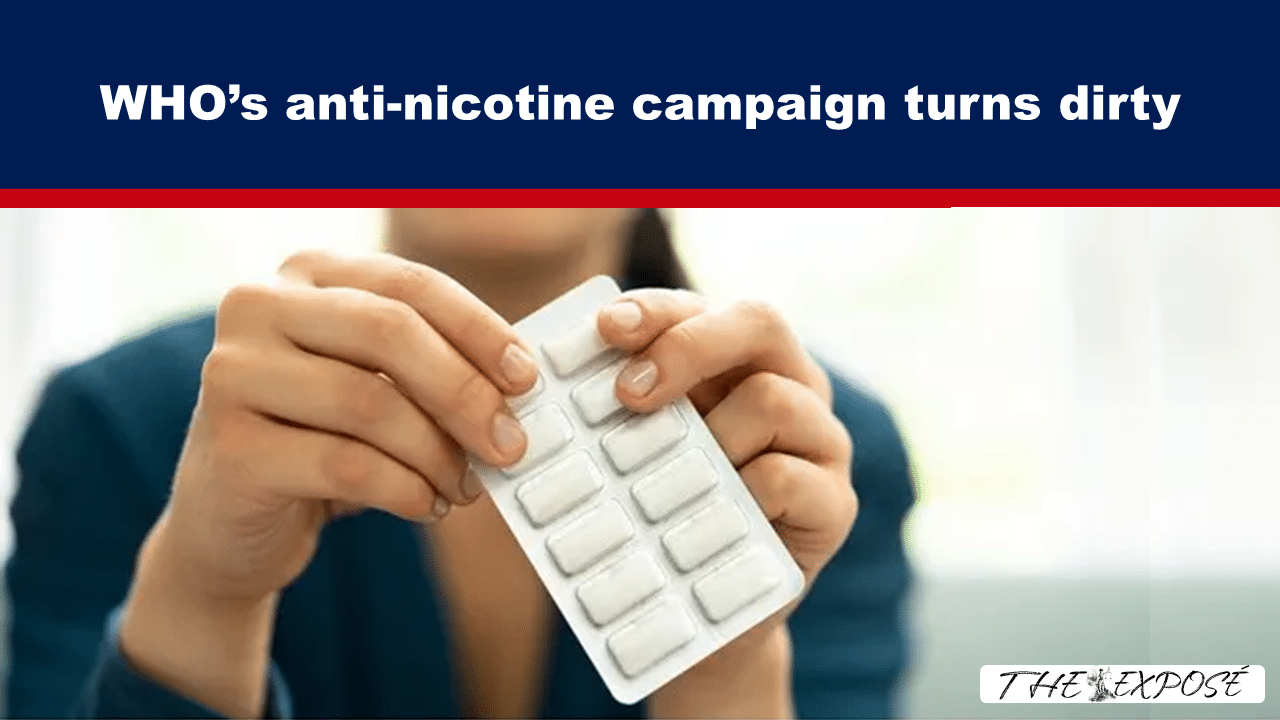
Why are they so obsessed with banning tobacco or, perhaps more accurately, nicotine? Is it because of the possible health benefits of nicotine?
Let’s not lose touch…Your Government and Big Tech are actively trying to censor the information reported by The Exposé to serve their own needs. Subscribe to our emails now to make sure you receive the latest uncensored news in your inbox…
The WHO’s Campaign Against Safe Nicotine
By Roger Bate, as published by Brownstone Institute on 27 November 2025
Every two years, the 183 Parties to the WHO Framework Convention on Tobacco Control (“FCTC”) meet for the Conference of the Parties (“COP”). This is the treaty’s governing body: a closed-door diplomatic forum where decisions are made on global tobacco policy, regulatory guidelines, technical documents and the political direction of the treaty system.
Civil society is largely excluded. Journalists are barely tolerated. Outsiders appear only in tightly controlled “public sessions,” while all substantive negotiations occur behind locked doors. These meetings are dominated by the FCTC Secretariat and a small constellation of Bloomberg-funded NGOs that orbit it. What they endorse becomes the agenda; what they oppose is often treated as illegitimate. That structure is an essential backdrop to the story of COP11.
The most revealing episode from COP11 was not about taxes or liability. It was the campaign against a small group of countries – Saint Kitts & Nevis, Dominica, New Zealand, the Philippines and others – that dared to raise an uncomfortable but obvious point: safer nicotine products exist, millions use them, and the treaty should look honestly at the evidence. For this, they were attacked, shamed and accused of serving tobacco interests. The charge is not only false but a calculated lie designed to protect the ideological authority of the FCTC machine.
The insiders – the Bloomberg-funded NGOs, Secretariat technocrats and a few entrenched academics – know harm reduction works. They know adult smokers switch when safer products are available. And they know acknowledging this would expose the limits of the FCTC’s own strategies. Rather than confront that reality, they target the nations that speak it out loud.
A Simple Request: “Can We Look at the Evidence?”
Saint Kitts & Nevis put forward a reasonable proposal at COP10: create a working group on tobacco harm reduction, grounded in Article 1(d) of the treaty, which explicitly defines tobacco control as including harm reduction. It was bureaucratic rather than revolutionary – essentially a request for evidence review. By COP11, the same states, joined by Dominica and quietly supported by others, backed language recognising the difference between combustible and non-combustible products. New Zealand came not with theory but with results. Smoking there has collapsed faster than almost anywhere else, driven by vaping and other safer products regulated within a robust national framework. The Philippines brought its new law on vapes and heated tobacco, debated and passed domestically, reflecting local science and consumer realities.
None of these countries is a tobacco industry hub. None were asking for smoking deregulation. They were asking for proportionate regulation based on risk. Their positions reflected either data, national policy, or both.
The FCTC Ecosystem’s Response: Smear, Distract, Invent “Interference”
Before delegates even arrived, the Secretariat set the trap. The COP11 agenda omitted Article 1(d)’s harm-reduction clause and instead framed the discussion under Article 5.3 – the anti-industry article. This reframing transformed a scientific question into a suspicion of misconduct. The message was unmistakable: any mention of relative risk would be treated as potential interference.
Bloomberg-funded Campaign for Tobacco-Free Kids then launched a public campaign accusing small Caribbean governments of being targeted by tobacco companies – an allegation made without evidence. The Global Alliance for Tobacco Control piled on by giving Saint Kitts & Nevis and Dominica its “Dirty Ashtray Award,” a childish ritual meant to shame any delegation that challenges anti-THR orthodoxy. Meanwhile, the University of Bath’s Tobacco Tactics platform produced another round of insinuations, asserting that THR positions are inherently industry-aligned, regardless of their origin.
This was not policy analysis. It was ideological enforcement: delegations were told that any deviation from the Secretariat’s anti-THR line would be punished and publicly delegitimised.
They Know Harm Reduction Works
The dishonesty of these attacks is compounded by the fact that the insiders know harm reduction succeeds wherever it is permitted. Sweden has nearly eliminated smoking because adults switched to snus and nicotine pouches. Japan experienced a historic decline in cigarette sales after heated tobacco products became widely available. Norway’s smoking rate collapsed as snus use rose, especially among women. New Zealand’s rapid fall in smoking is already the most dramatic in the developed world.
These are not industry inventions. They are real-world public health outcomes. They demonstrate that innovation, not prohibition, has driven the most rapid reductions in smoking ever observed. Yet none of these examples were meaningfully acknowledged in Panama. To admit success in these countries would be to admit failure at the treaty level: after twenty years, the FCTC has produced far slower declines in smoking than expected, and many of its core measures have stalled.
Recognising harm reduction would force the Secretariat to explain why the one proven mechanism for accelerating smoking declines – offering safer alternatives – is the one it refuses to consider. This is why dissenting countries had to be attacked, not heard.
The Big Lie: “These Countries Are Doing Industry’s Bidding”
Portraying New Zealand as an industry pawn is absurd. It has one of the most aggressive anti-smoking strategies in the world, built around a legislative commitment to reduce harm. Accusing Saint Kitts & Nevis or Dominica of being industry-aligned is even more outrageous. They have no tobacco industry presence. Their proposals were administrative requests for evidence evaluation – exactly what international treaty bodies are supposed to do.
Calling these countries “industry fronts” is not a misunderstanding. It is a deliberate tactic to intimidate smaller nations, discredit any discussion of relative risk and prevent harm reduction from gaining a formal foothold inside the FCTC. And it comes from groups whose own budgets dwarf those of the small nations they attack. When Bloomberg-funded NGOs accuse tiny delegations of being captured by private interests, the cynicism is obvious.
What COP11 Actually Proved
COP11 demonstrated how deeply the FCTC has become trapped in an ideological posture that cannot survive honest scrutiny. The treaty’s leadership would rather shame sovereign countries than admit that safer nicotine products reduce harm. They would rather smear democratically accountable governments than confront the weakness of their own approach. Their response to evidence was not to debate it, but to suppress it.
The countries that spoke up – Saint Kitts & Nevis, Dominica, New Zealand, the Philippines and others – showed more integrity than the system that tried to silence them. They raised legitimate, science-based concerns, grounded either in national outcomes or in the treaty text itself. For that, they were targeted, caricatured and treated as threats.
Harm reduction works. The people who claim otherwise know it. And until the FCTC is willing to grapple honestly with that fact, its biennial gatherings will continue to be political theatre rather than genuine public-health leadership. The tragedy is not that dissenting countries were attacked. The tragedy is that millions who could benefit from safer alternatives will remain unserved because those same insiders refuse to let the treaty confront the truth.
About the Author
Roger Bate is a Brownstone Fellow, Senior Fellow at the International Centre for Law and Economics (Jan 2023-present), Board member of Africa Fighting Malaria (September 2000-present) and Fellow at the Institute of Economic Affairs (January 2000-present).
Health Benefits of Nicotine
The Globalists have had a particular obsession with tobacco, smoking or anything deemed to be related to smoking. Apart from using the demonisation of smoking as a blueprint for public conditioning for social control, and to raise taxes to extraordinary levels, could there be another reason why they have declared war on nicotine products? Reasons such as nicotine’s health benefits?
Nicotine is a naturally occurring chemical in tobacco plants, making up about five per cent of the plant by weight and is also found in lower levels in other nightshade family plants like tomatoes and potatoes. Nicotine is not the cause of smoking-related diseases; the harm from smoking comes primarily from the hundreds of toxic chemicals in cigarette smoke, not nicotine itself.
Contrary to what many may believe, nicotine has been associated with several potential health benefits, primarily related to cognitive function, neuroprotection and metabolic effects. It has shown promise in improving cognitive impairments linked to neurodegenerative diseases such as Alzheimer’s Disease and Parkinson’s Disease.
Nicotine has demonstrated mood-regulating properties, with studies indicating it can reduce anxiety and anger, and may improve depressive symptoms, especially in older adults with late-life depression.
Additionally, nicotine enhances the efficiency of information processing in the central nervous system, improving work efficiency and reducing fatigue, which contributes to better performance in work situations. It promotes wakefulness by enhancing brain activity and inducing alpha brainwave activity, leading to improved attention, alertness and creativity.
Metabolic benefits include appetite suppression, which can promote weight loss, and improved insulin sensitivity and blood sugar levels. Nicotine also increases metabolic rate and lipolysis, contributing to fat burning, primarily through its effects on catecholamines such as adrenaline. Furthermore, nicotine has been linked to protective effects against conditions such as ulcerative colitis, Tourette’s disease and sleep apnoea, although the reliability of these effects varies.
Read more: Nicotine Is Not the Problem, R Street, 10 June 2024
Nicotine, Covid and Covid Vaccines
There is biologically plausible evidence that nicotine could impact SARS-CoV-2 infection through its interaction with nicotinic acetylcholine receptors and the renin-angiotensin system, particularly by modulating ACE2 receptors, which the virus uses to enter cells. Some studies suggest nicotine may block viral entry by competing for ACE2 binding sites.
Read more: The role of nicotine in COVID-19 infection, The Centre for Evidence-Based Medicine, 26 May 2020
According to Dr. Bryan Ardis, the real target of the spike protein is not the ACE2 receptors but the nicotinic acetylcholine receptors. In April 2020, French researchers identified that the SARS-CoV-2 spike proteins are identical to two snake venoms, which are neurotoxins.
“Identifying that the venomous spike proteins target nicotine receptors, this finally explained to the scientists why smokers were less affected by covid than any other demographic,” he said.
Related:
- How to Use Nicotine, The Dr. Ardis Show
- Nicotine Can Reverse Brain Fog, Inflammation, Dementia and Chronic Illness | Dr. Bryan Ardis, Myers Detox Podcast, 28 August 2025
- “Snake venom” on The Exposé
If nicotine stops the infection, then it might also stop the effects (so-called “efficacy”) of the vaccine. Vaccines contain the virus or, in the case of covid, a part of the virus. Covid injections contain the disease-causing spike protein of SARS-CoV-2 or the genetic instructions (mRNA) for the recipient’s body to manufacture the spike protein.
A systematic review and meta-analysis found that exposure to tobacco, including nicotine, may reduce vaccine efficacy, particularly for mRNA, hepatitis B, measles and tetanus vaccines.
Some covid vaccines were also found to contain graphene. In May 2024, Pfizer whistle-blower Melissa McAtee said that Pfizer’s internal database had evidence from a laboratory in Spain that up to a third of covid injection vials contained graphene oxide.
We have noted before that graphene can be flushed out of the body naturally. An enzyme found in our blood, myeloperoxidase, degrades graphene oxide. Alcohol (ethanol) or tobacco (nicotine), for example, can help to increase this enzyme.
Read more: Zinc Inhibits Influenza Virus, Covid and Helps Our Body Detox from Graphene, The Exposé, 30 December 2021
As Paul Philips noted in an article about self-replicating RNA “vaccines” that were being rolled out in Japan last year: “It has been said that there are a number of protective solutions that will destroy the so-called vaccine nano-bots and their replication capabilities. Treatment solutions include EDTA/Vitamin C, methylene blue, nicotine patches, hydroxychloroquine and ivermectin. It’s up to you to do your own research and find solutions.”
The Expose Urgently Needs Your Help…
Can you please help to keep the lights on with The Expose’s honest, reliable, powerful and truthful journalism?
Your Government & Big Tech organisations
try to silence & shut down The Expose.
So we need your help to ensure
we can continue to bring you the
facts the mainstream refuses to.
The government does not fund us
to publish lies and propaganda on their
behalf like the Mainstream Media.
Instead, we rely solely on your support. So
please support us in our efforts to bring
you honest, reliable, investigative journalism
today. It’s secure, quick and easy.
Please choose your preferred method below to show your support.

Categories: Breaking News, World News
Salt reduces inflammation also , go figure !!
Salt is necessary in order to hydrate on a cellular level….go figure why they say we have to cut down on salt
Take all of the “vaccines” and pharmaceuticals (OTC and prescribed) you want. Eat as many chemicals as you want… chemicals that are in pretty much all of the food one eats anymore. But, by God, don’t you DARE ingest or smoke anything with nicotine in it! These people are such tyrannical monsters I no longer have words to describe just how much I despise them all.
Agree. Utter scumbags aren’t they…
That’s a bit kind coming from you!
https://www.youtube-nocookie.com/embed/fwKipVXD4Y8 Medicine 💊
https://www.youtube-nocookie.com/embed/TSRn8BzpvLc Kamloops res. school truth
https://www.youtube-nocookie.com/embed/u53G5WBpVmc the end of free speech in canakastan
This “anti-tobacco display” of WHO propaganda is intended to fool the public into believing they care about health and saving lives, instead of being cold blooded killers via mystery serum injections. It’s another worn out platitude, virtue signaling, an easy con, as most cognizant people already know that smoking tobacco is detrimental to lung health. Ho Hum 🤭😴. As a public institution, the WHO is as useless as it is worthless … a complete waste of time, effort and money, and a lurking menace to boot. WEF lackeys, tools, part of the Schwab Mob & Agenda 2020-2030.
how could the ‘covid virus’ enter cells when it didn’t exist
Hi Rhoda,
Since you have mentioned Dr Bryan Ardis I will take the article seriously.
Dr Ardis mentioned the US had built hundreds of water checking stations, so they could put snake venom in the water.
He was one of the first to say nicotine was good for you, not all the additives they put in tobacco.
did cancer kill during the 1800,s early 1900,s tobacco was around . when did cancer surface ? I worked in a pulp mill with a hydraulic bale line and we had a Sunds rep stop in from time to time . This gentleman also visited the tobacco plants down in the Carolina,s and they told him that tobacco didn’t cause cancer . “ just saying ..
[…] The WHO’s anti-nicotine campaign turns dirty – Why are they so obsessed with banning tobacco or, perhaps more accurately, nicotine? Is it because of the possible health benefits of nicotine?https://expose-news.com/2025/12/03/whos-anti-nicotine-campaign-turns-dirty […]
[…] avec le point de vue du Dr Hatchard sur les produits à base de nicotine. Voir: La campagne anti-nicotine de l’OMS devient sale et Le tabac génère davantage de recettes fiscales ; c’est pourquoi ils répriment […]